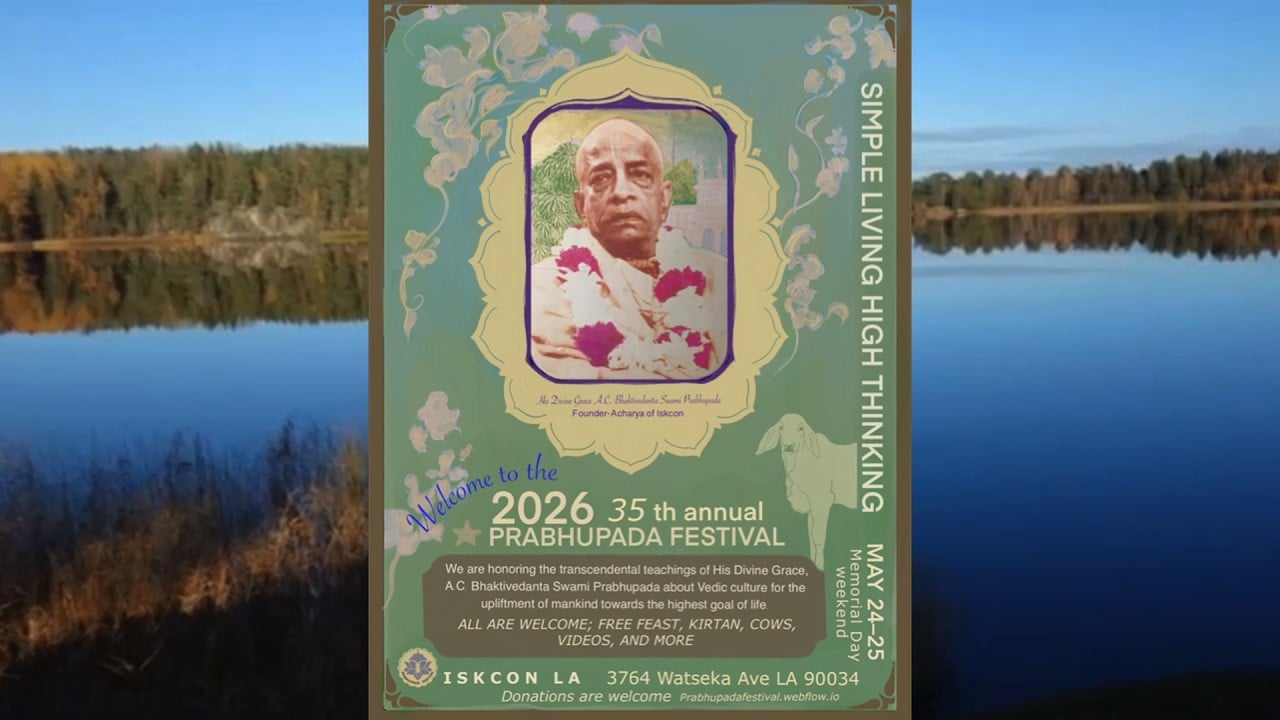
The 35th Annual Srila Prabhupada Festival in Los Angeles embodies a living tradition of honoring His Divine Grace A.C. Bhaktivedanta Swami Prabhupada (1896–1977), the founder of ISKCON (International Society For Krishna Consciousness). A newly released promotional video distills the festival’s ethosjoyful kirtan, devotion, community, and collective remembrancewhile inviting devotees and well-wishers into a space where cultural heritage and contemporary city life converge. This annual gathering functions as both a devotional observance and a civic-cultural event, affirming shared values of compassion, service, and unity that resonate across Hindu, Buddhist, Jain, and Sikh communities.
Historically, A.C. Bhaktivedanta Swami Prabhupada established ISKCON in 1966 in New York City, catalyzing a global movement of bhakti-yoga centered on the chanting of divine names, study of sacred texts, and practical service. Through translations and commentaries on canonical works such as the Bhagavad-gita and Srimad-Bhagavatam, he articulated Gaudiya Vaishnava theology in a manner accessible to diverse audiences. The festival’s focus on remembrance aligns with this legacy, situating Prabhupada’s contributions within broader currents of devotional practice, publishing, and community formation.
Los Angeles has long served as a principal hub for ISKCON’s educational, cultural, and devotional activities. The New Dvaraka communityhome to Sri Sri Rukmini Dwarakadishbecame prominent in the late 1960s and 1970s as a center for congregational worship, outreach, and devotional arts. The festival’s continuity over three and a half decades testifies to the durability of diaspora institutions that transmit values, stories, and practices across generations while engaging with the city’s multicultural landscape.
Kirtan forms the festival’s sonic and spiritual core. In the Gaudiya Vaishnava tradition, nama-sankirtana (congregational chanting of the divine names) is upheld as a primary means of spiritual realization. Characteristically call-and-response, kirtan employs harmonium, mridanga, and kartals to support group participation. The Hare Krishna maha-mantra“Hare Krishna, Hare Krishna, Krishna Krishna, Hare Hare / Hare Rama, Hare Rama, Rama Rama, Hare Hare”serves as the principal text of musical meditation, inviting participants to move from passive listening to embodied practice through clapping, singing, and contemplative focus.
Programmatic elements at such commemorations often include guru-puja–style homage to Srila Prabhupada, thematic talks on bhakti philosophy, recitations from the Bhagavad-gita, dramatic or dance presentations, and prasadam (sanctified vegetarian food) distribution. These components together enact a full devotional ecology: philosophical inquiry, liturgical offering, aesthetic expression, and communal sharing. The festival thus becomes a holistic pedagogy of bhakti, translating theology into lived, participatory experience.
From a cultural-psychological perspective, group singing and rhythmic entrainment are associated with social bonding, reduced stress, and heightened prosocial affect. Ethnomusicological studies describe how repetitive mantra forms, steady tempos, and responsive structures facilitate accessibility for first-time participants while enabling depth for experienced practitioners. The affective dimension commonly associated with kirtanbhava, or devotional moodarises as practitioners align voice, breath, attention, and intention in a shared soundscape.
Community formation remains a defining feature of the Los Angeles festival. Intergenerational participationelders, youth, and childrensupports transmission of ritual literacy and cultural memory. Informal learning occurs in conversations about japa (personal mantra meditation), scriptural study, and practical service opportunities. Attendees frequently describe a palpable sense of welcome that extends beyond institutional membership to well-wishers, neighbors, and visitors, reflecting a community ethic grounded in seva (service), satya (truthfulness), and ahimsa (nonviolence).
The promotional video’s visual language amplifies this inclusivity. Joyful sequences of kirtan, smiling faces, and congregational worship function as a cinematic invitation, using color, rhythm, and montage to communicate the festival’s atmosphere even to those unfamiliar with Gaudiya Vaishnavism. Archival or reflective moments (when present) foster collective remembrance, aligning personal narratives of transformation with the movement’s historical arc in Los Angeles and beyond.
Significantly, the festival’s values and practices align with the broader family of dharmic traditions. Core principlesethical living, disciplined practice, interior cultivation, compassion, and community serviceare shared across Hindu, Buddhist, Jain, and Sikh lineages, even as each tradition preserves its distinctive liturgy and philosophy. By foregrounding devotion, respect, and hospitality, the festival models unity in spiritual diversity without erasing doctrinal nuances, thereby contributing to inter-dharmic understanding in a plural city.
For prospective attendees, a few orienting notes enhance respectful participation. Temple etiquette generally includes modest attire, removing footwear before entering sanctums, and maintaining a reflective demeanor during arati and kirtan. Call-and-response makes participation intuitive; one can begin simply by clapping softly on the beat and joining the refrain. Accepting prasadam offers an accessible entry point into the community’s hospitality and food ethics, which emphasize vegetarianism and sustainability.
Viewed through the lens of cultural heritage, the 35th Annual Srila Prabhupada Festival operates as a dynamic archivesustaining devotional music, ritual arts, and philosophical discourse in a diasporic setting. Its continued vitality demonstrates how bhakti-yoga adapts to contemporary media, urban rhythms, and interfaith contexts while preserving core theological commitments. In celebrating Srila Prabhupada’s life and mission, the festival also celebrates a civic ideal: that shared spaces of sound, service, and study can deepen social cohesion and illuminate common ground across dharmic traditions.
Inspired by this post on Dandavats.