Across the dharmic world of Hinduism, Buddhism, Jainism, and Sikhism, drums have long carried the pulse of ritual, learning, and community. In the classical Indian framework set down by Bharata in the Natyashastra, musical instruments were classified into four broad families: tata (stringed), sushira (wind), avanaddha (covered or fastened), and ghana (solid). The Sanskrit term avanaddham means a drum, an instrument whose skin or membrane is stretched and fastened over a resonant body to yield sound. As a shared soundscape in temples, monasteries, and gurdwaras, these instruments remain a unifying heartbeat of the subcontinent’s cultural heritage.
Vedic literature contains references to crude earthern and wooden drums covered with the hide or skin of wild animals. The pushkara appears alongside other early names such as dundubhi (war or signal drum), bheri (kettledrum), and panava (barrel drum). These mentions trace a lineage from utilitarian signaling and martial contexts to refined aesthetic and ritual applications. The enduring presence of drum-based timekeeping and procession music across dharmic traditions signals how sonic practice grew from everyday life into a vessel for devotion, meditation, and performance.
Within the Natyashastra’s technical system, avanaddha instruments are described with attention to shell material, membrane fastening, and performance technique. Later treatises such as the Brihaddesi and the Sangita Ratnakara elaborate drum types, tuning procedures, stroke vocabularies, and ensemble roles. Though regional repertoires evolved distinct aesthetics, the common organological principle remains constant: a stretched membrane driven by the human hand forms the core of the sound.
Organologically, avanaddha maps closely to what modern acoustics calls membranophones. Shapes vary widely and include barrel (mridanga, pakhawaj, mardala), conical (dhol, dholak, tavil), hourglass (damaru, idakka/edakka, udukku), frame (duff, kanjira), and kettle (nagara/naqqara). Construction materials range from terracotta and wood to metal alloys like brass or copper for kettledrums. This variety supports ritual functions, courtly and liturgical ensembles, and classical concert platforms.
A few representative forms illustrate the breadth of avanaddha practice. In South Indian classical music, the mridangam anchors rhythm with a sophisticated stroke system and a distinct loading paste on the right head that yields pitch-centered resonance. North Indian art music preserves the pakhawaj in dhrupad and temple traditions, with bass-rich sonority and powerful “paran” compositions. The pair of drums known as tablathough a later, early modern developmentbelongs to the same avanaddha family and features a highly refined tuning system and a codified repertoire (peshkar, kaida, rela) performed as theka and improvisation.
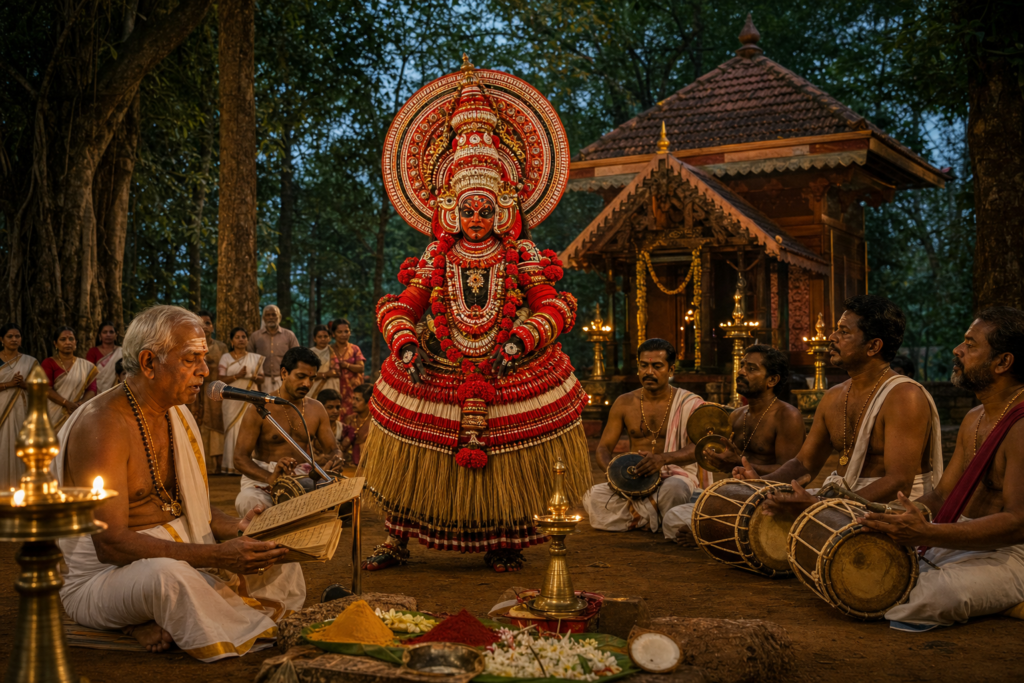
In devotional and regional arts, the khol (or mridanga of Bengal and Assam) animates Vaishnava kirtan, the mardala supports Odissi music and dance, and the chenda, idakka, and udukku are central to Kerala’s temple and processional music (including thayambaka and melam). The tavil pairs magnificently with the nadaswaram in temple festivals of Tamil Nadu, while frame drums like kanjira and duff contribute agile textures to folk and classical idioms alike. Processional and communal life across regions relies on the dhol, dholak, and tasha, where the tactile beat fosters collective participation.
Iconography and ritual symbolism further attest to the drum’s cultural depth. The damaru in Śiva’s iconography signifies the cyclic rhythm of creation and dissolution; in Vajrayana Buddhist contexts, paired hand-drums and large frame drums punctuate liturgical recitation and signal transitions in meditation. The nagara (naqqara) serves as a ceremonial timekeeper in Hindu temples and has historically functioned as an emblem of sovereignty and community assembly. In Sikh history, the great nagara has marked martial and spiritual resolve, integrating rhythm with the lived ethic of discipline and devotion.
The craft of drum-making reveals a deep confluence of acoustics and artisanal knowledge. Shells are fashioned from hardwoods (such as jackwood, sheesham, or teak), terracotta, or metal, then seasoned to withstand climate and tension. Skins traditionally include goat, cow, or buffalo, selected for distinct acoustic propertiesthin membranes emphasize articulation, thicker ones support bass. The heads are layered with rings and laces; in many drums, a central or off-center loading pasteoften called syahi in the North Indian traditioncomprises fine particulates and organic binders to shape overtone structure and stabilize pitch.
Acoustically, a circular membrane produces a spectrum of inharmonic partials by default. The genius of the Indian drum lies in tensioning patterns and mass loading that coax these partials into a near-harmonic series, allowing distinct, pitch-centered strokes. As a result, strokes such as na, ta, tin, tun, ghe, and dha correspond to controlled vibrational modes, giving avanaddha instruments both percussive attack and sustained tone. This engineered consonance enables modal integration with melodic frameworks in raga and raga-like regional systems.
Tuning practices vary by instrument and tradition. Strap-laced drums are tensioned through knots and wooden dowels; mechanical lugs are used on some modern instruments. Fine-tuning employs heat, small mallets, and application or removal of temporary masses (for instance, soft paste placed on bass heads in certain South Indian practices). In performance, drummers generally tune to the ensemble’s tonic (sa), with bass and treble heads positioned at musically functional intervals to support both accompaniment and solo exposition.
Pedagogically, avanaddha traditions transmit rhythm through verbal syllablesbols in the North and solkattu in the South. These onomatopoeic vocabularies encode stroke mechanics, phrase structure, and tala (metric cycles). In Hindustani practice, drummers articulate the theka as the cyclic ground, then unfold peshkar, kaida, and tihai-based designs, while pakhawaj exponents render stately dhrupad pakhawaj bols and powerful parans. In Carnatic music, mridangam artists weave korvais and mohra patterns, culminating in the tani avartanam, an extended, codified solo that displays mathematical finesse and dynamic control.
Ritual and communal uses of avanaddha instruments bridge dharmic traditions in practical, lived ways. In Hindu temples, drums announce arati and accompany processions; in Buddhist monasteries, large drums regulate monastic time and punctuate chants; in Sikh gurdwaras and historical settings, the nagara’s sonority has rallied congregations and honored martial-spiritual ideals; in many Jain community events, percussion marks processions and congregational gatherings, with growing attention to non-leather and synthetic alternatives in harmony with ahimsa. The shared functionsummoning, synchronizing, and sanctifying collective lifeoffers a powerful reminder of cultural unity amid diversity.
From a historical perspective, the evolution of avanaddha reflects technological and aesthetic shifts. Early references to earthen mridanga (etymologically linked to mrid, or earth) suggest clay shells before the widespread adoption of hardwoods. Courtly and temple environments fostered specialized forms like the muraja and anaka; medieval and early modern periods consolidated the pakhawaj’s art and saw the emergence of the tabla’s paired architecture. Regional devotional movementsfrom Gaudiya Vaishnavism in the East to Shaiva and Shakta processional cultures in the Southguided the repertory and function of local drum types, ensuring continuity through adaptation.
Dance, theater, and drum are integral in Indian aesthetics. The mridangam, mardala, and pakhawaj serve as rhythmic pillars for Bharatanatyam, Odissi, Kathak, and related forms; the chenda and idakka are inseparable from Kerala’s temple arts and vibrant folk-theatrical traditions. This confluence echoes the Natyashastra’s holistic visiongesture, melody, and rhythm converge to evoke rasa, inviting audiences into shared emotional states that transcend sectarian boundaries.
Contemporary practice balances heritage with ethical and environmental considerations. Communities increasingly explore cruelty-free and synthetic membranes, responsible sourcing, and repair-centered maintenance. Artisans, often from hereditary lineages, sustain living knowledge through iterative, hands-on craft. Educational programs and documentation initiatives, in turn, help preserve repertoires and construction methods, while modern staging employs microphones, contact pickups, and digital archiving to expand reach without diluting acoustic integrity.
For practitioners and listeners alike, avanaddha instruments evoke both intimacy and grandeur. The quiet pulse of a khol in kirtan, the meditative roll of a monastery drum, the rallying call of a nagara in a courtyard, or the crystalline articulation of a mridangam in concert all craft states of attention, devotion, and communal belonging. These experiences are relatable across generations: a child drawn to the visceral thump of the dhol, a devotee stilled by a temple cadence, an audience exhilarated by a virtuoso solo. Such moments embody how drumming, far from a mere accompaniment, becomes a vehicle for unity and insight.
The concept of avanaddha thus links early Vedic mentionspushkara and dundubhiwith the refined artistry of classical and devotional music today. Through careful design (membrane loading, tensioning systems), rigorous pedagogy (bols and solkattu), and deep ritual meaning (assembly, timekeeping, and sanctification), Indian drums present a complete science and art. Most importantly, their ongoing role across Hinduism, Buddhism, Jainism, and Sikhism reaffirms a simple, profound truth: rhythm unites. The shared cadence of avanaddha remains a living testament to india’s civilizational genius and its inclusive, dharmic spirit.
Inspired by this post on Hindu Blog.