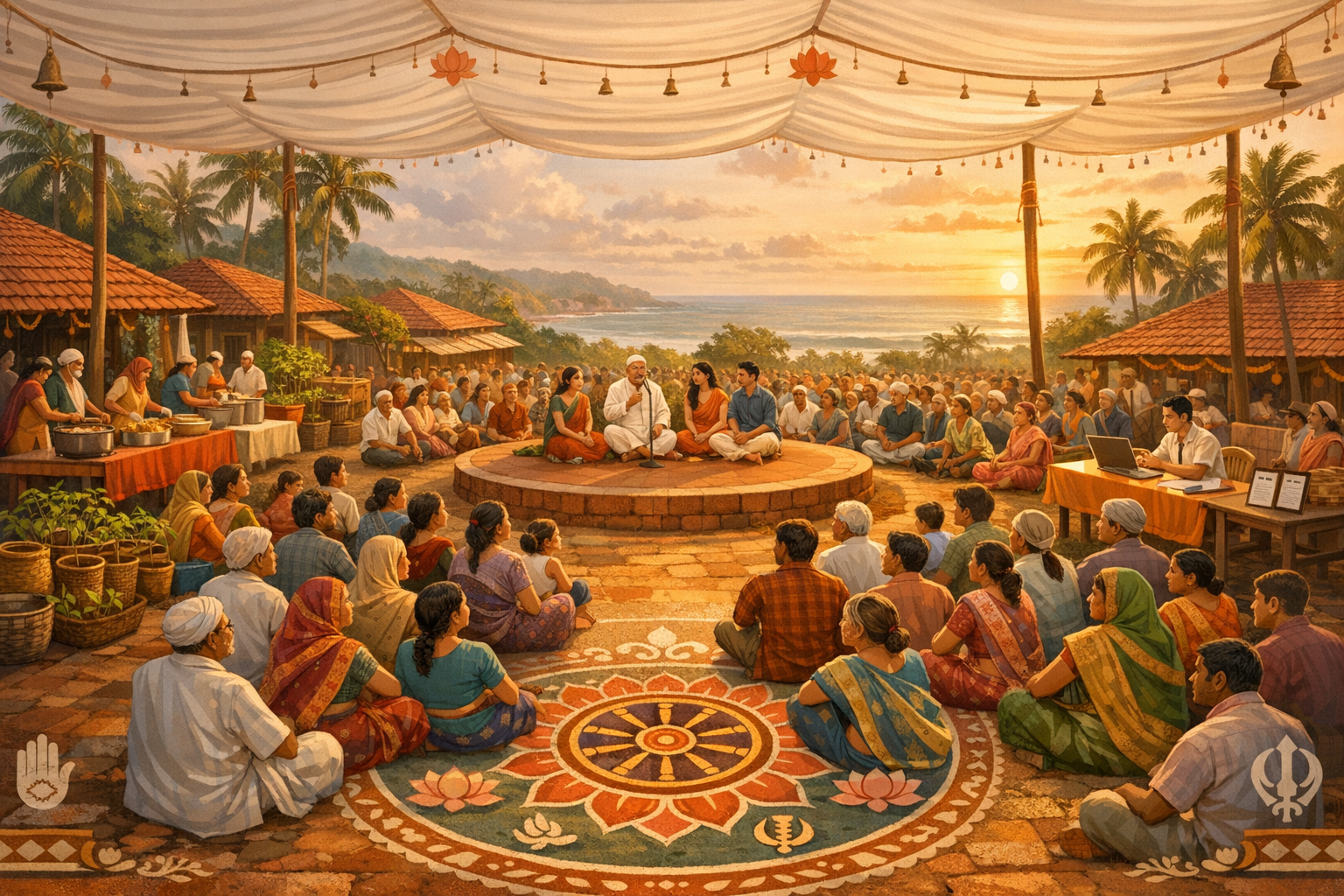
Over 400 community members converged at the Sakal Hindu Sammelan in Padel, Devgad (Sindhudurg, Maharashtra), a grassroots assembly convened to reaffirm Dharma-rakshan and to strengthen community coordination. Speakers emphasized disciplined organization, volunteer training, and collaborative decision-making as essential responses to contemporary social and cultural concerns. While the event focused on Hindu community priorities, its central callto safeguard dharmic values through lawful, compassionate, and service-oriented actionresonates across the wider family of Buddhism, Jainism, and Sikhism.
Situated in the Konkan belt, Devgad is known for resilient coastal communities, agrarian and maritime livelihoods, and a living heritage of festivals, temples, and local arts. Padel, as a village node, reflects the intimate scale at which social cohesion is built: neighbor-to-neighbor trust, intergenerational mentorship, and locally governed customs. In this context, a Sammelan is not merely a meeting; it is a civic platform for community engagement, cultural preservation, and strategic planning.
Conceptually, Dharma-rakshan denotes the protection, cultivation, and transmission of ethical order and communal well-being. It aligns with shared dharmic principlesahimsa, karuna, daya, seva, and satyaequally honored in Hinduism, Buddhism (Dhamma), Jainism (Dharma), and Sikhism (Dharam). Framed academically, it operates as a multi-layered social contract: safeguarding rights and responsibilities; nurturing cultural literacy; and reinforcing institutions that anchor moral life, all under the constitutional guarantees of freedom of conscience and association.
Speakers at the Sammelan identified a cluster of contemporary concerns: rapid social change, economic migration that thins intergenerational ties, the homogenizing pull of mass media, fragmented online discourse, and the gradual erosion of intangible cultural heritage. These dynamics can weaken local institutionstemples, mathas, pathshalas, bhajan mandalisand allied spaces in the broader dharmic ecosystem such as viharas, derasars, and gurdwaras. The proposed remedy was not reaction but organization: nonviolent, lawful, and inclusive civic capacity-building.
From a social-science perspective, the Sammelan’s organizing thrust maps to the development of bonding, bridging, and linking social capital. Bonding networks deepen trust within neighborhoods and mandals; bridging networks connect Hindus with Buddhist, Jain, and Sikh partners for shared seva; and linking networks interface with public institutions for policy feedback and support. Such a configuration reduces coordination costs, enhances collective efficacy, and strengthens the local response to cultural and social stressors.
An operating model discussed at length centered on seven functional streams that a village or ward-level body can sustain: seva (service delivery and relief), shiksha (values-based education and legal literacy), samskara (rites of passage and cultural etiquette), samvaad (dialogue and dispute resolution), suraksha (lawful safety practices and risk awareness), sanskriti (heritage documentation and festivals), and satya-sankalpa (evidence-based planning and transparent reporting). Each stream benefits from clear roles, documented processes, and periodic audits to ensure accountability.
Programmatically, the Sammelan highlighted replicable practices that naturally extend to all dharmic traditions: community kitchens (annadana and langar), ecological stewardship (beach clean-ups, sacred-grove care, and water-body restoration), youth leadership camps focused on ethics and skills, weekend heritage and language classes, and inter-dharmic study circles on shared texts and values. These initiatives translate Dharma-rakshan from principle into tangible public good.
Legal-literacy emerged as a pivotal pillar. Familiarity with constitutional freedoms (Articles 25–30), local association bylaws, state cultural endowments frameworks, and due-process mechanisms empowers communities to act confidently and responsibly. Thoughtful documentationmeeting minutes, event logs, financial transparency statements, and culturally sensitive records of incidentssupports lawful grievance redressal, enables constructive dialogue with authorities, and keeps advocacy evidence-based.
Risk management was framed as integral, not ancillary. Codes of conduct that prohibit hate, disinformation, and provocation; protocols for de-escalation and first response training; safeguarding guidelines for women, children, and elders; and cooperative liaison with legal advisors and public safety officials reduce vulnerabilities. The emphasis remained on nonviolence, dignity, and restorative approaches consistent with dharmic ethics.
Measurement and evaluation ensure learning loops. Practical indicators include volunteer hours, youth retention in cultural programs, the number of documented heritage practices, inter-dharmic events convened, legal-literacy sessions completed, and the uptake of civic services by vulnerable groups. A balanced-scorecard approachtracking community participation, cultural outcomes, institutional capacity, and financial integritywas recommended for quarterly review.
Given the digital diffusion of information, communities were urged to build a modest but credible online presence in Marathi and other local languages, with clear editorial standards, fact-checking workflows, and respectful engagement policies. This mitigates the spread of misinformation, sustains transparent communication with residents and diaspora, and archives local knowledge for future generations.
Speakers also explored culture and livelihoods as mutually reinforcing. Responsible religious and cultural tourism around Devgad’s festivals can support artisans, farmers, and youth entrepreneurs when planned with capacity limits, waste management, and heritage safeguards. In this sense, Cultural Preservation aligns with sustainable development, not against it.
Attendees reported a palpable sense of reassurance in seeing diverse age groupsstudents, professionals, elderssharing one platform and co-creating a roadmap. Many cited lived experiences of community kitchens during monsoons, neighborhood study groups, and temple-led health camps as proof that small, reliable actions rebuild trust and resilience faster than rhetoric.
To embed inclusivity, participants proposed a Konkan Dharmic Coordination Foruman open, voluntary platform where Hindu, Buddhist, Jain, and Sikh representatives can exchange calendars, coordinate service projects, and share resources for education and youth development. Such bridging endeavors operationalize Unity in Diversity and embody the spirit of Vasudhaiva Kutumbakam.
A twelve-month roadmap was articulated in practical terms: constitute a representative core team; publish a one-page community charter; pilot two micro-seva projects with rigorous documentation; host quarterly inter-dharmic dialogues; deliver bi-monthly legal-literacy and digital-safety sessions; train youth volunteers as program stewards; and publish transparent quarterly updates to sustain trust.
Ethically, the Sammelan reiterated that Dharma-rakshan is inseparable from compassion, restraint, and service. Ahimsa, karuna, dana, and seva are not just moral ideals; they are operational principles that shape how communities plan, speak, and actespecially under pressure. By keeping the means as dharmic as the ends, the path itself becomes a form of protection.
In sum, the Sakal Hindu Sammelan at Padel, Devgad exemplified how local gatherings can convert concern into capacity. Through structured community engagement, Cultural Preservation, lawful advocacy, and cross-tradition collaboration, Dharma-rakshan becomes a shared civic enterprise. Scalable, transparent, and inclusive, this approach offers a replicable template for the Konkan region and beyondstrengthening Hindu Unity while welcoming the partnership of Buddhism, Jainism, and Sikhism in the broader dharmic quest for social harmony.
Inspired by this post on Hindu Jagruti Samiti.