Vishu 2026 will be observed on Wednesday, 15 April 2026, across Kerala and by Malayalam-speaking communities worldwide. Celebrated as the harvest festival of Kerala and widely regarded as the Malayalam New Year in popular usage, Vishu coincides with the first day of Medam in the Malayalam Panchang and the Sun’s ingress into sidereal Aries, known as Mesha Sankranti.
The calendrical determination of Vishu follows a clear rule in Kerala’s tradition: when Mesha Sankranti occurs after local sunset, the festival shifts to the following sunrise. In 2026, the Sankranti falls after sunset for Kerala, and therefore the auspicious observance takes place at sunrise on 15 April. This aligns with established Panchang conventions that privilege sunrise for festival observances tied to solar transitions.
While many households refer to Vishu as the Malayalam New Year, it is important to note a historical nuance. The Kollavarsham civil year begins in the month of Chingam (August–September), whereas Vishu marks the first day of the sidereal solar year (Medam 1). In practice, both conceptions coexist: Chingam 1 as the civil new year and Vishu as the astronomical new year and major cultural threshold for prosperity and renewal.
Vishu fosters a distinctive atmosphere of hope, gratitude, and renewal. Families awake before dawn to welcome the year with Vishu Kani, children receive Vishu Kaineettam as blessings for the months ahead, and communities share the Vishu Sadya, a festive vegetarian meal that expresses Kerala’s agricultural abundance and culinary memory.
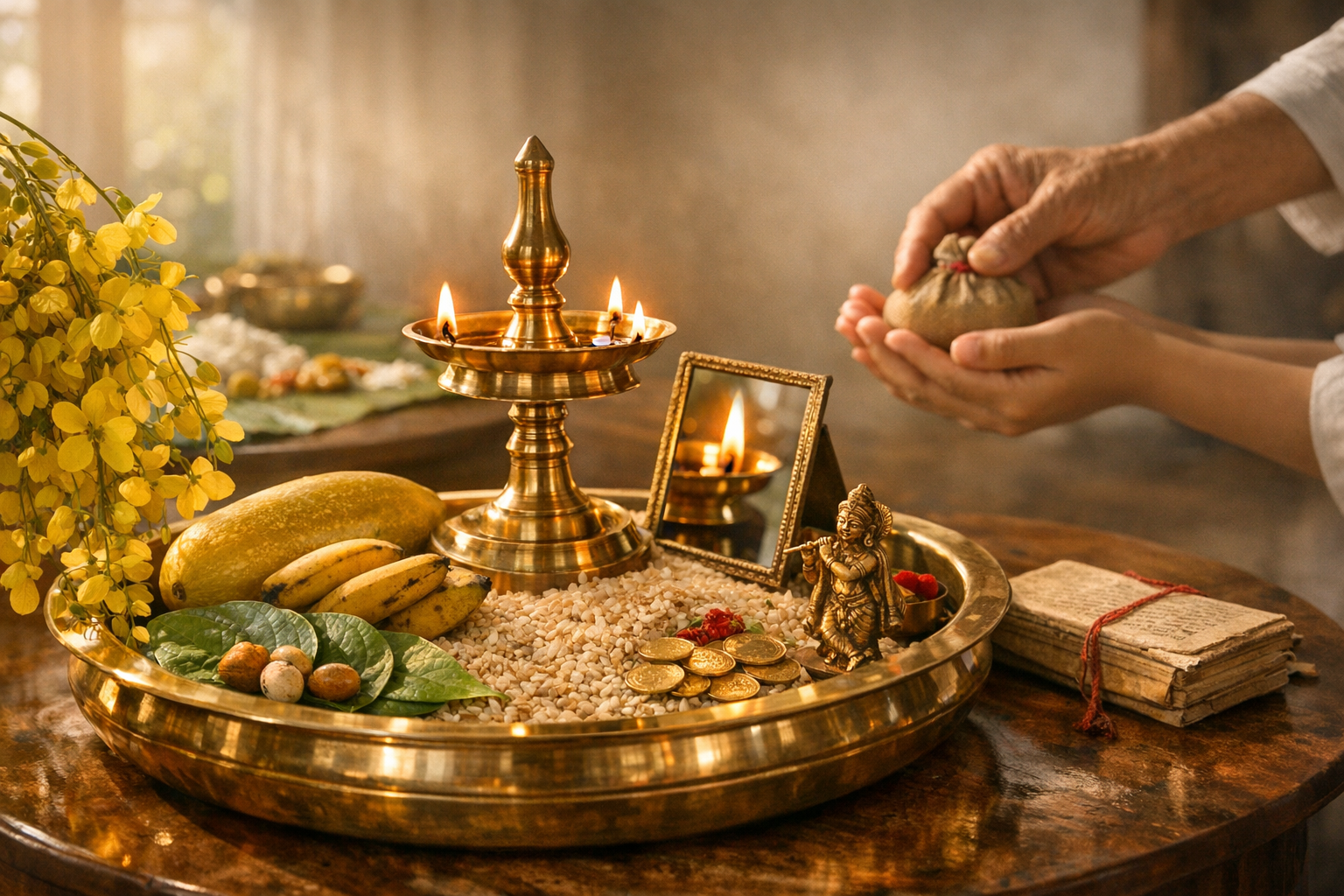
At the heart of the day lies the Vishu Kani, the first auspicious sight at daybreak. The term kani evokes the idea of a curated, prosperity-invoking tableau that one sees upon waking, shaping intention and outlook for the year. This ritual unites aesthetics, symbolism, and devotion: light, grain, flower, fruit, scripture, wealth, and divinity appear together as an integrated vision of abundance and dharmic order.
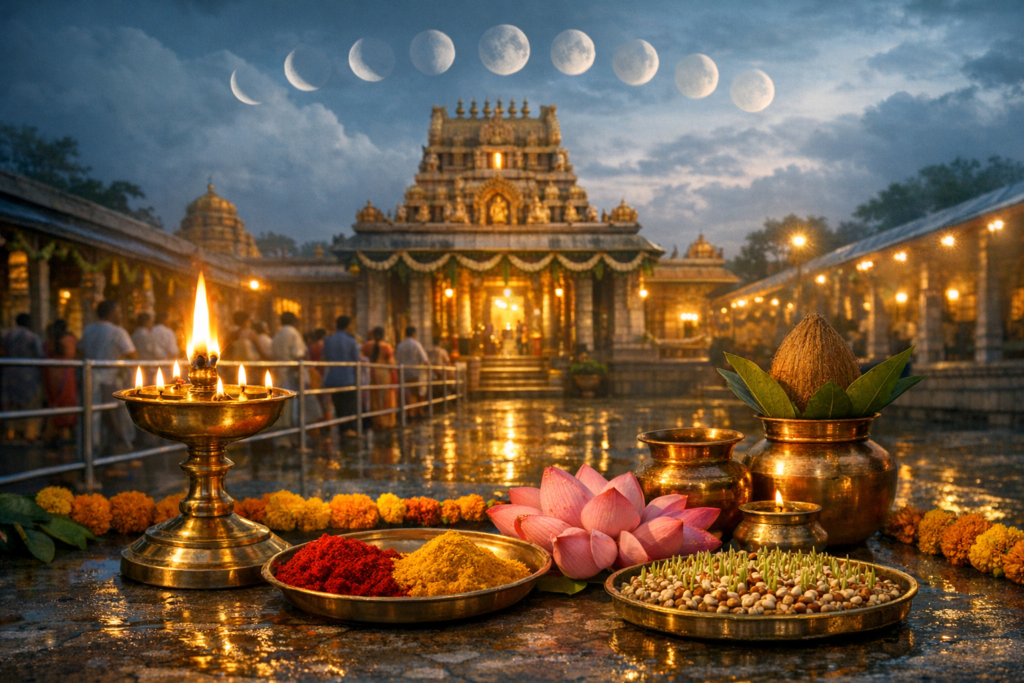
Households traditionally arrange the Kani in an uruli or similar vessel, placing rice or paddy to signify food security, a mirror to encourage self-reflection, and a lit nilavilakku to invoke clarity and auspiciousness. The kani konna (Cassia fistula) blossoms in their golden hue embody prosperity and seasonal rhythm. Fruits, vegetables such as the golden cucumber, betel leaves and areca nuts, currency or a gold coin, and a sacred text like the Bhagavad Gita are added with care. An image or idol of Vishnu or Krishna, especially beloved in Kerala’s devotional landscape, completes the arrangement.
The darshan of the Vishu Kani at sunrise—kani kaanal—is the focal muhurta of the day. Families often prepare the Kani the previous night to ensure the first sight after waking is the assembled blessing. In many homes, elders gently guide children—eyes lightly covered—to the lamp-lit Kani so that the year’s first gaze lands upon this harmonious vision of light, life, and learning.
Temple worship amplifies the devotional tone of the morning. Many visit Krishna temples, including prominent shrines across Kerala, for early darshan. The devotional current is inclusive in spirit: while Vaishnava imagery predominates, the ritual grammar—lamp, flowers, mantra, and dana—reflects practices shared across the dharmic spectrum.
Vishu Kaineettam, the giving of coins or small gifts by elders to younger members, enacts the principle of dana and signals intergenerational continuity. Beyond material exchange, Kaineettam reinforces belonging, care, and the ethical vision that wealth serves the flourishing of family and community.
The Vishu Sadya, a traditional vegetarian feast served on a plantain leaf, is central to the day’s conviviality. Classic dishes such as parippu with ghee, sambar, avial, kaalan, erissery, thoran, olan, pachadi, puli inji, pickles, and payasam present the shad-rasa—the six foundational tastes—reminding diners that a balanced palate mirrors a balanced life. The Sadya celebrates Kerala’s agrarian heritage while modeling gratitude for seasonal produce and mindful, communal eating.
New clothes (often called puthukodi) are worn to mark fresh beginnings, while early morning firecrackers—Vishu padakkam—signal joy. Where fireworks are customary, communities increasingly emphasize safety and environmental sensitivity, reflecting a contemporary ethic of celebration in harmony with nature.
Though styled as a harvest festival, Vishu’s agricultural logic is more than symbolic. It looks forward, positioning households spiritually and materially at a cusp in the seasonal cycle that precedes the monsoon. The Kani’s grains and produce are not mere décor; they are promises of sowing, stewardship, and shared prosperity.
From a calendrical perspective, Vishu’s timing rests on the sidereal zodiac used in the Malayalam Panchang. Mesha Sankranti—the Sun’s ingress into sidereal Aries—marks Medam 1 and anchors the festival to an astronomical event. Due to the precession of the equinoxes and the use of ayanamsa corrections, this sidereal ingress occurs around mid-April and differs from the tropical zodiac used in Western astronomy. The result is a culturally precise but globally understandable link between solar motion and ritual time.
Local sunrise determines the day of observance when Sankranti falls near dusk. This is why dates can differ slightly across India and the diaspora, especially for communities outside the Indian time zone. For Kerala in 2026, sunrise after a post-sunset Mesha Sankranti yields Vishu on 15 April.
Vishu’s symbolic grammar resonates strongly with wider dharmic traditions that celebrate mid-April as a solar new year. The same astronomical threshold inspires Puthandu in Tamil Nadu, Bihu in Assam, and Pohela Boishakh in Bengal. In Punjab, Vaisakhi carries profound cultural and Sikh historical significance. In Sri Lanka and across Southeast Asia, Buddhist communities mark the solar new year with water, merit-making, and communal joy. Though observances differ in form, they converge on shared values: renewal, dana (generosity), ahimsa (non-harm), gratitude for the harvest, and reverence for cosmic order.
Jain communities, while observing their new year in the Kartik period after Deepavali, participate in April’s spirit of reflection and giving through the universally dharmic practices of self-discipline, charity, and care for living beings. In this way, Vishu becomes a reminder of the deeper unity within dharmic civilizations—distinct calendars and rituals set within a shared ethical and cosmological horizon.
The Kani’s components carry layered meanings. The nilavilakku embodies light and knowledge; grain embodies sustenance; fruits and vegetables embody fertility and health; the mirror encourages self-knowledge and accountability; sacred texts foreground wisdom; and the presence of Vishnu or Krishna centers the vision in devotion. The kani konna’s golden blossoms, arriving with seasonal precision, knit the household ritual to the land’s own cycles.
For families unable to source kani konna—especially those in the global diaspora—substituting locally available yellow blossoms preserves the intent while honoring the ecological principle of using seasonal, regional flora. Likewise, if a brass uruli is not available, any clean vessel can serve; intentionality and reverence define the Kani more than materials.
Many households enhance the day’s spiritual quality by reciting prayers, reading select verses from the Bhagavad Gita, or chanting Vishnu Sahasranama. Quiet contemplation before the Kani, followed by temple darshan and acts of charity, completes an arc from inner clarity to outer service.
Environmentally thoughtful observance is increasingly integral to Vishu. Families opt for reusable lamps, cloth bags for provisions, locally grown produce for the Sadya, and minimal or eco-safe fireworks. These practices reflect the dharmic ethic of stewardship—celebration with restraint and care for all beings.
In summary, key details for planning are straightforward. Vishu 2026 in Kerala falls on 15 April 2026. The main observance occurs at sunrise with the darshan of the Vishu Kani, followed by temple worship, Vishu Kaineettam, and the Vishu Sadya. The date arises because Mesha Sankranti occurs after local sunset the previous day, moving the festival to the next sunrise as per Panchang rules.
Beyond date and ritual, Vishu carries a philosophical message. By placing light beside food, knowledge beside wealth, and self-reflection beside devotion, the Kani teaches integrative living. It suggests that prosperity without wisdom is incomplete, and that wisdom finds meaning in service, family cohesion, and reverence for the natural world.
Seen in the broader tapestry of India’s springtime festivals, Vishu becomes a luminous thread connecting Kerala’s culture with a pan-Indic rhythm of solar renewal. Its symbolism and practices harmonize with the shared ideals of Hinduism, Buddhism, Jainism, and Sikhism, affirming unity in diversity while honoring every community’s distinctive expressions.
Inspired by this post on Hindu Pad.