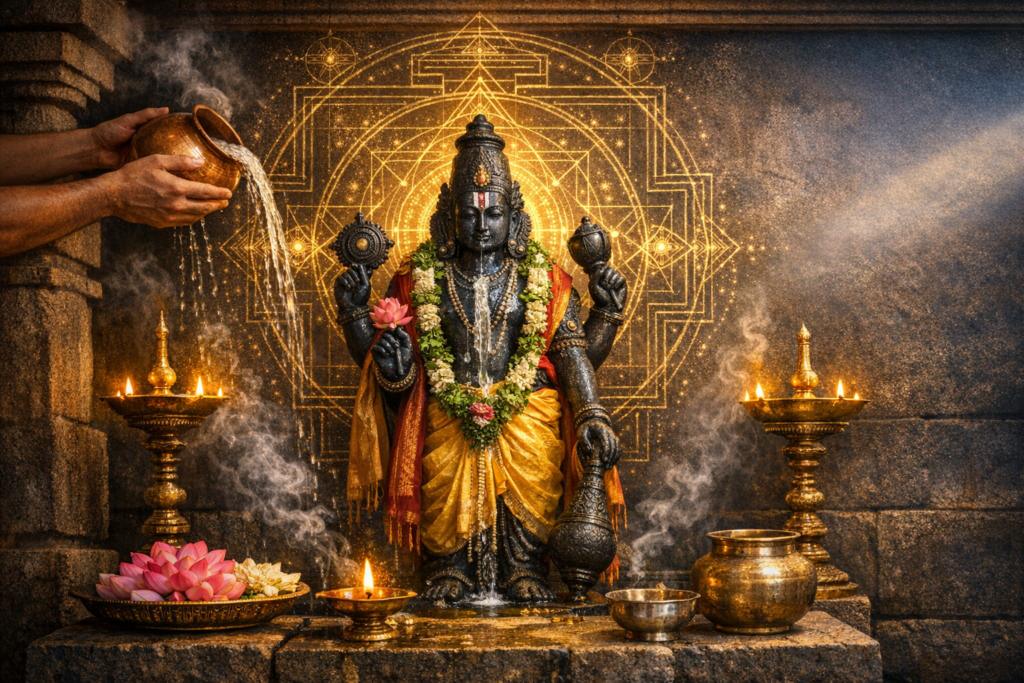
Set on the sacred northern bank of the Godavari in Bhadradri Kothagudem (Telangana), the Sri Sita Ramachandra Swamy Temple at Bhadrachalam stands as one of the most revered Vaishnava kshetras for the celebration of Sri Rama Navami, the grand Sri Rama Brahmotsavam, and the iconic Sri Sita Rama Kalyanam. Devotees from across India and the global diaspora converge here to witness a ritual sequence that is both meticulous and deeply moving, combining strict adherence to Vaishnava Agamic injunctions with a living devotional culture shaped by centuries of bhakti, especially the legacy of Bhakta Ramadasu (Kancherla Gopanna). The site’s ritual ecosystem—river, hill, and temple—imbues the festivities with a distinctive sanctity that is recognized nationwide.
In 2026, the Vasanta Paksha Thirukalyana Brahmotsavalu are scheduled from March 19 to April 2. Within this fortnight of festivities, Sri Rama Navami (Chaitra Shukla Navami) and the celestial wedding, Sri Sita Rama Kalyanam, form the spiritual and cultural heart of the program. While exact tithi observance depends on the local panchang, the Navami observance at Bhadrachalam in 2026 is expected to align with the midday (Madhyahna) window on or around March 27, 2026, with Sri Sita Rama Kalyanam traditionally performed during this sacred timeframe. The coronation ritual (Sri Rama Pattabhishekam) follows on Dasami, symbolically affirming maryada, dharma, and the benevolent kingship of Rama.
Sri Rama Navami puja at Bhadrachalam is anchored to Madhyahna, the middle portion of the day when Sri Rama’s birth is commemorated. For 2026, the practical devotional window for Madhyahna at Bhadrachalam is anticipated to fall roughly between late morning and early afternoon (approximately 11:00–13:30 IST). Because tithi boundaries (Navami start and end) can vary with local sunrise and sunset, devotees are encouraged to align personal observances with the Devasthanam’s daily almanac and announcements, ensuring that Sankalpa, puja, and darshan harmonize with the temple’s canonical timing.
The Brahmotsavam sequence at Bhadrachalam follows a classical Vaishnava liturgical architecture. Ankurarpana and Dwajarohanam establish the ritual sovereignty of the festival, inviting auspiciousness and announcing the commencement of utsavas to all loka-devatas. Vahana Sevas then unfold across days, each vahana symbolically amplifying Rama’s dharmic attributes: Hamsa for wisdom and discrimination (viveka), Sesha for cosmic equipoise and protection, Hanumad Vahana for steadfast service (seva) and courage, Garuda for sovereign protection and speed of grace, and Gaja or Ashwa Vahana for royal prowess and dynamic kshatra-dharma. The procession of the utsava murtis through pradakshina routes—accompanied by Veda parayana, Ramayana parayana, and Ramadasu keertanas—integrates scriptural recitation with living musical traditions, turning streets and mandapas into an extension of the sanctum.
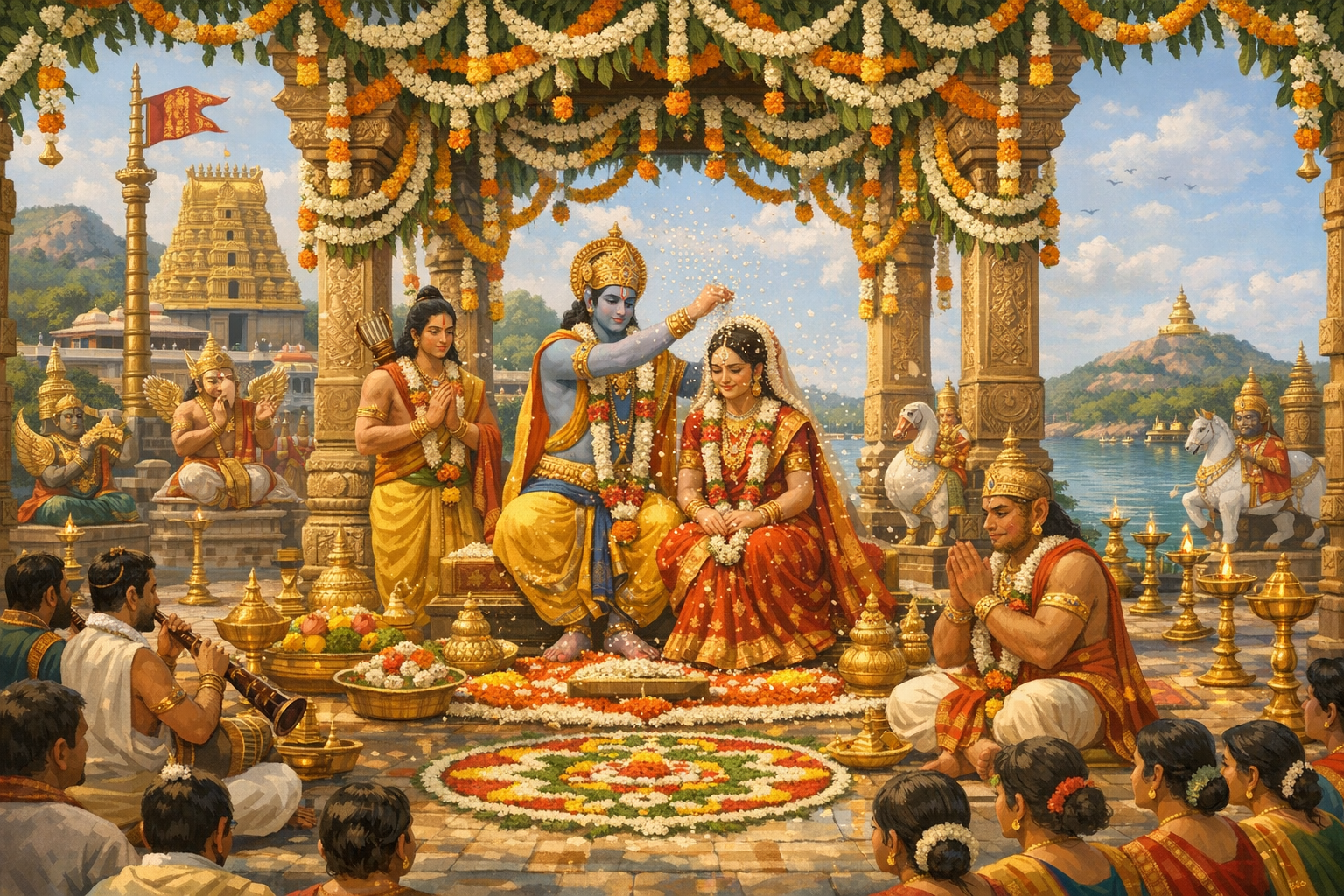
At the doctrinal core of the celebrations stands Sri Sita Rama Kalyanam, performed as per Vaishnava Agamas with a lucid ritual grammar and rich symbolism. After Punyahavachanam and Sankalpa, the sequence typically includes Kanyadanam, exchange of garlands, Mangalashtaka recitations, and the sanctifying shower of talambralu, culminating in mangalyadharana. The kalyana-mantras narrate and affirm the cosmic union of Sri Rama and Sita as the convergence of dharma (righteous order) and shakti (sustaining power). Bhadrachalam’s distinct tradition of Mutyala Talambralu—offered by the State as a mark of royal homage—enfolds civil authority within the ambit of sacred kingship, preserving a centuries-old interface between rajadharma and temple culture.
The day after the Kalyanam, Sri Rama Pattabhishekam on Dasami enacts Rama’s ideal kingship (maryada-purushottama rajadharma) as an ethical archetype for society. In liturgical terms, the Pattabhishekam consecrates the sovereign virtues established during Navami and the Kalyanam—compassion (daya), justice (nyaya), truthfulness (satya), and service (seva)—and re-centers them as shared civic and spiritual ideals. For many families, participation in both Kalyanam and Pattabhishekam becomes a yearly sankalpa, seeking blessings for household harmony, ethical decision-making, and intergenerational stability anchored in dharma.
Historically, Bhadrachalam’s devotional texture is inseparable from Bhakta Ramadasu, whose compositions (Ramadasu Keertanalu) infuse the utsavas with lyrical ardor and theological clarity. The deeply-felt narrative of Gopanna’s imprisonment and the subsequent divine intervention—preserved in collective memory and temple lore—has shaped a culture where music, ethics, and ritual authority reinforce one another. During Brahmotsavam, the chorus of Rama-nama, the cadence of mridangam, and the resonance of nadaswaram merge with the recitation of Srimad Valmiki Ramayana, creating an integrated field of shravana (listening), kirtana (singing), and smarana (contemplation).
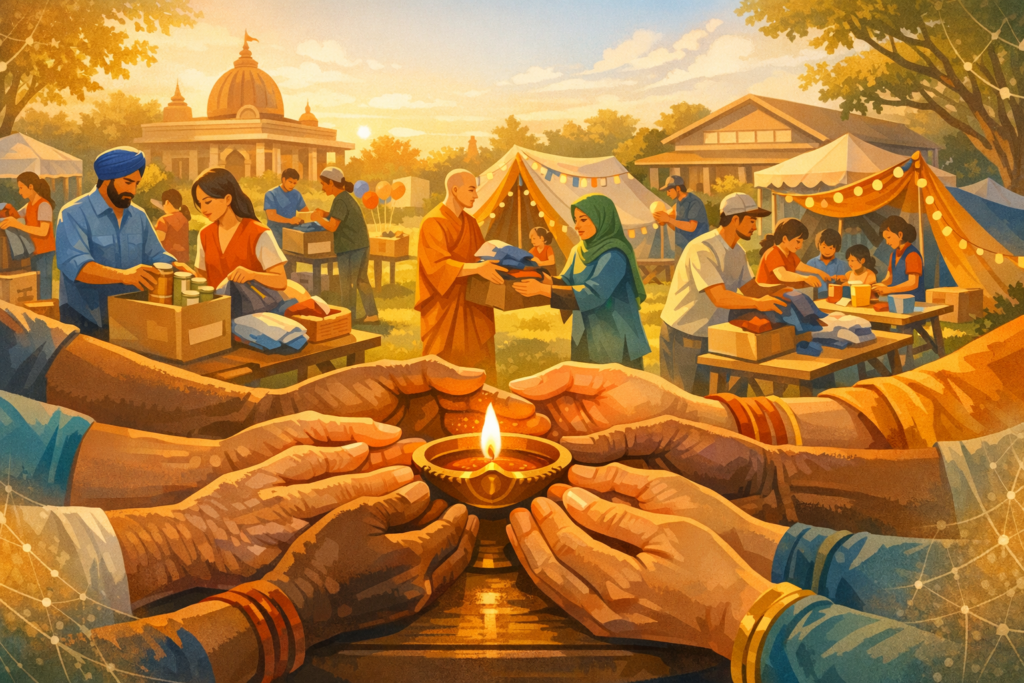
While Bhadrachalam is preeminently a Vaishnava kshetra, the festival’s ethical messages—non-harm, truth, duty, compassion, and service—resonate across the dharmic spectrum, finding respectful echoes in Buddhism, Jainism, and Sikhism. The Sita Rama Kalyanam, in particular, celebrates the sanctity of companionship, vows, and mutual upliftment—values embraced by all dharmic traditions. The confluence at Bhadrachalam thus becomes a living reminder that India’s civilizational unity in diversity is sustained not by uniformity but by shared ethical commitments and mutual reverence.
Pilgrimage logistics for 2026 should take into account the significant footfall expected between March 19 and April 2. Bhadrachalam is connected by road to Hyderabad (approximately 310–320 km) and to regional railheads via Bhadrachalam Road (Kothagudem). Given the concentration of devotees on the Kalyanam and Pattabhishekam days, early arrival, light baggage, and adherence to queue protocols are prudent. Families, elderly devotees, and children benefit from planning rest intervals, hydrating appropriately, and coordinating darshan timings with the temple’s advisories. Environmentally conscious practices—minimizing single-use plastics, respectful disposal of offerings, and mindful riverfront conduct—preserve the sanctity of the Godavari corridor.
From a ritual studies perspective, the 2026 Brahmotsavam at Bhadrachalam offers a textbook instance of how tithi (lunar day), nakshatra (lunar mansion), and muhurta (ritual timing) are triangulated to uphold shastra. Chaitra Shukla Navami anchors the festival’s theological center of gravity; Madhyahna provides the temporal locus for janma-puja; Dasami extends the ethical arc through coronation rites. Day-by-day vahana choices map metaphysical attributes onto public space, enabling devotees to engage with theology through sight (darshan), sound (shruti), movement (yatra), and offering (seva). The result is an immersive pedagogy of dharma—accessible to lay devotees yet rigorous enough to satisfy classical Agamic standards.
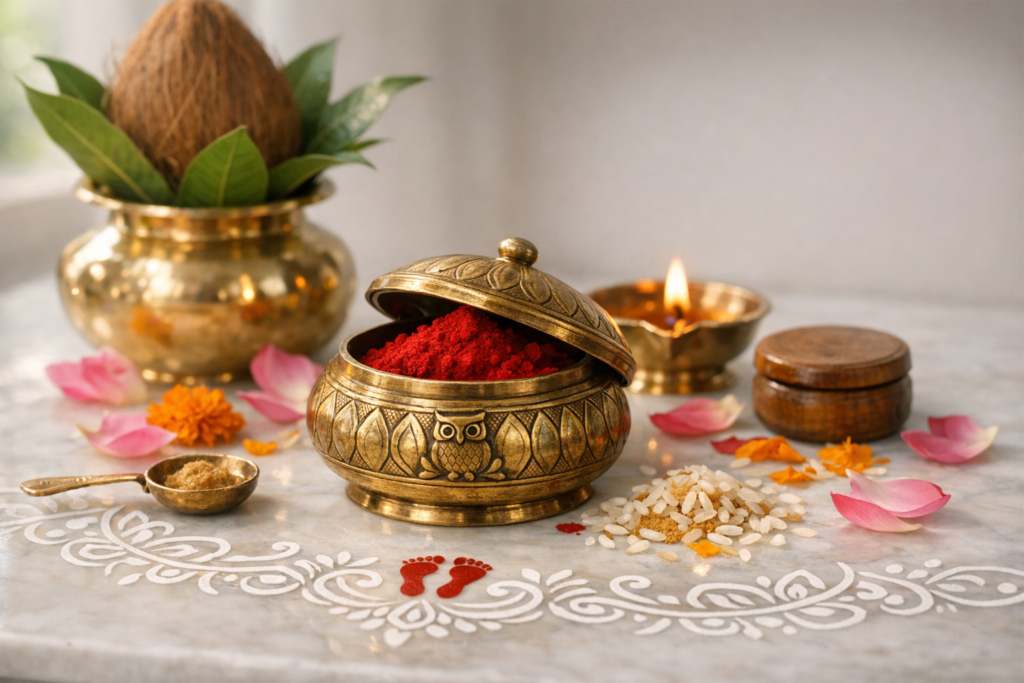
Devotees seeking more structured participation often align their vrata and japa with the festival rhythm: recitation of the Rama Taraka Mantra, daily parayana of Sundara Kanda, and observance of satvika ahara during Chaitra Navaratri, which coincides with the season. Households sometimes mirror the Kalyanam with simple home-based sankalpas—lighting a lamp at Madhyahna on Navami, exchanging akshata among family members, or singing Ramadasu and Tyagaraja kritis—thus harmonizing home worship with the temple’s public rites and reinforcing the family’s devotional culture.
As the Dwajarohanam inaugurates the 2026 Vasanta Paksha Thirukalyana Brahmotsavalu and the Dwajavarohanam brings them to a close, Bhadrachalam yet again demonstrates how a living temple sustains ethical consciousness for society at large. For devotees, the promise is experiential—serene darshan of Sri Sita Ramachandra Swamy, transformative participation in the Sri Sita Rama Kalyanam, and renewed clarity about one’s place within a larger dharmic order. For scholars and observers, the festival presents a rare continuity: precise ritual timing, classical liturgy, and an open, inclusive ethos that invites participation while honoring scriptural discipline.
Key dates at a glance for 2026: Vasanta Paksha Thirukalyana Brahmotsavalu are observed from March 19 to April 2; Sri Rama Navami and Sri Sita Rama Kalyanam are expected around March 27 during the Madhyahna window; Sri Rama Pattabhishekam follows on Dasami (the day after Kalyanam). As with all tithi-based observances, final confirmation should be taken from the temple’s published panchang and daily bulletins to align personal observances and travel with the Devasthanam’s official schedule.
Inspired by this post on Hindu Pad.