Vidyaranya Jayanti, observed on Vaishakha Shukla Saptami, commemorates the birth of Swami Vidyaranya (also known as Madhavacharya or Madhava Vidyaranya). In 2026, Swami Vidyaranya Jayanthi falls on April 23 in most Indian panchangas; practitioners outside India should verify local tithi conversions for alignment with the regional Vaishakh month.
The observance honors the philosopher-sage who served as rajaguru and patron-saint to the early Vijayanagara Empire. Traditional accounts place his birth in 1268 at Ekasila Nagaram (Warangal), within the vibrant Kakatiya-era cultural sphere. Over subsequent decades, Vidyaranya emerged as a guiding force for civilizational renewal, education, and ethical governance.
Known pre-sannyasa as Madhavacharya (Madhava Vidyaranya), he is distinct from the Dvaita philosopher Madhvacharya of Udupi—the shared honorific sometimes causes confusion in modern references. Within the Shankaracharya Parampara, Vidyaranya’s leadership is closely associated with the Sringeri Sharada Peetham, where epigraphic and matha records describe significant initiatives in education, temple stewardship, and community welfare.
Vidyaranya’s intellectual influence spans Advait and Vedanta literature. Tradition attributes to him (or to his immediate circle) pivotal works such as Panchadasi, Jivanmuktiviveka, and Sarvadarśanasaṅgraha. While scholars debate details of authorship and dating, the corpus as a whole has shaped how generations study, practice, and teach Advaita Vedanta, bridging rigorous logic with lived spiritual inquiry.
Panchadasi, a fifteen-chapter synthesis prized by Advaita students, is conventionally organized into three pentads: Viveka (discrimination), Dīpa (illumination), and Ānanda (bliss). Jivanmuktiviveka examines criteria and disciplines pertaining to liberation while living, integrating sadhana, ethical refinement, and contemplative cognition. Sarvadarśanasaṅgraha offers a panoramic survey of diverse darśanas—including Charvaka, Buddhism, Jainism, Nyaya, and Mīmāṃsā—culminating in Advaita, while modeling rigorous yet respectful inter-school dialogue.
Historically, Vidyaranya’s counsel to Harihara I and Bukka Raya I is cited in narratives of statecraft, cultural restoration, and social resilience associated with the Vijayanagara Empire. Inscriptions and later chronicles credit this alliance with reviving learning networks, supporting temple communities, and enabling agrarian and artisanal recovery—efforts that nourished a multi-sampradaya milieu and safeguarded plural religious practices.
The Jayanti’s spiritual focus rests on guru-bhakti and reflective study. Temples and mathas mark the day with special abhishekam, archana, and parayana from texts associated with the Acharya. Householders commonly observe a simple vrata, recite Guru Stotras (such as Dakṣiṇāmūrti Stotram), study selections from Panchadasi or Jivanmuktiviveka, and offer dana to educational or annadana initiatives in the spirit of dharmic service.
A practical home observance may include: lighting a lamp at sunrise; silent japa invoking the guru-parampara; reading a chosen section from Panchadasi’s Viveka panchaka; meditative contemplation on the unity of Atman and Brahman as expounded in Advaita Vedanta; and a sattvic meal shared in gratitude. Many devotees also reflect on Vidyaranya’s model of scholarship, service, and inclusive leadership in daily life.
Calendar note: Vaishakha Shukla Saptami is determined by the lunar tithi; many communities follow the rule that the Jayanti is observed when Saptami prevails at sunrise in the local calendar. Because tithi transitions can occur at different clock times across time zones, diaspora communities are advised to consult a reliable regional panchang to align observance with Vaishakh month and local sunrise.
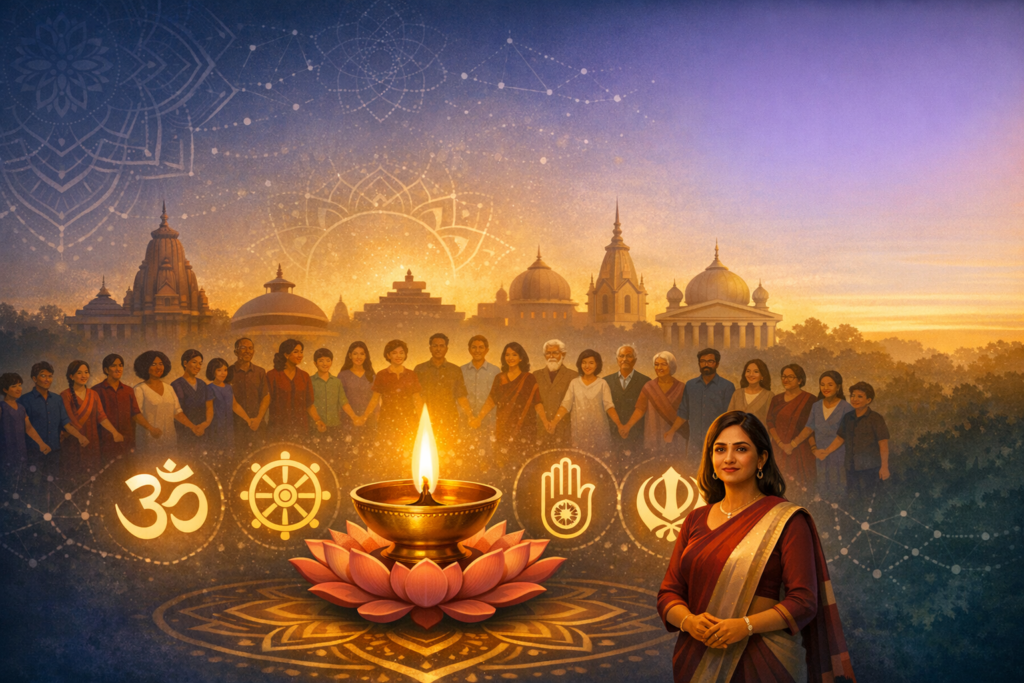
Beyond ritual, the day encourages ecumenical learning. By engaging Buddhist, Jaina, and other schools in Sarvadarśanasaṅgraha, Vidyaranya exemplified how rigorous debate can coexist with respect. Commemorations that include readings, dialogues, or lectures featuring the shared ethical and contemplative heritage of Hinduism, Buddhism, Jainism, and Sikhism naturally advance unity in spiritual diversity.
Educators and students often use the occasion to revisit primary sources and inscriptions related to Sringeri Sharada Peetham and early Vijayanagara. Such study highlights how knowledge systems (gurukulas and mathas), civic institutions (temple-centered charities), and political frameworks interacted to protect culture while remaining open to intercultural exchange across the Indian Ocean and within the subcontinent.
In contemporary life, Vidyaranya’s legacy offers a practical compass: cultivate clarity through viveka, steady the mind through sadhana, serve society with compassion, and honor multiple paths within the broader dharmic family. Observing Vidyaranya Jayanthi on April 23, 2026, thus becomes not only a remembrance but also an invitation to embody wise action grounded in Advaita’s insight and inclusive civic spirit.
Key reminders: traditions differ on the specific puja sequence; families new to the observance can consult local priests or matha guidelines. Where sources diverge on biographical details—such as birthplace traditions or precise authorship attributions—responsible study keeps the focus on the verifiable historical arc and, more importantly, on the enduring philosophical and ethical contributions.
Across regions once shaped by the Vijayanagara Empire and far beyond, Vidyaranya Jayanti continues to inspire. The confluence of scholarship, governance, and spiritual practice associated with his name provides a living template for cultural resilience, interfaith respect, and the pursuit of moksha guided by the guru-shishya tradition.
Inspired by this post on Hindu Pad.