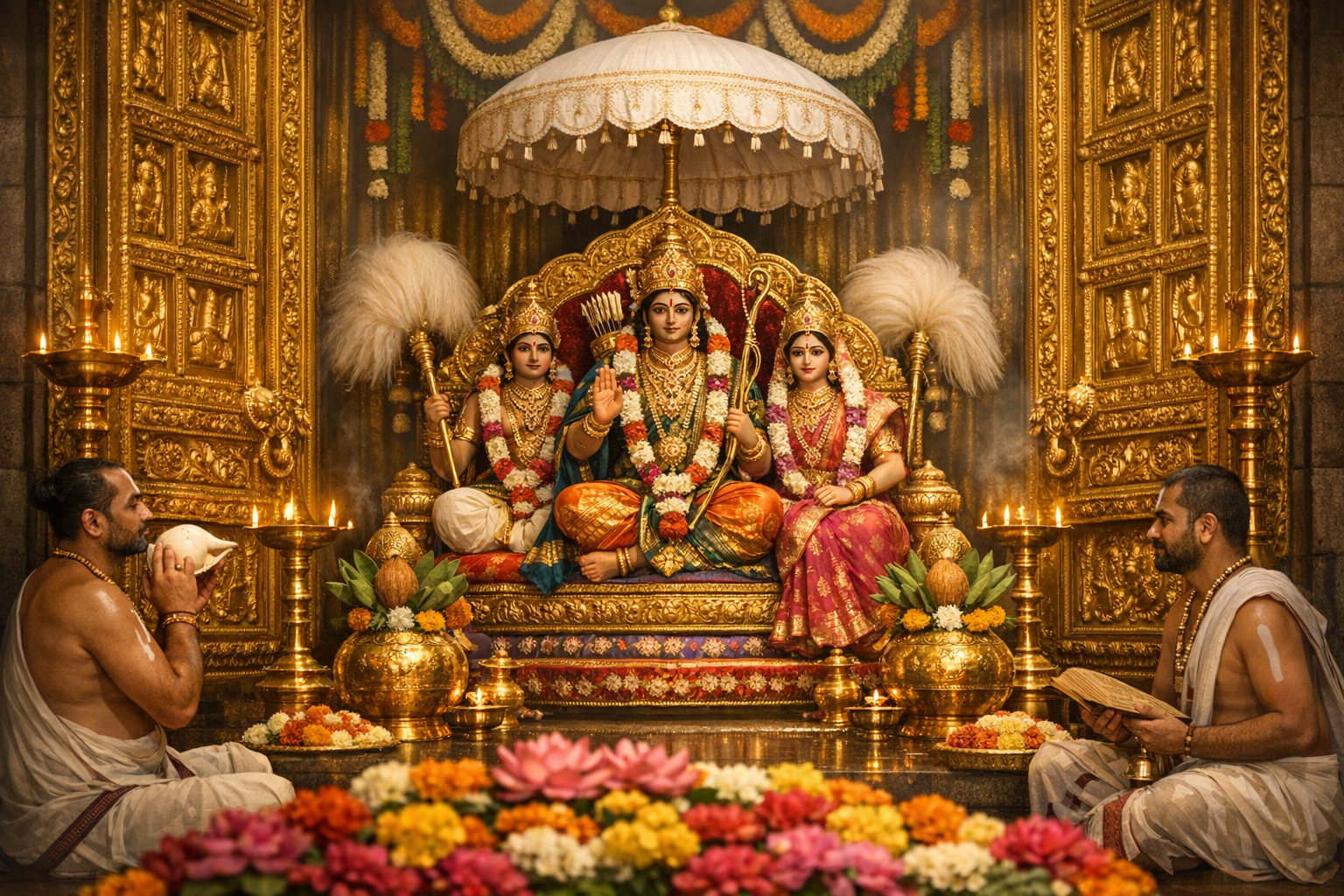
Sri Ramanavami Pattabhisheka Asthanam at the Tirumala Temple is a solemn and meticulously structured observance that commemorates the coronation of Sri Rama as narrated in Srimad Ramayanam. Held as part of the Sri Rama Navami festivities according to the lunisolar Hindu calendar, the ceremony centers on the recitation of the Coronation episode in the presence of the Utsava deities of Sri Rama, Sri Sita, and Lakshmana Swamy at the Bangaru Vakili, the temple’s iconic golden threshold.
In temple parlance, Pattabhisheka denotes royal anointment and enthronement, while Asthanam signifies a formal courtly assembly in which deities are honored as sovereigns. Together, they embody the theological and cultural ideal of righteous kingship, where governance is inseparable from dharma. At Tirumala, the ritual vocabulary emphasizes both textual fidelity to the Ramayana and adherence to the temple’s liturgical discipline.
The scriptural basis derives from Valmiki Ramayana, Yuddha Kanda, where the narrative culminates in Rama’s enthronement upon his return to Ayodhya. Across published recensions, the Pattabhisheka passages detail the arrangement of consecratory waters in sanctified vessels, the presence of Vedic seers led by Vasistha, and the installation of Sri Rama upon the royal throne with Sri Sita. The recitation at the Bangaru Vakili distills these themes, presenting the coronation as the restoration of cosmic order through just rule, or Ram Rajya.
Liturgically, the observance at Tirumala customarily features a sankalpa for collective well-being, the recitation of the Coronation chapters from Srimad Ramayanam, and a sequence of auspicious verses and benedictions. While local praxis can vary year to year within canonical bounds, the core remains constant: the narrative of enthronement is offered directly to the Utsava deities of Sri Rama, Sri Sita, and Lakshmana, affirming the inseparability of scripture, image, and ritual space.
Bangaru Vakili, literally the golden threshold, functions as a liminal and theologically charged zone that mediates between the sanctum and the congregation. As the ceremonial locus for Asthanam, it frames the deities in a courtly tableau, underscoring their sovereignty and the temple’s role as a living royal court of dharma. The architectural brilliance of the gilded doors heightens the sense of majesty appropriate to a coronation rite.
The Utsava deities are presented in classical iconography consonant with South Indian temple tradition. Sri Rama is typically visualized with bow and arrow as the upholder of dharma; Sri Sita embodies auspiciousness and steadfast virtue; Sri Lakshmana stands in devoted service. Many South Indian ensembles often include Hanuman in attendant posture, though the Tirumala observance noted here expressly features Sri Rama, Sri Sita, and Lakshmana Swamy at the Bangaru Vakili.
Calendar and temple regulation align this observance with Sri Rama Navami during Chaitra Shukla Paksha. The Tirumala Temple follows the Vaikhanasa Agama, under whose guidance festival timings, mantras, and ritual order are maintained. Within these parameters, the Pattabhisheka Asthanam is situated to harmonize scriptural remembrance with the temple’s daily and seasonal worship cycles.
The ceremony’s soundscape typically includes Vedic chanting and the resonant cadence of Ramayana recitation, often complemented by traditional temple music appropriate to the occasion. The layered acoustic environment is not merely aesthetic; it functions as a ritual technology designed to align mind, space, and narrative, allowing the community to internalize the ethical grammar of the Ramayana.
Doctrinally, the coronation narrative foregrounds the ethics of rulership. As Ram Rajya, it signifies governance grounded in justice, compassion, and social harmony. These values resonate across dharmic traditions: Buddhist articulations of the ten duties of the ruler, Jain emphasis on non-violence and just social order, and Sikh integration of spiritual and temporal responsibility all reflect convergent ideals of righteous leadership that center the common good.
For pilgrims, the Sri Ramanavami Pattabhisheka Asthanam offers an immersive encounter with a living canon. Devotees often describe a palpable shift from narrative memory to liturgical presence as the Coronation verses are intoned before the Utsava deities. This shared attentiveness fosters inner reflection on personal duty and societal ethics, translating the epic’s lessons into contemporary life.
From a heritage perspective, the observance exemplifies ritual continuity at Tirumala, where textual fidelity, iconographic integrity, and architectural symbolism are woven into a single ceremonial fabric. The role of Tirumala Tirupati Devasthanam in stewarding these practices ensures both accessibility to the faithful and the preservation of ritual precision within the temple’s established discipline.
Visitors customarily prepare by observing dress and decorum compatible with temple norms, maintaining quiet focus near the Bangaru Vakili, and allowing the ritual sequence to unfold without distraction. While visual splendor draws the eye, it is the disciplined attention to recitation and response that most effectively reveals the ceremony’s theological depth.
Viewed in its entirety, the Sri Ramanavami Pattabhisheka Asthanam in the Tirumala Temple is more than a ceremonial reenactment. It is a rigorous, text-grounded affirmation that ethical governance begins with inner alignment to dharma. By situating the Coronation episode amid the sanctity of the Bangaru Vakili and the presence of Sri Rama, Sri Sita, and Lakshmana Swamy, the observance invites the community to embody the Ramayana’s ideals in thought, word, and action, strengthening a shared civilizational ethic across Hinduism, Buddhism, Jainism, and Sikhism.
Inspired by this post on Hindu Pad.