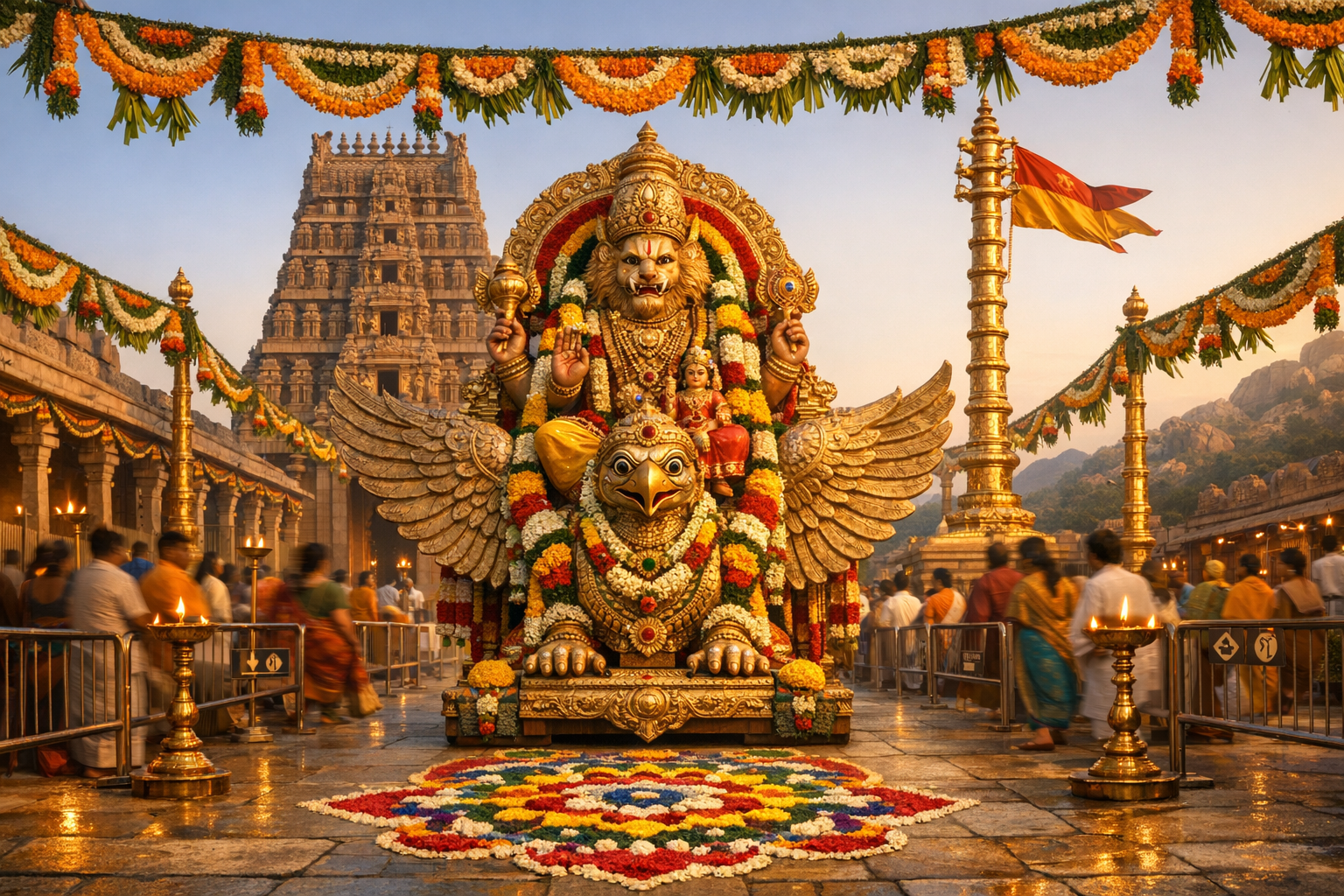
The annual Brahmotsavams at the Tarigonda Sri Lakshmi Narasimha Swamy Temple, near Gurramkonda mandal in Annamaya district (Andhra Pradesh), will be observed from February 24, 2026 to March 5, 2026, with Ankurarpanam scheduled on February 23. In coordination with the local administration, Tirumala Tirupati Devasthanam (TTD) has made extensive arrangements to facilitate seamless darshan and safe participation for devotees.
Set against the historical and cultural landscape of southern Andhra Pradesh, the Tarigonda Lakshmi Narasimha Swamy Brahmotsavams represent a classical Vaishnava festival tradition rooted in Agamic prescriptions and a living heritage of bhakti. Devotees consistently describe the celebrations as both grand and intimate: grand in their public pageantry, music, and temple alankarams, and intimate in the quiet moments of personal sankalpa, archana, and darshan that renew spiritual resolve.
As per Agamic practice, the festival commences with Ankurarpanam, the ritual sowing of seeds that consecrates space and time for the ensuing celebrations. This beejavapanam symbolizes auspicious beginnings, purification, and continuity—an invocation that the dharmic order may flourish for all participants and the wider community.
Following Ankurarpanam, Dwajarohanam traditionally marks the ceremonial commencement of the Brahmotsavams. With the hoisting of the Garuda dhvaja, the deity’s protective presence is ritually proclaimed, indicating that the days ahead will be dedicated to utsava-murtis, vahana sevas, and daily utsavas reflecting the theological and aesthetic richness of Sri Lakshmi Narasimha worship.
Across the festival period (February 24 to March 5), devotees may expect the hallmark Vahana Sevas that characterize a Brahmotsavam. While exact sequences are announced locally by TTD, the customary highlights at Narasimha kshetras often include Sesha Vahanam, Hamsa Vahanam, Simha Vahanam, Hanumanta Vahanam, Gaja Vahanam, Surya Prabha, Chandra Prabha, and, centrally, Garuda Seva. Each vahana symbolizes specific theological attributes—courage, wisdom, protection, and grace—enabling devotees to contemplate distinct facets of divinity through darshan and kirtan.
Complementing the processional sevas, the temple typically conducts Snapana Tirumanjanam (abhisheka) for the utsava murti on select days, accompanied by vedic recitations and stotra chanting. Kalyanotsavam, where observed, presents the divine wedding as a metaphoric rite of auspicious union, prosperity, and communal wellbeing, reaffirming the temple’s role as a nucleus of spiritual and social harmony.
The concluding sequence commonly features Rathotsavam, Chakra Snanam (sacred dip of the Sudarshana Chakra), and Dwaja Avarohanam, ritually completing the Brahmotsavams. Pilgrims often recount that the sense of fulfillment during the final rites lingers as a personal impetus toward dharmic living, seva, and greater inter-community empathy.
In preparation for the 2026 Brahmotsavams, TTD has coordinated comprehensive infrastructure upgrades and festival logistics. The temple precincts are being adorned with pandals and rangolis, while queue lines, barricades, and clear signage enhance orderly movement during peak hours. Focused arrangements for crowd control, drinking water, basic medical aid, public address systems, and cleanliness drives are prioritized to ensure a safe and devotional ambience.
Routine darshan protocols during Brahmotsavams may include structured entry through designated queue lines for Sarva Darshan and, where applicable, special arjitha sevas. Devotees typically procure seva tickets (such as archana or abhishekam) at authorized counters; availability can vary by day and crowd levels. Festival-day timings for vahana sevas and special rituals are announced locally; checking on-site notice boards at the temple and TTD communication channels closer to the date is recommended.
Beyond ritual precision, the festival atmosphere foregrounds a shared dharmic ethos. The seva culture of feeding, caring, and serving resonates across Indic traditions—Hinduism’s bhakti and dana, Buddhism’s karuna, Jainism’s ahimsa and aparigraha, and Sikhism’s seva and langar. Visitors frequently note how the inclusive spirit of Brahmotsavams fosters unity in diversity, encouraging mutual respect and welcoming all who approach with reverence.
Accessibility to Tarigonda is feasible by road from key urban centers. The temple lies within driving distance of Madanapalle (approximately 40–50 km), Kadapa (roughly 100–120 km), and Tirupati (about 120–140 km, via Renigunta). The nearest functional railway options include Madanapalle Road and Kadapa, while Tirupati serves as the primary airport for domestic connectivity. During Brahmotsavams, travelers are advised to account for festival traffic and parking directives issued on-site.
Accommodation around Tarigonda can be limited during peak days. Many devotees prefer to base themselves in Madanapalle, Kadapa, or Tirupati, commuting to the temple for key sevas and darshan. Early planning is prudent for families and senior citizens; local transport operators typically adjust frequency on major procession days, but early morning and late-night returns should be planned with care.
For a comfortable and respectful experience, modest attire suitable for temple premises is encouraged, along with light footwear for walking. Essentials such as water, a small umbrella or shawl, and any prescribed medications should be carried. As with most major utsavas, it is advisable to travel light, follow volunteer instructions, and keep personal belongings secure, especially during moving processions.
Eco-conscious practices augment the devotional quality of the event. Devotees increasingly opt for reusable water bottles, avoid single-use plastics, and dispose of offerings and packaging at designated points. Such mindful participation supports TTD’s cleanliness and sustainability measures, reflecting the dharmic commitment to care for shared sacred spaces.
Etiquette enhances collective darshan: maintaining the sanctity of alankaras, refraining from flash photography near the deity, and allowing elders and children safe passage during dense crowds. Many visitors find that joining in simple nama-sankirtana or silently reciting favorite stotras deepens the sense of presence during vahana darshans.
While a detailed, day-by-day program is traditionally published locally closer to the festival, an indicative flow for Brahmotsavams features pre-dawn temple rituals, morning vahana seva, midday alankaram and abhishekam-based observances, and an evening vahana procession. Major highlights such as Garuda Seva, Rathotsavam, and Chakra Snanam typically draw the largest congregations; arriving early, staying hydrated, and following route advisories ensure a fulfilling darshan.
The 2026 Tarigonda Lakshmi Narasimha Swamy Brahmotsavams are poised to be a sacred spectacle, uniting meticulous Agamic worship with accessible community participation. For devotees and culture-enthusiasts alike, the festival offers a rare confluence of theology, art, music, and disciplined ritual—an experience that uplifts personal devotion while reaffirming the wider dharmic ideal of harmony and shared wellbeing.
Inspired by this post on Hindu Pad.