Navratri 2026 Day 2 falls on 20 March during Chaitra (Vasant) Navratri and on 12 October during Sharad (Ashwin) Navratri. The day aligns with regional observances such as Preethi Dwitiya, Sthana Vriddhi Gauri Vrata, and Sindhara Dooj, and is dedicated to the worship of the Navadurga form Brahmacharini. In Nepal, where Navratri is celebrated as Dashain, the second day continues daily Goddess Durga worship in homes and shrines.
From a calendrical perspective, the 2nd day of Navratri corresponds to Shukla Dwitiyathe second lunar day of the bright fortnight. In 2026 this Dwitiya falls on Chaitra Shukla Dwitiya (20 March) and Ashwin Shukla Dwitiya (12 October) for most Indian Panchangs calculated for Indian Standard Time (IST), with minor regional adjustments for time zone and local sunrise. Observance is traditionally tied to the udaya tithi (the tithi at local sunrise), so households outside India and Nepal should consult a local Panchang to map Shukla Dwitiya to their latitude and time zone.
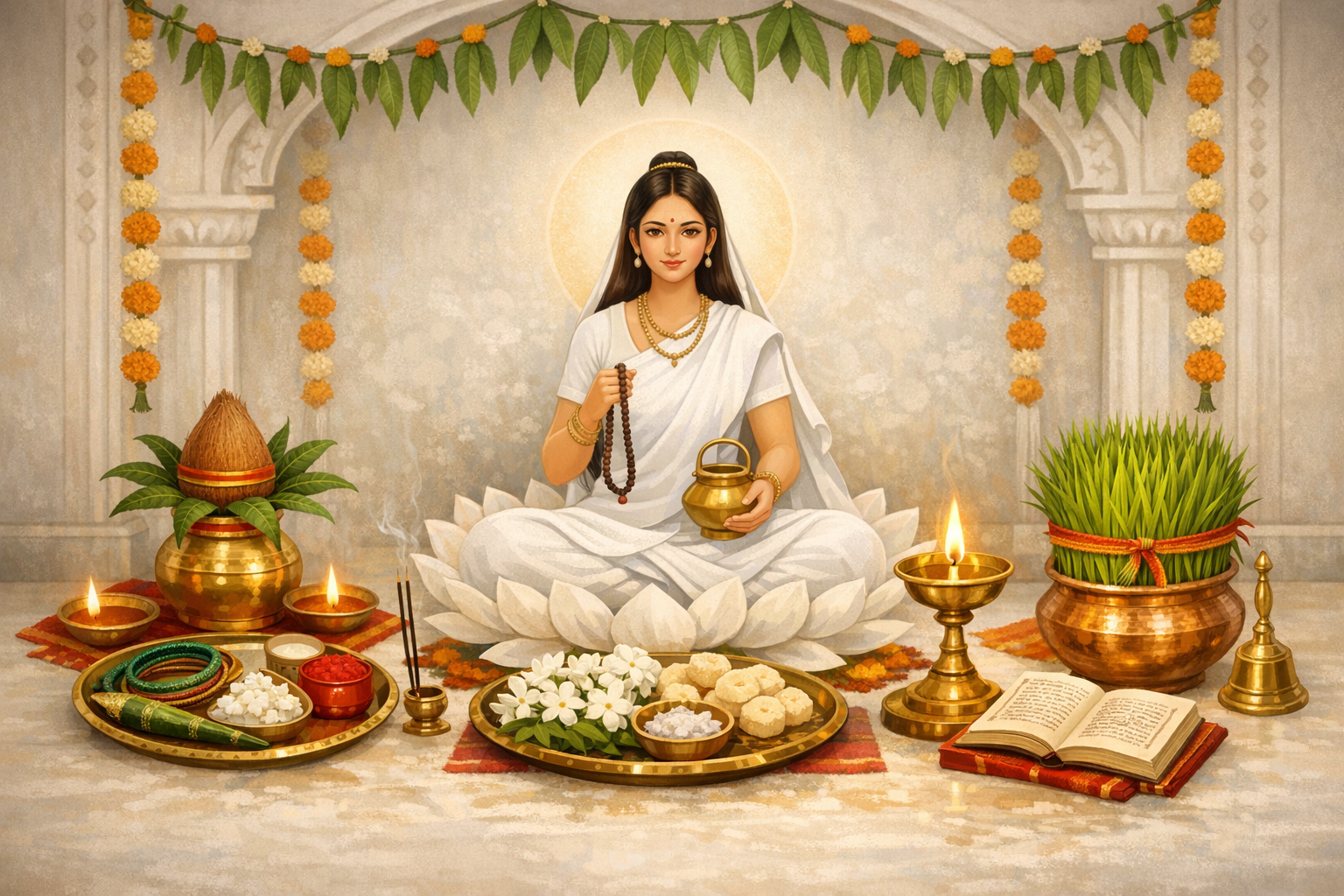
Brahmacharini, revered on the 2nd day of Navratri 2026, personifies tapas, steadfastness, and study. Iconographically she holds a japa mala and kamandalu, signifying disciplined sadhana and purity of conduct. This form guides devotees toward inner restraint and clarity, making Brahmacharini Puja an auspicious practice for cultivating focus across the nine nights of Navratri.
Traditionally the color of the day is white, symbolizing serenity and sattva. Offerings commonly include sugar or mishri, milk-based prasad, and white flowers, aligning the alankara with Brahmacharini’s contemplative energy. Devotees often chant Om Devi Brahmacharinyai Namah and recite chapters from the Devi Mahatmya or other Shakta hymns as part of daily Navratri 2026 sadhana.
A concise Brahmacharini Puja vidhi for the 2nd day of Navratri includes sankalpa for Shukla Dwitiya, purification (achamana), invocation (avahana), dhyana, panchopachara or shodashopachara worship, mantra japa, aarti, naivedya, and kshamapana. Many households maintain an akhand jyot through the nine nights, offer white flowers at the altar, and conclude with pradakshina and vandana. The same sequence applies on both 20 March and 12 October, adapted to family tradition and local muhurta guidance.
Fasting on the 2nd day of Navratri 2026 is observed as nirjala, phalahar, or a sattvik anukalpa depending on health and tradition. Common vrat foods include fruits, milk, sabudana, kuttu or singhada preparations, and light seasonal produce; hydration and moderation are emphasized. Elders, children, and those with medical needs customarily keep a gentle fast or a simple sattvik diet, underscoring that intent and discipline matter more than austerity for its own sake.
Regional observances enrich the day’s meaning. Preethi Dwitiya highlights harmony and auspicious bonding within families; Sthana Vriddhi Gauri Vrata, followed in certain gharanas, focuses prayers on well-being and maternal-nurturing ideals under Gauri’s grace; and Sindhara Dooj, known in parts of Rajasthan and neighboring regions, involves sending sindhara gifts and cosmetics to daughters and daughters-in-law, a custom that often intersects with the wider Chaitra season and Gangaur-related practices. These regional vratas coexist seamlessly with Brahmacharini Puja and reflect Navratri’s cultural diversity.
In Nepal, Navratri is observed as Dashain, and the second day sustains daily worship established at Ghatasthapana. Households continue nitya puja to Durga, tend to the jamara barley sprouts planted in the sacred pot, and perform evening aarti. While the most prominent Dashain milestones arrive later in the fortnight, the second day maintains the devotional cadence that culminates in the Vijaya Dashami blessings.
Across the dharmic spectrum, the ideals of the 2nd day resonate widely: disciplined effort in Hindu sadhana, viriya (diligence) among Buddhist paramitas, tapas and ahimsa-centered restraint in Jain practice, and steady simran and seva in Sikh tradition. These shared values foster unity while honoring distinct liturgies and lineages, making the 2nd day of Navratri 2026 a natural moment to celebrate common ethical ground.
Timing follows practical Panchang rules: observe the 2nd day’s rites when Shukla Dwitiya prevails at local sunrise (udaya tithi). If Dwitiya spans two dates in a region, priority generally goes to the date on which Dwitiya is present at sunrise; consult a reliable local Panchang or temple for muhurta specifics. Dates supplied here reflect common Indian almanacs for IST, while Nepal observes Dashain according to Nepal Time (NPT).
Some paramparas sequence the Navadurga forms differently; widespread practice honors Shailaputri on Day 1 and Brahmacharini on Day 2, with Chandraghanta on Day 3. Such variations express the living plurality of Shakta worship rather than contradiction, and devotees are encouraged to follow their family or sampradaya guidance while keeping the Dwitiya focus on discipline and purity.
Whether observed on 20 March in the spring cycle or on 12 October in the autumn cycle, the 2nd day of Navratri 2026 invites a serene recommitment to study, restraint, and compassionate conduct. Anchored by Brahmacharini’s example and enriched by Preethi Dwitiya, Sthana Vriddhi Gauri Vrata, Sindhara Dooj, and Dashain traditions, the day deepens the spiritual momentum that carries through all nine nights.
Inspired by this post on Hindu Pad.