Thursday, March 12, 2026, is observed in the Hindu calendar (Panchang) as Krishna Paksha Navami in most regions. The civil day begins under Krishna Paksha Ashtami until 02:17 on March 12, after which Krishna Paksha Navami prevails for the remainder of the day. Times may vary slightly by location; unless otherwise noted, the reference is to India-centric Panchang conventions.
Across regional systems, month designations differ while the Tithi remains the same. In the amanta tradition followed in much of western and southern India, this date aligns with Phalguna Krishna Navami. In the purnimanta convention used widely in northern India, it corresponds to Chaitra Krishna Navami. These parallel reckonings reflect the plural scholarly practice within the Hindu calendar, and both are correct within their respective traditions.
Tithi, the core temporal unit of the Panchang, is defined by the angular separation between the Sun and Moon in 12° segments. Krishna Paksha indicates the waning half of the lunar month; Navami marks the ninth Tithi after Purnima. In ritual planning and contemplative practice, Krishna Paksha Navami is often treated as a period favorable for disciplined study (svadhyaya), japa, and quiet service (seva), complementing the introspective tone of the waning moon.
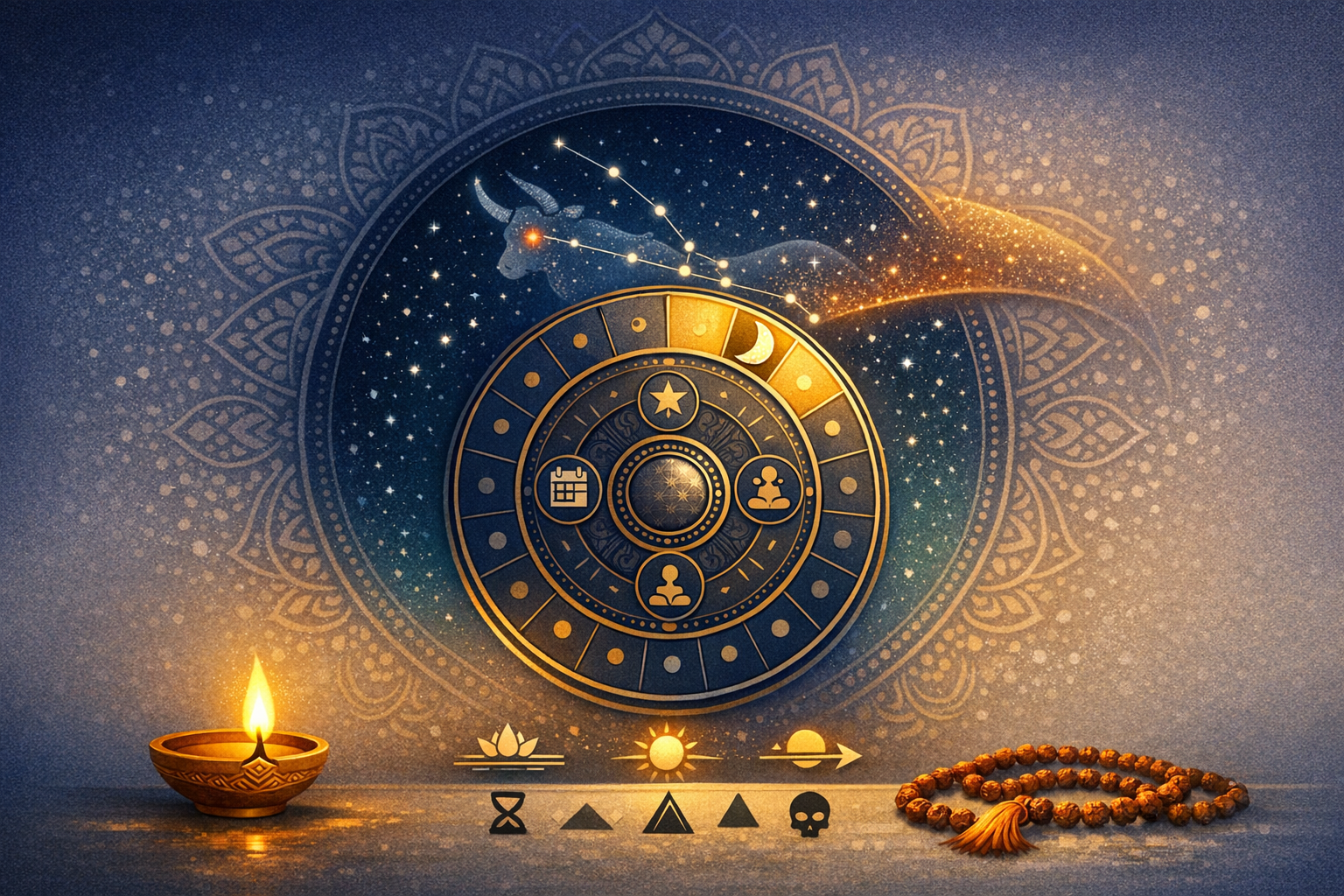
Indicative lunar context helps situate the day’s qualitative tenor. Based on standard sidereal estimates for mid-March 2026 (and the given Tithi transition at 02:17), the Moon is expected to be in Vrishabha (Taurus) for much of the Indian civil day, likely traversing Rohini before shifting toward Mrigashirsha. Exact Nakshatra spans and Chandra Rashi can differ by locality and the hour selected; verification with a precise, location-aware Panchang is recommended for muhurta-sensitive work.
When Krishna Paksha Navami coincides with a Vrishabha Moon and the Rohini–Mrigashirsha corridor, practitioners commonly frame the day’s disposition as steadying and methodical: auspicious for sustained effort, careful planning, and work that benefits from patience and aesthetic refinement. Even where the Nakshatra differs due to longitude or time zone, Navami’s rhythm still supports structured practice grounded in clarity and moderation.
Shubh Muhurat selection rests on universally taught guardrails in the Panchang. The Abhijit Muhuratconsidered broadly auspiciouscenters on local solar noon, spanning roughly 24 minutes before and after the exact midpoint of the daylight arc. This window is useful for concise initiations, sankalpas, and key signatures that benefit from a sattvic, balanced interval.
Brahma Muhurtaapproximately 1 hour 36 minutes before local sunriseis ideal for meditation, pranayama, japa, study of Shastra, and gentle yoga. Across Dharmic traditions, this predawn quiet is treasured: mindfulness and metta meditation in Buddhism, japa and svadhyaya in Hinduism, Navkar Mantra recitation in Jainism, and contemplative remembrance drawing on the Mool Mantar in Sikh practice. Observers consistently report heightened clarity and equanimity in this interval.
Another widely cited favorable segment is the Vijaya Muhurat, which typically occurs around 1 hour 36 minutes before local sunset and lasts for approximately 48 minutes. It is often selected for undertakings that require constructive assertion, resolution, or successful closure, provided it does not overlap with adverse periods such as Rahu Kalam.
For risk management in timing, Rahu Kalam, Yamaganda, and Gulika must be computed from local sunrise to sunset by dividing the daytime into eight equal segments. On Thursdays, Rahu Kalam occupies the sixth segment of daytime; Yamaganda the seventh; and Gulika the third. Precise clock times shift with season and latitude; a location-aware Panchang or an accurate sunrise–sunset ephemeris should be used to derive exact intervals for March 12, 2026, at the place of observance.
Choghadiya, employed widely in western India for both day and night, divides each into eight equal parts. For practical purposes: Amrit, Shubh, and Labh are generally auspicious; Char is neutral-to-functional; Udveg, Rog, and Kaal are typically avoided for new beginnings. Because Choghadiya blocks depend on local day and night length, consult a regional Panchang to map March 12, 2026, to the local clock with fidelity.
Yoga and Karana add further texture. Yoga (27 measures combining solar–lunar longitudes) and Karana (half-Tithis cycling through a set of seven recurring names, with Vishti or Bhadra often avoided for initiations) refine task suitability within a given day. Without exact longitudes for the observer’s location and chosen time, general guidance is preferable: confirm the prevailing Yoga and the running Karana before fixing irreversible commitments.
Practical scheduling on Krishna Paksha Navami benefits from a layered approach. First, filter out Rahu Kalam, Yamaganda, and Gulika. Next, favor Brahma Muhurta for sadhana and Abhijit or Vijaya Muhurat for concise initiatory steps or signings. Finally, refine selection with Nakshatra, Yoga, and Karana if the task is high-stakes or ritually sensitive. Many households find that this method reliably balances auspicious intent with real-world feasibility.
In terms of devotional emphasis, Krishna Paksha Navami lends itself to quiet offerings, japa, and scriptural reading. Those who align with Vaishnava practice may choose to recite the Vishnu Sahasranama or Om Namo Narayanaya; Shaiva traditions often favor Om Namah Shivaya and meditative Rudra recitations; Jain practitioners may reflect on the Navkar Mantra and principles of Ahimsa and Aparigraha; Buddhist practitioners may undertake mindfulness, metta (loving-kindness), and compassion practices; Sikhs may dwell in Naam Simran and contemplation of the Mool Mantar. In each tradition, the day’s waning-moon quality supports steady, compassionate introspection.
Regional diversity is a strength of the Hindu calendar tradition and a shared inheritance across Dharmic lineages. Amanta and purnimanta systems, local sunrise-based muhurta, and longitude-sensitive Nakshatra–Rashi variations all point to a living, observational science. Respecting these nuances while seeking common grounddevotion, mindfulness, ethical conduct, and servicenurtures unity among Hindu, Buddhist, Jain, and Sikh communities.
Summary for March 12, 2026 (India-centric context): Krishna Paksha Ashtami ends at 02:17, and Krishna Paksha Navami continues thereafter for the rest of Thursday. Indicative lunar placement suggests Chandra Rashi in Vrishabha (Taurus) for much of the day, likely engaging Rohini transitioning toward Mrigashirsha, subject to location and time. Select Shubh Muhurat windows such as Brahma Muhurta, Abhijit Muhurat, and (where applicable) Vijaya Muhurat, while excluding Rahu Kalam (Thursday’s sixth daylight segment), Yamaganda (seventh), and Gulika (third). Confirm exact local times with a precise Panchang or ephemeris before fixing high-importance actions.
Inspired by this post on Hindu Blog.