
Maha Shivaratriobserved on Krishna Paksha Chaturdashi of the Magha or Falgun month depending on regional Hindu calendarsis among the most revered Hindu festivals dedicated to Lord Shiva. This academically grounded yet simple Shivaratri Puja procedure explains a clear, step-by-step home practice with authentic mantras, accurate sequencing, inclusive guidance, and practical notes that respect regional sampradāyas as well as the shared values of the broader Dharmic family.
The essence of Maha Shivaratri centers on deep inner stillness, vrata (vow), jagaran (night vigil), and devotion through japa, abhishekam, and upacharas (offerings). The spiritual goal is śivānugraha (the grace of Shiva) signified by clarity of mind, compassion, and self-mastery. Many families prefer a straightforward, home-based Shivalinga Puja that can be completed with minimal items, while those trained in Vedic chanting may add Sri Rudram or longer stotras. Both approaches remain fully valid under the guiding principle of bhāva (devotional intent).
Timing is traditionally anchored to Tithi rather than clock time. Shivaratri falls on Krishna Paksha Chaturdashi, and the primary worship window is the night portionespecially Nishita Kaal (the midnight midpoint). Because Panchang computations vary by location and tradition, it is best to consult a reliable regional Panchang for the precise muhurta, prahar segmentation, and the next-morning parana (fast-breaking) time.
The vrata is often observed as nirjala (waterless), phalahara (fruit-based), or satvik (light, dairy/fruit) fasting depending on health, age, and local customs. Jagaranwakeful remembrance of Shiva through chanting, reading, or quiet contemplationsupports one-pointed awareness. Those with health constraints may keep a moderated fast while maintaining the devotional thread through mantra-japa and mental worship; intention and steadiness of practice take precedence over austerity for its own sake.
In the Dharmic spirit of unity, this observance honors values shared across Hinduism, Buddhism, Jainism, and Sikhismsuch as ahimsa, interiority, ethical self-discipline, and the transformative power of sacred remembrance. Practices like night vigil, mindful fasting, and repetitive naam/mantra occur in diverse forms across these traditions, emphasizing inner purification and service (seva) to all beings.
Preparation begins with cleaning the space, bathing, wearing fresh modest clothing, and arranging a quiet altar. A small Shivalinga (stone, metal, or paarthiva/clay), a Shiva murti, or even a dignified image is sufficient. A simple seat (āsana), a clean plate/thālī for offerings, and a stable base for the linga are important. Keep the practice non-injurious and environmentally considerate at every step.
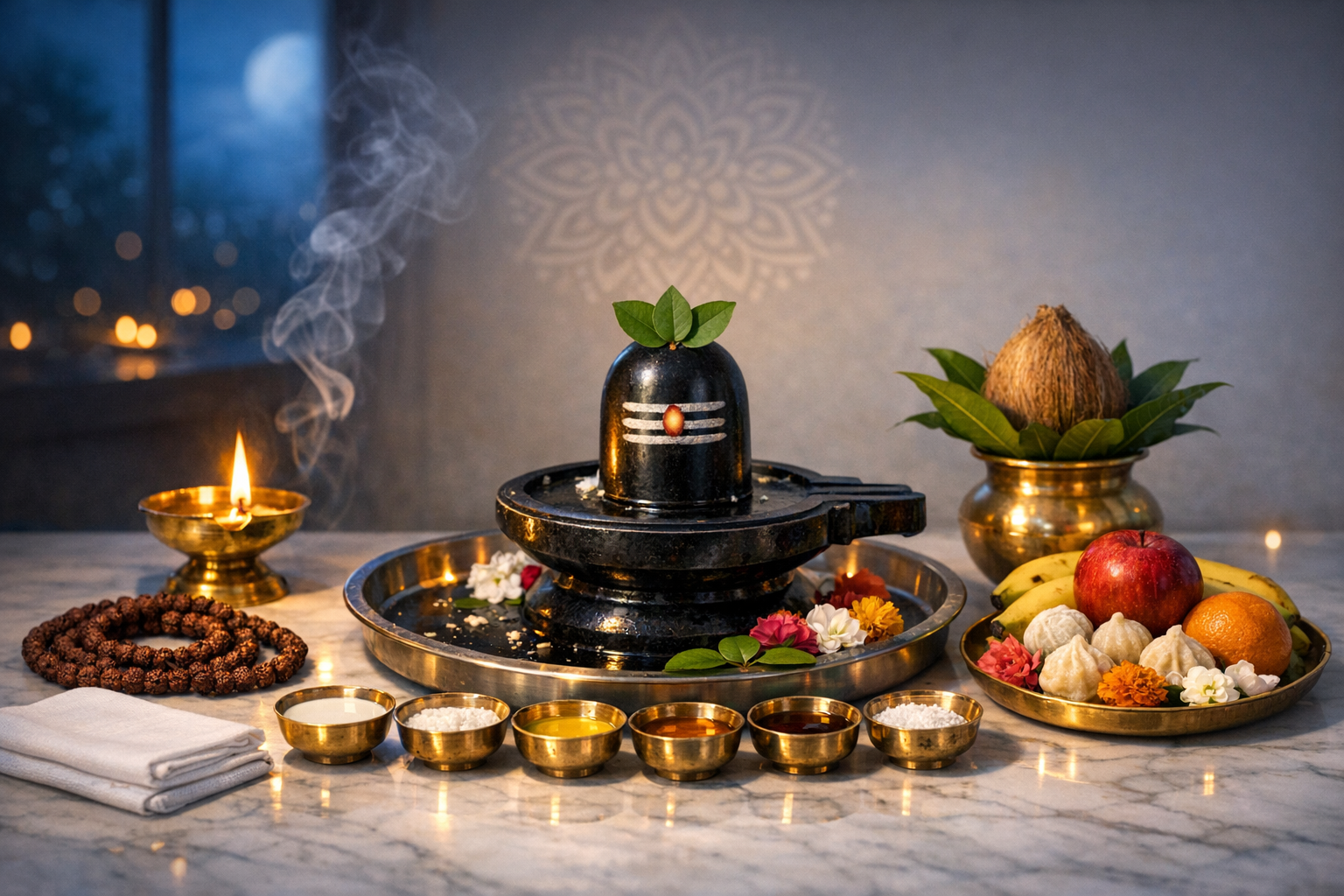
Common Puja Samagri includes clean water (or Ganga-jal if available), panchamrita (milk, curd, ghee, honey, sugar), vibhuti (bhasma), chandan (sandal paste), fresh bilva (bael) leaves, seasonal flowers, incense, a lamp (deepa), naivedya (fruit, milk, or sweets), akshata (unbroken rice), camphor (for aarti), and a rudraksha mālā for japa. Optional itemslike a kalasha with mango leaves and coconut, or additional dravyas for abhishekammay be included as per family tradition.
Arrange the altar so that the Shivalinga or image faces an undisturbed space. Place a plate or abhisheka tray beneath the linga to collect liquids. Keep a small cloth or tissue nearby to maintain cleanliness. If using a clay (paarthiva) linga, keep the abhishekam gentle and avoid hot liquids. If disposal is later required, return clay respectfully to clean soil or a garden; do not clog drains.
Begin with quieting the breath and gathering attention. A few rounds of gentle pranayama can prepare the mind for mantra. Light the lamp and incense to signify the transition from everyday activity to sacred time, and maintain a calm pace throughout the procedure.
Invoke Ganesha to remove obstacles, repeating with care: ॐ गं गणपतये नमः. Offer a flower and a moment of gratitude. This invocation harmonizes the mind and orients the proceedings toward auspicious completion (mangalānvaya).
Formulate a sankalpa (intention) that is truthful, specific, and benevolent. A concise sankalpa in Sanskrit can be: ममोपात्तसमस्तदुरितक्षयद्वारा श्रीपरमेश्वर प्रीत्यर्थं महाशिवरात्रि-व्रत-पूजां करिष्ये। State the place, date (as per local Panchang), and resolve (vrata) internally. The sankalpa anchors the ritual ethically and spiritually.
Offer a short dhyāna on Shivacontemplating the linga as the formless Absolute manifesting as auspicious presence. A simple dhyana can be held silently with slow repetition of the Shiva Panchakshari: ॐ नमः शिवाय. Maintain a steady, unhurried cadence.
Commence the abhishekam. Begin with pure water while chanting ॐ नमः शिवाय, allowing the mantra to synchronize with each libation. Follow with panchamrita in a respectful order (milk, curd, ghee, honey, sugar), and then rinse gently with water. Keep the linga visible and uncluttered, ensuring the base is not flooded.
During abhisheka, many prefer to alternate between ॐ नमः शिवाय and the Mahamrityunjaya mantra. Chanting may be performed 11, 27, 54, or 108 times depending on time and capacity. The focus is steadiness and sincerity rather than speed.
Offer bilva leaves with reverence. Select fresh, clean, intact tripartite leaves. Place them with devotion according to family tradition, avoiding damaged or insect-bitten leaves. Bilva is extolled in the puranas for its cooling and sattvic qualities, and is central to Shiva worship.
Proceed to Panchopachara (five offerings): gandha (sandal paste), pushpa (flowers), dhupa (incense), deepa (lamp), and naivedya (food). Each upachara can be accompanied by mindful breath and a brief mental salutation, acknowledging Shiva as the indweller (antaryāmin) of all beings.
Perform aarti with the lamp in smooth, clockwise movements while quietly reciting or listening to a Shiva stotra. Conclude by placing palms over the flame and drawing the warmth to the eyes to symbolize inner illumination. Offer pranamtouching the floor or heart with gratitude.
Mantra-japa is the heart of a simple home puja. The two most widely practiced mantras are the Shiva Panchakshari and the Mahamrityunjaya mantra. If possible, use a rudraksha mālā. Maintain a stable, upright posture and allow the mantra to settle gently in the breath.
Shiva Panchakshari (seed mantra): ॐ नमः शिवाय. This is universally accepted and appropriate for all devotees, including beginners, across sampradāyas.
Mahamrityunjaya Mantra: ॐ त्र्यम्बकं यजामहे सुगन्धिं पुष्टिवर्धनम् । उर्वारुकमिव बन्धनान् मृत्योर्मुक्षीय माऽमृतात् ॥ A traditional rendering in transliteration is: Om Tryambakaṁ Yajāmahe Sugandhiṁ Puṣṭivardhanam; Urvārukamiva Bandhanān Mṛtyor Mukṣīya Mā’mṛtāt.
Short devotional verses may be added if time allows. A beloved bilva verse is: त्रिदलं त्रिगुणाकारं त्रिनेत्रं च त्रयायुधम्। त्रिजन्मपापसंहारं एक बिल्वं शिवार्पणम्॥ Likewise, some recite the first verse of Lingashtakam: ब्रह्मा मुरारि सुरार्चित लिङ्गं निर्मलभासित शोभित लिङ्गम्। जन्माजदुःखविनाशक लिङ्गं तत्प्रणमामि सदाशिव लिङ्गम्॥ Choose stotras already familiar to maintain meditative flow.
Many households observe the traditional four-prahara worship through the night, repeating a brief cycle of abhishekam, upacharas, and japa at roughly equal intervals. Where that is not feasible, a single, thoroughly attentive puja during Nishita Kaal or any calm portion of the night remains fully meritorious.
Break the fast (parana) the following morning after sunrise and the prescribed Panchang window, offering a small portion of naivedya or milk first to Shiva and then partaking as prasada. Those with medical conditions should prioritize safety and opt for a moderated fast while maintaining japa and mental worship.
For those without a Shivalinga, worship may be directed to a dignified image or mentally to the inner “atmalinga” in the heart-lotus. The core is the contemplation of Shiva’s presence as the substratum of awareness and the source of compassion, not the elaborateness of materials.
Ritual care notes aid both accuracy and inclusivity. Common practice avoids kumkum and haldi on the Shivalinga, instead preferring vibhuti or chandan. Tulsi is traditionally dear to Vishnu and is generally not offered to Shiva; bilva remains the primary sacred leaf. Regional exceptions exist; in all cases, follow one’s kula or family tradition respectfully.
A quick, 20-minute home puja sequence for busy practitioners can be: sankalpa; lamp and incense; Ganesha invocation; water abhisheka with ॐ नमः शिवाय; brief panchamrita; water rinse; bilva and flower offering; Panchopachara; aarti; 108 japa of ॐ नमः शिवाय or 11 Mahamrityunjaya mantras; silent thanksgiving. Even this concise cycle, performed mindfully, accords with Shivaratri’s spirit.
Ethical and environmental considerations are integral to Dharma. Use modest quantities of liquids to prevent waste; prefer biodegradable offerings; return organic residues to soil when appropriate; avoid intoxicants and any practice causing harm to self, others, or the environment. In keeping with Dharmic unity, consider dedicating part of the day to compassionate acts or dana (charity).
Families often include children by assigning simple roleslighting the lamp under supervision, placing a single bilva leaf, or softly repeating ॐ नमः शिवाय. Such participation fosters reverence, focus, and shared cultural memory without overburdening young practitioners.
Addressing frequent questions succinctly supports clarity. Women and men alike may perform Shivaratri Puja with full dignity and devotion. Those observing personal or regional codes should do so without judging others’ practice; unity and respect strengthen the sanctity of the vrata.
Practitioners sometimes ask about longer recitations (e.g., Sri Rudram). Those who are initiated and trained in Vedic chanting may include it, while others can rely on Panchakshari, Mahamrityunjaya, or familiar stotras. The measure of practice is steadiness, humility, and aspiration toward inner transformation.
Given regional calendar variations, diaspora communities should consult a precise local Panchang or temple schedule for muhurta, especially Nishita Kaal and the parana window. Aligning with Tithi and local sunrise ensures conformity with the time-honored framework of Hindu time-reckoning (Tithi, Nakshatra, yoga, and karana).
Ultimately, Maha Shivaratri Puja at home is an invitation to discover silence, compassion, and courage in the midst of daily life. Whether performed in four praharas or in a single concentrated session, the practice unites altar and heart, mantra and breath, personal resolve and universal well-being.
Conclude with a simple peace invocation, offering the merit to all beings: ॐ नमः शिवाय … ॐ शान्तिः शान्तिः शान्तिः॥ May the auspicious presence of Shiva illumine thought, speech, and action, and may the shared values of the Dharmic traditions guide collective harmony.
Inspired by this post on Hindu Pad.








