
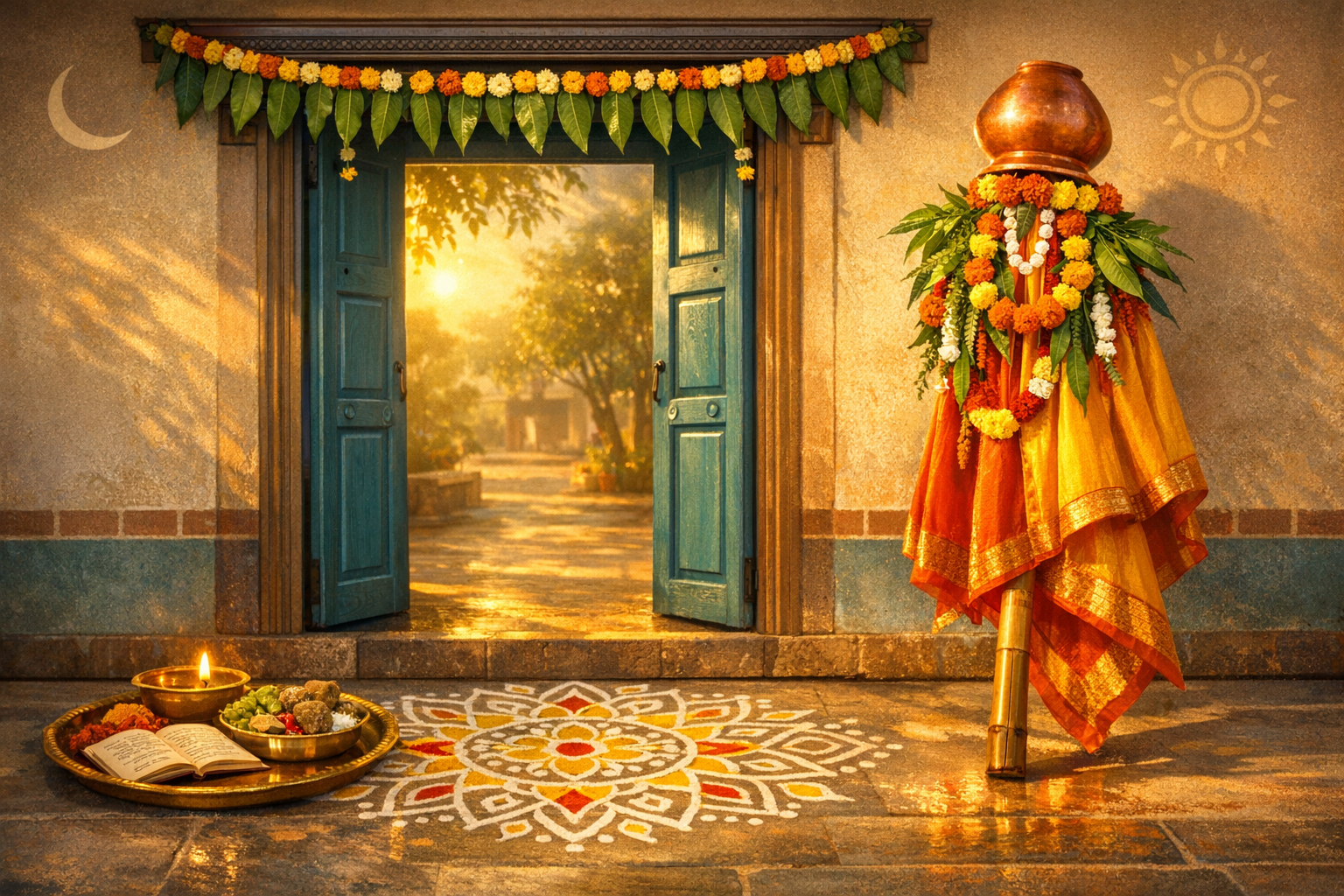
Gudi Padwa, also spelled Gudhi Padva and known in the Konkan region as Samvatsar Padvo, marks the Marathi and Konkani New Year on Chaitra Shukla Pratipadathe first bright lunar day of the Chaitra month. In 2026, Gudi Padwa falls on March 19. The same lunar day is celebrated as Yugadi/Ugadi across Telangana, Andhra Pradesh, and Karnataka, underscoring a shared civilizational rhythm within the dharmic family.
Anchored in the Hindu calendar’s lunisolar science, Gudi Padwa occurs when the Pratipada tithi (first lunar day) is operative at local sunrise. Because tithi boundaries are determined by precise lunar-solar angular relationships, the festival date can shift by a Gregorian day depending on time zone and local astronomy. In 2026, the alignment settles on March 19 across India, though those planning observances should verify with a regional Panchang for localized muhurat windows.
Gudi Padwa traditionally inaugurates a new Samvatsara (year) in the sixty-year cycle used across many Indic almanacs. With Ugadi 2026, the Samvatsara name transitions to Parabhava Nama Samvatsaram in several southern traditions, while the Shaka Era year also advances around this time in the Indian national calendar. This calendrical renewaltying lunar phases to seasonal markers near the spring equinoxspeaks to an advanced indigenous time-reckoning that harmonizes cyclical astronomy with cultural life.
Ritual observances begin at dawn with a sacred bath (abhyanga), home cleansing, and the adorning of thresholds with fresh mango-leaf torans and rangoli. Families then prepare the gudian elevated emblem of auspicious victoryby mounting an inverted copper or silver kalash atop a long bamboo staff, draping it with a bright silk cloth (often yellow or saffron), and garlanding it with neem leaves, mango leaves, marigolds, and sugar crystals (gathi). The gudi is raised at sunrise or within the morning muhurat and placed prominently, often to the right of the home entrance, inviting prosperity and warding off negativity.
The gudi embodies layered symbolism. Regarded as Brahmadhwaja (the flag of Brahma) in many traditions, it signifies prajna (higher wisdom) and the generative impulse of creation at the dawn of a new year. Folklore connects it with Indra’s victory banner, the triumphs of Shri Rama, and localized historical memories of valor and renewal. In every telling, the core meaning converges on dharma’s victory over inner and outer discord and the intentional beginning of a righteous cycle.
Chaitra Shukla Pratipada is also a day for Panchang Shravanthe ceremonial reading of the new year’s almanac. Families, community elders, or temple priests review the year’s tithis, nakshatras, yogas, and festivals, offering a reflective outlook on agriculture, health, travel, and social life. This practice centers responsibility and preparedness rather than fatalism, encouraging communities to meet the year with clarity and resilience.
Regional practices mirror the unity-in-diversity that characterizes the Hindu way of life. In Maharashtra, festive menus often include shrikhand-puri and puran poli. Along the Konkan coast, Samvatsar Padvo features community gatherings and house-front gudis raised in joyous unison. In Telangana, Andhra Pradesh, and Karnataka, Ugadi is welcomed with Ugadi Pachadia preparation combining sweet (jaggery), sour (tamarind), bitter (neem), pungent (chili), salty (salt), and other seasonal notes such as raw mangoan edible metaphor for life’s varied rasas and the cultivation of equanimity. The Kannada and Telugu greeting Yugadi Subhakankshalu conveys blessings for an auspicious start.
Gudi Padwa’s calendrical logic is both elegant and rigorous. The festival fixes to the lunar month’s first bright day after the new moon closest to the vernal equinox, while adhika masa (intercalary months) are inserted as needed to synchronize lunar months with the solar year. This long-refined system preserves seasonal fidelity for agrarian practices, pilgrimage cycles, and community rhythms without sacrificing the cultural centrality of the moon’s phases.
Broader dharmic connections add further depth. Kashmiri Hindus often observe Navreh on the same lunar day, while communities across India celebrate other spring New Years by solar reckoning a few weeks laterVarusha Pirappu/Puthandu in Tamil Nadu, Vishu in Kerala, and Vaisakhi in large parts of North India and among Sikhs. In many Buddhist-majority regions of South and Southeast Asia, New Year observances cluster around mid-April. Jain communities mark the New Year after Diwali in Kartik, highlighting the richness of methods through which dharmic traditions express renewal. Despite calendrical differences, the animating principlestruth, compassion, self-cultivation, and community harmonyare shared and celebrated.
For household planning in 2026, the following guidance preserves both tradition and accuracy: prioritize sunrise for hoisting the gudi; ensure Pratipada is operative at sunrise according to a trusted local Panchang; and, if Pratipada begins after sunrise or is skipped by local convention, follow the standard rule of observance on the day Pratipada prevails at sunrise. While some almanacs publish “Gudi Padwa muhurat 2026” ranges, local sunrise and tithi timings should take precedence.
The emotional contour of the day is as instructive as its ritual sequence. The bitter-sweet prasad of neem and jaggery (or Ugadi Pachadi’s six rasas) re-grounds families in the reality that a flourishing year integrates joy and challenge with steadiness. The act of raising a gudi in clear morning lightsilk glinting, kalash upliftedhas a quietly transformative power, reminding communities that dignity arises from disciplined beginnings and shared action.
From a historical perspective, Gudi Padwa also functions as a civil, social, and economic reset. Many families revisit financial plans, agricultural cycles, and study schedules on this day. Temple calendars roll forward, community kitchens prepare seasonal foods, and village/town committees coordinate fairs, music, and folk arts. This blend of spiritual and civic renewal underscores how the Hindu calendar serves as an organizing framework for ethical living and social cohesion.
Environmentally mindful observance is both possible and traditional: reuse the copper kalash and bamboo staff, opt for natural flowers and plant-based decorations, and compost floral remnants. Such choices resonate with the dharmic ethic of reverence for nature and responsible stewardship.
In summary, Gudi Padwa 2026 on March 19 offers a confluence of Panchang precision, cultural beauty, and dharmic unity. Whether named Gudhi Padva, Samvatsar Padvo, or Yugadi, the day invites reflection, disciplined renewal, and solidarity across the broader Indian and dharmic family. Observing the festival with clarity about tithi, care in ritual, and compassion in community translates ancient calendrical wisdom into contemporary well-being.
Inspired by this post on Hindu Pad.










