Choitro (Chaitra) Month in the Bengali calendar is the twelfth and concluding month of Bangabda 1432. In 2026, Choitro begins on 16 March and ends on 14 April, after which Poila Baisakh inaugurates Bangabda 1433. This long-form guide consolidates calendar logic, festival observances, and planning notes specific to Bengal while situating the month within the wider dharmic seasonal cycle.
Bengali calendrical timekeeping in West Bengal follows a sidereal solar system: each month begins with the Sun’s ingress into a sidereal zodiac sign. Choitro corresponds to Surya’s transit through Meena (Pisces), naturally yielding mid-March to mid-April boundaries in the Gregorian year. By contrast, Bangladesh primarily employs a revised civil Bengali calendar that fixes Pohela Boishakh to 14 April annually; in that system, Choitro runs roughly mid-March to 13 April. The 2026 range cited here16 March to 14 Aprilreflects the West Bengal panjika convention.
As the year’s threshold, Choitro carries the responsibility of closure. Households settle accounts, complete seasonal purification of homes, and prepare invitations for the Halkhata ceremony that is conducted on Poila Baisakh. Retailers often announce Chaitra Sale clearances, a cultural-economic rhythm that mirrors the spiritual movement from austerity to renewal.
Choitro Sankranti, the month’s final day, is both a calendrical and cultural high point. In 2026, Choitro Sankranti aligns with 14 April for most communities following West Bengal reckonings. The event immediately precedes the joy of Poila Baisakh, creating a deliberate arc from disciplined closure into auspicious recommencement.
Gajan and Charak Puja, prominent year-end observances in Bengal, culminate around Choitro Sankranti. These vow-based community ritesdedicated especially to Shiva (Shiva Gajan) and to Dharma Thakur (Dharma Gajan)unite villages and towns in processions, music, blessings, and dana. The emphasis remains on tapas, restraint, community health, and agricultural well-being in the coming Rabi–Kharif turn.
Charak Puja in 2026 is expected to be observed on 14 April alongside Choitro Sankranti in many almanacs. While celebrated with great fervor, its core is contemplative: the disciplines undertaken by initiates are framed as offerings for collective welfare, reflecting a lived ethic of self-mastery and service.
Neel Pujahonoring Shiva as Neelkanthais traditionally performed in the concluding days of Choitro. Many households also observe Neel Sasthi with simple vows and community prayers for freedom from seasonal ailments, a practice aligning spiritual intention with public health sensibilities as summer approaches.
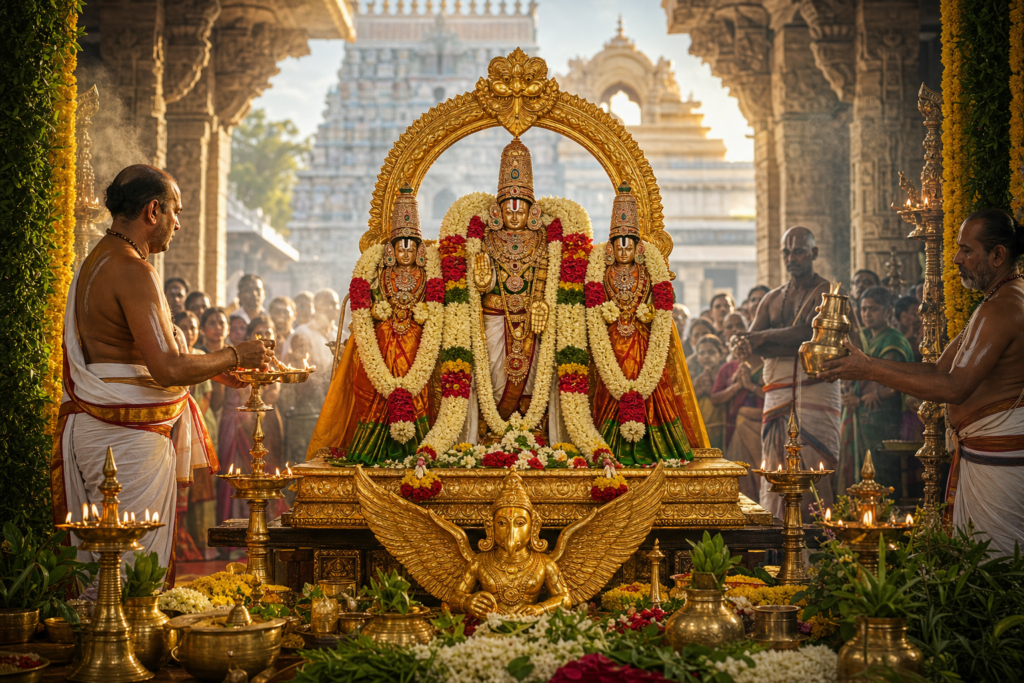
Across the broader Indian lunisolar framework, Chaitra Navratri and Sri Rama Navami occur within the lunar month of Chaitra, which overlaps the solar Choitro window. In Bengal, some families mark Basanti Durga Puja during this span, culminating with Ram Navami. In 2026, exact festival dates vary by panjika, locality, and sunrise-based tithi transitions; consultation of a trusted local panjika remains prudent for muhurta selection.
Further observances that frequently fall within the Choitro interval include Sheetala Puja, Annapurna Puja, and Hanuman Jayanti (often on Chaitra Purnima in several traditions). Though public intensity differs regionally, these vratas share a focus on cleanliness, nourishment, courage, and sevavirtues that harmonize with Choitro’s ethos of preparation and care.
The unity of dharmic traditions is especially evident at mid-April. Vaisakhi in the Sikh tradition coincides with Mesha Sankranti; Ugadi and Gudi Padwa mark the new year in parts of the Deccan; Vishu and Puthandu greet the solar year in Kerala and Tamil Nadu. These distinct names and practices reflect a shared civilizational rhythm that honors the Sun’s movement, ethical renewal, and inter-community goodwill across Hindu, Buddhist, Jain, and Sikh communities.
Technical calendrical notes for 2026 help explain why dates can differ across sources. Solar observances (Choitro Sankranti, Poila Baisakh) follow Surya’s sidereal ingress and are often observed on the civil date that contains the ingress in the relevant locality. Lunar observances (Navratri, Ram Navami, Hanuman Jayanti, Sheetala, Annapurna) are governed by tithi and nakshatra, with sunrise gating and local longitude–latitude affecting the civil date. Differences between Bisuddha Siddhanta Panjika, Drik computations, and the Bangladesh civil calendar can therefore yield one-day variations.
Key dates for planning in 2026 are straightforward. Choitro (Chaitra) spans 16 March to 14 April in the Bengali calendar used in West Bengal; Choitro Sankranti and Charak Puja fall on 14 April for most communities following this reckoning; Poila Baisakh ushers in Bangabda 1433 on 14 April. Aligning household rituals, travel, and community contributions within this window ensures both devotional integrity and logistical ease.
The deeper significance of Choitro rests in its disciplined cadence: resolve, restitution, purification, and gratitude before celebratory renewal. Families that approach the month with clarityclosing the year’s accounts, supporting Gajan-charity drives, completing vrata with careenter Poila Baisakh with lightness and purpose. That measured passage from austerity to abundance is a shared inheritance of the subcontinent’s dharmic heritage.
Summary at a glance for SEO-friendly reference: Choitro Month 2026 in the Bengali Calendar (Bangabda 1432) runs from 16 March to 14 April; Choitro Sankranti and Charak Puja fall on 14 April 2026; Poila Baisakh (Bangabda 1433 begins) is on 14 April 2026. Queries such as Choitro Month 2026 dates, Chaitra month 2026 in Bengali calendar, Charak Puja 2026 date, Gajan 2026, Choitro Sankranti 2026, and Poila Baisakh 2026 are addressed within this guide.
Inspired by this post on Hindu Pad.