
Chaitra Navratri (also known as Chait Navratras or Vasant Navratri) is the nine-night spring observance that begins with the first lunar day (Shukla Pratipada) of the Chaitra month in the Hindu lunisolar Panchang and culminates on the ninth lunar day (Navami) with Sri Rama Navami. For 2026, Chaitra Navratri falls from March 19 to March 27 (IST). These dates mark a cyclic return to renewal and discipline, aligning ritual practice with seasonal change and the inner cultivation of clarity, compassion, and courage.
Recognized across regions as Vasant Navratri, the festival foregrounds worship of the Divine Feminine (Devi/Shakti) through the nine manifestations of Durga (Nava Durga) while concluding with the celebration of Sri Rama Navami, symbolically uniting Shakti devotion and Rama-bhakti. Families, communities, and temples often experience these days as a period of intensified sadhanafasting (upavasa), mantra-japa, homa, collective kirtan, seva, and scriptural recitation, all framed within a sattvic lifestyle. Although the festival is a specifically Hindu observance, its core disciplinesself-restraint, mindfulness, generosity, and serviceresonate across the dharmic traditions of Hinduism, Buddhism, Jainism, and Sikhism, strengthening bonds of mutual respect and shared ethical practice.
The 2026 observance follows the Vikram Samvat lunisolar reckoning, in which a tithi (lunar day) can begin or end at any point in the solar day. For practical purposes, the nine observance days in 2026 are: March 19 (Shukla Pratipada) through March 27 (Navami/Rama Navami), subject to local Panchang calculations. As tithis vary by location, diaspora communities outside India should confirm dates and muhurta windows using authoritative local Panchang or Hindu temple calendars.
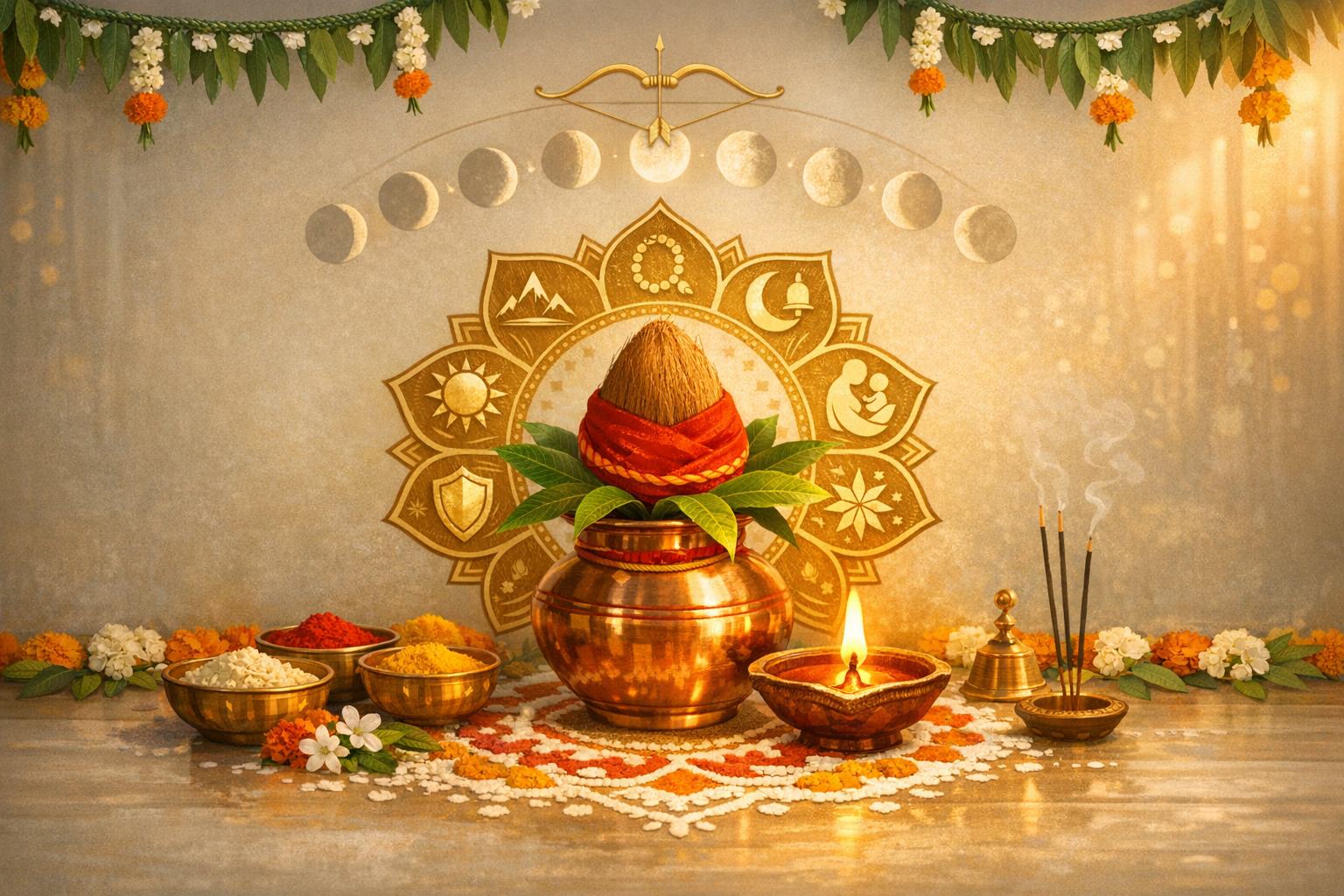
The opening rite, Ghatasthapana (Kalasha Sthapana), is traditionally performed after sunrise and within the first one-third of the day when Shukla Pratipada is in effect. Many authorities advise avoiding Ghatasthapana during Vaidhriti and Vyatipata yogas and recommend choosing a shubha lagna/muhurta when available. If Pratipada does not prevail at sunrise, the rite may be performed on Dwitiya before midday. The Kalasha (copper or earthen pot), mango leaves, a coconut wrapped in red cloth, and an Akhand Jyoti are installed to symbolize auspiciousness and the abiding presence of Shakti throughout the Navratri.
Each day of Chaitra Navratri honors a distinct form of the Goddess, mapping an inner journey from grounded resolve to serene fulfillment. Day 1 (March 19) venerates Shailaputri, emblematic of steadfastness and right intention. Day 2 (March 20) honors Brahmacharini, associated with disciplined tapas and luminous austerity. Day 3 (March 21) is dedicated to Chandraghanta, invoking courage and composure amid life’s challenges. Day 4 (March 22) celebrates Kushmanda, whose creative radiance nourishes vitality. Day 5 (March 23) venerates Skandamata, embodying nurturing protection and wisdom. Day 6 (March 24) focuses on Katyayani, who represents righteous strength aligned with dharma. Day 7 (March 25) honors Kalaratri, the fearless remover of darkness and ignorance. Day 8 (March 26), Durga Ashtami in Chaitra Navratri, venerates Mahagauri, associated with purification and grace. Day 9 (March 27), Mahanavami/Rama Navami, celebrates Siddhidatri and Sri Rama, culminating the observance in virtue and clarity.
Durga Ashtami (March 26, 2026, IST) is a focal point within Chaitra Navratri. According to regional sampradayas, Kumari Puja may be performed to honor the innate divinity in the feminine; many families also conduct Sandhi Puja at the juncture of Ashtami and Navamitraditionally observed around the transitional muhurta at the end of Ashtami and the beginning of Navamiseeking Devi’s blessings for decisiveness tempered by compassion. While local customs differ, a shared emphasis rests on humility, generosity (dana), and community service (seva) during this period.
Sri Rama Navami (March 27, 2026, IST) marks the birth of Sri Rama, “Maryada Purushottama,” the exemplar of righteousness and governance tempered by compassion. The day frequently includes recitation of the Ramayana, Sri Rama kirtan, and Rama Taraka mantra-japa alongside Devi worship. This convergence of Shakti and Rama-bhakti reinforces a central insight of the dharmic traditions: inner strength (Shakti) and ethical clarity (dharma) are mutually sustaining in the pursuit of a just and harmonious society.
Core Chaitra Navratri sadhanas include daily Devi archana, lighting of the Akhand Jyoti, and parayana of the Devi Mahatmya (Markandeya Purana), Lalita Sahasranama, or the Navarna Mantra (“Om Aim Hreem Kleem Chamundayai Viche”). Where possible, households and temples align homa offerings with the day’s Devi aspect, such as invoking Shailaputri for grounded beginnings or Kalaratri for dispelling obstacles. A sattvic vrataoften excluding grains (anna) during daytime for some practitioners, with fruit, milk, and simple preparationssupports mental clarity. Those with medical conditions should adopt moderated fasts in consultation with health professionals, preserving the spirit of ahimsa toward one’s own body.
While Navratri ritual structures are primarily Hindu, the season’s ethical disciplines connect meaningfully across dharmic paths. In Jain communities, the Chaitra period frequently overlaps with the Navpad/Ayambil Oli, a disciplined dietary and meditative observance centered on equanimity and self-restraint. Sikh heritage preserves reverence for divine courage and virtue, with traditions such as scriptural reflection on shaurya (valor) and seva echoing Navratri’s call for inner strength and social responsibility. Buddhist practice in spring often emphasizes mindfulness and metta (loving-kindness), resonating with Navratri’s ethos of compassion, clarity, and non-harm. These convergenceswhile doctrinally distinctunderscore shared dharmic values and a culture of mutual respect.
Regional expressions add richly to Chaitra Navratri 2026. In Maharashtra and among some North Indian communities, Shukla Pratipada closely aligns with Gudi Padwa, the regional new year, while many in the Deccan observe Ugadi around this time. In Bengal and nearby regions, Basanti Puja integrates Devi worship with the spring mood; in North India, temple fairs and community kirtan enliven the evenings; in Ayodhya and other Rama-ksetras, Sri Rama Navami attracts large congregations focused on maryada, seva, and harmony. These practices, though diverse, are united by the pursuit of inner transformation and collective well-being.
Chaitra Navratri 2026 also invites mindful, eco-conscious practice. Households increasingly adopt biodegradable decorations, natural rangoli colors, and sustainable oil for lamps; prasad and naivedya preparations emphasize seasonal, local, and plant-based ingredients; and devotional music, meditation, and scripture study replace noise-intensive activities. Such choices align spiritual intention with environmental responsibility, reflecting the dharmic ideal of reverence for Mother Earth (Bhumi Devi).
From a calendrical perspective, Navratri’s nine nights unfold according to tithi progression rather than fixed civil days. A tithi may begin or end between sunrises, which is why authoritative Panchang consultation is essential for muhurta-sensitive rites like Ghatasthapana, Sandhi Puja, and Kanya Puja. While the overarching festival dates for 2026 (March 19–27, IST) are clear, specific timings for one’s city can differ by several hours; planning with a trusted temple or Panchang source ensures fidelity to tradition and enhances the spiritual focus of sadhana.
In summary, Chaitra Navratri 2026 spans March 19 (Shukla Pratipada, Ghatasthapana) to March 27 (Navami, Sri Rama Navami) in India. Within this window, Durga Ashtami falls on March 26, and Sandhi Puja traditionally bridges late Ashtami and early Navami. Observers may structure daily worship around the Nava Durga sequence, integrate Devi Mahatmya or Lalita Sahasranama parayana, maintain a considerate vrata adapted to health needs, and amplify the festival’s spirit through seva and inter-community goodwill. The union of Devi worship and Rama-bhakti at festival’s end offers a compelling paradigm: strength guided by ethics, devotion informed by wisdom, and personal transformation expressed through compassionate action.
Ultimately, Chaitra Navratri 2026 offers an integrated pathritual, reflection, restraint, and serviceset within the living tapestry of India’s dharmic heritage. By honoring Shakti in her nine aspects and celebrating Sri Rama’s birth, communities reaffirm a shared commitment to truth (satya), non-harm (ahimsa), and societal harmony. In this way, the spring observance becomes not only a festival of nine nights, but also a sustained cultivation of virtues that outlast the season and uplift collective life.
Inspired by this post on Hindu Pad.








