
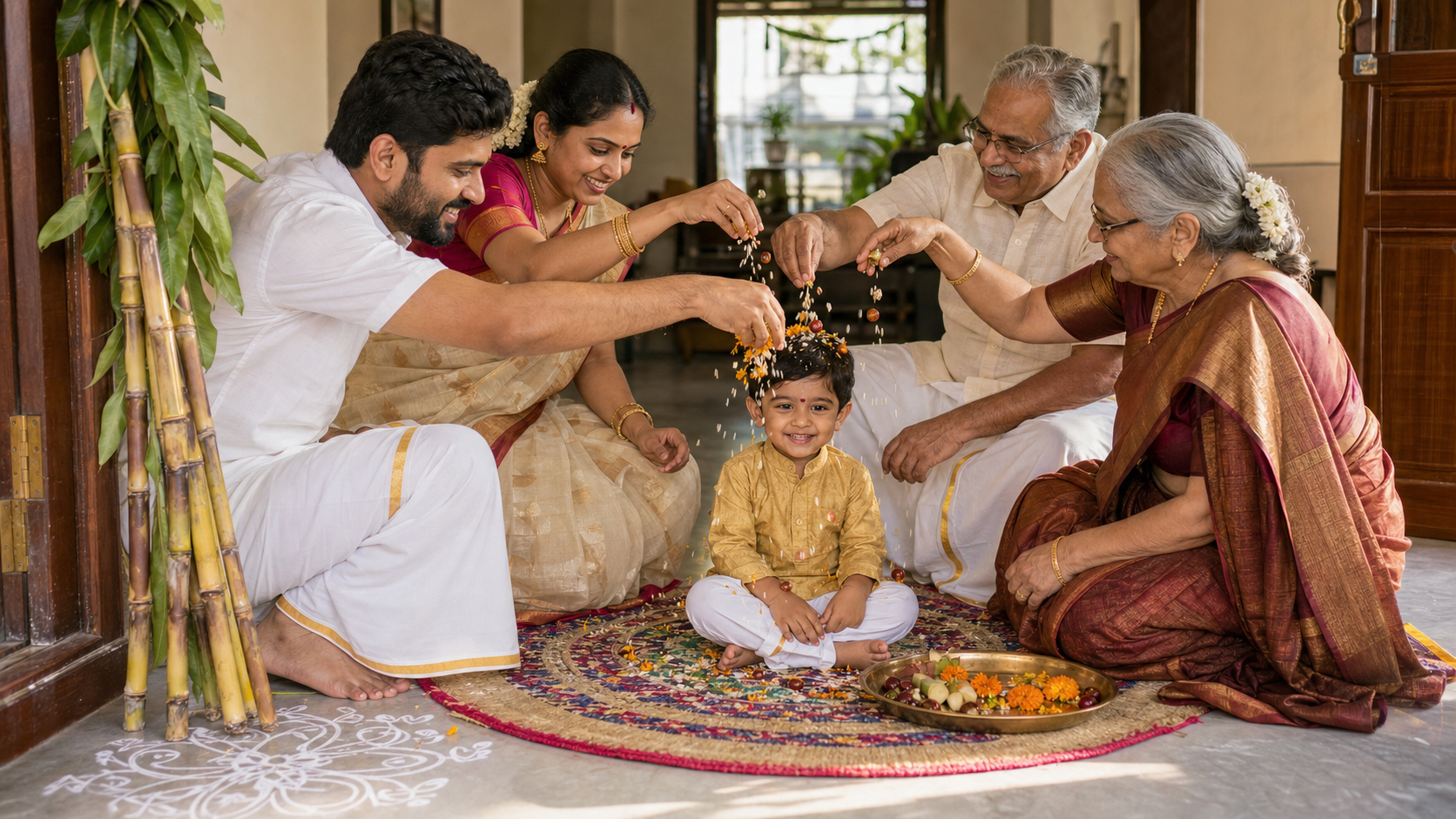
You may remember Bhogi Pallu from childhood yet feel uncertain about performing it without a grandparent beside you. Which ingredients matter? Must you light a bonfire? What should you say while blessing the children? And how much can you adapt when you live outside Andhra Pradesh or Telangana?
You do not need an elaborate ceremony. Preserve its clear center: the family welcomes the harvest season by surrounding its children with affection, auspicious foods and spoken blessings. Once that purpose is secure, many household details can remain flexible.
The core meaning: harvest gratitude becomes a child’s blessing
Bhogi Pallu, also called Bhogi Pandlu or Bhoda Pandlu, is observed on Bhogi, the first day of the Makar Sankranti or Pongal season. In Telugu households across Andhra Pradesh and Telangana, elders gently shower children with a mixture of seasonal foods after performing aarti. The act invokes health, prosperity and longevity while symbolically turning away drishti, or the evil eye.
The ceremony is not simply a collection of objects dropped over a child’s head. Its meaning comes from a relationship: elders offer protection and goodwill, children receive the first abundance of the season, and the household acknowledges that human flourishing depends on prakriti, the living natural order. The new harvest enters the home not merely as produce, but as something to be received with gratitude and shared.
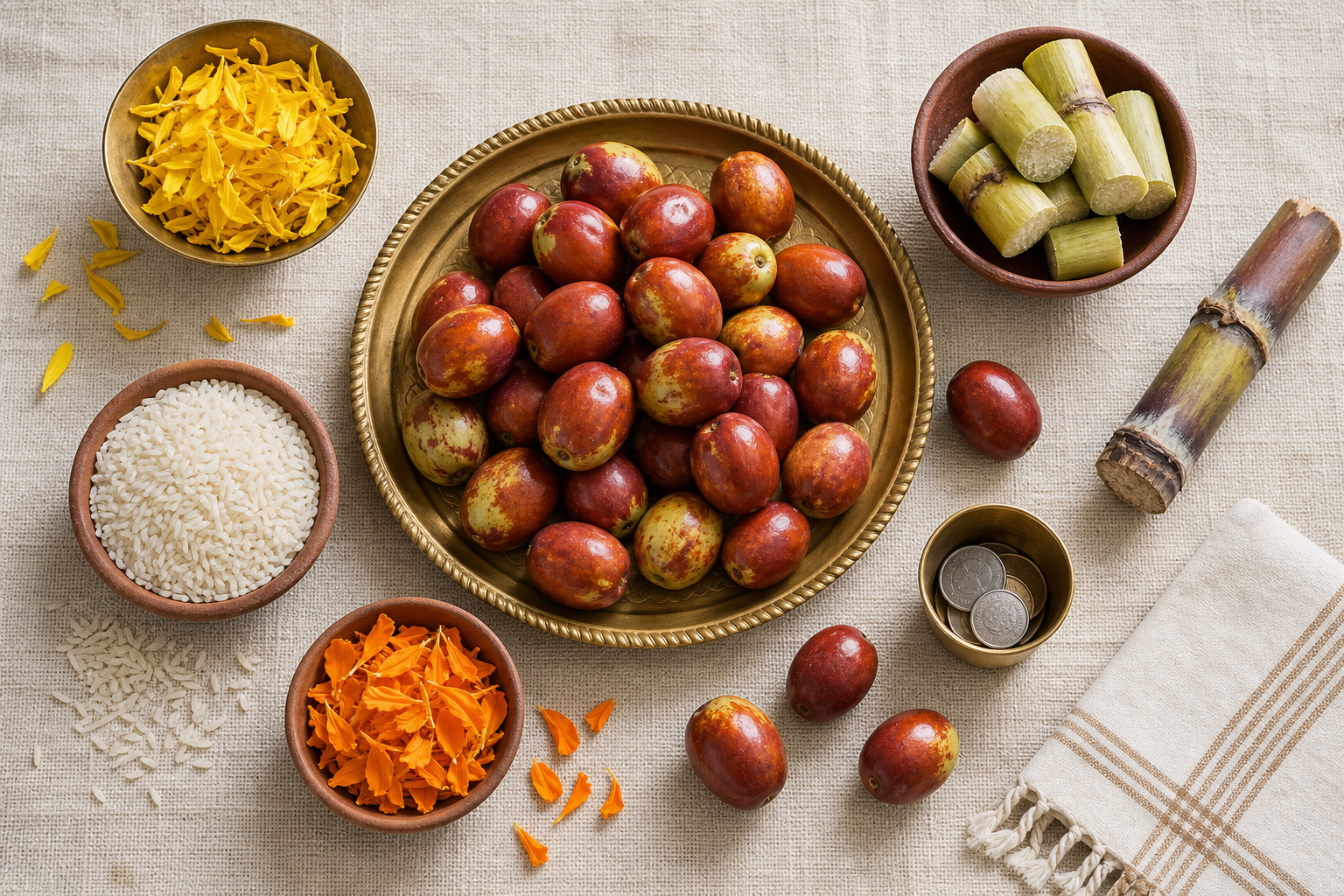
The traditional mixture makes that meaning visible. Gooseberry, or amla, represents vitality and resilience. Sugarcane stands for sweetness in speech and relationships. Rice or akshata signifies abundance and continuity. Other locally harvested foods may join them, but these ingredients give you a sound starting point when no written family recipe survives.
This is also why the ritual is especially suited to children. A young child may not understand an explanation of agrarian gratitude, family duty or seasonal renewal. The child can still feel the aarti’s warmth, hear familiar voices offering blessings and experience the harvest through colour, fragrance, texture and taste. Dharma is transmitted here through participation before it is transmitted through argument.
How to perform Bhogi Pallu at home
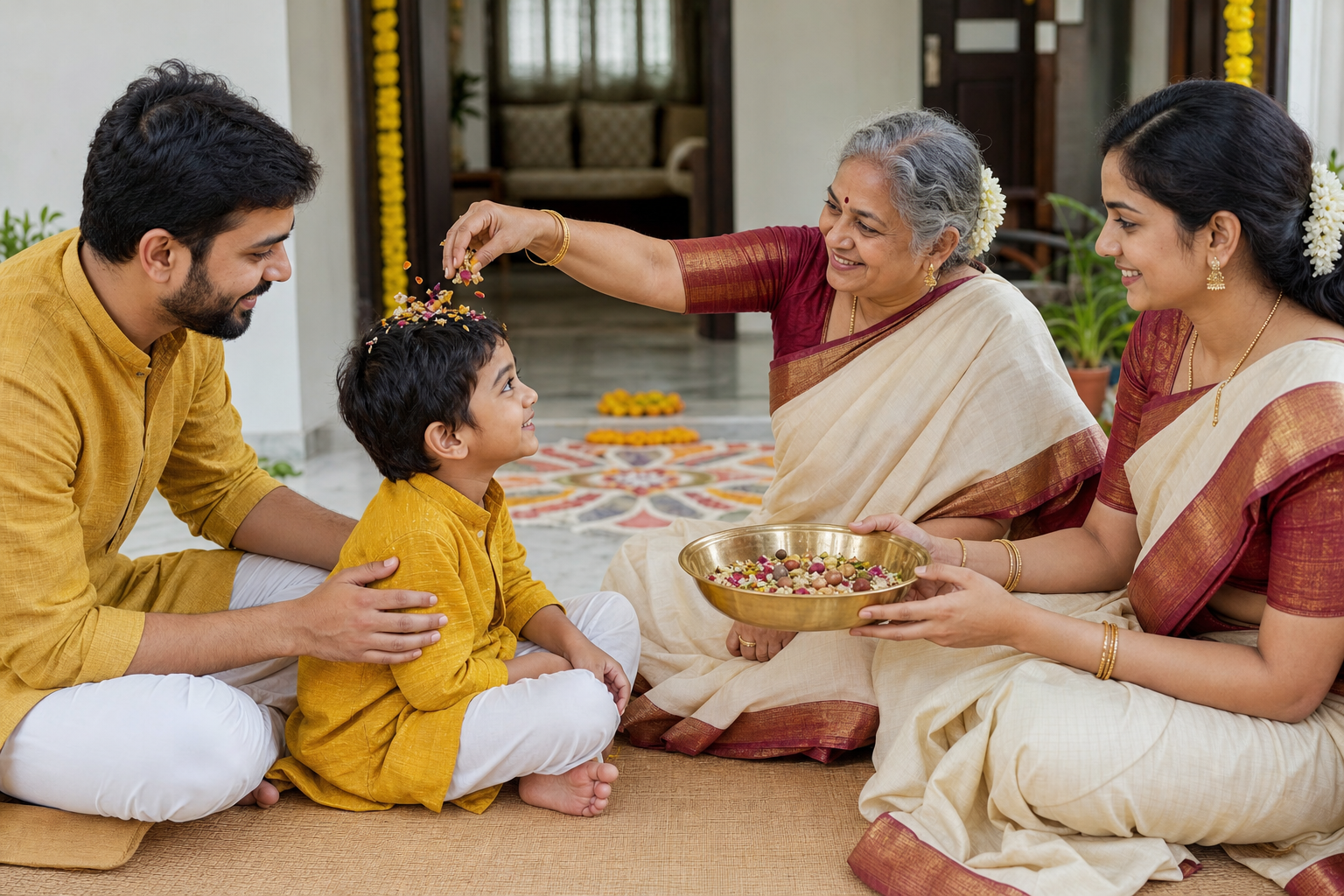
Household customs differ, so treat the following as a practical sequence rather than a claim that every Telugu family follows one fixed procedure. If an elder in your family remembers a particular order, song or blessing, preserve that inheritance wherever it can be followed safely.
- Prepare the place. Clean the area and draw a muggu or kolam if that belongs to your household practice. Choose a spot where the children can sit or stand comfortably and where the mixture can be gathered without creating a slipping hazard.
- Assemble the mixture. Place fresh amla, small pieces of sugarcane and rice or akshata in a clean, wide bowl. Flowers or puffed rice may be added if they belong to your regional or family custom. You do not need every known variation.
- Set aside prasad before the shower. If you intend to distribute the same foods afterward, keep a clean portion in a separate vessel rather than serving anything that has fallen on the floor.
- Prepare the children. New clothes are customary when practical. Explain what will happen before beginning, especially to a toddler who may be startled by objects falling over the head.
- Invite the elders to lead. Grandparents traditionally give the occasion its intergenerational character, while parents and other relatives participate. When grandparents are absent, parents or another respected family elder can carry the responsibility.
- Perform aarti. Bring the light before each child calmly, maintaining a safe distance from clothing, hair and loose decorations.
- Offer the Bhogi Pallu. Let small amounts of the mixture fall gently over the crown rather than throwing it from a height. Speak the child’s name and offer blessings for health, long life, good character, harmonious relationships and prosperity.
- Close through sharing. Distribute the reserved prasad and, where customary, visit or invite neighbours. The movement from private blessing to shared food turns a household observance into a community celebration.
Bhogi Pallu is commonly performed after Bhogi Mantalu, the seasonal bonfire associated with Bhogi. If your family does not hold a bonfire, that absence need not prevent the children’s blessing. The bonfire and Bhogi Pallu belong to the same festive setting, but the child’s ceremony can be conducted safely at home, in an apartment courtyard or in a community hall.
You also do not need to invent a Sanskrit mantra if your family has not handed one down. Bless the child in the language the child and elders understand. A simple form could be: “May you grow with health, strength, kindness and long life. May your words be sweet, your relationships harmonious and your life abundant.” Present it as your family’s spoken blessing, not as an ancient prescribed mantra.
Keep family variations without turning them into rules
Regional diversity is normal. Some households include flowers, coins or puffed rice. Some concentrate entirely on infants and young children, while others extend blessings to older children or newly married couples. Urban and diaspora families may gather in shared courtyards or halls instead of ancestral homes. These differences do not require you to assemble every possible element into one supposedly complete ceremony.
When two relatives remember the practice differently, ask which details came from their own household and which were seen elsewhere. That question usually produces a more useful answer than debating which version is universally correct. Telugu tradition is carried through families and regions; responsible continuity does not require artificial uniformity.
Use four questions to judge an adaptation:
- Does the child remain the recipient of a blessing rather than a prop for photographs?
- Does the mixture still express gratitude for food, harvest and seasonal abundance?
- Are elders and younger family members participating in a way that transmits memory?
- Can you explain why each added item is present, or are you adding it only because another family does?
If the first three answers are yes, a change of venue or a missing optional ingredient has not erased the ritual’s heart. If the fourth answer is no, simplify. A small bowl with meaningful ingredients is better than a crowded mixture no one can explain.
The same distinction helps families in the diaspora. Use traditional ingredients when they are fresh and reasonably available. When a customary item cannot be obtained, do not replace it with decorative plastic merely to reproduce a familiar appearance. Retain the blessing, the aarti, the harvest connection and the participation of elders; explain the unavailable item to the children so that adaptation becomes part of cultural learning rather than silent loss.
Bhogi Pallu also sits within a wider dharmic pattern. Seasonal celebrations connect gratitude for the land with care for the next generation. Sikh observances such as Lohri likewise bring families and children together around the harvest and a bonfire. The ceremonies are not interchangeable, but their family and agrarian orientation shows how distinct traditions can express related duties of gratitude, sharing and continuity.
Make a child-centred ritual safe and comfortable
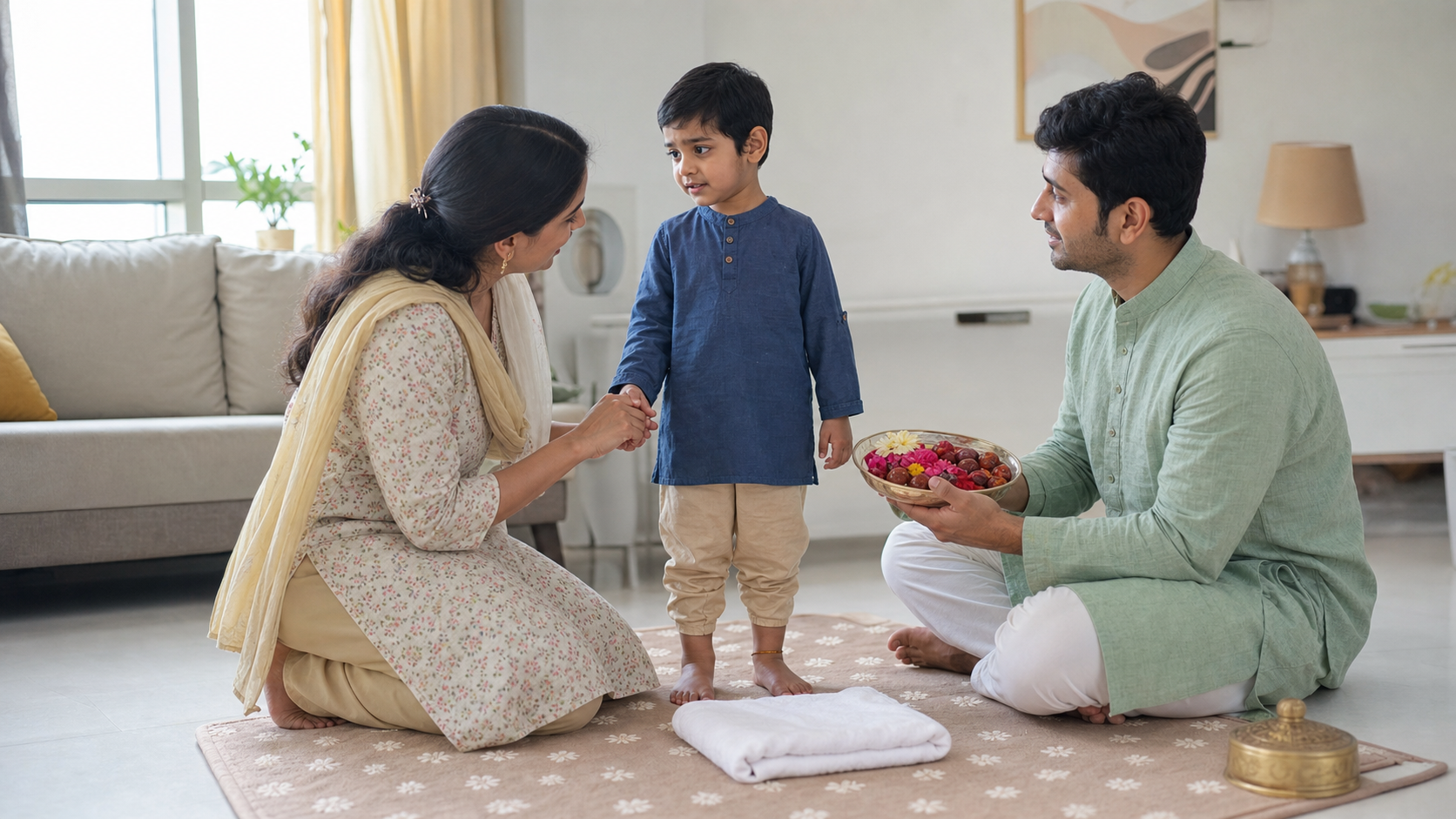
A ceremony intended to protect and bless a child should feel gentle in practice. A large public gathering, unfamiliar sensory experience or hard ingredients dropped from a height can frighten a small child. Adjust the scale to the recipient rather than forcing the child to endure the ritual for the sake of appearances.
- Wash and inspect edible ingredients before use. Remove spoiled pieces, grit and anything sharp.
- Cut sugarcane into manageable pieces, but do not use hard chunks in the portion showered over a small child. Let the mixture fall from close above the crown, away from the eyes and face.
- Seat an infant or unsteady toddler with a supporting adult. Use only a small, light quantity and stop if the child becomes distressed.
- Coins are an optional variation, not a requirement. Because coins and loose food pieces can be choking hazards, omit them from an infant’s or toddler’s shower or keep them completely beyond the child’s reach.
- Reserve clean prasad separately. Do not ask children to eat ingredients collected from the floor after the ceremony.
- Avoid synthetic confetti, glitter and unidentified powders. Fresh foods, flowers and other biodegradable materials better fit a harvest observance and are easier to clean responsibly.
- Keep the Bhogi Pallu area separate from the bonfire. Closely supervise children around Bhogi Mantalu and keep aarti flames away from hair, garments and decorations.
If a child dislikes having anything placed over the head, adapt the physical action without withdrawing the blessing. An elder can hold the bowl above the child briefly, place a few grains or petals on the crown, or offer the mixture into the child’s hands. The protective intention matters more than staging a dramatic shower.
Key takeaways for your Bhogi plan
- When: Observe Bhogi Pallu on Bhogi, the opening day of the Makar Sankranti or Pongal season.
- For whom: Children are the central recipients, with grandparents, parents and other elders offering aarti and blessings.
- What to prepare: Begin with amla, small sugarcane pieces and rice or akshata. Add flowers, puffed rice or another household variation only when it carries meaning for your family.
- What to preserve: Keep the connection among the new harvest, gratitude to nature, intergenerational care and hopes for the child’s well-being.
- What can change: The venue, size of the gathering, exact mixture and language of the blessing may be adapted to family circumstances.
- What not to compromise: Use clean materials, keep hard objects away from the face, treat coins as choking hazards around small children and maintain strict fire supervision.
Before the next Bhogi, write your household version on one page. Ask the oldest available relative which ingredients, words or songs belong specifically to your family. Then assign who will prepare the mixture, perform aarti, support the youngest child and reserve the prasad. That small act of preparation allows the celebration to feel inherited rather than improvised.
When the child eventually asks why amla, sugarcane and rice were placed overhead, answer plainly: strength for the body, sweetness in relationships and abundance shared with others. A tradition remains alive when the next generation can carry both its action and its meaning.
References
