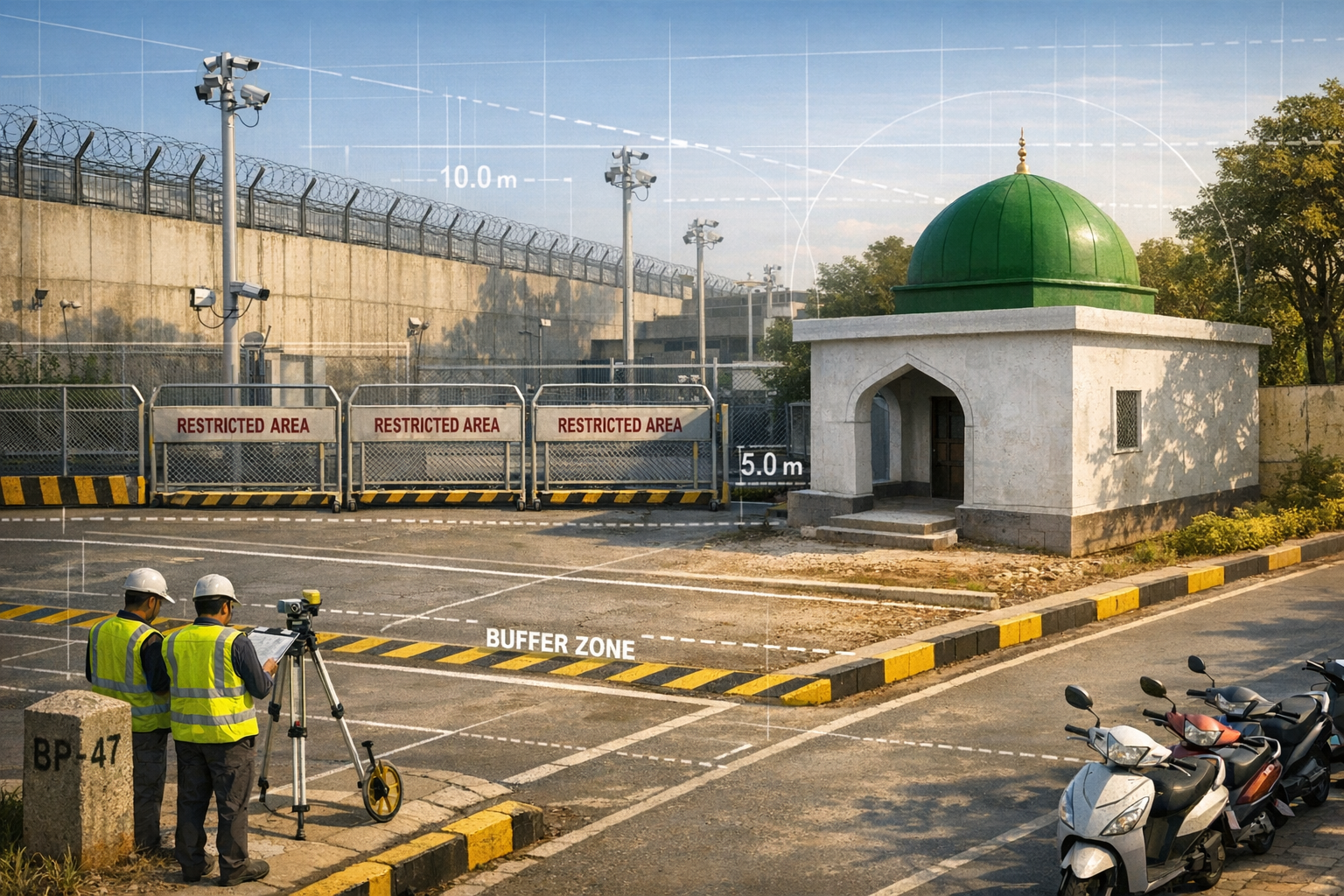
An unauthorized religious structure, locally identified as a mosque, has reportedly been constructed on government land adjoining the highly sensitive Anti-Terrorism Squad (ATS) facility within the Pune Police Lines precinct. The proximity to a counterterrorism hub elevates the matter from a routine land-encroachment dispute to a high-stakes public safety question, prompting calls for an immediate, law-based and community-sensitive response.
Framed correctly, this is an issue of legality, urban planning, and critical infrastructure protectionnot of faith or identity. India’s constitutional promise under Article 25 guarantees freedom of religion while expressly balancing it with public order, health, and morality. The same constitutional spirit underpins interfaith harmony and the unity of dharmic traditionsHinduism, Buddhism, Jainism, and Sikhismalongside other faiths, by insisting that public safety and the rule of law are non-negotiable common goods.
The Pune Police Lines is not an ordinary neighborhood. It concentrates policing assets, sensitive communication nodes, and personnel movement patterns. The adjacent Maharashtra ATS office represents a higher-value target set in security parlance, warranting layered access control, clear standoff zones, and unobstructed lines of sight. Any new congregation pointregardless of religious affiliationcan complicate risk management by increasing footfall, altering traffic flows, creating visual obstructions, and potentially offering cover for surveillance or opportunistic exploitation by adversaries.
Under India’s legal framework, construction on government land requires explicit sanction and, where relevant, no-objection certificates (NOCs) from competent authorities. Multiple regulatory instruments intersect here: state land administration norms governing encroachment, municipal development control regulations for building permissions and land-use conformity, and security advisories applicable to critical facilities. In Maharashtra, unified development control regimes and municipal bye-laws mandate prior approvals before any religious or community structure is erected or regularized.
Jurisprudence and executive guidance provide additional clarity. Pursuant to directions of the Supreme Court in 2009 and subsequent Union and state government advisories, states are obligated to prevent unauthorized religious structures on public land and to prepare time-bound policies for removal, relocation, or regularization under defined conditions. These directions, applied consistently across all religions, aim to reduce public hazards, decongest civic spaces, and preserve essential security perimeters around key assets.
Security risk analysis near an ATS facility follows a simple but robust principle: even benign, unauthorized changes in the built environment can degrade protective posture. A structure that draws regular gatherings can, unintentionally, create blind spots, strain perimeter control, and complicate emergency response protocols. The goal, therefore, is not to impugn intent but to restore a predictable, controllable operating environment around critical infrastructurean objective aligned with both public safety and civil liberties.
Crime Prevention Through Environmental Design (CPTED) offers practical guidance in such settings. Natural surveillance, controlled access, territorial reinforcement, and clear maintenance baselines reduce vulnerabilities. Around counterterrorism hubs, this translates into uncluttered buffer zones, sightline integrity, regulated entry and exit flows, and minimal unvetted congregation at the perimeter. Any deviationsuch as ad hoc construction or mixed-use spillovershould trigger a structured review.
Operationally, authorities consider standoff distance, choke-point risk, and routine-versus-peak crowd patterns. Even without assuming malice, a steady congregation near the ATS office can enable mapping of daily rhythms, personnel routines, or vehicular movements. The presence of parked two-wheelers and four-wheelers, temporary canopies, or vendor spillover further complicates quick-react contingencies. Restoring compliance and spatial clarity is a technical necessity, not a value judgment on worship.
Stakeholders in Pune’s context include local worshippers and residents, the Pune Municipal Corporation, the Pune district administration, Maharashtra Police, the Maharashtra ATS, and landholding departments of the state. Each has distinct responsibilities: verifying land title and status, assessing code compliance, balancing religious rights with security imperatives, and communicating decisions transparently.
A proportionate, rights-respecting roadmap can resolve the situation constructively. First, initiate a fact-based site survey and cadastral verification to confirm land ownership, sanction status, and the construction timeline. Second, convene a joint assessment by land administration, municipal planning, and security agencies to classify risks and determine compliance gaps. Third, communicate findings publicly in clear, non-inflammatory terms to preempt rumor or polarization. Fourth, if unauthorized status is confirmed, pursue one of three pathways in line with Supreme Court-guided policy: safe relocation to an approved site, regularization only if legally and operationally permissible (including mandatory security clearances), or removal with due process and humane safeguards.
Community engagement is central to sustaining harmony. Many Pune residents express a dual sentiment common across Indian cities: respect for prayer and a desire for safety. Officials can honor both by facilitating interim arrangements at a lawfully designated sitesuch as an already approved community hall or religious premisewhile the final decision is implemented. In parallel, interfaith dialogue platforms can reinforce a simple message: unauthorized religious constructiontemple, mosque, gurudwara, or monasterynear critical infrastructure is a systemic risk, not a sectarian issue.
Communication matters as much as enforcement. Clear timelines, multilingual notices, open houses with resident welfare associations, and a single-window helpdesk for queries reduce anxiety and rumor. Publicly sharing non-sensitive parts of the security rationalesuch as access-control norms and the importance of buffer zoneshelps communities understand why such perimeters are universally applied.
From a governance perspective, monitoring and compliance mechanisms should be strengthened. A geo-referenced inventory of public lands surrounding critical facilities, periodic perimeter audits, and early-warning triggers for unauthorized activity can prevent recurrence. Where surveillance is used, privacy-by-design guardrails and data minimization norms protect civil liberties while enabling proportionate risk control.
It helps to recall relatable, everyday experiences. Anyone who has navigated a crowded chowk beside a police campus knows the unease that arises when emergency vehicles must squeeze through or when lines of sight close unexpectedly. That lived reality builds empathy on all sides: worshippers seek dignity and continuity; residents want order and safety; frontline personnel need clear space to do difficult jobs without delay. Lawful planning is how those needs meet in the middle.
At the policy level, Maharashtra can treat this as a template for statewide resilience: codify standoff and access norms around police lines and ATS units; create a fast-track, good-faith relocation program for any unauthorized religious structure proximate to critical infrastructure; and publish an annual perimeter-security audit. Such steps both depoliticize enforcement and reassure citizens that safeguards apply across the board.
In conclusion, the reported unauthorized mosque near the Pune ATS office crystallizes a broader principle: public safety and religious freedom reinforce each other when institutions uphold the rule of law with fairness and empathy. A measured responsegrounded in Supreme Court directions, municipal regulations, and critical infrastructure protection standardscan restore compliance, protect the ATS mission, and preserve the social trust that undergirds interfaith harmony in Pune and beyond.
Inspired by this post on Hindu Jagruti Samiti.