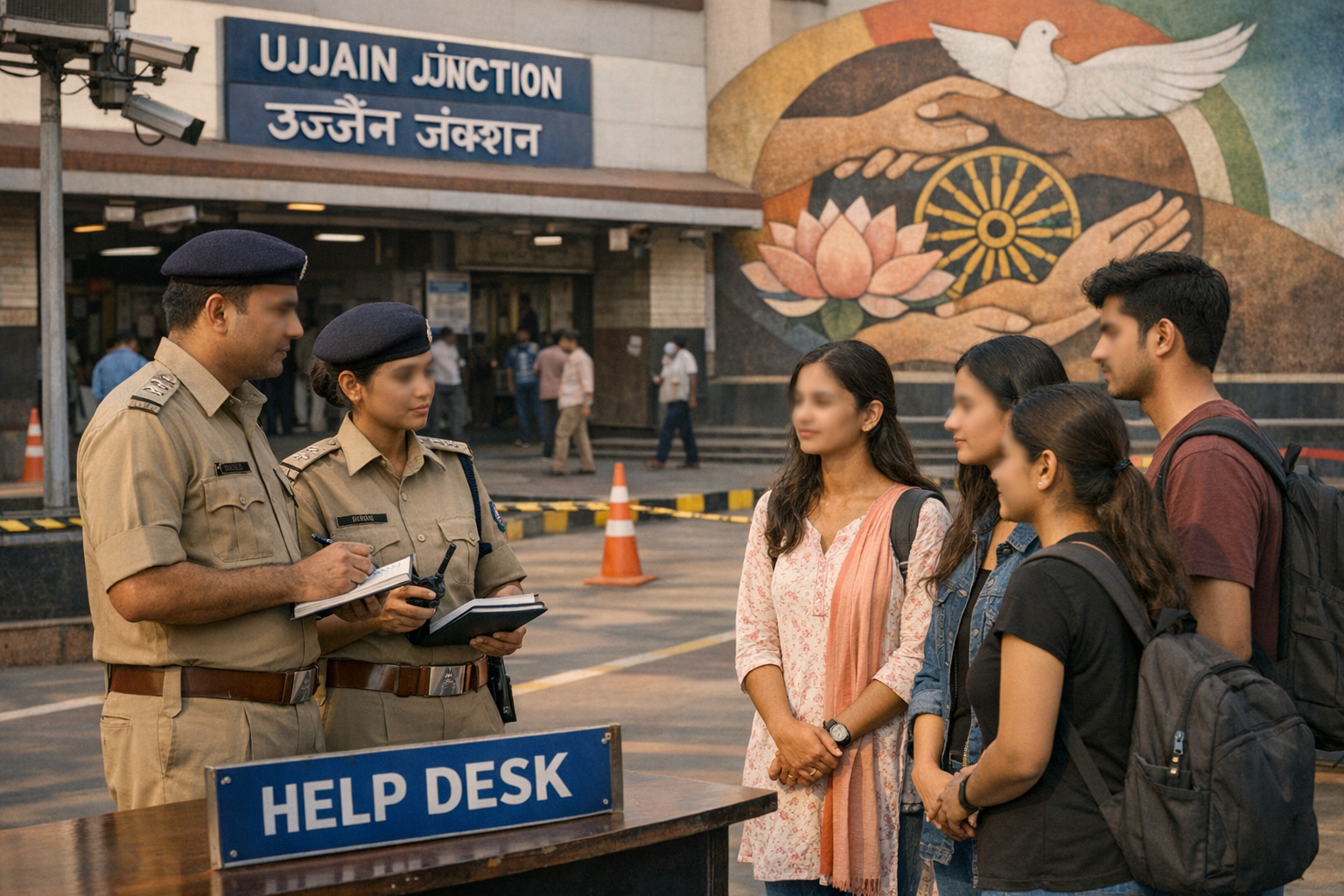
Reports from Ujjain indicate that outside the city’s railway station, a Muslim student was allegedly assaulted by a group of self-identified Hindutva activists while he was in the company of three female students. Invoking a ‘Love Jihad’ angle, the group confronted the students; local police subsequently detained four students for inquiry. While facts continue to emerge, the episode underscores urgent concerns about campus safety, public order, and the imperative of due process in Madhya Pradesh.
‘Love Jihad’ is not recognized as a legal category under Indian criminal law; it is a politicized narrative used by various actors to allege deceitful interfaith relationships aimed at religious conversion. Courts and law-enforcement agencies rely instead on codified statuteschiefly the Indian Penal Code (IPC) and state-level freedom-of-religion lawsto evaluate specific conduct. Framing a public confrontation around such claims risks fueling communal polarization and distracting from the evidentiary standards that must guide investigations.
Incidents of moral policing in public transit nodesrailway stations, bus terminals, and marketsare particularly volatile because crowds assemble quickly, rumors travel fast, and bystander dynamics can escalate ordinary disagreements into communal flashpoints. Ujjain’s railway station is a high-footfall hub in a pilgrimage city, which makes swift, impartial policing essential to prevent harassment, assault, and communal violence.
From a legal perspective, assault and mob intimidation in a public place can attract a range of IPC provisions depending on the evidence, such as unlawful assembly and rioting (Sections 141–149), wrongful restraint (Section 341), voluntarily causing hurt (Section 323), and criminal intimidation (Section 506). Where women are targeted or threatened, additional provisions may apply subject to facts. The criminal justice framework is unequivocal: grievances must be addressed through lawful complaint mechanisms, not vigilante action.
Madhya Pradesh’s Freedom of Religion Act, 2021, regulates conversion by misrepresentation, coercion, undue influence, or allurement, and prescribes procedures for declaration and inquiry. However, the statute does not authorize private groups to detain, interrogate, or assault adults in consensual association. Even where a complaint alleges unlawful conversion, the investigation must be conducted by police following the Code of Criminal Procedure and judicial oversight. Rule of law, not street-level adjudication, safeguards everyone’s rights.
Because the site of the confrontation was a railway station, two agencies are typically relevant: the Government Railway Police (GRP), which handles IPC crimes and law and order on station premises under the state police, and the Railway Protection Force (RPF), which secures railway property and assists passenger safety. Effective coordination between GRP Ujjain and the RPFsupported by CCTV retrieval, crowd-control protocols, and victim-witness protectionis crucial for an evidence-led, time-bound inquiry.
Sociologically, episodes built around a ‘Love Jihad’ claim operate like moral panics: a charged allegation primes confirmation bias, group polarization, and rumor cascades. In such contexts, bystanders often misread the situation or defer to the loudest voices. De-escalation toolsclear police presence, public-address guidance, and bystander-intervention normshelp restore calm and protect students irrespective of religion.
Digital virality can compound harm. Short video clips of partial altercations, stripped of context and amplified on social media, can inflame Hindu-Muslim relations far beyond the locality. Responsible communicationtimely, factual police briefings; measured media coverage; and community-leader appeals for restraintreduces the risk of misinformation and retaliatory mobilization.
A dharmic lens offers a principled way forward. The values of ahimsa in Hinduism and Jainism, karuna in Buddhism, and sarbat da bhala in Sikhism converge on non-violence, compassion, and the welfare of all. Upholding these shared ideals requires condemning harassment and hate crimes, rejecting communal vigilantism, and centering the dignity and safety of women and men in all communities.
Preventive architecture can be strengthened without profiling or prejudice: routine joint GRP–RPF patrols at high-footfall stations; complaint desks that are accessible and gender-sensitive; campus–police liaison cells for student safety; and community dialogues that foreground communal harmony, interfaith dialogue, and religious tolerance. Training modules on crowd psychology and rumor control can further equip security forces to manage sensitive situations professionally.
In the Ujjain matter, key questions remain: What do CCTV and eyewitness accounts establish about the sequence of events? Were the alleged assailants identified and booked under appropriate IPC sections? Were the detained students afforded legal safeguards and support services? Transparent answers will build public trust and reinforce the principle that accountability attaches to unlawful conduct, not to identity.
Ultimately, incidents like this test collective commitment to constitutional morality and social cohesion. Protecting the rights of students, ensuring impartial law enforcement in Madhya Pradesh, and resisting incendiary narratives will strengthen communal harmony. When grievances arise, lawful remediesnot mob actionmust prevail, so that dharmic unity can flourish in practice, not merely in aspiration.
Inspired by this post on Struggle for Hindu Existence.