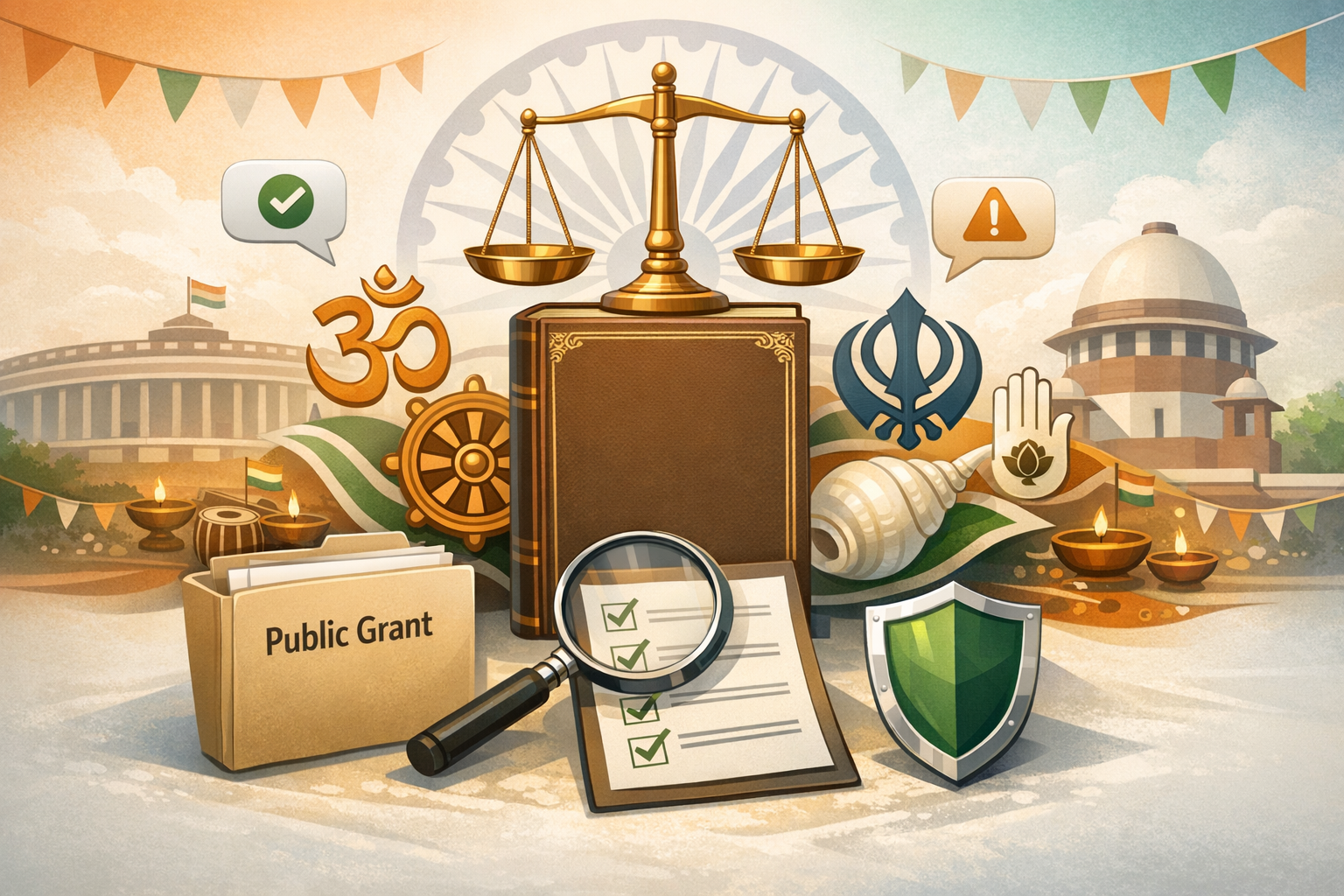
The Union Government’s grant of ₹63 lakh to the Sanatan Rashtra Shankhnad Mahotsav has drawn sharp criticism from opposition parties, including the Indian National Congress and several Left formations, which argue that such funding is unconstitutional and risks legitimizing hate speech. Sanatan Sanstha has publicly rejected these allegations and countered by highlighting past instances where governments, including those led by critics, have supported religiously inflected cultural events. Rather than amplify polemics, a constitutional and policy-grounded evaluation clarifies what the law permits, what administrative due diligence requires, and how cultural funding can be aligned with India’s ethos of pluralism and dharmic unity.
At its core, the controversy invokes three intersecting questions: whether central grants-in-aid to cultural festivals with religious elements are compatible with the Indian Constitution; how Indian hate speech jurisprudence applies to event programming and public funding; and what governance safeguards ensure transparency, neutrality, and accountability. Addressing these systematically helps move the conversation from accusation to standards-based assessment.
India’s secularism, long expressed as Sarva Dharma Sambhava, is embedded within fundamental rights and institutional practice rather than a strict wall of separation model. Articles 25 and 26 of the Indian Constitution protect freedom of conscience and the rights of religious denominations to manage their own affairs in matters of religion, subject to public order, morality, and health. In parallel, the state remains empowered to support culture, heritage, and public purpose activities, provided such support is non-arbitrary and nondiscriminatory.
Article 27 prohibits compelling any person to pay taxes for the promotion or maintenance of any particular religion. The Supreme Court, however, has clarified that the mere use of general revenues for activities with an incidental religious dimension does not, by itself, violate Article 27 when the overarching objective is secularfor instance, ensuring public order, facilitating heritage management, or supporting cultural tourism. In Prafull Goradia v. Union of India (2011), the Court read Article 27 narrowly, noting it applies to the imposition of a specific tax earmarked to promote a religion, not to general appropriations from the Consolidated Fund. Later, in Union of India v. Rafique Shaikh Bhikan (2012), the Court directed the phase-out of the Haj subsidy on policy and equity considerations, reinforcing that state support around religion is not categorically barred but must withstand tests of purpose, equity, and proportionality.
Equally relevant is Article 282, which allows the Union (and States) to make grants for any public purpose, even outside their legislative competence. Cultural policy instrumentsoften under the Ministry of Culture and schemes such as the Kala Sanskriti Vikas Yojanaroutinely extend grant-in-aid to festivals, institutions, and research bodies across India’s diverse traditions. The constitutional question thus narrows to whether a particular grant serves a bona fide public purpose (cultural preservation, scholarship, community engagement, tourism), is implemented through neutral and transparent criteria, and complies with equality norms under Article 14.
Administrative law principles and the General Financial Rules (GFR 2017) further anchor such grants. A defensible grant requires a published scheme or rubric, eligibility norms that do not discriminate among communities, a reasoned sanction order, due diligence (including background checks and prior compliance review), clear deliverables, and robust post-event verificationutilisation certificates, audit trails, and outcome documentation. These mechanics matter as much as constitutional text because they demonstrate non-arbitrariness, proportionality, and accountability.
Critics have argued that the Sanatan Rashtra Shankhnad Mahotsav risks enabling hate speech. Indian criminal law already regulates such risks through provisions like Sections 153A, 295A, and 505(2) of the Indian Penal Code. In Pravasi Bhalai Sangathan v. Union of India (2014), the Supreme Court underscored that existing statutes provide tools to address inflammatory speech. In Amish Devgan v. Union of India (2020), the Court elaborated context-sensitive factorsintent, target group, likely impact, and the line between robust criticism and vilification of a community. Shreya Singhal v. Union of India (2015) affirmed that restrictions on speech must be precise and tethered to the reasonable restrictions listed in Article 19(2). This framework means that any speech crossing into vilification can be investigated and sanctioned ex post, while due diligence and codes of conduct can minimize risk ex ante.
Applying these standards to the present case requires evidence, not conjecture. The constitutional permissibility of the ₹63 lakh grant turns on the event’s declared objectives (cultural versus sectarian), the neutrality and transparency of the selection process, pre-grant due diligence, and post-grant compliance. If the Mahotsav primarily advances culture, scholarship, and lawful assemblywhile adhering to hate speech and public order normspublic funding can be justified under Articles 14 and 282 and does not ipso facto infringe Article 27. Conversely, if program content or conduct crosses statutory red lines, accountability mechanisms must trigger proportionate corrective action.
Illustratively, governments at the Centre and in States have historically supported a wide spectrum of large public gatheringsKumbh Melas, Gurpurab commemorations, church-linked heritage projects, Buddhist and Jain festivalsoften under culture, tourism, or urban management heads. The key is not whether an event relates to religion in any way, but whether the underlying purpose is secular and public-spirited (heritage, safety, livelihoods, scholarship), the criteria are applied evenly, and compliance is enforced uniformly across communities.
Sanatan Sanstha’s rebuttal to the allegations foregrounds a claim of inconsistency among critics. The more productive test, however, is principled consistency: identical grant norms, risk controls, and transparency measures should apply to all cultural-religious events, regardless of which community hosts them or which party happens to be in power. This equal treatment principle best reflects India’s constitutional secularism and avoids instrumentalizing culture for partisan ends.
Beyond legalities, the human texture of cultural festivals matters. For many families, such gatherings weave together learning, seva, music, scholarships, artisan livelihoods, and the intergenerational transmission of values. When curated responsibly, they can also convene dharmic conversations across Hinduism, Buddhism, Jainism, and Sikhismdemonstrating how shared ethics of ahimsa, satya, daya, and karuna enrich social cohesion.
A governance blueprint improves both legality and legitimacy. First, an event code of conduct should explicitly prohibit vilification, threats, and dehumanization; define protocols for moderators; and provide escalation paths for grievances. Second, organizers should appoint compliance officers to review speaker line-ups and materials against Indian hate speech law and the event code. Third, the sanctioning authority should require pre-event briefings on permissible speech, and designate on-site observers who can flag potential breaches in real time.
Transparency can lower the political temperature. The sanctioning ministry should publish the grant scheme, selection criteria, and weightages; disclose all sanctioned events and amounts; and anonymize peer-review notes where applicable. Post-event, organizers should file a utilization certificate, short impact report (attendance, programming mix, community outreach), and evidence of compliance. These steps enable parliamentary oversight, audit scrutiny, and informed public debate.
For the Union Government, four safeguards are advisable: clarify the public purpose (culture, scholarship, heritage) in the sanction order; record how neutrality and non-arbitrariness under Article 14 were satisfied; build explicit hate speech compliance into the memorandum of understanding; and publish a standardized post-event audit template under the GFR. For opposition parties and civil society, constructive engagement through RTI, reasoned parliamentary questions, and independent event monitoring can elevate substance over rhetoric. Where violations occur, statutory remedies already exist.
It is also essential that cultural grants actively advance dharmic unity. Programming can include inter-tradition panels featuring Buddhist, Jain, Sikh, and Hindu scholars on shared philosophical inquirieskarma, ahimsa, seva, and the dialogical tradition of debate without malice. Showcasing inclusive arts, multilingual recitations, and shared ethics curricula for youth reflects India’s lived pluralism.
From a policy standpoint, the questions to ask about any grant are consistent: Is the aim cultural and public-spirited? Were neutral criteria applied? Did due diligence flag and mitigate risks? Did the event comply with speech and public order laws? Are the outcomes documented? When these boxes are ticked, public funding is more defensible; when they are not, corrective action should followwithout fear or favor.
In sum, the Sanatan Rashtra Shankhnad Mahotsav dispute highlights the need to read the Indian Constitution holistically: Articles 14, 25–27, and 282 work together to protect religious freedom, ensure equality, and permit grants for public purpose, while criminal and administrative law curb abuse. A standards-based approachgrounded in transparency, neutrality, and compliancecan protect both cultural vibrancy and constitutional morality.
India’s cultural future is best served when political critique is rigorous but fair, administrative processes are transparent, and cultural spaces remain open, lawful, and inclusive. If handled with principle and care, grants to cultural festivals can strengthennot strainIndia’s secular fabric and the unity of its dharmic traditions.
Inspired by this post on Hindu Jagruti Samiti.