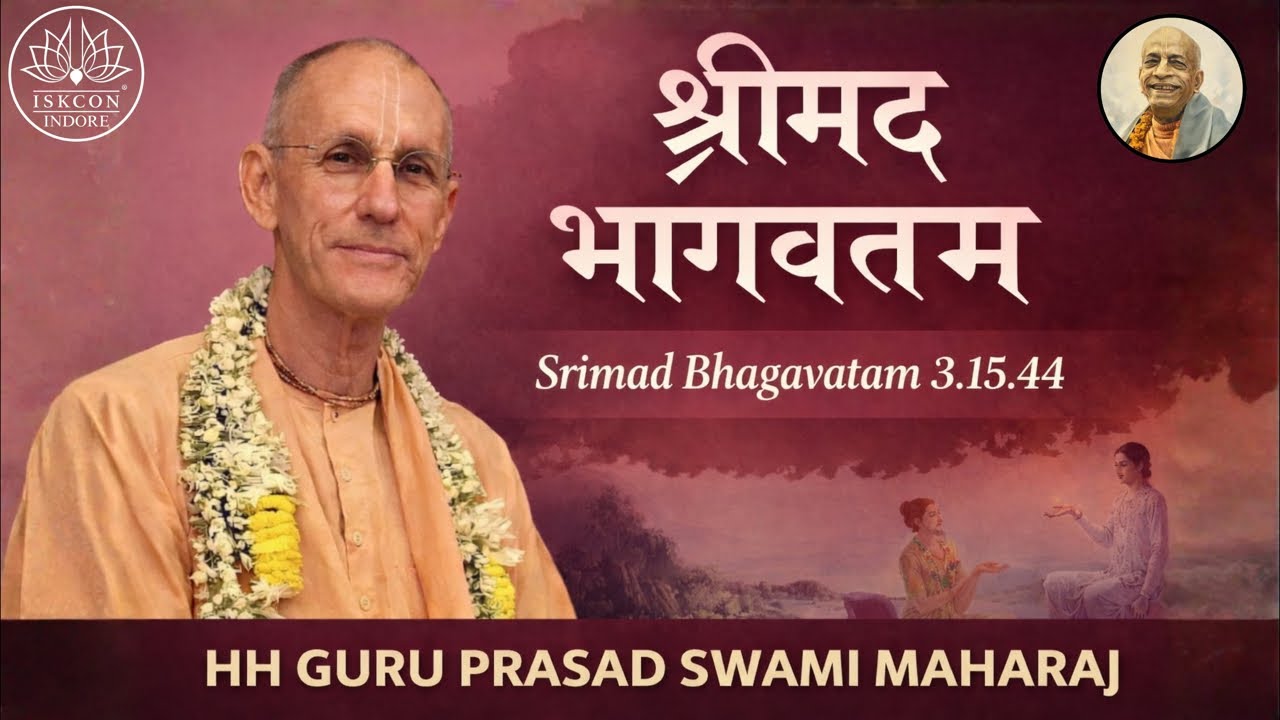
At ISKCON Indore, HH Guru Prasad Swami’s exposition on Srimad Bhagvatam 3.15.45 underscores a foundational thesis in Hindu spiritual traditions: the divine form of the Supreme Lord as described in scripture is ontologically real and thus a legitimate, potent support for meditation. The discourse situates true yoga not merely in physical postures but in disciplined mental focusdharana and dhyanaupon the Supreme within the heart, specifically the four-armed form of Narayana. This orientation, while centered on bhakti yoga, is presented in a way that harmonizes with the wider dharmic landscape and its shared emphasis on inner transformation, compassion, and self-mastery.
Placed within the narrative arc of Canto 3, Chapter 15, the Bhagvatam portrays the realm of Vaikuntha and the encounter of the Kumaras with the Lord’s attendants. The verse tradition around this episode carefully details the Lord’s auspicious iconographyśankha (conch), chakra (disc), gada (mace), and padma (lotus)together with divine ornaments such as Kaustubha and the Srivatsa mark. These features are not material embellishments but spiritual identifiers that stabilize meditative attention. For contemplatives, the precise description offers a clear alambana (support) for dhyana, allowing the mind to rest in a luminous, living reality rather than abstractions alone.
Philosophically, this account coheres with Vedic and Vedantic claims that the Supreme’s form is transcendental (aprakrita), beyond the three gunas, and thus capable of revealing itself in consciousness without diminishing its fullness. The experiential testimony of accomplished yogiswho traditionally meditate on Narayana’s form dwelling within the heartreinforces the text’s claim that divine rupa can be directly contemplated, leading to transformative states of mental clarity, devotion, and equanimity.
Yoga philosophy provides a complementary framework for this vision. In classical Yoga, isvara-pranidhana (dedication to the Supreme) functions as a direct means of samadhi, situating devotion and surrender at the heart of contemplative progress. Name (nama) and form (rupa) serve as precise anchors for attention; they reduce cognitive dispersion and, through repetition and sustained visualization, cultivate one-pointedness (ekagrata). This synergy between scriptural revelation and yogic method explains why the Bhagvatam’s descriptions have been central to the Bhakti Tradition and to many streams of Hindu spirituality and practice.
Yogic anatomy supplies further specificity. The heart-lotus (hridaya) is a favored locus for meditation, corresponding to the anahata chakra in many traditions. Contemplating Narayana within this inner sanctum aligns with teachings that speak of the Paramatma the indwelling witnessguiding all beings. Breath regulation (pranayama) and sense-withdrawal (pratyahara) create the physiological and attentional conditions necessary for steady dharana, upon which luminous dhyana naturally arises. Over time, this sequence cultivates a stable, compassionate, and inwardly quiet presence.
Importantly, the lecture’s emphasis on personal meditation upon Narayana is set within an inclusive dharmic frame. While this pathway prioritizes a personal divine form, other Indic paths that emphasize formless awarenesssuch as reflections on sunyata in certain Buddhist traditions or nirguna contemplation in Advaitaare recognized as neighboring disciplines aiming at similar ethical and contemplative outcomes. Jain contemplative science likewise distinguishes arta dhyana, raudra dhyana, dharma dhyana, and shukla dhyana, charting a progressive refinement of attention and intention. Sikh simran and Naam-jap center the heart on the Divine through remembrance, cultivating humility and service (seva). Across these traditions, the shared commitmentsto non-violence, truthfulness, self-restraint, and compassioncreate a natural basis for unity in spiritual diversity.
In practical terms, meditating on Narayana’s four-armed form can be approached methodically. A steady, comfortable asana supports relaxed alertness. Gentle pranayama balances the nervous system and steadies attention. With eyes softly closed, awareness is invited to the heart-lotus, where the luminous presence of Narayana is contemplatedlotus eyes, radiant complexion, śankha, chakra, gada, and padmaheld with affection and respect. Whether accompanied by silent japa of a sacred name or by natural breath awareness, the practice privileges continuity over intensity, returning to the image and presence whenever distraction arises.
Practitioners frequently report that such visualization evokes calm, moral clarity, and a spontaneous impulse toward seva. The mind, given a precise and sublime object, grows less reactive and more reflective. Over time, devotion (bhakti) and insight (jnana) intertwine: the heart softens while discernment sharpens, reducing compulsive patterns and nourishing steady attention, gratitude, and ethical resolve in daily life.
This contemplative orientation also supports social harmony. By affirming both personal and formless meditations as legitimate means of inner purificationand by emphasizing their shared ethical fruitspractitioners can bridge communities across Hinduism, Buddhism, Jainism, and Sikhism. The result is an ethos that prizes dialogue over dogma and recognizes that multiple paths, when sincerely practiced, converge in compassion, wisdom, and responsible action.
Read in this light, Srimad Bhagvatam 3.15.45 is not only a theological description; it is a practical contemplative map. The Bhagvatam’s vivid iconography becomes a tool for yogic concentration, while its devotional core aligns seamlessly with classical Yoga methods. When approached with humility, consistency, and respect for the broader dharmic family, meditation on Narayana’s form can illuminate the inner life and strengthen a culture of unity in spiritual diversity.
In sum, the lecture from ISKCON Indore presents a rigorous yet accessible pathway: center the mind on the Supreme Lord as revealed by scripture; refine attention through time-tested Yoga techniques; embody the ethical virtues that all dharmic traditions celebrate; and honor the plurality of methods that lead to peace, insight, and liberation. This synthesisdevotional in heart, yogic in method, and inclusive in spiritcaptures the enduring relevance of the Bhagvatam for contemporary seekers.
Inspired by this post on Dandavats.