Public debate around Ram Navami 2026 intensified after remarks by Maharashtra minister Nitesh Rane reignited a perennial question in Indian civic life: how to protect freedom of religious expression while ensuring law and order, and how to do so with visible parity across all festivals. Beyond the flashpoint, the moment offers a useful lens to assess constitutional guarantees, administrative practice, and community engagementespecially through a dharmic framework that foregrounds ahimsa, anekantavada, seva, and sarva dharma sambhava.
Ram Navami, one of the most widely observed Hindu festivals, often includes large processions, devotional music, and expansive public participation. In recent years, some processions across India have encountered sporadic violence and stone-pelting, prompting heightened security measures and intense media scrutiny. While reports are frequently contested and under investigation, the core governance issue remains clear: all communities benefit when rights are upheld equitably and restrictionswhen necessaryare narrowly tailored, content-neutral, and transparently administered.
Calls for “equal rules” across festivals resonate with a foundational constitutional promise. India’s secular framework rests on equality before the law (Article 14), freedoms of speech, assembly, and association (Article 19), the right to life and dignity (Article 21), and freedom of conscience and free profession, practice, and propagation of religion (Articles 25–28), all subject to reasonable restrictions on grounds including public order, morality, and health. When carefully implemented, time–place–manner regulations that apply uniformly to Ram Navami processions, Muharram juloos, Ambedkar Jayanti yatras, Eid congregations, Nagar Kirtans, Christmas services, or Buddha Purnima events reinforce trust and reduce perceptions of bias.
From a jurisprudential standpoint, Indian courts have consistently upheld content-neutral restrictions that protect public order without discriminating on the basis of religion. Noise control and procession management fall under established regulatory frameworks such as the Noise Pollution (Regulation and Control) Rules, 2000, municipal and police laws governing public assemblies, and state-level standard operating procedures that mandate prior permissions, route approvals, time windows, and safety provisions. The core test is proportionality: any restriction must be lawful, pursue a legitimate aim, be necessary, and be the least restrictive option available.
Equal enforcement in practice means similar permission protocols, comparable decibel limits, equivalent traffic diversions, consistent crowd management standards, and uniform accountability for violationsirrespective of the festival or the community involved. This parity is not cosmetic; it is operational. It must appear in police deployment matrices, event calendar coordination, communication advisories, and post-event audits. States frequently receive advisories from the Union Ministry of Home Affairs to ensure law and order during sensitive periods; translating advisory intent into on-the-ground parity is where credibility is either built or lost.
Risk-based policing can and should coexist with equal treatment. Certain localities or dates may objectively carry a higher risk profile due to road geometry, crowd density, or recent history. Adjusting deployment or restrictions to those factors is not discrimination if the criteria are transparently applied across all events. The legitimacy test here is twofold: are criteria content-neutral and publicly communicated, and are similarly situated events treated the same way?
Citizens across Maharashtra and beyond often describe a familiar civic rhythm: the same chowk may host a Ram Navami akhada in April, a langar during Gurpurab, a Muharram tazia route in Muharram, an Eid-eve charity drive, and a Christmas carol evening in December. When permissions, barricades, and sound controls feel predictable and even-handed, the community experience is one of reassurance rather than rivalry. The everyday memory of sharing streets and servicesshop shutters up, children watching processions from balconies, neighborhood groups offering water to participantsremains the most powerful antidote to polarization.
There is also a governance science to festival management. Pre-event joint intelligence assessments, formalized route negotiations with organizers, and hazard mapping for bottlenecks or sensitive stretches help defuse tensions ahead of time. During events, command centers can integrate CCTV feeds, GPS-tracked patrols, ambulance readiness, and fire safety checks. After events, structured debriefs with all stakeholdersHindu, Buddhist, Jain, Sikh, and also interfaith neighborscreate a feedback loop that continuously strengthens protocols.
Equally important is information hygiene. Rumor control cells, coordinated public messaging, and verified updates reduce the ambient anxiety that often turns manageable frictions into dangerous confrontations. Content moderation requests and rapid clarificationsapplied neutrally to all inflammatory falsehoodscan curb incitement without weakening legitimate expression. Training frontline personnel in de-escalation, crowd psychology, and the graded use-of-force continuum further diminishes the likelihood of escalation.
Accountability must be even-handed. If any processionof any faithcrosses agreed limits on route, time, sound, or provocative sloganeering, proportionate penalties should follow, anchored in due process. Conversely, if bystanders or counter-groups engage in violence or vandalism, culpability must be pursued with equal vigor. Transparency builds confidence: police should publish anonymized post-event reports indicating permissions granted, deviations (if any), violations recorded, and action taken.
The economics of peaceful festivals often goes unremarked. Stable, well-managed public celebrations drive local commercefood vendors, transport, artisans, musical troupes, and flower markets all benefit. Conversely, clashes impose steep costs: medical care, property repair, insurance claims, and lost workdays. A uniform compensation and claims mechanismprompt, fair, and non-discriminatoryreinforces the idea that the state serves all citizens equally, irrespective of which event was disrupted.
A dharmic lens strengthens these administrative and legal arguments. Hindu dharma’s insistence on dharma-yukta conduct aligns with non-violence and mutual respect; Buddhist metta (loving-kindness) and karuna (compassion) invite restraint and empathy; Jain anekantavada encourages seeing multiple facets of truth; Sikh seva (selfless service) and “sarbat da bhala” (welfare of all) orient communities toward shared well-being. Together, these traditions foreground coexistence as a positive duty rather than a reluctant compromise.
Many residents recall formative memories that illustrate this ethic: a Jain sangh distributing water along a Ram Navami route; a Sikh gurdwara hosting a medical camp used by devotees of all faiths; a Buddhist group coordinating traffic volunteers during a crowded city celebration. Such cross-support is not ornamental; it directly reduces friction and models the unity of purpose that constitutional secularism expects and dharmic teachings affirm.
In this light, appeals by public figures for “equal rules” should be coupled with language that calms rather than inflames. Democratic discourse benefits when leaders articulate principlesparity, proportionality, and due processwithout personal invective. The Model Code of Conduct and existing hate speech jurisprudence emphasize that speech should not stoke communal tensions. Responsible rhetoric is not weakness; it is strategic statecraft that preserves both rights and order.
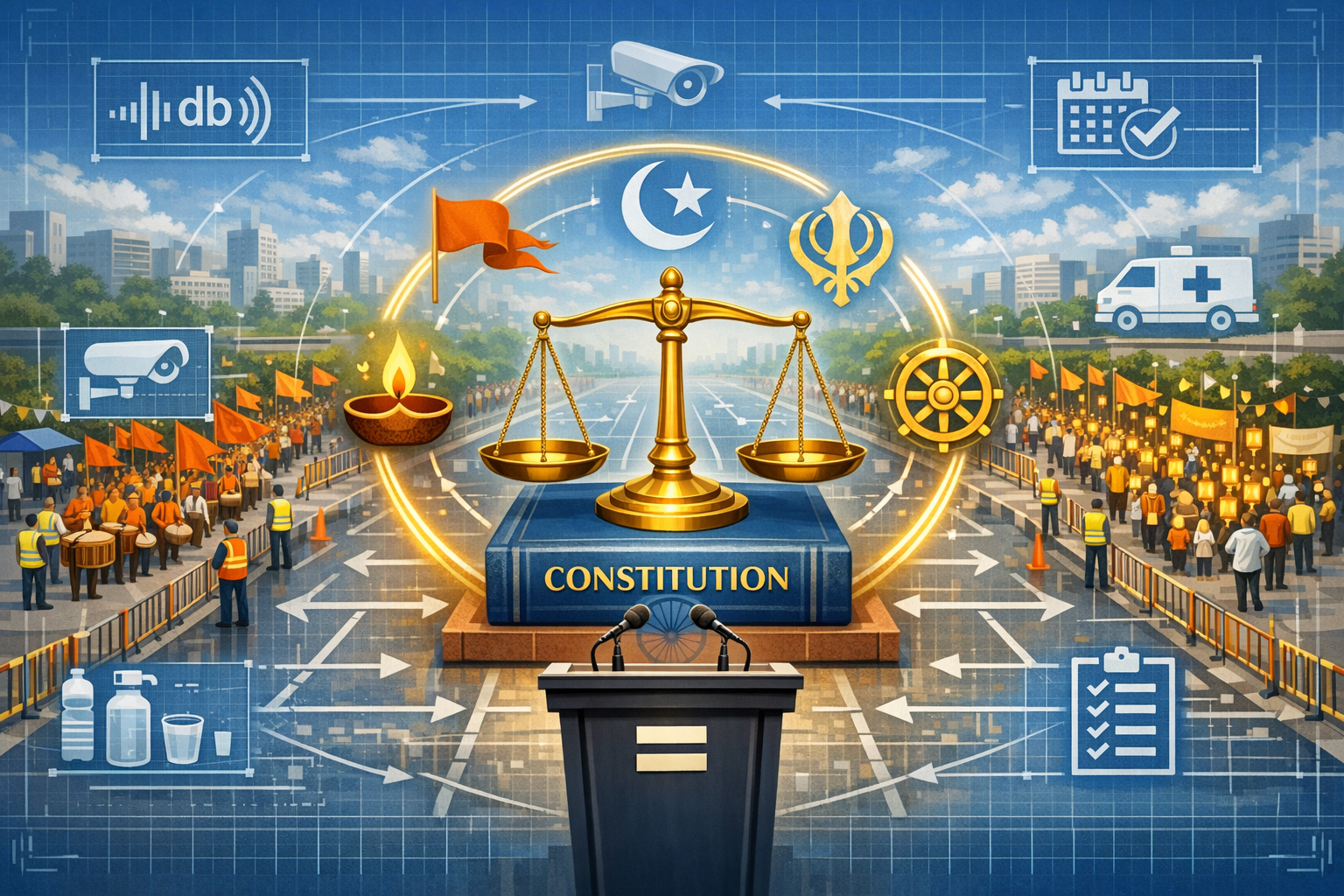
Operationalizing parity is a matter of systems, not sentiment. A practical blueprint includes ten interlocking steps: first, publish an annual, citywide interfaith festival calendar; second, codify a single-window, time-bound permission process with identical documentation for all processions; third, adopt uniform time–place–manner guidelines, including decibel and route standards; fourth, convene permanent community liaison groups representing Hindu, Buddhist, Jain, Sikh, and neighboring communities; fifth, institute joint drills for emergency response; sixth, establish real-time rumor control dashboards; seventh, deploy body-worn cameras for frontline transparency; eighth, guarantee quick, uniform compensation for verified losses; ninth, conduct third-party audits after major events; and tenth, create a public grievance redress portal with reasoned, time-bound replies.
Cities that implement such systems typically see a measurable decline in flashpoints. The key is predictability. When organizers know exactly what to expect in permissions, and residents know how traffic and sound will be managed, anxiety recedes. When the same matrix applies to every processionRam Navami, Muharram, Nagar Kirtan, Eid, or Christmasthe conversation shifts from “why them, not us” to “how do we help make this work smoothly for everyone.”
A note of caution is warranted regarding attribution during unfolding incidents. Investigations should determine responsibility based on evidence, not assumption. Law enforcement updates that are prompt and precise help prevent the amplification of unverified claims. Media and civil society play a vital role here; clear distinctions between allegation and fact protect reputations and reduce retaliatory spirals.
It is also prudent to define red lines and remedies with care. Provocative sloganeering, brandishing weapons, or altering pre-approved routes should attract uniform penalties that are known in advance to all organizers. Similarly, stone-pelting, vandalism, or assaults on processions or bystanders require swift and unbiased prosecution. A balanced approach is both firm and fair: the right to celebrate ends where another’s safety begins, and that boundary is the same for every community.
Maharashtra’s administrative experience adds relevant context. Dense urban corridors, mixed-use neighborhoods, and overlapping religious calendars demand disciplined coordination. Where district administrations and police have institutionalized joint liaison committees, standardized SOPs, and transparent communications, festivals have largely proceeded peacefullyeven amid heated national discourse. Replicating these practices consistently across districts is the next governance frontier.
Beyond immediate policing, civic architecture matters. Well-lit routes, unobstructed sidewalks, accessible first-aid posts, and reliable public transport options reduce friction during peak hours. Civil society organizationsincluding dharmic institutionscan co-create volunteer corps trained in first response, crowd guidance, and conflict de-escalation. These “civic Sherpas” multiply the state’s capacity without blurring accountability.
A wider educational horizon also helps. School and college programs that examine Articles 14 and 25–28, the logic of reasonable restrictions, and the ethics of pluralism equip young citizens to hold two truths together: equal freedom to celebrate, and equal duty to safeguard public order. Embedding dharmic insightsahimsa, metta, anekantavada, and sevatranslates constitutional abstractions into lived civic virtues.
Viewed through this composite lens, the current conversation is an opportunity. Equal rules across festivals are not only possible; they are the best protection for everyone’s religious freedom. When neutrality is embedded in permissions, operations, and accountabilityand when leaders frame differences in the language of law and compassion rather than grievanceIndia’s plural public square grows safer and more vibrant.
The path forward is neither complicated nor easy; it is disciplined. It asks institutions to standardize and explain, communities to cooperate and empathize, and leaders to choose words that build rather than break. The result is tangible: festivals that feel welcoming, streets that feel safe, and a public culture where the dharmic commitment to shared well-being meets the constitutional promise of equal protectionand keeps it.
Inspired by this post on Struggle for Hindu Existence.