On March 20, 2026, in Dakshina Kannada, Karnataka, a 17-year-old Muslim boy visiting a yatra mela with Hindu female friends was allegedly abducted and assaulted by a group of men. Local police registered a First Information Report (FIR) and opened an investigation, while community leaders and civil society actors urged calm and cooperation to safeguard communal harmony during the festival season.
Yatra melas are traditionally woven into the social fabric of coastal Karnataka, bringing together families, friends, and pilgrims under a canopy of lights, music, and devotion. Against this familiar backdrop of shared celebration, an incident of targeted intimidationparticularly one involving a minorfeels like a tear in the collective social fabric, heightening public concern and demanding a measured, law-driven response.
According to preliminary reporting and initial police action, the case centers on the alleged abduction and physical assault of the minor. The FIR process under Section 154 of the Code of Criminal Procedure (CrPC) enables the investigation to proceed, including statements under Section 161 CrPC, judicially recorded statements under Section 164 CrPC when appropriate, medical examination, and collection of corroborative evidence such as CCTV footage and call detail records. Until the investigation concludes, all descriptions of the incident remain allegations and must be treated as such.
Some accounts indicate that the assailants may have been aligned with a Hindutva group; however, organizational affiliation is a matter of evidence and is typically established only after police verify identities, motives, and communication trails. Premature attributions can deepen polarization and impede due process. Responsible reporting and public discourse therefore focus on verifiable facts and the applicable law rather than on labels that may not withstand evidentiary scrutiny.
A review of likely penal provisions helps clarify the legal frame. Depending on verified facts, relevant sections of the Indian Penal Code (IPC) may include wrongful restraint (Section 341), wrongful confinement (Section 342), voluntarily causing hurt (Section 323), assault or criminal force (Section 352), kidnapping/abduction of a minor (Sections 361–365), criminal intimidation (Section 506), and common intention (Section 34). The choice of charges ultimately rests on the evidence the police collect and the prosecutor’s assessment.
The involvement of a minor heightens the State’s duty of care. Authorities must ensure that the identity of the child victim is protected in line with Section 74 of the Juvenile Justice (Care and Protection of Children) Act, 2015, and allied media guidelines that bar disclosure of identifying details. Unless sexual offences are alleged (in which case the Protection of Children from Sexual Offences Act, 2012 would apply), the prosecution will pivot on general IPC provisions and victim-protection protocols tailored to minors, including trauma-informed interviewing and access to psychosocial support through the District Child Protection Unit or allied services.
Best practice in such cases emphasizes a trauma-informed approach: ensuring the minor’s medical care without delay, keeping interviews non-coercive and child-friendly, and providing counseling that reduces secondary victimization. Police and support professionals are encouraged to record statements promptly to preserve memory while also minimizing repeated questioning, consistent with international victim-witness standards and national advisories issued by the Ministry of Home Affairs.
Beyond the specifics of this case, vigilantism and group violence have drawn sustained judicial scrutiny. In Tehseen S. Poonawalla v. Union of India (2018), the Supreme Court of India issued preventive, remedial, and punitive guidelines to curb mob violence, including appointment of nodal officers, rapid response protocols, and time-bound investigations. Though each incident demands fact-specific handling, the principles of deterrence, accountability, and coordinated community policing remain germane wherever group intimidation disrupts public order.
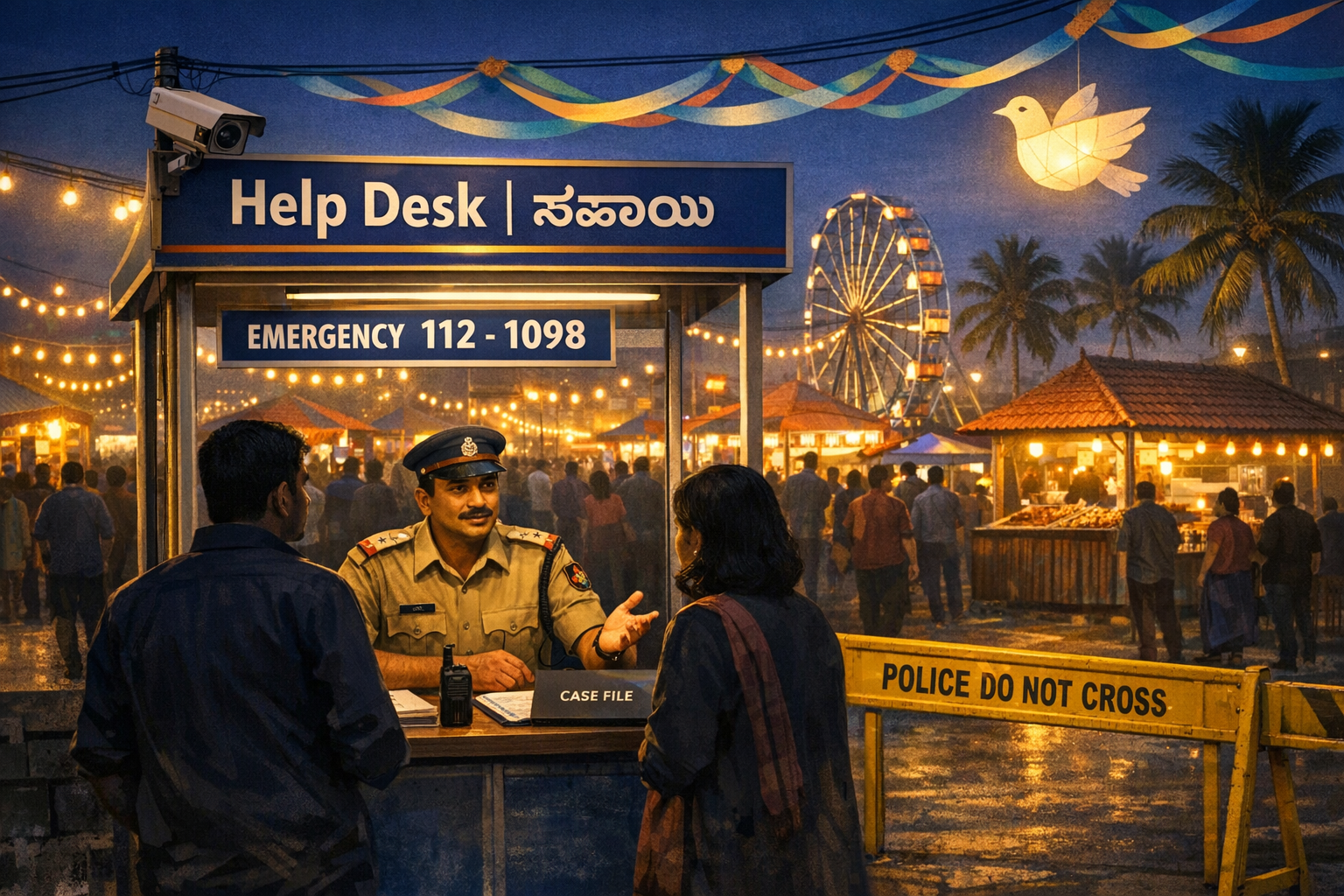
Proactive festival safety planning can mitigate risks in crowded melas. Measures with proven impact include well-lit thoroughfares, demarcated safe zones, trained volunteer wardens, and visible police presence near transport nodes. Publicizing emergency numbers112 (national emergency) and 1098 (Childline)and establishing a dedicated help desk on site improve response times and signal institutional readiness to assist vulnerable groups, especially minors.
Communal harmony is not an abstract aspiration in coastal Karnataka; it is a practical necessity sustained by everyday acts of civility. Across dharmic traditionsHinduism, Buddhism, Jainism, and Sikhismshared ethical touchstones such as ahimsa (non-violence), karuna (compassion), maitri (friendliness), and seva (selfless service) reinforce a civic ethos that rejects vigilantism and protects the dignity of every person. Re-centering these values in public messaging can help de-escalate tensions and reaffirm trust in the rule of law.
Public discourse benefits from resisting reductive tropes or conspiracy frames that assign collective guilt based on identity. Terms that pathologize friendships across communities, particularly those invoking unverified “plots,” tend to inflame rather than illuminate. Evidence-led reasoning, careful language, and fidelity to due process protect both the integrity of investigations and the possibility of reconciliation after harm.
For bystanders and citizens, clear guidance empowers constructive action: contact 112 immediately; guide the victim to a safe, well-lit area; avoid confrontation that could escalate risk; record essential details (location, time, identifiers) without circulating sensitive visuals on social media; and share evidence directly with law enforcement. These steps support swift intervention without compounding harm or violating privacy.
Local administrations and festival committees can reinforce preparedness through multi-faith liaison groups, rumor-control cells, and scheduled briefings that dispel misinformation. Periodic walk-throughs of mela routes, mock drills for emergency response, and multilingual public announcements (including Kannada and other locally spoken languages) improve situational awareness and community confidence.
Accountability and fairness should advance together. Swift and impartial investigation, timely filing of the charge sheet under Section 173(2) CrPC, and adherence to victim and witness protection standards strengthen credibility. At the same time, the presumption of innocence remains foundational; the aim is not collective blame but individual accountability anchored in evidence and governed by law.
Ultimately, festivals endure as vessels of social trust. Preserving that trust requires rejecting any vigilante impulse, standing firmly for non-violence, and insisting that disputes be resolved only through lawful institutions. If the Dakshina Kannada investigation confirms criminal conduct, proportionate legal consequences should follow; if allegations are unsubstantiated, public communication should promptly correct the record. In either outcome, a shared commitment to ahimsa and the rule of law offers the most reliable path back to calm.
Inspired by this post on Struggle for Hindu Existence.