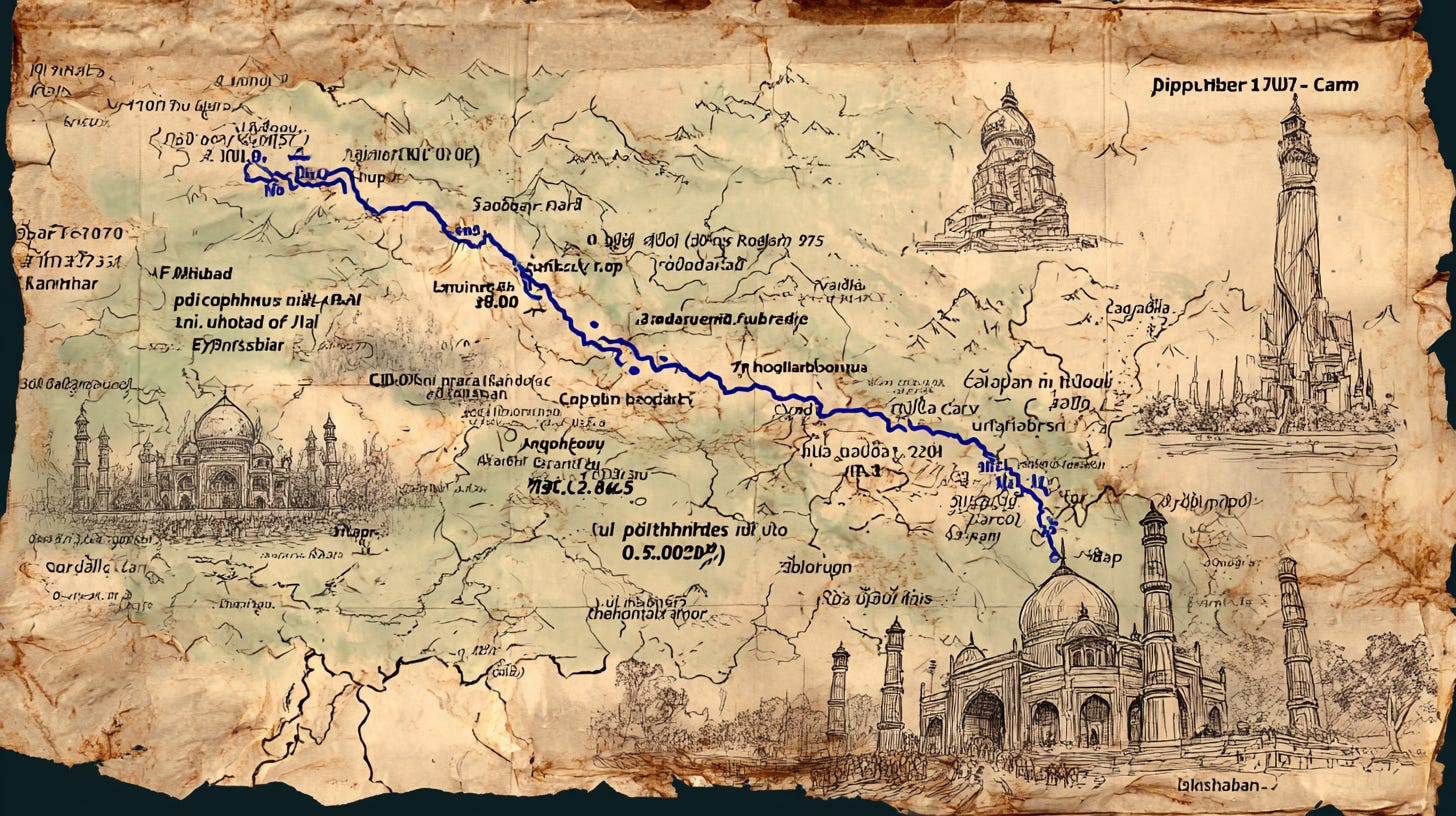
On 27 January 1803, Marquess Wellesley sketched a rapid itinerary for Viscount Valentia through the upper provincesBihar, Awadh, and the regions now comprising Uttar Pradeshpromising full administrative support, secure passage, and precedence second only to executive officials. The exchange illustrates how aristocratic rank and Company machinery intertwined to produce seamless mobility for elite observers within the Bengal Presidency.
Despite the urgency, nearly a month elapsed before Valentia set out for Lucknow. Illness intervened, followed by an intense social circuit of dinners and calls upon judges, physicians, botanists, and senior officers eager to cultivate goodwill. The pace and hospitality reveal the Bengal Presidency’s culture of patronage and networking, where status and information flowed through convivial rituals as much as through formal office.
A final private audience on 20 February reinforced Wellesley’s assurance of “manly, open, and generous” assistance in matters of political intelligencean emphasis that foreshadowed potential collaboration after his return to England. The moment reads as a calculated alignment of interests: a governor’s desire to shape narratives and an aristocratic traveler’s resolve to record them.
At 11 a.m. on 21 February, Valentia departed from Chitpore Ghat by river, disappointed to find only a modest reed-covered boat rather than the grand state barge that had first received him. He disembarked at Chinsura, continued by palanquin to Hooghly, and accepted the customary hospitality of Mr. Brook. Thereafter, he traveled chiefly at nightfinding the flat Bengal landscape visually monotonous by daywith Varanasi as the principal goal.
Wellesley’s arrangements ensured conspicuous comfort: a palanquin borne by eight bearers, accompanied by three mussals (link-boys) and men for luggage; blinds and pillows allowed full-length repose. The apparatus of movementroad and river, bearers and escortsbecame an instrument of power, encoding the privileges of British colonial rule and the hierarchies that sustained it across hundreds of miles.
At Palashi, Valentia’s enthusiasm for the battlefield’s significance was unequivocal; he perceived Robert Clive’s victory as the pivot that made the British “masters of Bengal.” The landscape functioned as an imperial ledger, where sites signified gains in revenue, military authority, and administrative reach for the East India Company.
Proceeding to Berhamporeone of six major military stationsValentia stayed with Captain Parby. The itinerary, choreographed with military precision, rotated him through cantonments and senior officers’ residences. Even amid undisputed dominance, the security calculus remained acute; the route reflected an administrative habit of anticipating unrest and insulating elite travelers from contingencies.
Nearby Murshidabad drew special notice. Founded as a seat of Nawabi power under Murshid Quli Khan and later subsumed by British supremacy, the city still revolved around the formidable Munni Begum, widow of Mir Jaffar, who had been honoredtellinglyas “Mother of the Company.” Valentia’s account records her wealth, authority over the royal household, and enduring prestige, while also revealing the period’s biases in how he framed household finances and social change. Read critically, such passages illuminate colonial perceptions more than they describe social realities.

Valentia also documented the ecological impact of Company policy at Cossimbazar: tiger and leopard populations had been heavily reduced through bounty schemes. He recorded the prevailing ratesten rupees for a tiger’s head and five for a leopard or tiger’s cubshowing how fiscal incentives accelerated wildlife extermination and reconfigured Bengal’s natural environment under British colonial rule.
On 25 February at Jangipur, then a thriving silk-manufacturing hub, the journey turned toward Rajmahalmarked as his final halt within Bengal. The onward passage to Bhagalpur traversed forested hills, ravines, and tight passes that tested palanquin-bearers and underscored the need for road-building. Valentia criticized the Company’s tendency, in his view, to prioritize dividends over durable public works, urging a more constructive vision befitting a power in tranquil possession of empire.
At dawn on 27 February, a wide plain of “European grain” signaled proximity to Bhagalpur. A few miles ahead, he observed convicts laboring on a roadevidence of penal labor in public works that the British popularized and which, in later decades, would often be cited in major state projects. The sight offered a sober counterpoint to the luxuries of elite travel: infrastructure as discipline, as much as development.
Approaching Bhagalpur, a tower “resembling a pagoda” marked the Cleveland Memorial at Tilaka Manjhi. The monument celebrated Augustus Cleveland, Collector and Judge of Bhagalpur and Rajmahal, and praised conciliation with the hill zamindars of the Jungleterry. The inscription’s languagehighlighting a “conquest over their minds”captures colonial paternalism with unusual clarity, portraying administrative outreach as benevolent uplift while eliding coercive structures behind it.
Valentia was received by Major Shaw in Bhagalpur and resumed travel by night. By 7 a.m. he reached Munger, where Captain D’Auvergne extended customary hospitality. Each halting place doubled as a node in the Company’s administrative and social network, reinforcing the symbiosis between movement, information, and authority from Calcutta to Bhagalpur and onward to Lucknow.
Viewed together, this leg of the voyage reads as an ethnography of power: Wellesley’s patronage, palanquin logistics, cantonment hospitality, silk trade at Jangipur, bounties reshaping wildlife, and memorials canonizing colonial virtues. For contemporary readers across dharmic traditionsHindu, Buddhist, Jain, and Sikhthe account invites a shared, plural reflection: to recognize how imperial narratives once defined India from above, and to recover a more grounded memory that honors the subcontinent’s diversity, resilience, and civilizational unity.
Inspired by this post on Dharma Dispatch.