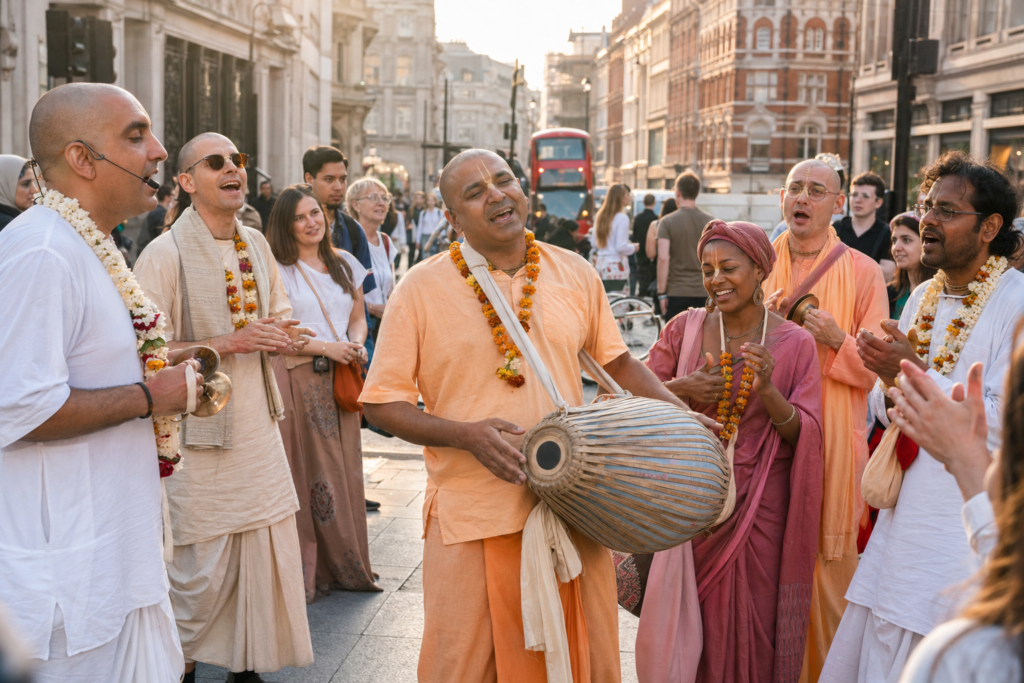
Drawing on the benediction voiced by His Divine Grace A.C.B. Swami Prabhupada, the reflection centers on a timeless aspiration: may there be auspiciousness throughout the universe and the pacification of envy. The vision proposes a practical path to this endbhakti-yogaas a discipline that calms the heart, orients the mind toward others’ welfare, and anchors consciousness in remembrance of the supreme transcendence, Lord Sri Krsna. Such remembrance nurtures empathy, steadies intent, and expands concern beyond self-interest.
Within this framework, devotion does not negate reason; rather, it refines motivation. Bhakti-yoga, expressed as loving service and continuous contemplation, naturally inclines practitioners to act for the common good. This aligns with foundational dharmic principles shared across Hinduism, Buddhism, Jainism, and Sikhism: maitri and karuna (friendliness and compassion), ahimsa (non-violence), and seva and simran (selfless service and remembrance). The result is unity in spiritual diversitydistinct practices converging on the same ethical horizon of care, dignity, and mutual uplift.
The Vaisnava ideal provides a vivid model for this orientation. Like a desire tree, a Vaisnava is depicted as striving to meet the needs of those who seek shelter, praying not for personal gain but for all living entitiesthe gentle, the envious, and the mischievous alike. The emphasis is universal compassion without exclusion, an ethic that dissolves rigid boundaries and cultivates harmony, love and tolerance. Such a stance supports social cohesion and deepens interfaith understanding.
Experience across dharmic communities consistently suggests that contemplative remembrancewhether through japa, simran, or metta practicereduces reactivity and softens jealousy, while increasing generosity and equanimity. Contemporary contemplative studies similarly indicate that compassion training enhances prosocial behavior and emotional regulation. These convergences between lived tradition and empirical insight reinforce the practical relevance of bhakti-yoga and allied disciplines for personal well-being and social harmony.
In daily life, this vision becomes actionable through steady, simple commitments: beginning the day with remembrance of Lord Sri Krsna or one’s chosen form of the Divine (Ishta), cultivating maitri and karuna toward all beings, observing ahimsa in speech and conduct, and engaging in seva that tangibly benefits others. Such practices, undertaken with sincerity and consistency, gradually transform intent and behavior, aligning inner devotion with outward responsibility.
The original benediction’s calllet all engage in the service of the supreme transcendence and remain absorbed in thought of Himcan be read as an invitation to collective flourishing. Across dharmic traditions, mindful remembrance and ethical action reinforce each other: devotion deepens compassion; compassion gives devotion its ethical form. As this cycle matures, individuals and communities become steadier sources of peace, courage, and care.
Thus, the welfare of others is neither a peripheral value nor a sectarian aim; it is the center of a shared dharmic ethic. By integrating bhakti-yoga with ahimsa, seva, and interfaith goodwill, spiritual life becomes a force for universal auspiciousness. In this spirit, the wish for good fortune throughout the universe is not merely a prayer; it is a practiceenacted moment by moment, for the benefit of all.
Inspired by this post on Dandavats.