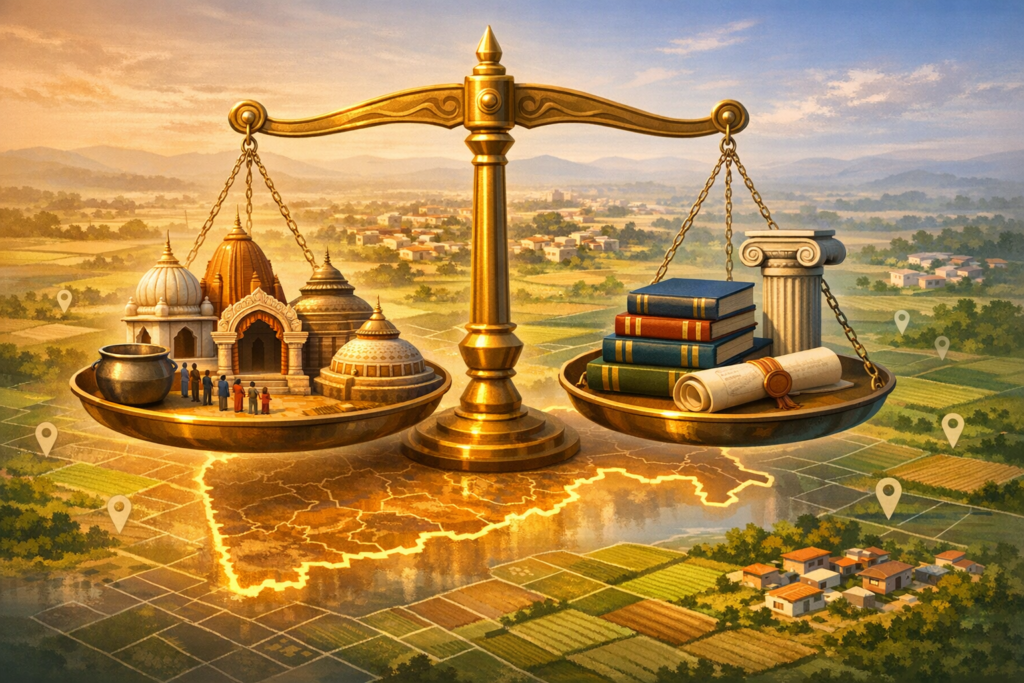
This analysis examines the aftermath of the recently concluded Bihar Assembly Elections, in which the National Democratic Alliance (NDA) secured a commanding majority while the INDI alliance underperformed. It interprets the verdict through the lenses of electoral arithmetic, governance credibility, and historical continuities that have long shaped Bihar’s political culture.
Placing the result in a civilizational frame, the discussion traces a broad arc from the statecraft of the Magadha Empire to the administrative legacies of leaders such as the late Congress Chief Minister Jagannath Mishra, and the rise of Lalu Prasad Yadav with the subsequent law-and-order challenges of the 1990s. This longue durée perspective clarifies how older institutions, social hierarchies, and regional political idioms continue to influence contemporary coalitions, voting blocs, and issue salience.
The electoral map indicates that the NDA effectively aligned development narratives with ground-level organization, translating mobilization into seats across key regions. In contrast, the INDI alliance struggled with coordination, message discipline, and the conversion of vote share into constituency-level victories. Constituency outcomes underscore how micro-strategies—candidate selection, booth management, and localized welfare delivery—often determine aggregate swings.
Voter motivations reveal a layered decision-making process that blends aspirations for jobs, infrastructure, and safety with enduring community identities. Many first-time voters, observed queueing at dawn at neighborhood polling stations, projected a quiet resolve for stability and opportunity. These lived moments—elderly citizens arriving with folded voter slips, women turning out in higher numbers in several booths, and youth discussing migration and skilling—capture an emotional undercurrent that purely statistical recaps can miss.
Historical memories of governance quality, including periods marked by administrative strain and law-and-order stress, remain potent in Bihar’s political imagination. The current verdict suggests that credible delivery of welfare benefits, visible infrastructure improvements, and assurances of public safety can recalibrate loyalties beyond traditional caste alignments. In effect, performance legitimacy can temper identity-driven voting, even if it does not fully displace it.
Socio-economic indicators further illuminate the outcome. Districts reporting better road connectivity, healthcare access, and digital services often mirrored stronger support for continuity. At the same time, areas facing agrarian distress or limited non-farm employment expressed sharper scrutiny of promises and timelines. The verdict, therefore, simultaneously rewards execution and signals expectations for accelerated job growth, quality education, and targeted skilling.
Anchoring the analysis in dharmic pluralism—drawing on the shared civilizational ethos of Hinduism, Buddhism, Jainism, and Sikhism—highlights Bihar’s longstanding heritage of intellectual openness and social harmony from sites such as Nalanda and Vaishali. This ethical frame emphasizes dialogue, dignity, and collective well-being as guiding principles for public policy. It also cautions against divisive rhetoric, urging political actors to prioritize social cohesion, rule of law, and inclusive development as non-negotiable baselines of democratic life.
Nationally, the Bihar outcome influences coalition calculations, cabinet priorities, and federal-state coordination on welfare, infrastructure, and investment. It signals voter appetite for stability with delivery, not stability alone. For policymakers, the forward path rests on measurable improvements in employment, urban services, rural incomes, and public safety—benchmarks that will frame the next electoral cycle.
In sum, the Bihar Assembly Elections affirm a pragmatic voter mood that rewards governance credibility, tangible development, and a unifying civic spirit. The historical echoes remain present, but the electorate’s gaze is firmly fixed on the future—a future best served when democratic competition is matched by ethical statecraft, institutional trust, and a shared commitment to the dharmic ideal of societal harmony.
Inspired by this post on Dharma Dispatch.