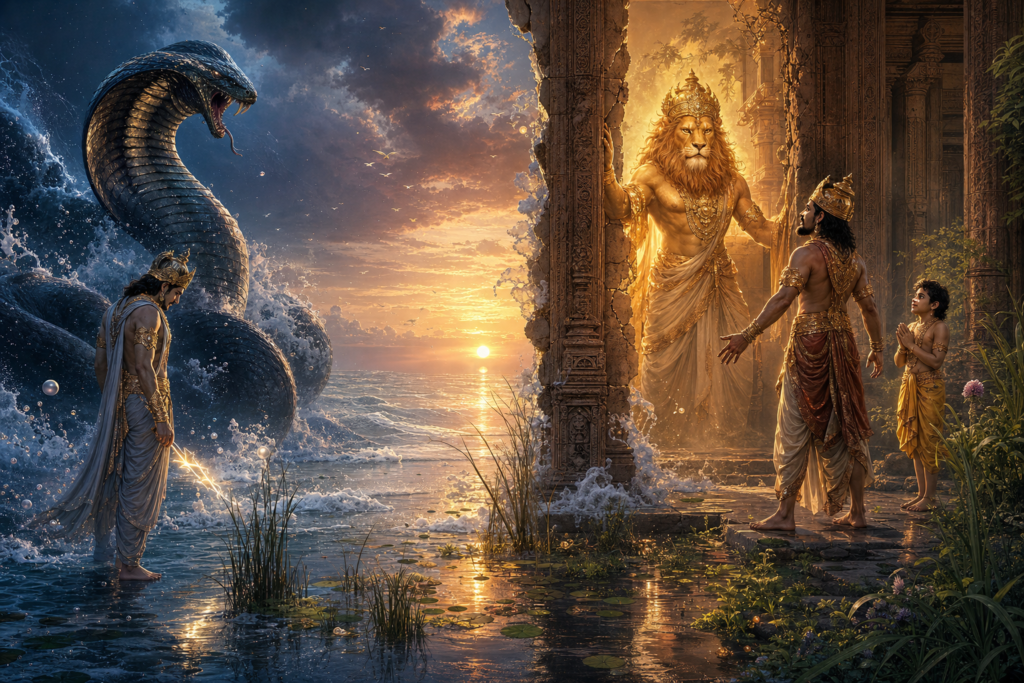
Vaikuntha Chaturmurti is revered as a powerful aspect of Lord Vishnu, depicted with four heads and venerated in the temples of Vishnu across Kashmir. Regarded in many traditions as a supreme manifestation, this composite form unites a human head, a lion head, a boar head, and a fierce (demonic) head, offering a panoramic vision of preservation, protection, and cosmic order within Vaishnava iconography.
Each head is laden with symbolism. The human head suggests compassion, discernment, and the steady guardianship that sustains dharma. The lion head recalls Narasimha, embodying fearless protection and the swift correction of injustice. The boar head evokes Varaha, the rescuer who raises the earth from chaos and restores balance. The fierce head conveys the dissolution of adharma and the uncompromising removal of hindrances to spiritual progress. Together, the four directions of vision express omnipresenceVishnu’s capacity to preserve, protect, uplift, and purify the cosmos from every side.
In Kashmir, this form holds a special place in temple worship and visual culture, where art, devotion, and philosophy intertwine. Devotees encounter Vaikuntha Chaturmurti through darshan, mantra japa, and quiet contemplation, often focusing on the unity of attributes the icon conveyscompassion with strength, power with restraint, and justice with mercy. While practices vary by temple, the devotional mood commonly centers on gratitude for protection and a renewed commitment to live in harmony with dharma.
Devotees often describe a sense of assurance in the presence of this image: the lion’s courage steadies the heart in difficult times; the boar’s restorative power inspires perseverance; the human face invites empathy and ethical clarity; and the fierce aspect encourages the disciplined removal of ego and fear. This lived experience transforms iconography into guidance for daily lifereminding seekers that resilience and compassion are not opposites but partners in spiritual growth.
Beyond its regional roots, Vaikuntha Chaturmurti illuminates a core dharmic insight: many forms can express one truth. The composite image resonates with the shared ethical vocabulary of dharmic traditionsHinduism, Buddhism, Jainism, and Sikhismwhere non-harming, courage, inner purification, and social harmony are held in high regard. Read in this light, the four-headed form becomes a unifying symbol, encouraging mutual respect and demonstrating how diverse paths can nurture a common commitment to wisdom, compassion, and collective well-being.
As a focal point of Vaishnava devotion, the Vaikuntha Chaturmurti invites study and contemplation: it is at once a theological map of Vishnu’s roles and a practical mirror for ethical living. By integrating the human, leonine, boar, and fierce aspects into a single form, the image teaches balancestrength paired with sensitivity, decisive action tempered by insightthereby guiding seekers to act for the preservation of dharma in both personal and communal life.
Inspired by this post on Hindu Pad.