The widely cited idea that “it is only one in a million that truly turns towards God” captures a core insight of Hindu philosophy: genuine spiritual awakening is rare, demanding unwavering commitment, ethical refinement, and clarity of purpose. Within this frame, the phrase functions less as a numerical claim and more as a contemplative mirror, inviting deeper inquiry into what sustained Godward orientation entails in the quest for Self-Realization and moksha.
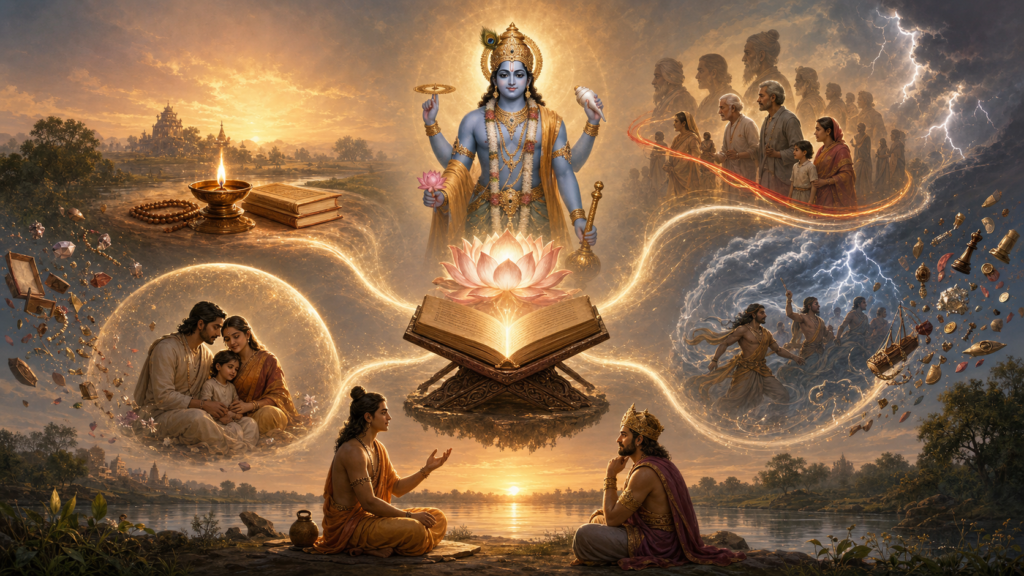
Hindu scriptures articulate this rarity with precision. The Bhagavad Gita (7.3) states: “manuṣyāṇāṁ sahasreṣu kaścid yatati siddhaye, yatatām api siddhānāṁ kaścin māṁ vetti tattvataḥ.” Among countless individuals, few strive for perfection; among the perfected, hardly one truly knows the Divine in essence. The teaching emphasizes both the arduous path of sādhanā and the profundity of tattva-jñāna, situating devotion and insight as mutually reinforcing dimensions of spiritual maturity.
Interpreted academically, the claim of rarity addresses depth rather than exclusion. Obstacles such as habitual distraction, psychological inertia, and karmic tendencies often divert attention from inner inquiry. Progress requires dharma-aligned living, sustained vairāgya (dispassion), and disciplined practice. Far from elitist, the teaching cultivates humility, perseverance, and reverence for the arduous nature of Spiritual Awakening within a plural and open-ended Hindu spirituality.
This perspective resonates across dharmic traditions that share a commitment to inner transformation. Buddhism underscores the “precious human birth” and the rarity of authentic liberation; Jainism affirms the scarcity of samyaktva (right vision) as the foundation of the path; Sikh thought speaks of manas janam durlabh hai and the indispensability of Gur Prasad. Together, these streams affirm a civilizational consensus: profound Godward or truth-oriented turning is exceptional, yet open to all who cultivate the appropriate causes and conditions.
Practitioners frequently describe relatable moments that illuminate this teaching. In the midst of obligations, news cycles, and digital noise, brief intervals of silence reveal an unmistakable contrast between scattered attention and one-pointed awareness. Over time, this contrast clarifies how “turning towards God” is not an isolated event but a sustained orientationevident in daily choices, ethical integrity, and the readiness to prioritize the inner life over habitual distractions.
Hindu philosophy proposes complementary pathways that scaffold this orientation. Bhakti fosters devotion through kirtan, japa, and pūjā; Karma Yoga refines intention through selfless service (seva) and duty aligned with dharma; Jñāna Yoga unfolds through śravaṇa–manana–nididhyāsana (listening, reflection, deep contemplation); Rāja Yoga stabilizes the mind via meditation and disciplined practices. These yogas are not rival systems but integrative disciplines that, in concert, support Self-Realization.
Effort and grace also work together in the dharmic view. Hindu spirituality recognizes kṛpā (grace) and prasāda as essential complements to personal striving; Sikh teachings foreground Gur Prasad; Buddhism highlights the vital role of kalyāṇa-mitta (spiritual friendship); and Jainism emphasizes the transformative impact of saṅgha and disciplined conduct. This shared grammar suggests a unifying insight: while rigorous practice prepares the ground, realization often ripens through the subtle convergence of guidance, community, and compassionate grace.
Ethically, the “one in a million” motif counsels humility and compassion rather than triumphalism. Recognizing the difficulty of this turning encourages patience with oneself and empathy for others, strengthening unity in spiritual diversity. Such unity is intrinsic to the dharmic ethosHinduism, Buddhism, Jainism, and Sikhism each affirm multiple valid approaches to truth, inviting mutual respect, shared learning, and cooperative spiritual culture.
Ultimately, the phrase functions as a call to depth. It invites sustained devotion, refined discernment, and inclusive fellowship anchored in interfaith respect within the broader dharmic family. By honoring many paths while upholding rigorous practice, seekers collectively nurture a milieu where rare awakening becomes a realistic, lived possibilityone that benefits not only individuals but the wider fabric of society.
Inspired by this post on Hindu Blog.