
Parental guidance in spiritual life is often understood as a one-way offering from elders to the young, yet the reciprocal dynamic is just as formative. A celebrated narrative from Srimad-Bhagavatam illustrates this truth with clarity: the account of King Citraketu, whose journey through joy, loss, and insight reveals how children can inadvertently catalyze a parent’s spiritual progress. The episode invites reflection across dharmic traditionsHinduism, Buddhism, Jainism, and Sikhismon detachment, compassion, duty, and the nature of impermanence.
King Citraketu, a powerful ruler renowned for wealth and authority, suffered a deep void: despite many marriages, he had no heir. Observing the king’s anguish, the sage Angira visited and blessed him with a son, foretelling the child’s name as Harsa-soka“Happiness-Distress.” The name signaled a dual destiny. Interpreting it as a warning of ordinary childhood mischief, the king underestimated its gravity, and the omen was set aside.
In time, one queen bore a son of exceptional beauty, and the king’s affection concentrated upon the child and the mother. Neglect of the other queensborn of attachment and favoritismbred envy and despair within the palace. Clouded by resentment, they conspired to poison the child. The sudden loss shattered the king’s heart, and grief, profound and disorienting, overwhelmed the royal household.
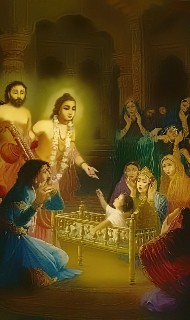
At the precipice of despair, Angira Muni returned with the transcendental sage Narada. By mystic power, Narada summoned the departed soul, who briefly re-entered the child’s body at their command. Animated once more, the child was asked to address the king and queen. This intervention created a transformative pause in the narrativea threshold between attachment and understanding, between samsara’s cycles of gain and loss and the dawning of wisdom.
Even without recounting the soul’s discourse, the scene itself conveys essential dharma principles: worldly relationships, while sacred, are also subject to impermanence; partiality invites suffering within families and communities; and grief, when illumined by knowledge, can become a portal to spiritual growth. The name Harsa-soka encapsulates this arcjoy and sorrow interwoven as tutors of discernment. The episode thus models how leadership, parenting, and devotion must be tempered by viveka (discernment) and vairagya (measured detachment).
For contemporary readers and parents, the narrative offers practical insight. Love requires presence, yet clinging intensifies pain. Equanimity, grounded in atma-tattva (knowledge of the self), enables compassionate decision-makingespecially in moments of crisis. The king’s experience functions as a mirror: one recognizes how attention, fairness, and inner steadiness protect familial harmony and reduce the karmic ripples of envy and neglect.
Across dharmic traditions, the episode resonates in complementary ways. Hindu teachings emphasize atman’s continuity beyond birth and death; Buddhism highlights anitya (impermanence) and the relief found in non-attachment; Jainism affirms aparigraha (non-grasping) as an ethical and spiritual discipline; Sikh thought points to hukam (divine order) and acceptance aligned with righteous living. Read together, these perspectives form a unified framework for transforming grief into wisdom and for cultivating compassionate detachment without abandoning responsibility or love.
In sum, the story of King Citraketuguided by Angira Muni and Narada Munipresents a proven path for navigating happiness and distress with dignity. It urges readers to balance devotion with discernment, to honor relationships while recognizing their temporal nature, and to embrace unity in spiritual diversity. By integrating these insights, households and communities can advance toward inner stability, ethical clarity, and shared well-being.
Inspired by this post on Dandavats.










