Bright, fast-cut children’s media such as “Baby Shark” illustrates a defining feature of the attention economy: visual and auditory novelties rotate every few seconds to keep young eyes fixed on the screen. Many will recognize how effortlessly such stimuli command attention, not just in childhood but across a lifetime spent with devices designed to captivate.
Across contemporary products, services, and apps, design choices often privilege attention capture and retention. This is not accidental; it reflects a system optimized for clicks, swipes, and streaks. The result is an environment where attention becomes the prized commodity, shaped and traded by algorithms and aesthetics calibrated to maximize engagement.
Attention, however, is first and foremost an innate biological function. It arises from evolutionarily ancient neural systems—often nicknamed the “lizard brain”—that monitor threat and opportunity, much like camouflage hides prey from predators while vibrant displays invite mates. In human life, that same sensitivity to novelty, contrast, and movement remains exquisitely easy to trigger.
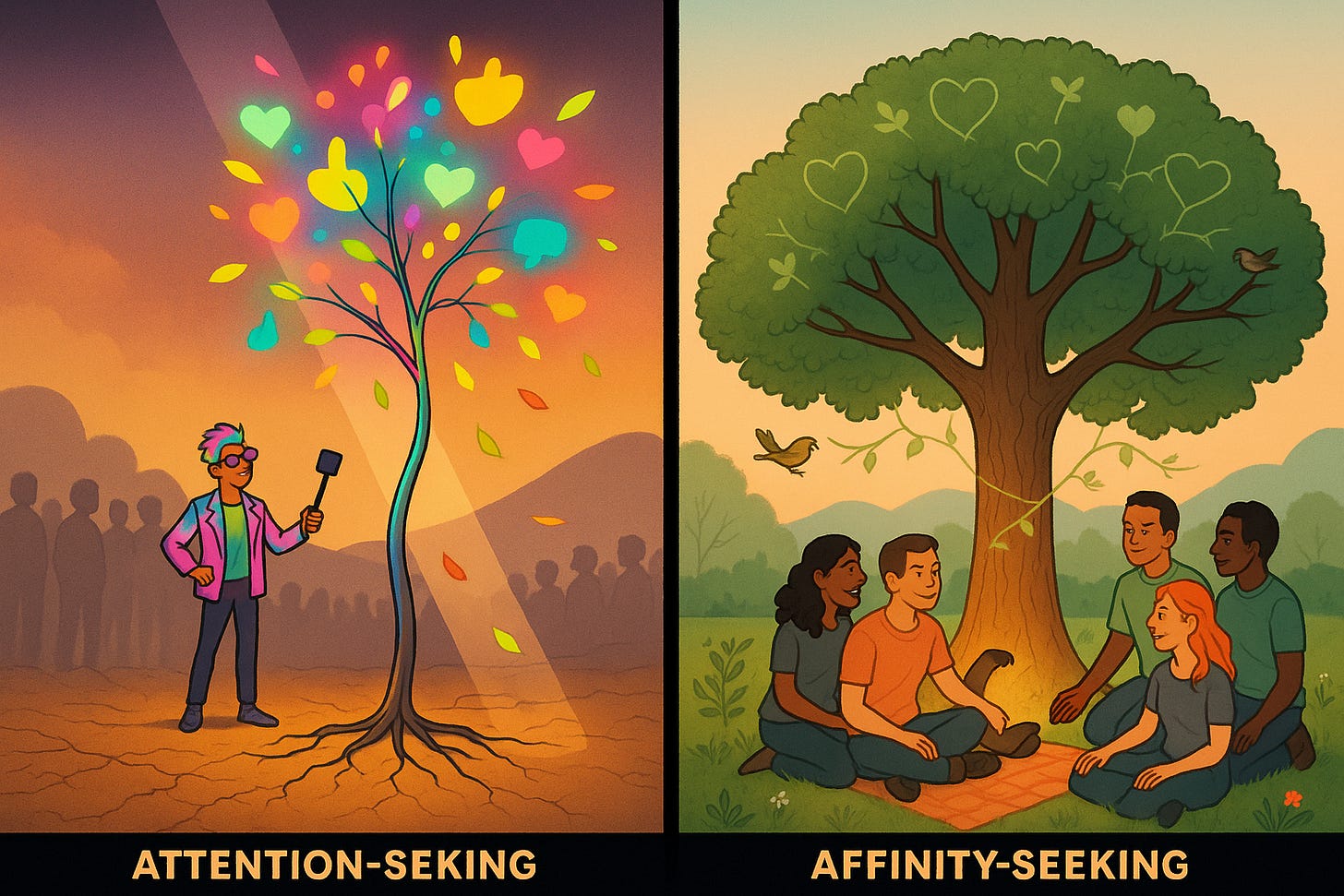
Designers and marketers have learned to leverage this primal circuitry. Shiny objects, urgent cries, unboxing theatrics, and emotionally charged cues exploit salience and arousal to keep minds glued to the feed. Social media norms encourage similar behaviors among users, who craft reels, filters, and even self-mocking humor to win moments of visibility. The pursuit of notice can become its own loop.
Focus is different. Unlike attention, which can be reflexive and fleeting, focus is deliberate, effortful, and transformative. It relies on sustained executive control, taxes mental energy, and reshapes understanding over time. Even focused individuals, however, can be derailed by attention-grabbing cues in their environment. As distractions proliferate, the threshold for beginning and sustaining deep work rises, making academic study, creative craft, and ethical decision-making feel harder than they should.
Dharmic traditions offer a shared, practical language for this distinction. Practices akin to pratyahara (wise regulation of sensory input) preserve cognitive resources; dhyana fosters steady awareness; and one-pointedness (ekagrata or one-pointedness) stabilizes intention. Across Hinduism, Buddhism, Jainism, and Sikhism, mindful attention and disciplined focus are cultivated not to withdraw from life, but to participate more compassionately and skillfully within it.
Beyond focus lies affinity. When values, capabilities, and context align, time seems to move with ease; distractions recede; and work feels energizing rather than depleting. This state, often described as flow, emerges when tasks resonate with intrinsic motivation. In human connection, affinity reduces the need for performative filters and fosters authentic presence. In design and business, building affinity means recognizing people as whole persons rather than as data points or consumption units; in doing so, it cultivates memory, trust, and loyalty grounded in respect.
This ethic is consonant with dharmic ideals such as maitri (friendliness), karuna (compassion), seva (selfless service), and ahimsa (non-harm). When products, services, and communities are shaped by these virtues, affinity naturally displaces distraction. The result is not only better outcomes—deeper learning, richer relationships, more humane technology—but also greater unity across diverse paths, reflecting a shared civilizational commitment to wisdom and well-being.
In sum, attention is a stepping stone, not a destination. It can be captured in seconds, but it rarely endures. Focus takes work and changes the person who undertakes it. Affinity transforms the experience entirely, replacing effortful vigilance with meaningful engagement. Few may want to hear “Baby Shark” in adulthood, while composers like Bach and Vivaldi endure because their works invite sustained focus and evoke lasting affinity. In personal practice and public design alike, the arc from attention to focus to affinity provides a proven path—guided by dhyana, pratyahara, and one-pointedness—toward learning that lasts, connections that matter, and a more unified dharmic ethos in modern life.
Inspired by this post on RightViews.