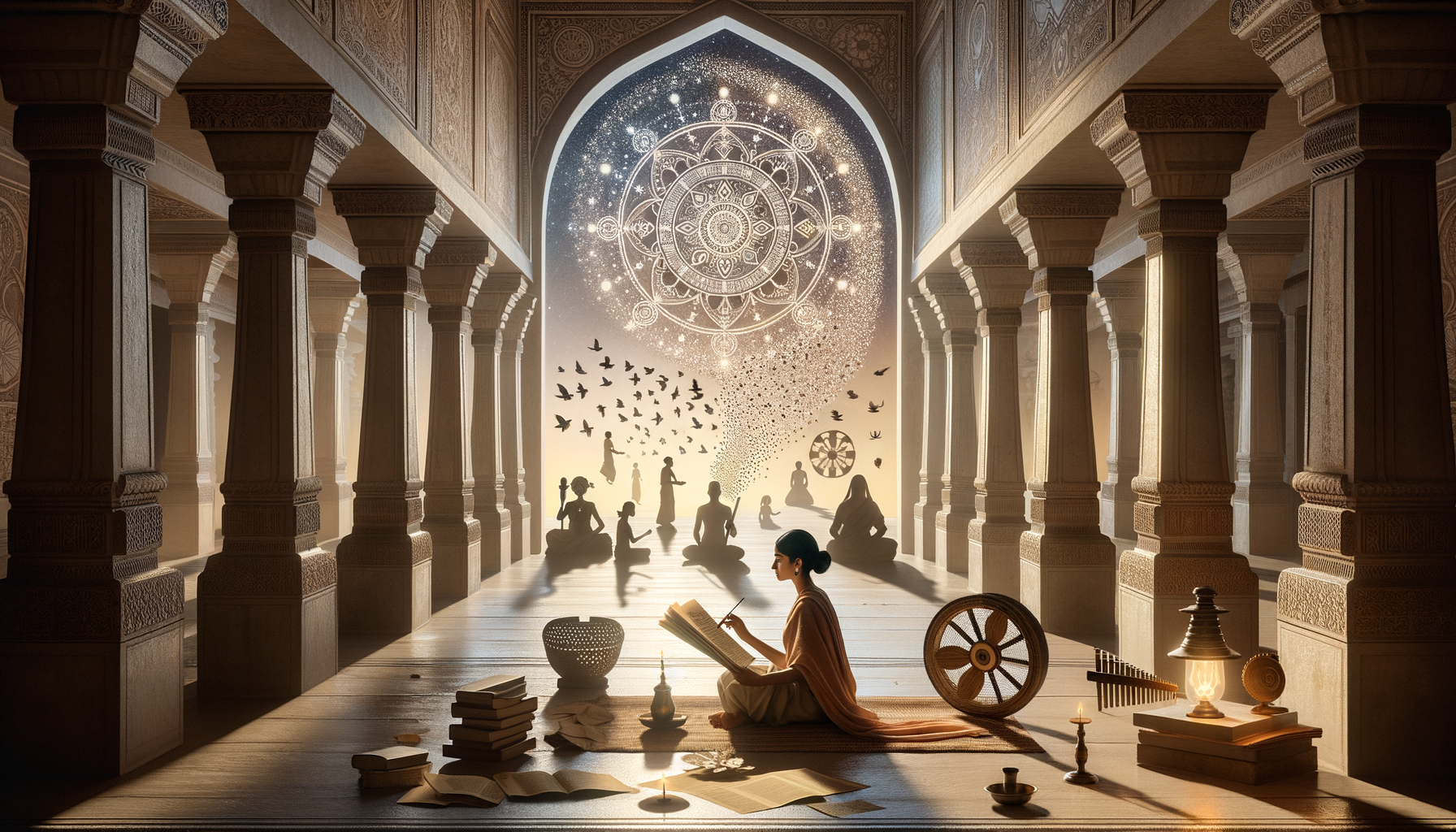
Hinduism and feminism intersect most powerfully in the realm of intellectual freedomfreedom to inquire, to interpret, and to pursue truth beyond social convention. Long before “feminism” became a hashtag or a university course, women within Hindu civilization cultivated rigorous inquiry, debated metaphysics, and questioned both cosmic order and societal norms. Rather than negotiating only material or professional thresholds, they engaged what may be called conceptual ceilings, dismantling the limits that constrain thought, speech, and spiritual aspiration.
From the earliest textual memory, figures such as Gargī Vāchaknavī and Maitreyī in the Upanishads exemplify this tradition of inquiry. Their questions on Ātman, Brahman, and the nature of liberation (moksha) signal a culture that recognized women as capable of shaping philosophical discourse. In later centuries, the Bhakti Tradition amplified this intellectual and spiritual agency through voices like Āṇḍāl, Akka Mahādevī, Mīrābāī, and Lal Dedwomen who contested narrow social scripts by articulating direct, experiential knowledge of the divine.
This freedom was neither accidental nor peripheral; it emerged from core Hindu philosophy. Concepts such as dharma (ethical order), jñāna (knowledge), and the realization of Ātman cultivated a disciplined, reflective mind. The Guru–Shishya Tradition fostered intellectual rigor alongside humility, while the acceptance of Ishtathe legitimacy of multiple valid spiritual pathsnormalized pluralism and the Diversity in spirituality. In such a framework, shattering ceilings meant dissolving avidyā (ignorance) and expanding capacity for viveka (discernment) rather than merely overturning external hierarchies.
Crucially, this intellectual freedom resonates across dharmic traditions. In Buddhism, the Therīgāthā preserves the philosophical insights of bhikkhunīs whose verses reflect a mature understanding of impermanence and liberation. In Jainism, sādhu-sādhvī traditions, grounded in ahiṃsā and stringent ethical discipline, formalized spaces for women’s spiritual and philosophical practice. In Sikhism, the Gurus articulated a principled equality of spiritual dignityan ethos that rejects denigration of women and emphasizes shared access to the highest truth. The unifying thread is clear: dharmic cultures view truth-seeking as a universal human capacity.
Seen through this lens, the metaphor of the “glass ceiling” is reframed. While social reform remains essential, the dharmic contribution emphasizes breaking conceptual barriersfear, internalized constraint, and the subtle assumptions that narrow inquiry. Intellectual freedom becomes a lived practice: questioning respectfully, studying scriptures such as the Upanishads and the Bhagavad Gita, and engaging debates that refine understanding without diminishing the dignity of difference. This is where Hindu philosophy offers enduring resources for Gender equality and WomenEmpowerment.
In lived experience, this ethos often takes root in households and community spaces. Many recall grandmothers who taught verses at dawn, mothers who led bhajan circles, or teachers who encouraged open debate on dharma and ethics. Such settings transmit both knowledge and couragethe quiet confidence to test ideas against reason, experience, and compassion. This is intellectual freedom as practice, not slogan: learning to ask better questions and to receive many answers with maturity.
Today, the same principles enable constructive dialogue across Hinduism, Buddhism, Jainism, and Sikhism. Unity in spiritual diversityrooted in respect for multiple valid pathsstrengthens social cohesion while enriching individual understanding. When communities honor plurality and uphold rigorous inquiry, they protect a space where women and men alike can contribute to philosophy, culture, and ethical public life without erasing distinct identities.
Ultimately, the dharmic vision advances a model of freedom that is inwardly anchored and outwardly responsible. It champions clarity over noise, depth over fashion, and integrity over conformity. By remembering and renewing this inheritancefrom Gargī and Maitreyī to the Bhakti poet-saintscontemporary society can move beyond the merely physical or institutional toward a more complete form of liberation: an intellectual and spiritual freedom robust enough to meet modern challenges with wisdom.
Inspired by this post on Hindu Blog.