

Sathuragiri Aadi Amavasai 2026 falls on Wednesday, August 12, bringing one of Tamil Nadu’s most significant new-moon pilgrimages to the forested hills associated with ‘Sundara Mahalingam’. Thousands of devotees are expected to seek darshan at Sri Sundara Mahalingam Swamy Temple and Sri Sandhana Mahalingam Swamy Temple, making careful preparation as important as religious enthusiasm.
The observance combines three distinct dimensions: remembrance of deceased ancestors, Shaiva temple worship and a physically demanding ascent through protected forest. Its emotional power arises from this convergence. The pilgrim does not simply arrive before a shrine; every step becomes an act of memory, discipline and reverence within a living sacred landscape.
Sathuragiri Aadi Amavasai 2026 date
The principal date is Wednesday, August 12, 2026. Published Tamil calendar calculations place the day within Aadi Masam, which runs from July 17 to August 17 in 2026, and identify August 12 as Aadi 27. The date is also confirmed by the detailed Aadi Amavasai 2026 calendar entry.
Aadi is the fourth month of the traditional Tamil solar calendar and begins around the Sun’s entry into Karka, or Cancer. Aadi Amavasai occurs when the lunar new-moon tithi falls within this solar month. This intersection of solar-month reckoning and lunar tithi calculation is one reason the festival occupies a distinctive place in the Tamil religious calendar.
A tithi is not identical to a midnight-to-midnight civil date. It is calculated from the changing angular distance between the Sun and Moon, with each tithi covering 12 degrees of relative longitudinal motion. Amavasai is the concluding tithi of the waning lunar fortnight, ending at or near the astronomical conjunction. It can therefore begin or end at any hour of a civil day.
Exact tithi times should be taken from a reliable panchangam calculated for the pilgrim’s location. Timings published for another country or city should not automatically be applied in Tamil Nadu, and procedural questions about tarpanam should follow the family’s sampradaya or the guidance of a qualified priest. The festival date is clear, but ritual time windows may be expressed differently by individual almanacs.
Why Aadi Amavasai is spiritually important
Aadi Amavasai is widely associated with gratitude toward forebears and the remembrance of deceased family members. Many Tamil Hindu households perform tarpanam, offering water—often with sesame according to custom—while some traditions undertake more elaborate shraddha observances. These rites express continuity between generations and acknowledge the inherited relationships, duties and values that shape the present.
The observance should not be reduced to a single standardized procedure. Domestic customs differ according to family lineage, region, Vedic affiliation, community practice and the availability of a priest. A concise internet formula cannot responsibly replace those traditions. Where uncertainty exists, the most appropriate course is to consult an elder or priest familiar with the family’s established practice.
At Sathuragiri, ancestral remembrance is joined to worship of Lord Shiva. Devotees approach the hill shrines with prayers for grace, clarity and the welfare of the family line. Special worship may include abhishekam, alangaram, archana and deepa aradhana, but the exact 2026 temple programme must be confirmed through the temple administration rather than inferred from schedules used in earlier years.
The emotional centre of Aadi Amavasai lies in the recognition that individual identity does not begin with one lifetime. Family memory, inherited responsibility and gratitude are brought into the present through disciplined ritual. Even for a devotee unable to perform elaborate ceremonies, sincere remembrance, ethical conduct and respectful prayer retain profound meaning.
Comparable ancestral observances appear under different names across India, including Karkidaka Vavu Bali in Kerala and forms of Shravan or Ashada Amavasya elsewhere. These parallels reveal shared concerns without erasing regional differences. Buddhist, Jain and Sikh communities maintain their own commemorative practices and calendars; dharmic unity is best served by respecting those distinct traditions rather than treating every rite as identical.
The sacred geography of Sathuragiri
Sathuragiri is also written as Chathuragiri and is popularly associated with Mahalingam Hill and ‘Sundara Mahalingam’. One traditional explanation derives the name from chathur, meaning four, and giri, meaning hill, interpreting the landscape as the meeting place of the four Vedas. Another explanation connects it with the square, or chathuram, form attributed to the surrounding hills.
These explanations belong to sacred geography: they communicate how generations of devotees have understood the hills rather than functioning as modern archaeological proofs. The distinction does not diminish their religious value. It allows inherited narratives to be presented honestly as traditions while administrative, environmental and historical claims are evaluated through documentary evidence.
Sathuragiri is also called ‘Siddargal boomi’. Devotional tradition holds that 18 Siddhas lived, meditated or continue to worship Lord Shiva in an unseen form within the hills. The landscape is consequently approached not merely as terrain but as a field of tapas, healing traditions and spiritual attainment. Some Shaiva devotees reverentially describe it as a southern Kailash.
The principal shrines are Sri Sundara Mahalingam Swamy Temple and Sri Sandhana Mahalingam Swamy Temple. Official and English-language records also transliterate the second name as Santhana Mahalingam. Anandavalli Amma Temple stands behind the Sundara Mahalingam shrine, while several guardian and subsidiary shrines occur along or near the recognized approach.
Local tradition regards the Shiva lingams as exceptionally sacred and associates Sundara Mahalingam with worship by the Siddhas. Such claims should be understood within the devotional record. The religious significance of the site is firmly established, but precise claims about extreme antiquity require epigraphic or archaeological evidence beyond oral tradition.
The temples also attract devotees for Thai Amavasai, Chitra Pournami, Maha Shivaratri, Aani Thirumanjanam and Margazhi Thiruvathirai. Aadi Amavasai nevertheless creates an exceptional concentration of pilgrims because ancestor observance, the new-moon tithi and the sanctity of the Shaiva hill temples coincide.
Where Sathuragiri is located
The usual public approach begins at Thaniparai near Vathirairuppu, also written Watrap, in Virudhunagar district. Administrative descriptions can appear contradictory because the foothill approach lies on the Virudhunagar side, while portions of the forest and temple enclosure are associated with Saptur in Madurai district. Coordination between both district administrations is therefore a practical necessity rather than a geographical inconsistency.
The administrative relationship is documented in the Madras High Court’s Sathuragiri judgment, which records that the permitted footpath begins at Thaniparai and that authorities from Madurai and Virudhunagar must coordinate pilgrim management. The distinction is useful when monitoring official notices, since relevant instructions may be issued through either district.
A festival period does not mean unrestricted entry
Older descriptions characterize the Aadi Amavasai celebration as a festival lasting about ten days and sometimes speak of unrestricted climbing. That language must not be treated as current travel authorization. A religious festival period, a temple’s ritual programme and the dates on which the public may enter the forest are separate matters governed by different authorities.
Contemporary access is controlled through a checkpoint, an authorized footpath, specified admission hours and weather-dependent decisions. Directions have changed through court orders and subsequent administrative practice. A time window used during one monthly Amavasai, Pournami or Pradosham period cannot safely be assumed to apply to the larger Aadi festival.
As of July 15, 2026, the festival date of August 12 is confirmed, but this guide does not treat any secondary website’s proposed multi-day entry window as a final government authorization. Pilgrims should consult the Virudhunagar District press-release archive, the Madurai district administration, the Forest Department and the Tamil Nadu Hindu Religious and Charitable Endowments Department shortly before departure.
Admission hours, climbing dates, transport arrangements, parking controls and prohibited articles may be announced only near the festival. Heavy rain, a dangerous stream level, wildlife movement or another emergency can produce a same-day suspension. The district administration’s safety decision is final, and possession of a travel booking does not create a right to enter when the route is closed.
A pilgrimage inside a protected forest
Sri Sundara Mahalingam Swamy Temple is approached through the Saptur Reserve Forest, within the wider Srivilliputhur–Megamalai Tiger Reserve landscape. Government environmental records identify elephants, wild boar, deer, monkeys and grizzled giant squirrels in the area. The reserve is not an ornamental backdrop to the pilgrimage; it is a sensitive habitat with legal and ecological limits.
A government biodiversity impact assessment places the temple route within this protected setting and explains why regulated access is necessary. Pilgrim rights and forest conservation are not opposing principles: safe worship depends upon preserving the very landscape that gives the pilgrimage its sacred character.
The Madras High Court has similarly emphasized a balance between religious access, public safety and constitutional duties toward forests and wildlife. Its directions include using only the permitted path, counting entrants and those returning, preventing unauthorized night stays, prohibiting litter and screening visitors at the forest checkpoint.
The same judicial record describes the grave consequences of heavy rain on May 17, 2015, when approximately 4,000 pilgrims were reported stranded and 15 people died during a flash flood. This history explains why apparently strict weather closures must be taken seriously. Rain falling upstream can transform a stream crossing rapidly even when conditions at the foothill initially appear manageable.
Government documents have recommended steel bridges at stream crossings on the Thaniparai–Sundara Mahalingam route. A 2025 forest-clearance recommendation concerns three bridge locations and forms part of wider safety planning. A proposal or clearance recommendation is not proof that every bridge has been completed, so pilgrims should still prepare for a rugged, weather-sensitive path.
The Sathuragiri trek from Thaniparai
Published route lengths vary according to the points measured. The Srivilliputhur Municipality guide describes an uphill journey of about eight kilometres, while infrastructure documents refer to a route of approximately seven kilometres. A prudent plan should therefore allow for roughly seven to eight kilometres of walking each way rather than relying on the shortest quoted figure.
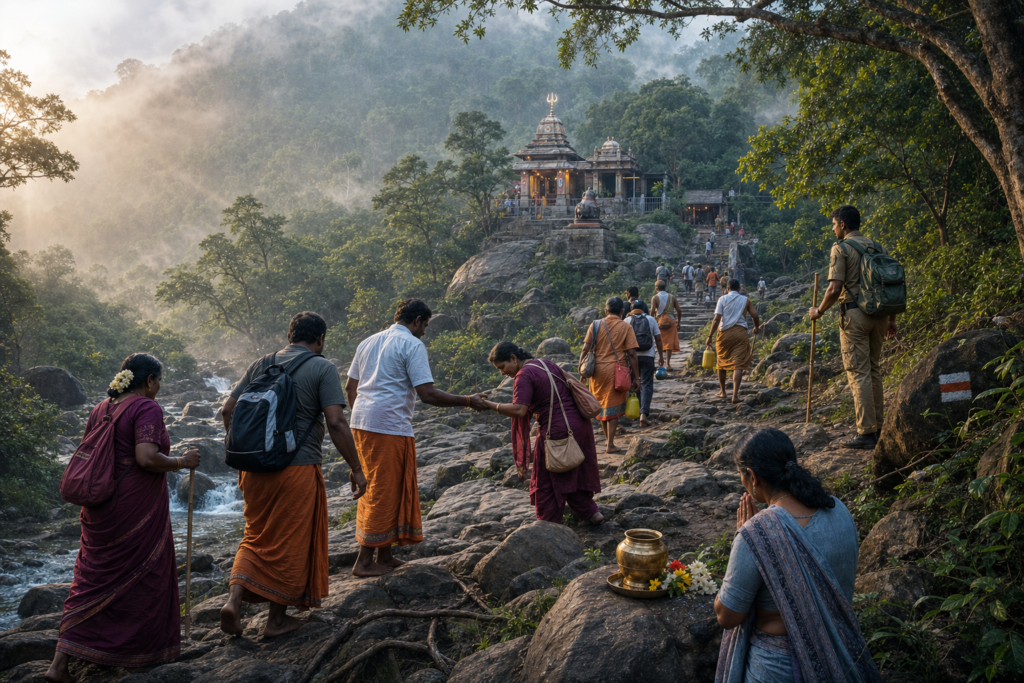
The path is not a level road. It contains rocky gradients, narrow sections, slippery surfaces and stream crossings. Heat, humidity, crowd density and waiting time can make the effort substantially greater than the distance suggests. Descent also requires concentration because tired legs and polished or wet rock increase the risk of a fall.
Municipal route descriptions identify traditional points such as Kudhiraiootru, Vazhakkuparai, Sangali Parai, Gorakkar Cave, Irattai Lingam, Vanadurgai Temple and Pilavadi Karuppasamy Temple before the principal shrine area. Transliteration and local pronunciation vary, and the sequence should be treated as cultural orientation rather than a substitute for signs or official instructions on the ground.
Sri Sundara Mahalingam Swamy Temple is reached before the further ascent toward Sri Sandhana Mahalingam Swamy Temple. Descriptions of additional caves, lingams or remote sacred points should not encourage detours. Only officially permitted areas should be visited, especially during a crowded festival when leaving the marked path creates risks for the pilgrim, wildlife and rescue personnel.
The ascent should consequently be understood as a regulated pilgrimage rather than recreational trekking. Speed is less important than steady movement, awareness and compliance. A pilgrim who turns back because of fatigue, weather or an official instruction has not failed spiritually; recognizing physical and environmental limits is itself an expression of responsibility.
How to reach the Thaniparai foothill
Srivilliputhur is the most commonly cited nearby railway station. From Srivilliputhur, travellers proceed toward Vathirairuppu and then Thaniparai, the authorized base for the ascent. Published local guidance places Thaniparai approximately 28 kilometres from Srivilliputhur and about 80 kilometres from Madurai, although the actual road journey depends on the chosen route.
Madurai functions as the principal regional air, rail and intercity-bus hub. Travellers arriving from southern Tamil Nadu may approach through Tirunelveli, Rajapalayam and Srivilliputhur. Festival-day diversions, temporary bus services and remote parking areas may change the final segment, so ordinary map estimates should not be treated as reliable arrival times during Aadi Amavasai.
Accommodation should be arranged in a lawful facility outside the protected route. No traveller should assume that camping, sleeping at the foothill or staying overnight near the hill temples will be permitted. If an official notice sets a morning checkpoint time, arriving in the wider area on the preceding day can reduce transport uncertainty without creating pressure to enter before authorization.
Essential preparation before the pilgrimage
1. Verify access repeatedly. The first check should be made while planning, the second on the evening before travel and the final check before leaving for Thaniparai. The official notice should be read in full because a headline may omit entry cut-off times, age-related advice, weather conditions or newly prohibited materials.
2. Prepare for a full hill journey. Regular walking and stair climbing in the weeks before the festival can help establish realistic fitness. Anyone who becomes breathless during ordinary exertion should not assume that devotional determination will compensate for inadequate conditioning on a steep, crowded trail.
3. Evaluate health honestly. People with heart or respiratory disease, uncontrolled blood pressure, recent surgery, serious joint problems or other conditions affected by exertion should obtain individualized medical guidance. Prescribed medication should remain with the patient, not in a bag carried by someone who may become separated in the crowd.
4. Use appropriate clothing and footwear. Lightweight, modest clothing that permits free movement is preferable. Footwear should provide grip and already be broken in; festival day is not the time to test new shoes. Footwear can be removed where temple protocol requires it, but the rocky approach demands protection and stability.
5. Carry only permitted essentials. A compact load reduces fatigue and makes checkpoint inspection easier. Water, necessary medicine, simple permitted food, a charged telephone, basic identification and minimal first-aid supplies are generally more useful than ceremonial or travel items that add weight. The container used for water must comply with that year’s forest instructions.
6. Do not depend entirely on stalls or Annadhanam. Annadhanam is an important expression of service during the festival, but quantity, location and availability can change with crowd conditions and official restrictions. Pilgrims should have a lawful, minimal hydration and nutrition plan while avoiding food packaging that generates waste or attracts monkeys.
7. Respect prohibited-material rules. Court directions specifically identify polythene, plastics, matchsticks, flammable materials and combustible articles as prohibited. Forest staff may inspect bags at the checkpoint. Camphor, incense, cooking fuel or other objects associated with worship elsewhere must not be carried into a protected forest when officials forbid them.
8. Treat weather as a safety system. A rain forecast, official closure or rising stream is not an inconvenience to negotiate around. Pilgrims should never cross a swollen channel, climb around a barricade or seek an unofficial forest path. Conditions higher in the catchment may be dangerous before visible rain reaches Thaniparai.
9. Keep the group manageable. Family members should agree upon a meeting point at the foothill and keep children within physical reach. Each person should carry essential identification and a contact number. Large informal groups can fragment at queues and narrow passages, so a simple head count at regular intervals is valuable.
10. Plan the descent as carefully as the ascent. Entry cut-off time is not a target arrival time. Starting early within the authorized window preserves daylight and a margin for queues, darshan and rest. Pilgrims should begin descending when directed and should not delay for unauthorized exploration or photography.
Environmental discipline is part of the vrata
Nothing should be left on the trail—not bottles, food wrappers, cloth, flowers, coconuts, ritual residue or sanitary waste. Biodegradable material is not automatically harmless in a wildlife habitat; discarded food changes animal behaviour and can increase encounters between wildlife and people. Every item carried in should return to an authorized disposal point unless temple staff expressly receive it.
Wild animals must not be approached, photographed at close range or fed. Monkeys can become aggressive around visible food, while larger animals require immediate distance and obedience to forest personnel. Loud music, shouting and unnecessary noise weaken both the contemplative character of the pilgrimage and the ecological protection expected within the reserve.
Open flames and unauthorized cooking create a serious forest-fire risk. The same restraint applies to smoking and the careless disposal of batteries or other hazardous items. A sacred geography is honoured most convincingly when religious practice leaves no material injury behind.
Ritual participation at Sathuragiri
Many families complete ancestral rites at home, at an established water body or under priestly guidance before undertaking temple darshan. Others integrate remembrance into their prayers at the hill. Neither approach should be presented as universally mandatory, because ritual competency, family custom and local temple rules determine what is appropriate.
Tarpanam should not be improvised in a stream merely because water is present. Forest streams are part of a sensitive catchment and may be unsafe, environmentally protected or outside an authorized ritual area. Offerings should be made only where permitted and according to qualified guidance, without releasing plastic, cloth, oil, food or non-biodegradable objects into the landscape.
At the shrines, orderly queueing is itself an ethical practice. Devotees should follow the instructions of temple personnel, avoid obstructing movement and accept that crowded darshan may be brief. The spiritual value of worship does not depend upon remaining before the deity longer than safety and fairness allow.
Annadhanam represents the dharmic principle that service to pilgrims is sacred. Those receiving food should take only what can be consumed, avoid waste and place utensils or refuse exactly where volunteers direct. Hospitality and ecological restraint reinforce each other when food service is conducted within authorized arrangements.
A realistic pilgrimage sequence
On the preceding evening, the pilgrim should verify that access remains open, review the official cut-off time, monitor the weather and pack minimally. Transport to the authorized base should allow a substantial buffer for traffic controls. Adequate sleep is more useful than an exhausting overnight journey followed immediately by a steep climb.
At Thaniparai, every traveller should enter only through the official checkpoint, submit to inspection and listen carefully to route instructions. The group should begin at a sustainable pace rather than attempting to overtake the initial crowd. Short rests should be taken away from narrow bottlenecks and without blocking those descending.
Near the temple area, darshan at Sri Sundara Mahalingam Swamy Temple should be completed in accordance with queue controls. A further visit to Sri Sandhana Mahalingam Swamy Temple should be attempted only if the route remains open, health is adequate and officials indicate that sufficient time remains for descent.
The return should begin before exhaustion becomes severe. At the foothill, the group should confirm that every member has exited and comply with any head-count procedure. The pilgrimage concludes not at the summit but with the safe return of all participants and the responsible removal of everything they carried.
If rain or an official order closes the route, prayer at home or at an accessible Shiva temple remains a meaningful observance. Aadi Amavasai does not require defiance of safety instructions. Rescheduling the Sathuragiri visit to another authorized period preserves both life and the dignity of the pilgrimage.
Frequently asked questions
When is Sathuragiri Aadi Amavasai in 2026? It is observed on Wednesday, August 12, 2026. The applicable ritual time should be checked in a Tamil Nadu panchangam and, where relevant, with the family priest.
Are the 2026 climbing dates and hours confirmed? The festival date is confirmed, but the final multi-day public-access window and daily checkpoint hours remain subject to official notification. Secondary websites should not be treated as substitutes for district, Forest Department or HR&CE instructions.
Where does the recognized trek begin? The public approach begins at the Thaniparai checkpoint near Vathirairuppu in Virudhunagar district. Entry through an unofficial path is unsafe and contrary to forest regulation.
How long is the Sathuragiri trek? Published figures vary, but a practical estimate is approximately seven to eight kilometres uphill and a similar distance back. Terrain, queues, weather and physical condition matter more than the nominal distance.
Is this suitable for an inexperienced walker? The route is physically demanding and includes steep, rocky and potentially slippery sections. An inexperienced walker should prepare in advance, travel with a responsible group and be willing to turn back when conditions or health require it.
Can older adults and children participate? Age alone does not determine fitness, but the environment demands individualized judgment. The family should consider endurance, medical conditions, crowd density, heat and the absence of immediate road access on much of the route rather than relying upon religious enthusiasm alone.
Is overnight stay permitted? No pilgrim should assume so. Court and administrative directions have addressed unauthorized night stays, and festival-specific permission can be tightly controlled. The current official notice must govern the plan.
What should not be carried? Polythene, prohibited plastics, matchsticks, flammable or combustible materials and anything barred by the current notice should be left behind. Bags may be inspected at the forest checkpoint.
Must every visitor perform ancestral rites? No single ritual format applies to every devotee. A person may visit primarily for Shiva darshan, while families observing tarpanam or shraddha should follow their inherited practice and qualified guidance.
Why do spellings such as Sathuragiri, Chathuragiri, Sandhana and Santhana differ? They are English transliterations of Tamil names and vary across publications and government records. The variants generally refer to the same hill and temple complex rather than separate destinations.
A pilgrimage of memory, restraint and responsibility
Sathuragiri Aadi Amavasai is powerful because it brings ancestral memory into a landscape associated with Lord Shiva and the Siddhas. The ascent gives physical form to devotion: progress is gradual, effort is shared and the destination cannot be separated from the discipline required to reach it.
Its deepest lesson is not measured by crowd size or the length of darshan. It is found in gratitude toward earlier generations, compassion toward fellow pilgrims and restraint within a vulnerable forest. When those principles guide the journey, the 2026 Aadi festival can remain spiritually meaningful, environmentally responsible and safer for everyone who approaches the sacred hills.
Calendar information and the original festival description were cross-checked with the Sathuragiri Aadi Amavasai source page and the Aadi Masam 2026 calendar. Travel and safety claims were evaluated against municipal information, court records and government forest documents. Because operational directions can change, the latest official notice always takes precedence over this guide.
Inspired by this post on Hindu Pad.










Leave a Reply
You must be logged in to post a comment.