
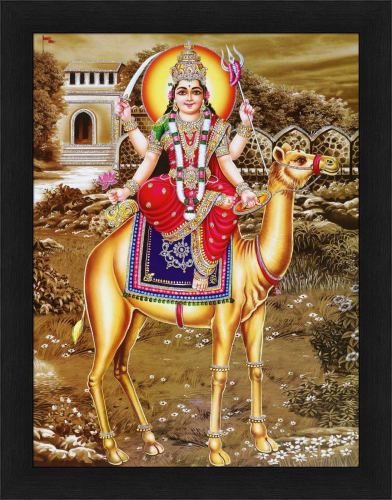
Dashama Vrat 2026: a ten-day Gujarati observance of Shakti
Dashama Vrat 2026 in Gujarat will be observed from Thursday, August 13, through Saturday, August 22. Also known as Dasha Maa Vrat and Dashama na Naurta, this ten-day observance is dedicated to Dasha Maa, a regional manifestation of Goddess Shakti associated with courage, protection, prosperity and the overcoming of difficult circumstances. Its devotional structure combines a religious vow, dietary restraint, daily puja, narration of the Dashama Vrat Katha, family participation and a concluding jagran or visarjan according to local custom.
Although the date range appears straightforward, the observance belongs to a lunar calendar rather than a fixed Gregorian cycle. Understanding the Gujarati panchang, the distinction between Amavasya preparation and Shravan observance, and the diversity of household customs prevents the festival from being reduced to a single rigid ritual formula.
Dashama Vrat 2026 dates at a glance
The formal ten-day sequence begins on August 13, 2026, corresponding to Shravana Sud Padvo, or Shukla Pratipada, in the Gujarati lunar calendar. It concludes on August 22, corresponding to Shravana Sud Dasham, or Shukla Dashami. Counting both the opening and concluding dates gives ten civil days. In the Gujarati Vikram Samvat system used by many regional panchangs, the observance falls in Samvat 2082.
A tithi is not simply another name for a twenty-four-hour date. It is calculated from each twelve-degree increase in the angular separation of the Sun and Moon. Because a tithi may begin or end at any time of day, panchangs generally associate a religious day with the tithi prevailing at the relevant local sunrise. This astronomical method explains why festival dates must be recalculated every year.
Gujarat generally follows an amanta lunar convention in which a new month begins after Amavasya. Ashadha Amavasya falls immediately before the opening of Shravan in 2026, and August 13 is recognized as Shravan Sud Padvo in Gujarat. The ten-day Dashama Vrat sequence therefore extends through Sud Dasham on August 22.
Precise tithi boundaries and sunrise-based assignments depend on location. Families in Ahmedabad, Rajkot, Vadodara, Kutch or outside India should use a panchang calculated for their city when recording a formal sankalpa or selecting an exact puja time. The August 13–22 range applies to the established 2026 observance in Gujarat, but diaspora communities should still verify local calendrical conditions.
Some traditions perform Dashama Sthapana on Ashadha Amavasya, often associated with Divaso, before counting the ten days from Shravan Sud Padvo. In 2026, such preparation may occur on August 12. This does not necessarily contradict the August 13 opening date: one custom emphasizes the preliminary installation, while another identifies the first full day of Shravan as the beginning of the vrata. Family parampara should determine which convention is followed.
Who is Dasha Maa?
Dasha Maa belongs to the richly localized Shakti traditions of western India, especially Gujarat. She is approached as a protective mother whose grace is sought during periods of uncertainty, material difficulty, illness, domestic strain or social instability. Statements that she grants prosperity or removes adversity represent devotional beliefs; they should be understood within the theological language of the vrata rather than as guaranteed material outcomes.
Regional identifications are not completely uniform. Some communities identify Dasha Maa closely with Momai Maa or Ashapura Maa, while others honor Momai Maa and Nagbai Maa alongside her as related but distinct divine forms. Certain observances also include reverence for the Peepal tree. These variations illustrate how Gujarati Hindu practice develops through family lineages, village traditions, temple customs and oral narratives rather than through one centralized ritual authority.
Popular iconography often depicts Dasha Maa with four arms and a camel as her vahana. The camel is especially meaningful within the ecological and cultural setting of western Gujarat and Kutch, where endurance, mobility and survival in demanding terrain are familiar themes. Iconographic details may vary between temples and household images, so one representation should not be treated as the only permissible form.
In popular devotional explanation, dasha refers to a person’s condition, fate or difficult phase. The name is consequently interpreted as expressing the goddess’s power to improve an unfavorable state. Some devotees also connect it with an adverse astrological dasha. Such explanations illuminate lived belief, but they do not establish one uncontested etymology or turn the vrata into a mechanical astrological remedy.
For a devotee experiencing uncertainty, this theology can have a deeply relatable emotional dimension. Ten days of measured discipline do not eliminate every external problem, but they can create a stable rhythm in which fear is named, responsibility is reconsidered and hope is sustained. Dasha Maa consequently represents both divine protection and the inner capacity to meet adversity with steadiness.
What the word vrata means in practice
A vrata is more comprehensive than fasting alone. It is a chosen religious discipline organized around sankalpa, bodily restraint, worship, remembrance and ethical conduct. Food restrictions support the vow, but they do not replace truthfulness, patience, cleanliness, compassion or responsible behavior. A severe fast performed without reflection would therefore capture only one part of Dasha Maa Vrat.
The sankalpa expresses the purpose and duration of the observance. A devotee may pray for peace, health, family welfare, resilience or relief from hardship, while acknowledging that religious practice is not a commercial exchange with the divine. In an academic reading, the sankalpa converts a general desire for change into a defined period of attention and self-regulation.
Women, particularly married women, often lead Dashama Vrat in Gujarati households, but the festival can also involve spouses, children and extended family members. Public pandals and temples add a communal dimension through aarti, bhajans and katha recitation. The observance therefore moves between domestic devotion and collective cultural identity without requiring every participant to undertake the same dietary austerity.
Preparing for Dashama Sthapana
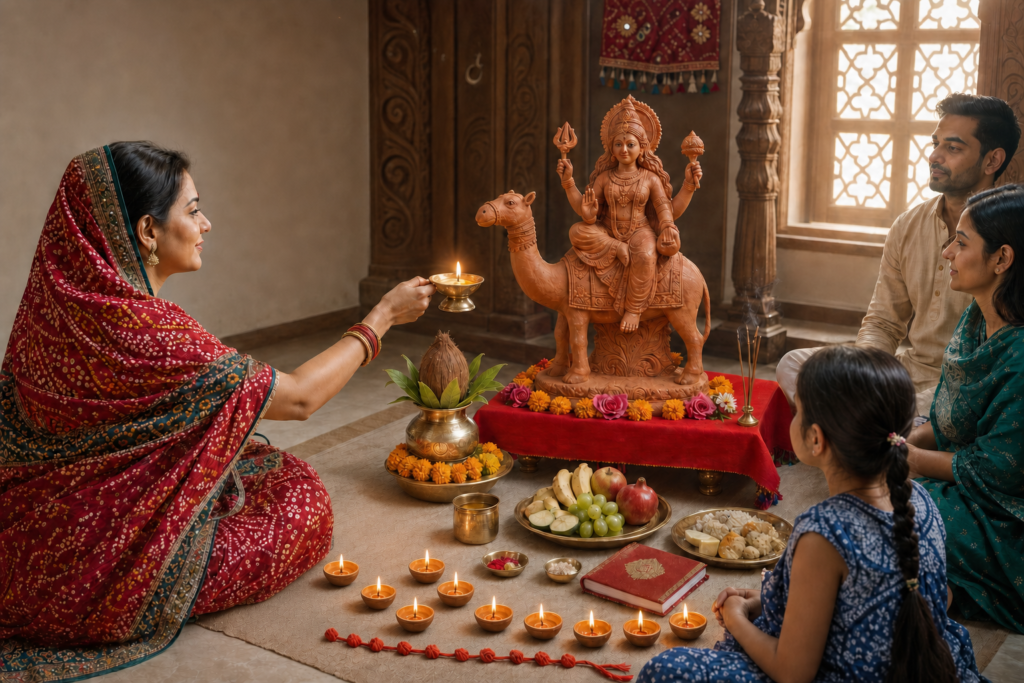
Preparation should begin by identifying the household’s established procedure. The family may use a temporary clay murti, a Sandhani representation associated with Dasha Maa, or a framed image. A clean and stable altar space is then arranged, usually with a fresh cloth, lamp, incense, flowers, kumkum, unbroken rice, fruit, water, prasad ingredients and the text or recording used for the Dashama Vrat Katha.
Documented customs include offerings of wheat and betel leaves, as well as a red kautuka thread tied on the right wrist with ten knots. The ten knots visibly recall the ten-day commitment. These elements are customary rather than universally compulsory, and substitutions should be guided by a knowledgeable family elder, temple priest or community tradition rather than by improvised claims circulated online.
Some households keep a ghee lamp burning throughout the vrata, while others light it only during morning and evening worship. A continuously burning lamp should never be maintained where children, animals, fabric or an unattended room create a fire hazard. Safe devotion is not spiritually inferior; care for life and property is itself a religious responsibility.
An environmentally responsible setup favors an unpainted or naturally colored clay image, reusable metal or earthen puja vessels, seasonal flowers and minimal plastic. Decorations containing glitter, thermocol, synthetic foam or toxic paint complicate immersion and can damage waterways. The material form of worship should reflect the principles of restraint and non-harm embodied by the vow.
Where the family performs installation, the space is cleaned, Lord Ganesha is remembered at the beginning, and Dasha Maa is respectfully invoked into the temporary sacred setting. The devotee then states the sankalpa for ten days. The exact language may be Sanskrit, Gujarati or a familiar devotional language; sincerity and continuity matter more than reciting unfamiliar words without comprehension.
Dashama Vrat 2026 puja vidhi for daily worship
A careful daily sequence begins with bathing, wearing clean clothes and preparing the altar. After a brief moment of mental quiet, the devotee remembers Ganesha, renews the intention of the vrata and offers respectful attention to Dasha Maa. A lamp and incense may then be lit, followed by water, kumkum, rice, flowers and the food offerings recognized by the household tradition.
Wheat and betel leaves are frequently mentioned in descriptions of Dashama worship, while fruit, sweets or a simple cooked preparation may be offered as prasad. Every item should be clean, ethically obtained and suitable for later consumption or responsible disposal. Excessive offerings that are ultimately wasted are inconsistent with the vrata’s discipline.
The Dashama Vrat Katha may be read or heard each day, followed by aarti, bhajans or a family-recognized mantra. There is no need to invent a supposedly mandatory mantra when the household tradition does not preserve one. Clear pronunciation, understood meaning and reverence are preferable to hurried repetition undertaken only to reach a numerical target.
After worship, prasad is shared respectfully and the altar is kept orderly. Many families repeat a shorter form of the same procedure in the evening. The repetition is significant: a familiar lamp, the same story and a few minutes of shared silence can transform ten ordinary evenings into a memorable period of family cohesion.
Daily worship should be accompanied by disciplined conduct. Avoiding unnecessary anger, harsh speech, deception, food waste and deliberate harm gives the vrata an ethical foundation. Charity or community service may also be undertaken quietly, but no fixed payment or public display is required for the observance to be meaningful.
Dashama Vrat fasting rules and responsible adaptation
Published accounts describe several fasting patterns. A common form is a partial fast with one simple meal a day, sometimes called ek tanu. Some traditions emphasize wheat-based food, while others permit fruit, milk or foods accepted in the family’s vrata practice. The person undertaking the vow should decide on a sustainable discipline before the opening sankalpa rather than changing rules impulsively each day.
More severe abstention, including a complete fast, is reported in some communities but is not the universal standard and should not be treated as proof of greater devotion. The purpose is trained restraint, not injury. A modest observance maintained calmly for ten days may be more faithful to the vrata than an extreme restriction that causes illness, irritability or abandonment.
Pregnant or breastfeeding people, children, older adults, those with diabetes, kidney disease, eating disorders or other medical conditions, and anyone taking medication with food should adapt or avoid fasting under qualified medical guidance. They may participate through puja, katha, aarti, vegetarian simplicity, charity or another safe discipline. Medical care should never be delayed or discontinued in the belief that ritual alone will resolve illness.
How the ten days are structured
Unlike some festivals with a standardized deity, color or offering assigned to every date, Dashama Vrat does not have one universally documented ten-day chart accepted across Gujarat. Families should be cautious of attractive day-by-day schedules that present recent inventions as ancient obligations. The stable core is the ten-day vow, daily worship, fasting discipline, katha and concluding observance.
The opening phase centers on sthapana, sankalpa and the establishment of a workable routine. The devotee decides when worship and the permitted meal will occur, arranges responsibilities and begins the katha. This early planning is practical as well as spiritual because consistency becomes difficult when the vow is treated as an addition to an already crowded schedule.
The middle days test continuity rather than novelty. Puja is repeated, dietary boundaries are maintained and attention is directed toward speech and conduct. This phase often reveals the vrata’s psychological value: enthusiasm may diminish, yet the devotee learns to continue without depending on a constantly changing emotional state.
The final days prepare the household for completion. The altar is refreshed, the concluding katha or aarti is arranged, and plans are made for jagran, prasad and a lawful, environmentally safe visarjan where applicable. On August 22, the tenth day, gratitude and orderly completion are more important than adding elaborate rituals unsupported by local tradition.
Dashama Vrat Katha: narrative and ethical meaning
The widely circulated Dashama Vrat Katha tells of King Vijay Singh and his spiritually inclined queen, Roopmati, who lived in a palace known as Jal Mahal. From a window, the queen saw women worshipping Dasha Maa. Curious about their practice, she learned about the vrata and decided to undertake it with devotion.
The king objected and disparaged the observance as a practice associated with poor people. Within the sacred narrative, his contempt brings a reversal of fortune. Orchards lose their abundance, sweets offered during a visit turn into stones, royal security collapses and the king is eventually imprisoned by a neighboring ruler.
In confinement, Vijay Singh recognizes his arrogance and his disrespect toward both the goddess and her devotees. He turns to Dasha Maa, observes the ten-day vrata and reforms his attitude. His lost prosperity is ultimately restored. The katha thus presents recovery as inseparable from humility, repentance and renewed reverence.
The story belongs to devotional and oral tradition and should not be presented as a verified political chronicle. Its authority is ethical and religious. The drying orchard can be read as the loss of sustaining abundance; sweets becoming stones suggest generosity emptied of sincerity; imprisonment represents the confinement created by pride; and restoration follows an honest change in conduct.
A particularly important theme is social dignity. The king’s error is not simply failure to perform a ritual; it is his contempt for worshippers whom he considers beneath him. The katha challenges the assumption that wealth or status grants spiritual superiority. In this reading, Dasha Maa protects devotional sincerity while exposing the instability of pride.
Jagran, Dashama Visarjan and udyapan
The final observance commonly includes aarti, bhajans, katha recitation and jagran, or devotional wakefulness during the night. Jagran should be understood as attentive remembrance rather than a competition in exhaustion or volume. Communities should respect neighborhood rules, older participants, children and people who need rest.
A temporary clay murti may be carried for visarjan after the concluding worship. The immersion symbolizes a respectful farewell to the installed form and the continuation of divine presence beyond the physical image. A framed picture or permanent household murti is normally retained and should not be immersed merely because a temporary image would have been.
Modern visarjan should follow municipal instructions and use designated tanks or approved facilities whenever available. Natural clay images without chemical paint are preferable, and plastic decorations should be removed before immersion. No participant should enter unsafe water, overload a vehicle or create hazardous crowding. Ecological responsibility gives practical form to reverence for life.
Some lineages observe Dashama Vrat for five consecutive years and complete the cycle with an udyapan. Published descriptions mention a silver Sandhani, dakshina, food sharing or another concluding gift in certain communities. None of these should be declared universally mandatory. The appropriate completion follows the original sankalpa and the custom under which the vow was begun.
The religious, psychological and social significance of Dasha Maa Vrat
Theologically, the vrata expresses Shakti as protective and transformative power. Dasha Maa is not approached only as a distant cosmic principle; she is addressed as a mother present in the uncertainties of household life. The observance links prosperity with ethical conduct, suggesting that well-being includes humility, restraint, gratitude and responsible relationships rather than wealth alone.
Psychologically, a ten-day vow provides structure during adversity. Regular worship marks time, dietary discipline reinforces intention, and the katha gives hardship a narrative through which remorse and recovery can be considered. These effects do not replace professional medical, financial or psychological help, but ritual can coexist with appropriate practical action.
Socially, shared aarti, prasad preparation and storytelling transmit memory between generations. Children learn not only the name of a goddess but also the local vocabulary of Shravan, tithi, sankalpa, katha and visarjan. At the same time, responsible families can explain that customs vary and that unfamiliar forms of worship deserve respect rather than ridicule.
Dashama Vrat remains specifically a Gujarati Hindu Shakti observance, yet its ethical emphases on self-restraint, humility, compassion, service and care for the natural world resonate across Hindu, Buddhist, Jain and Sikh traditions. Recognizing such shared values can strengthen dharmic unity without erasing the distinct theology, history or ritual identity of any community.
Regional variations should not be confused
In Gujarat, the relevant Dashama Vrat is associated with the beginning of Shravan and follows the August 13–22 schedule in 2026. In Rajasthan and some other parts of North India, a Dasha Mata Vrat may be observed in Chaitra after Holi. Similar names do not establish identical calendars, narratives or puja procedures, so regional practices should be described separately.
The expression Dashama na Naurta can also cause confusion with the better-known Sharad Navratri. It is a popular name for this Dasha Maa observance and does not relocate it to the autumn Navratri calendar. Search results or social-media instructions that merge the two festivals should be checked against a Gujarati panchang and a recognized local tradition.
Practical questions about Dashama Vrat 2026
Women often lead the vrata, but men and other family members may participate in puja, katha, aarti, food preparation and service according to household custom. Children should not be pressured into unsafe fasting. Their participation can center on listening to the story, helping maintain the altar and learning respectful environmental practices.
A family without a clay murti may worship a clean framed image if its tradition permits. The image remains in the home after the festival, and no visarjan is required. A temporary installation should not be purchased merely from fear that worship without an expensive object is invalid.
If illness, travel or an unavoidable emergency interrupts one day, the devotee should not panic or conceal the difficulty. Worship may be resumed with a sincere acknowledgment, while an elder or priest can advise on any customary completion. The katha itself emphasizes correction after error, making honest recommitment more appropriate than guilt-driven excess.
There is no single universal clock time for every Dashama puja. Morning worship after bathing and evening aarti are common, but a formal muhurta or sankalpa should be based on the local panchang. Devotees outside Gujarat should not copy Indian clock times because sunrise and tithi assignment are location-sensitive.
The most common practical errors are treating one household custom as binding on all devotees, beginning a medically unsafe fast, purchasing a chemically painted immersion idol, leaving a lamp unattended, wasting food and presenting the katha as documented political history. Avoiding these errors preserves devotion while improving accuracy, safety and environmental responsibility.
A reflective conclusion
Dashama Vrat 2026 offers more than a calendar entry between August 13 and August 22. Its ten days bring together the Gujarati lunar calendar, regional Shakti theology, family memory, disciplined fasting and an enduring story about the consequences of arrogance. The observance becomes most meaningful when reverence for Dasha Maa is expressed through humility, safe practice, social respect and responsible care for the environment.
For families facing a difficult phase, the vrata can provide a measured passage from anxiety toward steadiness. Its deepest promise is not that every hardship will disappear on command, but that adversity can be met with devotion, accountability and communal support. That combination explains why Dasha Maa continues to hold an intimate place in the religious life of Gujarat.
Research and calendrical note: The date sequence and customary details were synthesized from the supplied HinduPad account of Dashama Vrat, the 2026 Dashama Vrat date listing, a Gujarati overview of the rituals and katha, and the 2026 Gujarati panchang for Vadodara. These references support the ten-day Shravan framework while also documenting variations in Amavasya preparation, fasting and household ritual.
Inspired by this post on Hindu Pad.







Leave a Reply
You must be logged in to post a comment.