
Open Magazine’s July 10, 2026 report on Sanskrit’s contemporary revival documents an unusual convergence of machine learning, community conversation, literary experimentation and cultural memory. Sanskrit is appearing in text-to-speech systems, online classrooms, social-media comedy, popular music, public parks and even motorcycle journeys. These developments do not amount to a simple return to an earlier age. They reveal a language being adapted to new institutions, technologies and forms of attention while remaining connected to oral transmission, philosophical inquiry and sacred practice.
The revival begins with sound. Before a learner understands a verse of the Bhagavatam, the verse is encountered as an acoustic structure: short and long syllables, pauses, consonantal contrasts, breath groups and metre. Meaning matters, but it does not arrive alone. A shloka is also a disciplined event in time, shaped by generations of recitation. This is why a technically fluent synthetic voice can still sound wrong if it ignores syllabic quantity, aspiration, retroflex consonants or the cadence associated with parayana.
That relationship between sound and meaning explains why the present movement cannot be measured only through census figures, university enrolment or social-media reach. Sanskrit now occupies several overlapping lives. It remains a liturgical and philosophical language, a subject of formal scholarship, a source language for Indian Knowledge Systems, a field for computational research, a creative medium and, for a modest but energetic community, a language of everyday conversation. Its future depends on whether these spheres can reinforce one another without flattening the language’s historical depth or plural inheritances.
A machine learns the cadence of a shloka
Prathosh AP, an assistant professor of machine learning at the Indian Institute of Science in Bengaluru, approached Sanskrit recitation as both an engineering problem and a preservation problem. During a semester break, he created Vagdhenu, a system designed to convert a metrical Sanskrit verse into a chant resembling traditional parayana. Its large-scale deployments include approximately 18,000 verses of the Bhagavatam and 5,183 verses of Mahabharata Tatparya Nirnaya. The achievement is significant because ordinary text-to-speech systems are optimized for intelligible speech, not for the structured timing and phonological care demanded by classical chanting.
The response reported at the time was substantial: roughly two million page hits worldwide and about 1,500 model downloads. Such numbers indicate curiosity and discoverability rather than verified fluency, but they show that an apparently specialized tool can attract a geographically dispersed public. Some users approached it for chanting, while others treated repeated listening as an aid to conversational Sanskrit. A system conceived as a recitation engine had therefore begun to suggest the outline of a tutor.
The official Vagdhenu technical description shows why this is more than a conventional voice generator. The system is built on a flow-matching text-to-speech backbone. In simplified terms, a neural network predicts the acoustic representation of the requested utterance, usually in the form of a mel spectrogram, while a neural vocoder converts that representation into a waveform. Vagdhenu adds a Sanskrit-specific processing layer around this general architecture so that the generated audio responds to metre, orthography and pronunciation rather than merely producing plausible speech.
One of its most instructive design choices concerns script. Indic speech models trained across several languages may associate Devanagari input with pronunciation patterns learned primarily from Hindi. That can introduce Hindi-style schwa deletion, in which an inherent vowel represented by the script is suppressed according to Hindi phonology even when Sanskrit requires a different realization. Vagdhenu therefore routes Sanskrit internally through Kannada orthography. This is not a claim that Kannada script is inherently superior; it is an engineering workaround for bias in the base model’s training and language-to-script associations.
The front end also attempts to preserve distinctions that are easy for generic systems to blur. These include aspiration, the three sibilants, the retroflex series, vocalic sounds, homorganic anusvara and context-sensitive visarga. A listener may regard some of these as minor differences, yet a substituted consonant or shortened vowel can alter a word, disturb a metre or weaken the pedagogical value of the recording. For chant synthesis, pronunciation is therefore not a cosmetic layer placed on top of intelligibility; it is part of the linguistic content.
Metre supplies another layer of control. Vagdhenu detects the metrical form and selects an appropriate reference pattern so that phrasing and duration follow the verse’s structure. Reference audio guides pace, voice and prosody, while the text associated with that reference must correspond closely to the spoken segment. This design reflects a practical limitation of the underlying model: prosody is guided more effectively through a matched example than through abstract commands such as “chant more traditionally.” The result is a hybrid system in which learned acoustics depend on explicit philological and recitational knowledge.
The published training corpus contains about 1,467 clips and approximately 5.3 hours of single-speaker audio. Recordings were made with controlled microphone distance, low background noise, stable pitch reference and carefully maintained articulation. Long vowels, aspiration, geminates, conjunct consonants and verse-boundary pauses received deliberate attention. A fine-tuned BigVGAN-v2 vocoder was used because long vowels and sustained chant exposed weaknesses in a more general vocoder. This illustrates a broader principle of speech technology: a relatively small but carefully designed corpus can be more useful for a specialized task than a much larger collection of inconsistent recordings.
The system reports an expert mean-opinion score of about 4.6, but that figure requires disciplined interpretation. It is a creator-reported assessment of perceived quality, not proof that every recitation tradition, metre or regional style has been modelled. The corpus represents one speaker, and the current system does not reproduce Vedic svaras. It should therefore be understood as a strong specialized implementation, not as a universal or final authority on Sanskrit pronunciation. Independent evaluation by reciters, linguists and teachers from multiple traditions would make its claims more robust.
A genuinely corrective tutor would require additional components that Vagdhenu’s synthesis pipeline does not yet fully provide. It would need Sanskrit-capable speech recognition, phoneme- or syllable-level alignment, detection of vowel quantity, recognition of aspiration and retroflexion, metrical analysis and a confidence-calibrated feedback system. It would also need to distinguish a learner’s error from an acceptable regional or sampradaya-specific realization. Without that distinction, automated correction could reward conformity to the training voice rather than accuracy within a legitimate recitation tradition.
The most responsible design would keep a human teacher within the learning loop. A machine can provide unlimited repetition, immediate playback and a private environment in which beginners are not embarrassed by mistakes. A trained instructor can explain why a sound changes, determine whether the model is mistaken and connect pronunciation to grammar, metre and meaning. Technology is most valuable here as a multiplier of access, not as a declaration that embodied lineages of teaching have become unnecessary.
From Cubbon Park to Kodagu: Sanskrit returns to social life
The other side of the revival is strikingly nontechnical. Samashti Gubbi, known online as sanskritsparrow, has helped make Sanskrit visible as a language of leisure, humour, music and friendship. On Sunday mornings at Cubbon Park in Bengaluru, participants converse while walking, count in Sanskrit, play antakshari with subhasitas and record the occasion with a sunlit group photograph tagged suryachumbitam. These activities lower the emotional cost of participation. A beginner is not immediately examined on declensions; the beginner is invited into a shared situation in which speech has a purpose.
Gubbi’s WhatsApp community, Kimbho, had nearly a thousand members when the report appeared. The name was described as roughly equivalent to “what’s up,” signalling a willingness to place Sanskrit in contemporary conversational space. The same tendency appears in sanganakah for computer, duravani for telephone and prajwalitam in the sense of lit. Not every coinage will survive, and successful vocabulary cannot be imposed by novelty alone. Yet the activity demonstrates that speakers are treating Sanskrit as capable of semantic extension rather than as a sealed inventory of ancient words.
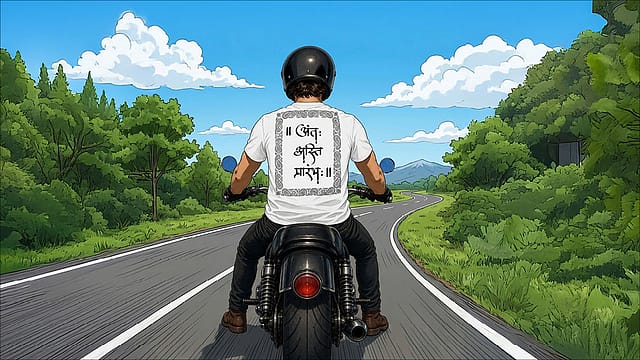
The Cubbon Park gathering also developed into the Kimbho Sanskrit Riders’ Club. At the time of publication, its next journey was planned for the second week of August 2026, with riders travelling from Bengaluru to a coffee estate in Kodagu and attempting to use Sanskrit at stops, meals, walks, games and songs. The motorcycle is not incidental to the story. It changes the visual grammar associated with Sanskrit: the language appears not only in a classroom or temple but on a road, among young adults engaged in an ordinary modern pursuit.
Other public experiments reinforce the pattern. At the Tata Mumbai Marathon in January, 21 participants from Samskrita Bharati ran under a theme marking 150 years of Vande Mataram while volunteers addressed passing runners in Sanskrit. Samskrita Bharati’s introductory ten-day spoken programme is based on the premise that simple conversation can begin before exhaustive grammatical mastery. The claim should not be confused with complete proficiency in ten days. Its value lies in replacing paralysis with an initial capacity to listen and respond.
The Sanskrit Club at IIT Roorkee offers another model. Its Subhashita-Samskritam programme organizes conversational and literary learning around 108 subhasitas. The report states that approximately 14,000 people registered and that more than half belonged to the 18-to-40 age group. The course design moves from speech into inflection, verbal forms, indeclinables, sandhi, compounds and sentence analysis. Traditional wisdom literature thus becomes a structured pedagogical corpus rather than ornamental quotation.
These initiatives illustrate why enjoyment is not the enemy of seriousness. Music, games, movement and companionship can provide repeated exposure, emotional safety and memorable context. Grammar remains indispensable for advanced reading, but grammar presented without communicative reward often leaves students able to reproduce paradigms while fearing spontaneous speech. A durable curriculum joins the two: conversation builds motivation, while grammar explains and expands what conversation has made desirable.
The demographic paradox
The official numbers initially appear to contradict the scale of this activity. India’s 2011 Census C-16 mother-tongue table recorded 24,821 people under Sanskrit. That figure is important, but it measures a specific form of self-identification: the language returned as a mother tongue. It does not count everyone who can read a shloka, follow a ritual, study philosophy, teach grammar, understand technical vocabulary or participate in a spoken-Sanskrit group. Mother-tongue population, second-language competence, liturgical use and civilizational reach are distinct variables.
The date also matters. The figure comes from 2011 and cannot, by itself, establish the size or composition of a 2026 learning community. Online participation further complicates measurement because a class may include diaspora families, yoga practitioners, software engineers, Buddhist scholars and adults returning to a language encountered at school. A rigorous account of revival would therefore track enrolment, course completion, reading proficiency, frequency of use and production of new work rather than relying on a single demographic indicator.
Formal infrastructure is much larger than the mother-tongue figure suggests. The Central Sanskrit University lists 13 campuses, 260 affiliated institutions and 118 programmes. Its offerings extend beyond conventional degrees to distance education, teacher preparation and interdisciplinary study. The presence of institutions does not automatically guarantee high-quality teaching or public engagement, but it demonstrates that Sanskrit has a substantial organizational base from which new pedagogies and research partnerships can grow.
Public policy has added another layer. A Ministry of Education budget statement allocated ₹347.03 crore in 2025–26 for the promotion of Indian languages, an increase over the preceding year. This was an aggregate language allocation, not a Sanskrit-only budget. Precision on that point prevents institutional support from being exaggerated. The Indian Knowledge Systems Division, established in 2020, has also supported centres spanning linguistics, philosophy, mathematics, health, agriculture, arts, architecture and engineering.
The article reported 91 Indian Knowledge Systems centres at the time of writing, while the official IKS directory presents an evolving programme structured around research, education and outreach. Changing counts should be treated as time-stamped administrative data rather than permanent facts. The larger significance lies in the effort to connect textual study with specialized disciplines. Such work succeeds only when language training, domain expertise, source criticism and historical method are present together.
Sanskrit’s new ecology can consequently be understood as the intersection of three forces: public institutions, decentralized communities and a digital market for teaching and content. Each contributes something different. Institutions can fund long-term scholarship; communities can create belonging; and digital platforms can connect geographically separated learners. Each also has a weakness. Institutions can become ceremonial, communities can lack quality control, and platforms can reward visibility over depth. Sustainable revival requires cooperation without allowing any single sphere to define the language’s value.
A corpus far wider than ritual
Radhavallabh Tripathi, a prominent Sanskrit scholar interviewed in the report, argues that Sanskrit was narrowed to a language of ritual through colonial habits of classification. The religious inheritance is unquestionably central, but it is not exhaustive. Sanskrit preserves philosophical debate, grammar, poetics, drama, mathematics, astronomy, medicine, political thought and narrative literature. It also carries Hindu, Buddhist and Jain textual traditions as well as arguments associated with Carvaka thought. Treating this range as a single uniform worldview would be as misleading as reducing it to ritual alone.
This plurality is especially important for unity among Dharmic traditions. Hindu traditions use Sanskrit across Vedic, Puranic, philosophical, devotional and ritual domains. Buddhist scholars produced extensive Sanskrit sutras, philosophical treatises and scholastic works alongside Pali, Prakrit, Tibetan, Chinese and other textual languages. Jain intellectuals composed in Sanskrit while also sustaining major Prakrit and vernacular traditions. Sikh scripture and intellectual life are primarily transmitted through Gurmukhi and a multilingual Indic register rather than through Sanskrit alone, although Sanskritic vocabulary and concepts form part of the wider linguistic environment.
A unifying approach must therefore avoid turning respect for Sanskrit into linguistic assimilation. Pali, Prakrit, Apabhramsha, Tamil, Kannada, Bengali, Punjabi, Tibetan and numerous other languages are not secondary containers whose value depends on proximity to Sanskrit. Each preserves distinctive voices, practices and intellectual developments. Sanskrit contributes to a shared civilizational conversation most honestly when its influence is studied alongside these languages rather than used to erase them. Dharmic unity is strengthened by accurate recognition of difference.
Tripathi also points to serious contemporary composition. Sachchidananda Mishra has treated Carvaka epistemology, ontology and logic in Sanskrit, while modern scholars have revisited ambitious philosophical projects such as Ramavatar Sharma’s attempt to formulate an additional system beyond the six classical Vedic schools. These examples matter because they use Sanskrit for analysis rather than merely for commemoration. A language remains intellectually active when it can formulate disagreement, not only praise its inheritance.
Translation is moving in both directions. Sanskrit works continue to enter modern Indian languages, but contemporary writing in Hindi, Gujarati, Manipuri and other languages is also being translated into Sanskrit. The report describes younger translators working with Dalit and tribal poetry, thereby extending the social range of modern Sanskrit literature. Such work can build dialogue across communities, provided that translators preserve historical context and do not smooth away the political or emotional specificity of the source.
Harshdev Madhav’s experiments demonstrate the language’s formal adaptability. His Sanskrit writing includes haiku, tanka and sijo, bringing Japanese and Korean poetic structures into conversation with Sanskrit poetics. He has also worked across science fiction, children’s literature, tantra, poetry, novels and short stories. The report attributes approximately 180 books to him and records his estimate that at least 400 major Sanskrit literary works appeared over the preceding two decades. These are interview-based figures, but the breadth of genres is itself evidence against the assumption that modern Sanskrit composition is limited to imitation of ancient forms.
Panini’s Astadhyayi helps explain the perception of continuity. Its roughly 4,000 sutras describe linguistic operations through a compressed technical system involving definitions, ordered rules, inherited conditions and meta-rules. A trained reader can therefore encounter both classical and modern composition within a remarkably stable grammatical framework. Stability, however, does not imply stasis. Vocabulary, genre, style and social context can change while a highly conserved grammatical tradition continues to organize analysis.
Admiration for this achievement should not become an excuse for uncritical glorification. A language is not revived by repeating that it was once great. It is revived through competent teachers, reliable editions, accessible dictionaries, sustained composition, careful translation, oral practice and scholarly disagreement. Historical pride can motivate study, but pride without method easily produces inflated claims that ultimately weaken public trust.
Why the classroom is changing
The Centre for Sanskrit Learning at IIT Bombay began a spoken outreach programme in Powai in 2022 under the aspiration Sahasramukhesu samskratam. The report records more than 1,500 learners in the local ecosystem. Its grammar-through-communication approach emerged partly from a nearby school survey that revealed intense dislike of Sanskrit as an academic subject. Games, songs and simple speech were introduced before formal curriculum could make the language feel punitive. The intervention recognizes that aversion is often produced by teaching design rather than by the intrinsic difficulty of the subject.
Online tutoring has expanded the range of motives visible in a single classroom. Some learners want to pronounce the Gita accurately; others seek direct access to the Mahabharata, Kalidasa or the Yogasutra. Heritage-minded parents want children raised outside India to encounter the language, while scholars of Buddhism need Sanskrit for research. Yoga practitioners often discover that translations cannot fully resolve specialized terminology. The same teacher may therefore serve devotional, literary, academic and linguistic goals in a single day.
Sunitha KN’s experience illustrates the change in demand. After leaving a guest lecturership in Kerala to teach online, she initially found few students. Three years later, the report described days containing as many as 12 hours of instruction. Her students included a young reader in Tamil Nadu studying the Mahabharata, older adults seeking the meanings of verses recited throughout their lives and a Chinese professor of Buddhism progressing toward Kalidasa’s Kumarasambhava and the Yogasutra. The digital classroom had become a meeting point between personal memory and specialized scholarship.
Deepshikha Kaushalya, another online instructor, had taught 67 students after completing postgraduate study in Sanskrit and English. Among them was Aishwarya Poddar, who returned to the Mahabharata after reading English translations and wanted to engage with Adi Parva verse by verse. Her favourite Sanskrit word, kautuhala, captures a central pedagogical truth: curiosity can reverse an identity formed by schoolroom anxiety. For an adult who once feared Sanskrit, the ability to parse even a small passage can feel less like acquiring a credential and more like recovering a lost relationship.
Music provides another entry. VG Shreehari’s Sanskrit versions of familiar Hindi, Marathi and Telugu songs have attracted large online audiences, while St Xavier’s College in Mumbai introduced Sanskrit as a two-credit course for early undergraduate students. Familiar melody functions as scaffolding: the listener already understands rhythm, emotion and narrative expectation, so attention can shift toward the new language. Quality still matters, because a literal translation that disregards metre may sound grammatical yet fail as song or verse.
Prabhanjan Moleyar’s interest in an interactive online grammar class reflects a different route. His background in computing drew him to the formal economy of Panini’s Astadhyayi. This attraction is understandable: programmers recognize rule ordering, abstraction, recursion-like effects and compact technical notation. Yet resemblance should not be converted into the popular claim that Sanskrit is naturally executable or uniquely suited to computer programming. A grammatical metalanguage and a programming language solve different problems, even when both reward formal precision.
The debate over modern vocabulary exposes a related misconception. When a technology executive suggested that Indian languages lacked adequate words for efficiency and productivity, Sanskrit scholar Nityananda Misra responded through terms including daksata, ksamata and utpadakata. The deeper point is not that every English business term possesses one timeless Sanskrit equivalent. Languages create technical registers through derivation, borrowing, semantic extension and repeated use. English did the same during industrialization; Sanskrit and modern Indian languages can do it as new communities establish shared meanings.
Aditi Madhavan’s work with teachers and textbooks reveals both promise and constraint in Indian Knowledge Systems education. Teachers asked how Sanskrit could be made engaging, and some later discovered that they needed basic language competence to teach source-based material responsibly. Students were sometimes ahead of the institutional response. Botany students, for example, sought access to Surapala’s Vrksayurveda for a project on the Sanskrit science of trees. Their interest demonstrates the value of textual access, but historical scientific works still require critical editions, translation, contextual interpretation and comparison with modern evidence.
Early learning can benefit from the same principles that support first-language acquisition: rhythm, repetition, concrete context and low-stakes interaction. Sanskrit nursery rhymes, conversational routines and short narratives give children sound patterns before introducing full grammatical explanation. The objective is not to eliminate grammar but to sequence it intelligently. A learner who already recognizes a phrase has a reason to understand its case ending; a learner given the ending in isolation must first invent a reason to care.
A mature pedagogy would combine four forms of competence. Pronunciation training would develop accurate listening and speech. Conversational practice would make forms retrievable in real time. Grammatical analysis would enable unfamiliar sentences to be understood. Textual study would connect language to literature, philosophy and history. Programmes that cultivate only one of these capacities may create enthusiastic speakers who cannot read difficult texts, or technically accomplished readers who remain unable to use a simple sentence spontaneously.
Digital texts, machine translation and the new research infrastructure
Fresh bilingual editions, online courses and searchable archives have made Sanskrit texts easier to discover. Availability, however, is not the same as accessibility. A scanned manuscript may be visible but impossible to search; a searchable transcription may contain OCR errors; a translation may conceal textual variants; and an online course may simplify a work beyond recognition. Digital revival therefore depends on editorial labour that users rarely see: collation, encoding, proofreading, annotation, licensing and long-term preservation.
The Itihasa dataset marked an important step in Sanskrit machine translation by assembling more than 93,000 Sanskrit-English pairs from the Ramayana and Mahabharata. Its creation involved automated extraction and alignment work, and its published benchmarks showed that standard translation architectures struggled with the corpus. This result is valuable. A dataset does not merely make a problem appear solved; it can reveal precisely where contemporary systems remain inadequate.
The 2026 Mitrasamgraha corpus expanded the scale to 391,548 Sanskrit-English pairs drawn from ritual, epic, philosophical, poetic and scientific material. Greater coverage gives machine-learning systems more examples of vocabulary, syntax and genre. Size alone, however, does not guarantee representativeness. If several pairs reproduce one translator’s interpretive habits, a model may learn those habits as though they were properties of Sanskrit itself. Corpus documentation must identify editions, translators, dates, genres, licences and known limitations.
Building a dependable parallel corpus requires a chain of technical decisions. Printed sources must be scanned and corrected. Scripts and Unicode sequences must be normalized without erasing meaningful distinctions. Sandhi complicates token boundaries, while compounds may contain several semantic units within one orthographic word. Verses must be aligned with translations that may rearrange clauses, supply omitted subjects or expand culturally specific terms. Training, validation and test sets must then be separated in ways that prevent near-duplicate verses from making evaluation appear easier than it is.
Sanskrit presents additional computational challenges through rich inflection, productive compounding, relatively flexible constituent order and frequent ellipsis. Poetry adds metrical rearrangement and dense figurative usage. A translation model may produce fluent English while assigning the wrong agent to an action, missing a negation or collapsing a philosophically important distinction. Automatic scores can detect broad overlap, but serious evaluation also requires philologists and domain specialists who can judge morphology, semantic fidelity and doctrinal context.
Speech systems require their own evaluation framework. Ordinary word-error rate cannot determine whether a long vowel was shortened, a retroflex consonant became dental or a metrical boundary was mishandled. Useful assessment should combine phoneme recognition, syllable-duration measurements, metre-specific timing and expert listening. Confidence estimates are essential: when a model is uncertain, it should request human review rather than issue a precise but unreliable correction.
Computational resources can also support comparative Dharmic scholarship. Properly documented corpora could connect Sanskrit works with Pali, Prakrit, Tibetan, Chinese, Kannada, Tamil, Punjabi and other translations or commentarial traditions. Such alignment would help researchers trace how a concept changed across language, region and community. It should not be used to collapse different traditions into a single machine-generated equivalence. Parallel text becomes intellectually valuable when variation is preserved as evidence.
Preservation must include plurality and consent
Synthetic chant introduces a subtle preservation risk. A widely used model trained on one voice may gradually be heard as the default pronunciation, even when living communities preserve legitimate differences in pace, melody, pause and phonetic realization. A responsible archive would record multiple reciters and attach metadata describing region, lineage, recension, metre, performance context and recording conditions. The objective should be to represent a field of practice rather than manufacture one canonical sound.
Consent and licensing are equally important. Vagdhenu identifies its voice as that of its creator, publishes its contribution under an open-source licence and releases the associated data under CC BY 4.0, while also noting dependencies with their own terms. Future projects should document who was recorded, what uses were authorized, how attribution works and whether generated voices can be redistributed. Sacred or personally identifiable recordings should not be treated as ownerless raw material merely because they are culturally significant.
Voice synthesis also creates an impersonation risk. A convincing generated recitation can be detached from its source, mislabelled as a historical recording or used to attribute speech to someone who never produced it. Watermarking, provenance metadata and clear synthetic-audio labels would help preserve trust. In a field grounded in lineage and accurate transmission, provenance is not a secondary administrative concern; it is part of authenticity.
The accessibility gains are nevertheless substantial. High-quality audio can support learners who lack a nearby teacher, diaspora families working across time zones and readers who benefit from synchronized text and speech. Searchable recordings can help scholars compare repeated forms, while slow playback can make complex conjuncts easier to hear. These benefits are strongest when the system reveals its sources and limitations instead of presenting generated output as unquestionable authority.
Human scholarship remains indispensable beneath the digital layer. Manuscripts must be located, conserved, catalogued, transcribed and compared before a clean dataset can exist. Commentaries must be understood before difficult passages can be translated responsibly. Teachers must decide how much simplification a beginner can tolerate. Reciters must explain the conventions that a model is expected to imitate. The visible application is therefore the final surface of a much older and slower knowledge infrastructure.
How a durable revival should be measured
Page views, registrations and model downloads are useful indicators of attention, but they do not establish durable language use. More meaningful measures would include course completion, retention after one year, growth in reading comprehension, frequency of conversation, number of trained teachers, quality of new editions, sustained publication of contemporary literature and independently evaluated digital resources. A learner who returns every week to read ten verses represents a different kind of success from a video that attracts a million brief impressions.
Teacher development may be the most important bottleneck. Social media can create demand faster than institutions can prepare instructors capable of pronunciation, conversation, grammar and textual interpretation. Training should therefore include modern language pedagogy alongside traditional grammatical study. Teachers also need the ability to evaluate digital tools, identify unreliable translations and guide learners whose motivations range from devotion to linguistics or computational research.
Contemporary creative work is another essential measure. A language used only to repeat inherited material can remain sacred and valuable, yet its public life will differ from that of a language in which people also write stories, jokes, essays, science fiction, criticism and children’s literature. New composition tests whether vocabulary and style can respond to unfamiliar experience. It also gives learners attainable texts between elementary lessons and demanding classical works.
The revival should remain open to criticism. Some participants approach Sanskrit through heritage or devotion; others through scholarship, aesthetics, nationalism, technology or professional opportunity. These motives can coexist, but no political interpretation should be allowed to monopolize the language’s history. Sanskrit’s Buddhist, Jain, heterodox, scientific and literary archives complicate every attempt to reduce it to a single ideological emblem. That complexity is a strength because it invites rigorous conversation across communities.
The same principle applies to claims about science and computing. Sanskrit texts contain historically important work in mathematics, astronomy, medicine, linguistics and other disciplines, but historical importance is not equivalent to automatic modern validity. Each technical claim requires dating, textual criticism, accurate translation and comparison with relevant contemporary knowledge. Responsible admiration distinguishes documented achievement from speculation. This standard protects both scientific integrity and the credibility of Sanskrit studies.
A healthy cultural economy can help sustain the work. Skilled teachers, editors, translators, software developers, manuscript specialists, voice artists and researchers require viable careers. At the same time, public-interest infrastructure should prevent foundational texts and datasets from becoming accessible only to affluent learners. Open resources, libraries, universities and paid professional services can coexist if licensing, attribution and quality standards are transparent.
A living legacy rather than a museum object
Sanskrit’s emerging second life is best understood as continuity under new conditions. The language was never absent from ritual, scholarship, monastic learning, literature or education, but digital media have changed who can encounter it and how quickly communities can form. A learner may now move from a short video to a spoken class, from that class to grammar, from grammar to the Mahabharata and from textual study to computational research. The pathways have multiplied even though the discipline required for mastery has not diminished.
Vagdhenu embodies both the promise and the caution of this moment. It can produce tireless recitation, make metrical sound available on demand and inspire the design of pronunciation feedback. It also depends on a small single-speaker corpus, specialized front-end rules and human knowledge that cannot be inferred from raw audio alone. Its greatest significance may therefore lie not in replacing a pandit but in showing engineers why traditional expertise must be represented explicitly.
The park gatherings, online classes and riders’ club supply what a model cannot: reciprocal speech, humour, friendship and shared memory. They turn Sanskrit from an object that people admire into an activity that people perform. For many learners, that transition carries an emotional force. A verse heard throughout childhood may become intelligible for the first time; a school subject once associated with fear may become a source of kautuhala; and inherited sound may become chosen study.
The strongest revival will neither romanticize technology nor distrust it reflexively. It will use speech synthesis for repetition, digital corpora for research, social media for discovery and online teaching for access. It will also preserve manuscripts, train teachers, compensate experts, document recitation traditions and maintain space for disagreement. Machines can extend the reach of sound, but communities, scholars and practitioners must continue to supply context, judgment and meaning.
Sanskrit’s future will ultimately be secured through use: speaking it without embarrassment, reading it with competence, chanting it with care, translating it with honesty and composing in it without pretending that modernity is a betrayal. Its living value also depends on respectful dialogue with the many languages and traditions that share India’s civilizational landscape. Under those conditions, the language’s second life is not a nostalgic reconstruction. It is a rigorous, plural and creative renewal.
Inspired by this post on Hindu Post.








Leave a Reply
You must be logged in to post a comment.