
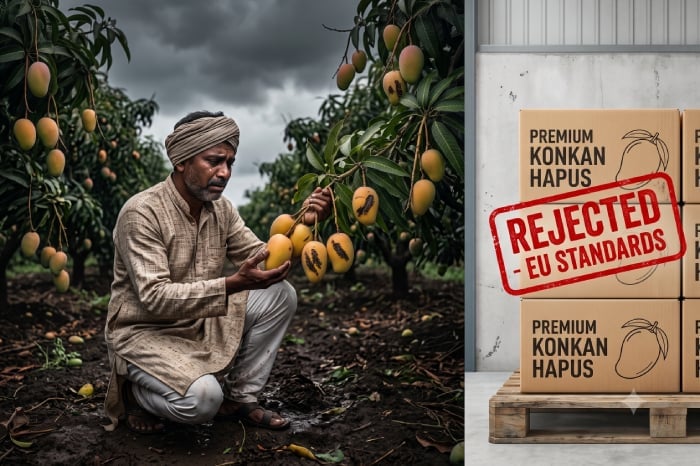
A crisis of governance, not merely crop protection. The difficulties confronting Konkan Hapus are often narrated through erratic flowering, unseasonal rain, rising pest pressure and falling yields. Surajya Abhiyan has introduced a narrower but potentially far-reaching question: did public agricultural institutions recommend pesticides for Alphonso mango without valid, crop-specific label claims, and did those recommendations expose growers to avoidable legal, financial, environmental and food-safety risks? Citing information obtained through the Right to Information process, the campaign has called for an immediate government white paper, a high-level inquiry and strict accountability wherever wrongdoing is established. These are serious allegations and public-interest demands; they are not, by themselves, adjudicated findings.
Evidence must precede conclusions. An RTI reply is an official record of what a public authority has stated or disclosed, but its evidentiary value depends on the questions asked, the completeness of the reply and the documents attached. A rigorous assessment therefore requires publication of the applications, replies, file numbers, annexures, pesticide schedules, advisory circulars and relevant dates. It must also identify records that were requested but withheld, reported as unavailable or transferred to another authority. This discipline protects farmers seeking answers while preserving due process for scientists and officials whose decisions may have been misunderstood, superseded or presented without their technical context.
Why Konkan Hapus carries exceptional stakes. Alphonso mangoes originating in Maharashtra’s Ratnagiri, Sindhudurg, Palghar, Thane and Raigad districts were registered as a geographical indication in 2018, according to the Ministry of Commerce and Industry’s GI notice. The designation links the fruit’s reputation to a defined landscape, accumulated horticultural knowledge and the livelihoods sustained by that reputation. A failure in pesticide governance can therefore travel beyond an individual orchard. It can affect consumer confidence, the premium associated with the GI, the bargaining position of small growers and the credibility of an entire regional supply chain.
The pesticide controversy should not be presented as the sole explanation for the wider Hapus crisis. Orchard productivity is shaped by temperature, humidity, rainfall at flowering, pollinator activity, soil conditions, tree nutrition, pest populations, disease pressure and the timing of farm operations. In March 2026, the Indian Council of Agricultural Research highlighted nutrient leaching as a constraint affecting mango and cashew productivity in the high-rainfall Konkan region. A credible inquiry must separate these interacting causes and determine the specific contribution, if any, of deficient or unauthorised pesticide advice. Scientific accountability is strengthened, not weakened, by resisting single-cause explanations.
The institutional chain is fragmented. The Central Insecticides Board and Registration Committee evaluates pesticide registration and approved uses under the central regulatory framework. Agricultural universities generate research and extension recommendations. Maharashtra’s Agriculture Department distributes advisories and enforces quality-control provisions within the state. The Food Safety and Standards Authority of India sets food-residue requirements, while the Agricultural and Processed Food Products Export Development Authority operates traceability and residue-monitoring systems for export supply chains. When these institutions rely on different databases, publication dates or terminology, a recommendation can move from research to field circulation without a final regulatory reconciliation. The inquiry must examine the entire chain rather than assigning generic blame to only one office.
What a pesticide label claim actually means. Registration of an active ingredient or formulation in India does not automatically authorise its use on every crop or against every pest. An approved label claim connects a specified formulation and concentration with a crop, target pest or disease, dose, dilution or water volume, method and timing of application, safety precautions and, where prescribed, a waiting or preharvest interval. Two products containing the same active ingredient may have different formulations or approved uses. A familiar brand name is therefore not the unit of compliance; the relevant unit is the exact product, formulation and authorised use pattern recorded in its registration documents and label.
The distinction between research and public recommendation is equally important. An agricultural university may conduct controlled efficacy or residue trials under applicable permissions and protocols. A successful experimental result, however, does not automatically become permission for unrestricted commercial use on farmers’ orchards. Before a trial result enters a seasonal spray schedule, the formulation, crop, target organism, dose and associated conditions must be reconciled with the legally approved label. Any advisory describing a non-label-claim result must clearly identify it as research, state its regulatory status and prevent experimental produce from entering commerce contrary to applicable safeguards.

The legal question requires document-level analysis. The Insecticides Act, 1968, including Section 18, regulates the sale, distribution and use of unregistered or prohibited insecticides and conduct contrary to the Act or its rules. The associated rules govern labelling, leaflets, warnings and licensed activities. Yet it would be premature to declare every disputed advisory a criminal offence. Liability depends on the registration certificate in force at the relevant time, the exact formulation, how the recommendation was communicated, whether it was experimental or commercial, who authorised it and whether a statutory provision was knowingly or negligently breached.
Registration and maximum residue limits answer different questions. Registration asks whether a pesticide product may be used for a defined agricultural purpose and under what conditions. A maximum residue limit, or MRL, specifies the legally acceptable residue level in a food commodity under the relevant food standard. The FSSAI contaminants and residues compendium lists commodity-specific limits, including numerous entries relevant to mango. The existence of an MRL does not independently grant permission to spray a product on mango, and a residue result below an MRL does not retrospectively validate an unapproved use.
An MRL should also not be described as a simple boundary between poison and safety in a single serving. It is an enforceable compliance limit derived from authorised agricultural practice, residue data and toxicological assessment. A detected exceedance can trigger food-law and trade consequences, but risk assessment may also consider the substance, concentration, consumption pattern and duration of exposure. Conversely, a disputed recommendation does not prove that fruit was contaminated, that a worker was poisoned or that an export consignment was rejected. Each outcome requires its own evidence. The inquiry must preserve these distinctions to avoid both complacency and unnecessary public alarm.
Registration status must be reconstructed historically. Pesticide approvals, restrictions, labels and product registrations change over time. A list downloaded in 2026 cannot conclusively establish what was permitted when an advisory was issued several years earlier. Investigators must retrieve the certificate and approved label effective on each advisory date, record subsequent amendments and distinguish a fully unregistered insecticide from a registered formulation lacking a claim for mango or for the named pest. The government’s integrated pest-management package for mango illustrates how approved mango uses can be presented, but the current status of any product must still be confirmed from the latest authoritative record.
The concern is not historically unprecedented. A 2013 Centre for Science and Environment review reported that 15 of 21 pesticides then recommended for mango by Dr. Balasaheb Sawant Konkan Krishi Vidyapeeth were not registered by the Central Insecticides Board and Registration Committee for that crop at the time of its comparison. That old count cannot be projected onto the present because approvals and recommendations may have changed. Its continuing relevance is institutional: extension schedules require recurring, documented reconciliation with the regulator rather than reliance on inherited lists.
What Surajya Abhiyan is demanding. The campaign’s three principal demands form a coherent accountability sequence. A white paper would place the documentary record in the public domain. A high-level inquiry would test the record through regulatory, scientific and legal expertise. Legal or disciplinary action would follow only where the evidence establishes responsibility. This sequence is preferable to either summary exoneration or punishment by public accusation. It allows affected growers to understand what occurred, gives institutions an opportunity to explain their decisions and enables the government to correct systemic weaknesses even when individual misconduct cannot be proved.
A useful white paper must be more than a press statement. It should disclose every official mango pesticide schedule issued during the period under review; the scientific trials and committee minutes supporting each recommendation; the officers who approved and circulated it; correspondence with the central regulator; changes made after objections arose; complaints received from growers; residue-testing data; reported worker-exposure incidents; export alerts, if any; and remedial action already taken. Documents should be searchable, machine-readable and accompanied by an index. Personal information can be redacted where legally necessary, but technical reasoning, approval trails and public expenditure should remain open to scrutiny.
At the centre of the white paper should be a reconciliation matrix. For every disputed entry, it should list the active ingredient, formulation, concentration, registration number, certificate holder, approved crop, approved pest or disease, dose, application method, waiting period, label revision and date of the public advisory. It should separately record the university trial relied upon, the status of any application to expand the label claim, the domestic MRL and the standards of significant export markets. A clear status field—compliant, superseded, unsupported, under verification or non-compliant—would allow farmers and regulators to understand the finding without decoding several disconnected files.
The inquiry must be independent enough to command trust. Its membership should include pesticide-registration expertise, independent agricultural entomologists and plant pathologists, a residue chemist or toxicologist, food-safety and export-traceability officials, a legal specialist, and representatives of mango growers and packhouses. Scientists who authored the disputed recommendations should provide evidence but should not determine findings concerning their own decisions. Members should disclose research funding, industry relationships and other potential conflicts. An interim report should identify immediate safety corrections, while the final report should establish responsibility, quantify impact and recommend durable institutional reform.

Evidence preservation cannot wait. Government departments and the university should secure signed circulars, draft schedules, email chains, file notings, messaging-platform advisories, meeting recordings, trial notebooks, raw efficacy data, residue studies, procurement records and website versions. Digital copies should be hashed and placed under controlled custody so that later changes are detectable. Investigators should interview the scientists who generated the research, officials who approved extension material, field officers who distributed it, dealers who interpreted it and farmers who acted on it. Oral testimony should be tested against contemporaneous records rather than treated as a substitute for them.
Due process is essential because several explanations are possible. A recommendation may have been valid when issued and later superseded; a trade name may have been confused with another formulation; research guidance may have been circulated without its experimental disclaimer; an obsolete document may have remained online; or an institution may have knowingly promoted a use outside the approved claim. These scenarios carry very different levels of responsibility. The inquiry should publish preliminary findings, provide affected institutions and individuals a defined period to respond, evaluate those responses in writing and disclose the reasons for accepting or rejecting them.
Farmers require interim protection before the final report. The state should immediately audit every currently circulated Hapus advisory and suspend only those entries that cannot be matched to a valid approval, replacing them with a dated and consolidated schedule. A blanket halt to all crop protection could leave orchards vulnerable, while continued circulation of disputed guidance would reproduce the original risk. The corrective notice should identify the exact formulations affected, avoid ambiguous brand-only descriptions and direct growers to verify the current label and obtain advice through an accountable public channel. Farmers should not be expected to resolve contradictions among government documents on their own.
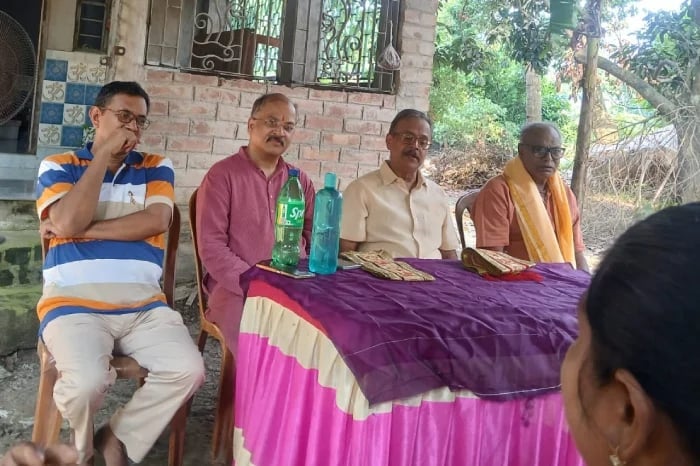
For a grower who has tended grafted trees for years, an advisory is not an abstract administrative note; it can determine whether a season’s income survives. A permanent, publicly funded helpline staffed during the mango season would therefore be more useful than personal telephone numbers that change with postings. A related November 2025 Surajya Abhiyan statement had already sought a stable helpline and a model orchard at the Girye–Rameshwar Mango Research Centre. Such a facility could demonstrate pest surveillance, non-chemical controls, lawful pesticide use and record-keeping, provided experimental plots and commercial recommendations remain clearly separated.
Integrated pest management offers the soundest operational framework. IPM begins with correct identification of the pest or disease, regular orchard scouting, weather-informed risk assessment and an action threshold. Cultural, mechanical and biological measures are prioritised before a chemical intervention is considered. Orchard sanitation, canopy and moisture management, removal of infested material, trapping, conservation of natural enemies and coordinated action across neighbouring farms can reduce pest pressure. When a pesticide remains necessary, selection should be confined to the current approved crop-and-pest claim, applied at the labelled rate and timing, documented in a spray record and followed by the prescribed waiting period.
Hapus orchards do not face a single biological problem. Mango hoppers can damage panicles and excrete honeydew that supports sooty growth; thrips can scar developing tissues; fruit flies can make fruit unmarketable; and powdery mildew or anthracnose can intensify under favourable weather conditions. Symptoms can be confused, while the economically important stage varies among pests. Vague advice to use whatever product is normally sprayed is therefore technically inadequate. A reliable service must connect pest identification, orchard stage, local surveillance and current approvals before any chemical recommendation is issued.

Resistance management must be part of the inquiry. Repeated exposure to the same mode of action can select resistant pest or pathogen populations, leaving growers with higher costs and declining control. Rotating brand names is ineffective when the products share the same biochemical target. Extension schedules should identify recognised mode-of-action groups, limit repeated applications and integrate non-chemical tactics, but only within legally approved uses. The inquiry should determine whether disputed schedules encouraged calendar spraying, unnecessary mixtures or repeated reliance on one mode of action, and whether resistance observations were documented and communicated to growers.
Ecological effects are economically relevant. Mango flowering depends on a diverse community of pollinating insects, while predators and parasitoids suppress several orchard pests. Indiscriminate spraying during bloom, excessive drift or unnecessary broad-spectrum treatment can disrupt these services. The result may be a paradox in which attempts to protect production weaken pollination or natural pest control. A revised Konkan Hapus programme should therefore include pollinator monitoring, drift reduction, protection of water bodies and soil, and selection of the least disruptive lawful intervention that can achieve the agronomic objective. Environmental stewardship is part of production security, not an ornamental addition to it.
Worker safety deserves equal attention. Orchard labourers may face concentrated exposure while mixing, loading and spraying, even when residues on harvested fruit remain within food standards. The white paper should assess whether advisories reproduced label precautions, personal protective equipment requirements, re-entry intervals, first-aid information and safe storage and disposal instructions. It should also examine training records and the availability of medical reporting pathways. A residue-compliant mango does not prove that the applicator was adequately protected, just as safe handling cannot compensate for an unauthorised crop use. Consumer and occupational safety must be evaluated separately.

Residue behaviour is technically complex. The residue present at harvest depends on the active substance, formulation, dose, number of applications, interval between applications, canopy coverage, fruit stage, temperature, rainfall and the preharvest interval. Systemic and contact pesticides behave differently, and visible washing cannot be assumed to remove every residue. Local supervised trials on Alphonso under Konkan conditions are therefore important when generating a lawful use pattern. Residue-decline data should be reviewed alongside efficacy data so that a recommendation controls the target without creating an avoidable domestic or export-compliance problem.
Testing must be representative rather than theatrical. A credible residue survey should use a pre-published sampling plan covering Ratnagiri, Sindhudurg and other relevant GI districts, different orchard sizes, domestic and export channels, and early, middle and late harvests. Samples require sealed chain-of-custody records and analysis by appropriately accredited laboratories using validated multi-residue methods such as LC-MS/MS and GC-MS/MS. Reports should state detection and quantification limits, measurement uncertainty, recovery performance and the standard used for comparison. Blind duplicates and independent confirmation of disputed results would reduce the risk of laboratory or sampling error.
Export safety depends on traceability. APEDA’s MangoNet system within HortiNet links registered farms, exporters, packhouses, laboratories and certification authorities. Its stated purpose includes pesticide-residue monitoring, standardisation and the ability to trace produce from the retail chain back to the grower. Lots may undergo laboratory analysis before the relevant certification and phytosanitary stages. Unauthorised or poorly documented recommendations can undermine that system by creating uncertainty over what was applied, when it was applied and whether the consignment meets the destination market’s requirements.

Export compliance cannot be reduced to the Indian MRL alone. Importing jurisdictions may use different residue definitions, limits, default thresholds or approved-use policies, and these can change. A fruit may comply with one market and fail another without any change in the sample. Export orchards therefore require destination-specific planning, complete spray records and early laboratory screening. The white paper should disclose any official alerts or consignment failures connected to the disputed substances, but it should not imply that an export rejection occurred without documentary proof identifying the substance, lot, measured residue, applicable limit and stated reason for action.
The economic burden is distributed unevenly. Large exporters may be able to finance testing, technical consultants and segregated supply chains. Small and tenant growers are more likely to depend on public extension officers, dealers or informal messages. If official-looking advice is later questioned, they may bear the cost of ineffective applications, additional sprays, crop loss, laboratory testing, rejected purchases and damaged market relationships. The inquiry should therefore calculate not only direct government expenditure but also farm-level losses, differentiating losses caused by weather or pest pressure from those credibly linked to deficient advice.
If the inquiry establishes that farmers reasonably relied on incorrect official guidance, a transparent claims mechanism should follow. Eligibility should depend on documentary evidence such as advisory copies, purchase invoices, spray records, laboratory reports and buyer communications, with reasonable alternatives where small growers were never taught to maintain formal records. Compensation should not be announced before causation is assessed, but neither should the absence of perfect paperwork automatically defeat a legitimate claim. The same mechanism could fund corrective residue testing, technical rehabilitation and transition to verified IPM practices rather than limiting relief to a one-time payment.
A single source of truth is achievable. Maharashtra could maintain a version-controlled digital repository in Marathi and English containing every current mango advisory, approval date, formulation, crop-pest claim, waiting period, regulator link and withdrawal notice. Each document should carry a revision number, QR code and expiry or review date. Field officers, universities and district offices should distribute the same version, while archived editions remain publicly visible. An automated comparison with updated central registration data could flag a mismatch before publication. Farmers could report doubtful recommendations through the same system and receive a numbered, auditable response.
Regulatory gaps require research, not improvisation. Where Hapus growers face a serious pest for which no effective label-claim option exists, the absence of an approved tool should be acknowledged openly. Universities, government agencies and registrants can then design supervised efficacy, crop-safety, residue and environmental studies needed to support an application for an expanded use. Emergency or experimental pathways, if legally available, must be invoked transparently and within their conditions. Informal off-label advice shifts regulatory uncertainty onto the farmer; a structured data-generation programme converts that uncertainty into evidence capable of supporting a lawful decision.
Commercial influence must be examined without presumption. The inquiry should disclose whether pesticide companies supplied products, financed trials, sponsored events, drafted technical material or participated in committees connected with the disputed recommendations. Industry involvement is not inherently improper and can be necessary for generating registration data. The problem arises when funding, authorship or commercial interests remain hidden, trial design is weak, or promotional claims enter government advisories before regulatory approval. Conflict-of-interest declarations, independent statistical review and public access to protocols would allow useful collaboration while limiting regulatory capture.
Public communication must use precise categories. An alleged mismatch, a verified non-label recommendation, a residue exceedance, an occupational exposure and an export rejection are not interchangeable events. Government notices and campaign statements should state which category is supported and what remains under investigation. Phrases such as unsafe mangoes or poisoned crop should not be used without analytical evidence, while verified discrepancies should not be minimised as harmless paperwork. Clear risk communication can protect consumers without destroying demand for compliant produce and can alert growers without encouraging abrupt, unscientific changes during a vulnerable crop stage.
Reform should be measured. Useful indicators include the percentage of active advisories reconciled with current label claims, time taken to correct an obsolete schedule, helpline response time, share of growers receiving IPM and safety training, adoption of spray records, frequency of representative residue testing, number and cause of non-compliant samples, pollinator and pest-surveillance trends, and export alerts linked to pesticide residues. Results should be reported by district and season without exposing individual farmers unnecessarily. Public metrics would show whether the response has improved orchard governance rather than merely produced another committee report.
Accountability should be proportionate and evidence-based. A clerical error corrected promptly may require procedural reform and training. Repeated failure to verify regulatory status may justify disciplinary action. Knowing circulation of an unauthorised commercial recommendation, concealment of evidence, falsification of trial data or collusion for private benefit could warrant stronger statutory, civil or criminal proceedings if the required elements are proved. Responsibility should also extend upward when deficient staffing, obsolete databases or approval systems made errors predictable. Strict accountability is most credible when it distinguishes honest scientific uncertainty from negligence and deliberate misconduct.
The controversy ultimately concerns the relationship between knowledge and trust. Farmers are asked to act on specialised advice they cannot independently reproduce, consumers rely on invisible safety systems, and exporters depend on records created far upstream. Public institutions therefore carry a heightened duty to make recommendations traceable, current and candid about uncertainty. Across Hindu, Buddhist, Jain and Sikh traditions, the ethical principles of truthful conduct, non-harm, stewardship and service offer a compatible civic foundation for this duty. In agricultural governance, those values are realised through verifiable science, care for workers and fair treatment of cultivators rather than through rhetoric.
The path forward is demanding but practical. Maharashtra can publish the RTI record, reconcile every disputed recommendation, establish an independent inquiry, issue a verified interim schedule, expand field support, test residues scientifically and create a lawful research pathway for unresolved pest problems. None of these measures requires prejudging guilt or portraying every Konkan Hapus mango as unsafe. They require the state to treat farmer guidance as a regulated public responsibility. If pursued transparently, the Surajya Abhiyan demands could become the starting point for a stronger system—one that protects growers, consumers, ecosystems, export credibility and the enduring reputation of Konkan Alphonso.
Inspired by this post on Hindu Jagruti Samiti.










Leave a Reply
You must be logged in to post a comment.