
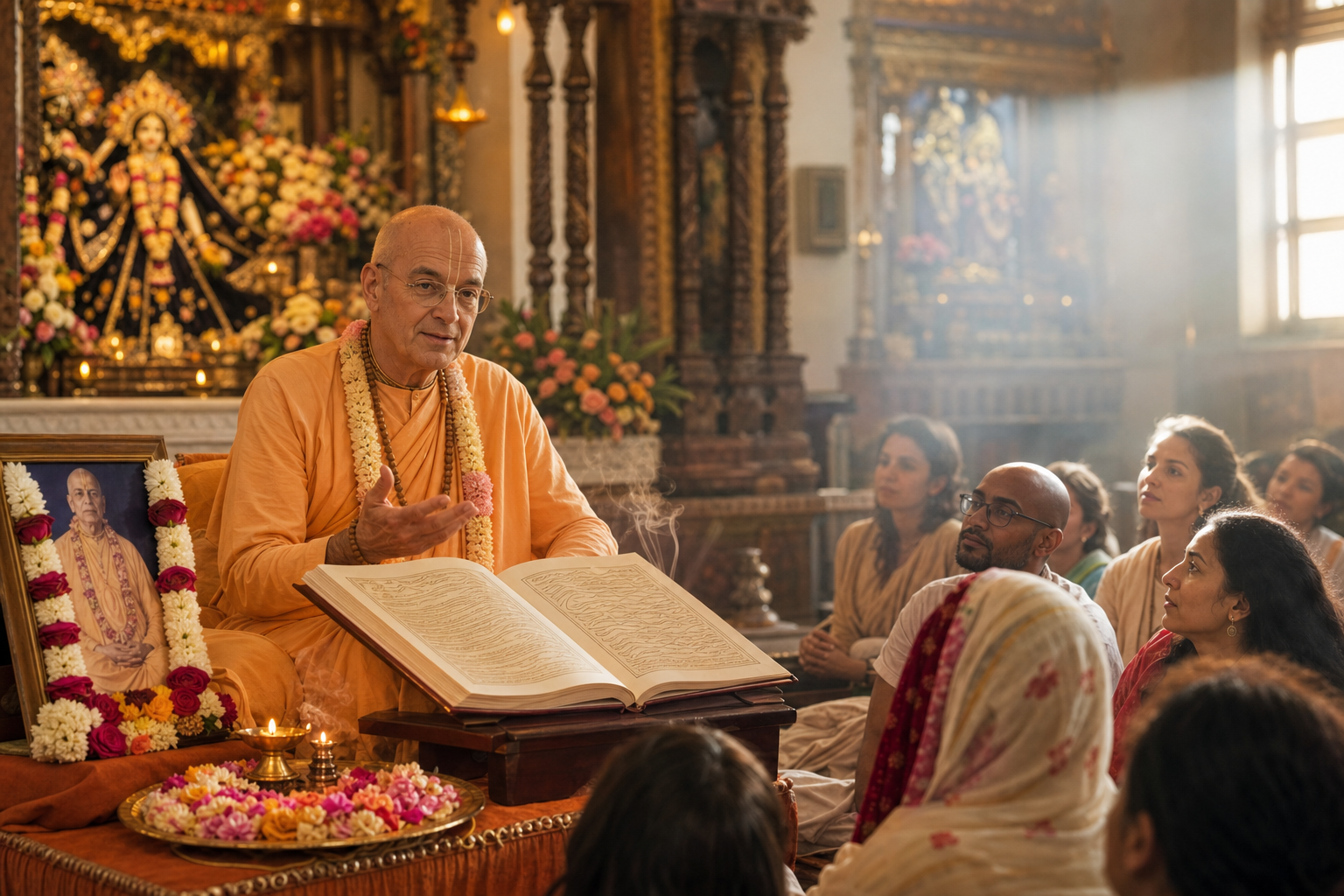

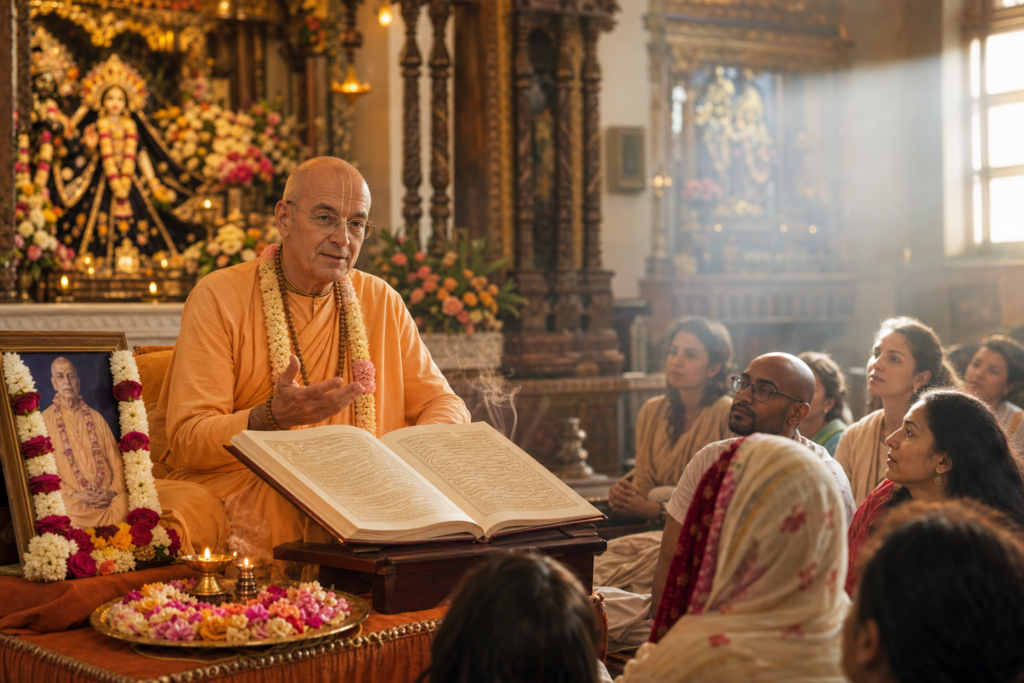
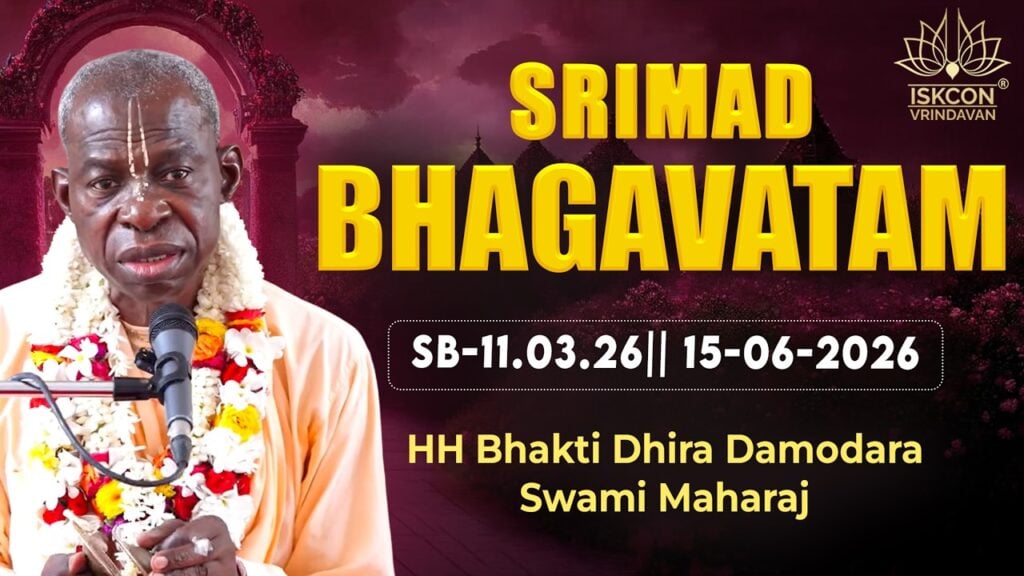
On 15 July 2026, a morning programme at ISKCON London brought together deity greetings, Guru Puja, and the study of Śrīmad-Bhāgavatam 2.8.28–29 with HH Vrindavan Chandra Swami. The official programme context identifies him as an ISKCON sannyasi and spiritual teacher. The sequence is significant because it unites three dimensions of Gaudiya Vaishnava practice: seeing the sacred form, acknowledging the lineage through which knowledge is received, and examining scripture through disciplined hearing. Each stage prepares for the next. Deity greetings orient attention toward Bhagavān; Guru Puja cultivates gratitude and humility; the Śrīmad-Bhāgavatam class turns that devotional disposition into sustained theological inquiry.
The supplied media record contains a title and thumbnail rather than a complete transcript. Accordingly, this long-form account offers a text-grounded examination of the announced verses and their ritual setting without assigning undocumented statements to HH Vrindavan Chandra Swami. Its purpose is to clarify the canonical context, Sanskrit terminology, Gaudiya Vaishnava interpretation, pedagogical principles, and practical relevance of the programme while preserving a clear distinction between the scripture, its traditional commentarial reception, and contemporary analysis.
Deity greetings: training the senses to recognize sacred presence
Within Gaudiya Vaishnava theology, the consecrated Deity is described as the arcā-vigraha, the worshipful form through which Bhagavān becomes accessible to embodied human senses. This is a theological claim internal to the tradition, not a claim that an ordinary manufactured object automatically becomes divine. Consecration, scriptural authorization, ritual discipline, and devotional intention establish the context of worship. Deity greetings therefore involve more than looking at an altar. They belong to the practice of darśana, a form of attentive seeing in which the practitioner approaches the sacred form with reverence and understands the encounter as relational rather than merely visual.
The word “greetings” also conveys an important emotional movement. A person ordinarily begins the day by entering private concerns, unfinished work, social obligations, and digital distraction. Temple darśana reverses that habitual order by placing the sacred at the center before personal demands occupy the mind. The beauty of the altar, the care expressed through dress and offerings, the sound of devotional music, and the presence of a gathered community coordinate sight, hearing, memory, and bodily posture. In this sense, ritual operates as an education of attention. It does not eliminate intellectual inquiry; it prepares the mind to inquire without reducing the subject to an abstract problem.
Guru Puja: gratitude directed toward a living tradition of knowledge
Guru-pūjā means worship or reverential honoring of the spiritual teacher. In daily ISKCON practice, Guru Puja commonly centers on Śrīla A. C. Bhaktivedanta Swami Prabhupāda as the Founder-Ācārya who established the movement and made Gaudiya Vaishnava teachings widely available through institutions, translations, commentaries, and personal instruction. The ceremony acknowledges that spiritual knowledge is not treated as a private invention. It is received through teachers who preserve texts, embody disciplines, answer questions, correct misunderstandings, and connect new students with an inherited body of practice.
A careful understanding of Guru Puja does not require the suspension of moral judgment or the creation of a personality cult. Classical guru theology presents the teacher as a transparent representative of divine teaching, not as the independent owner of truth. Authority remains accountable to śāstra, the recognized lineage, disciplined conduct, and the welfare of students. Reverence is therefore strongest when it produces humility, truthful behavior, service, and deeper engagement with scripture. If homage merely intensifies status, dependency, or self-display, it has lost the educational and ethical purpose expressed by the rite.
The guru–śiṣya relationship can also be understood as an epistemic structure: a disciplined method for acquiring and testing knowledge. The student brings attentiveness, service, questions, and a willingness to practice. The teacher brings textual competence, experience, responsibility, and the ability to arrange complex material coherently. Paramparā, or disciplic succession, is intended to protect continuity while allowing teaching to address new audiences and circumstances. Fidelity does not mean repeating isolated phrases without context; it means preserving the governing conclusions, interpretive principles, practices, and ethical orientation of the tradition.
Why worship precedes the Śrīmad-Bhāgavatam class
The movement from deity greetings to Guru Puja and then to scriptural discourse is itself a compact philosophy of education. Deity worship identifies the ultimate object of devotion. Guru Puja recognizes the human and institutional channels through which knowledge becomes accessible. Scriptural hearing then provides the conceptual substance by which devotion is understood, examined, and applied. Ritual without learning can become habitual sentiment, while learning without humility can become intellectual self-assertion. The morning programme holds the two together: devotion gives inquiry a purpose, and inquiry gives devotion depth and direction.
Śrīmad-Bhāgavatam 2.8 forms part of the dialogue between King Parīkṣit and Śukadeva Gosvāmī. Parīkṣit has learned that his death is imminent, traditionally described as occurring within seven days. He therefore withdraws from ordinary royal concerns and directs his remaining time toward fundamental questions about the self, the Supreme, creation, time, karma, devotional practice, social duty, cosmic order, liberation, and the purpose of sacred literature. The setting gives philosophical inquiry existential urgency. These are not questions asked to display learning; they arise from the recognition that limited time makes truthful understanding indispensable.
Chapter Eight is remarkable for the scale of Parīkṣit’s inquiry. His questions move from the distinction between the self and body to the nature of the universal form, planetary systems, cosmic time, creation and dissolution, the modes of material nature, social and spiritual duties, yoga, mystic accomplishment, Vedic literature, devotional service, conditioned life, and liberation. In verse 2.8.24, he even requests instruction concerning matters that he has failed to ask about. This reveals an advanced intellectual humility: the questioner recognizes not only a lack of answers but also the possibility of incomplete questions.
The narrative also presents Parīkṣit as so absorbed in hearing that physical exhaustion does not dominate his attention despite his fast. This should be read within the devotional logic of the text rather than converted into a general physiological prescription. The central point is that meaningful hearing reorganizes experience. When a person confronts mortality, suffering, or uncertainty, serious spiritual inquiry can become more compelling than the distractions that ordinarily fragment the mind.
Śrīmad-Bhāgavatam 2.8.28: the source and status of Bhāgavata knowledge
प्राह भागवतं नाम पुराणं ब्रह्मसम्मितम् ।
ब्रह्मणे भगवत्प्रोक्तं ब्रह्मकल्प उपागते ॥ २८ ॥
prāha bhāgavataṁ nāma
purāṇaṁ brahma-sammitam
brahmaṇe bhagavat-proktaṁ
brahma-kalpa upāgate
In a concise paraphrase, the verse states that Śukadeva began answering by identifying the Bhāgavata Purāṇa as teaching aligned with the Vedic revelation and as knowledge originally communicated by Bhagavān to Brahmā at the beginning of the Brahmā-kalpa. The verse therefore establishes four coordinates at once: the identity of the teaching, its relation to the Vedas, its divine source, and its primordial recipient. Before addressing Parīkṣit’s many individual questions, Śukadeva first establishes the authority and genealogy of the discourse.
The Sanskrit makes this structure especially clear. Prāha means “spoke” or “said.” The expression bhāgavataṁ nāma purāṇam identifies a Purāṇa known as the Bhāgavata. Brahma-sammitam indicates accord or consistency with the Vedic body of knowledge in the traditional interpretation. Brahmaṇe identifies Brahmā as the recipient, while bhagavat-proktam describes the teaching as spoken by Bhagavān. Finally, brahma-kalpe upāgate places the communication at the opening of a cosmic period associated with Brahmā. The compressed syntax joins textual classification, theology, cosmology, and lineage within a single stanza.
The designation Purāṇa deserves precision. It should not be reduced to the modern pejorative sense of a false or childish myth. Purāṇic literature integrates cosmology, genealogy, sacred history, ritual, ethics, philosophy, theology, and accounts of divine activity. The Śrīmad-Bhāgavatam is traditionally classified among the Mahāpurāṇas, yet it also presents itself as a concentrated exposition of devotion to Bhagavān. Its later structural summary identifies ten major topics: primary creation, secondary creation, cosmic order, divine protection, formative impulses, the ages of Manus, accounts of the Lord, dissolution, liberation, and the ultimate shelter. Parīkṣit’s broad questions anticipate this comprehensive architecture.
The reference to Bhagavān instructing Brahmā belongs to the text’s own sacred cosmology. It expresses the traditional conviction that ultimate knowledge begins beyond ordinary human speculation and then descends through revelation. This theological claim should be distinguished from modern historical-critical questions about manuscripts, redaction, language, and the chronological development of the Purāṇic corpus. The two modes of inquiry ask different questions. Traditional theology concerns the transcendent source and authority of the teaching; historical scholarship examines the forms in which a text appears and circulates in human history. Academic clarity permits both levels to be described without forcing either into the vocabulary of the other.
Chapter Nine develops the primordial instruction to Brahmā, and verses 2.9.33–36 are widely known in the tradition as the catuḥ-ślokī Bhāgavata, the four seed verses of the Bhāgavata. Their role is analogous to a compressed doctrinal matrix from which the wider teaching unfolds. This movement from seed principles to expansive narration helps explain why a Purāṇa can combine stories, cosmology, philosophy, and devotional practice without treating them as unrelated subjects. The diverse materials are organized around an ultimate theological center.
The traditional chain associated with this knowledge proceeds from Bhagavān to Brahmā, from Brahmā to Nārada, from Nārada to Vyāsa, from Vyāsa to Śukadeva, and from Śukadeva to Parīkṣit; Sūta Gosvāmī subsequently recounts the discourse to the sages. This chain illustrates why Guru Puja and scriptural study belong together. The guru does not replace scripture, and scripture is not treated as detached from communities of interpretation. Text, teacher, student, practice, and transmission form an integrated ecology of knowledge.
The frequently used English description of the Bhāgavata as a “science of the Personality of Godhead” also requires careful interpretation. The Sanskrit verse does not employ the modern technical term for experimental science. In this context, “science” signifies an ordered and reasoned body of knowledge concerning Bhagavān, the self, the world, causality, practice, and realization. The discourse is systematic within its theological premises, but that does not make its claims identical to hypotheses tested through modern laboratory methods. Recognizing the difference protects both religious and scientific vocabularies from confusion.
Gaudiya Vaishnava commentary reads the verse through a strongly personalist theology in which Bhagavān is the fullest realization of the Absolute and devotional relationship is central. That position can be stated firmly without disparaging other schools of Vedānta or other Dharmic traditions. Advaita, Viśiṣṭādvaita, Dvaita, various Śaiva and Śākta systems, Buddhist philosophies, Jain teachings, and Sikh theology employ different accounts of ultimacy, personhood, liberation, and revelation. Responsible interpretation identifies those differences accurately. Fidelity to a particular sampradāya does not require caricaturing neighboring paths.
Śrīmad-Bhāgavatam 2.8.29: complete answers arranged in a meaningful order
यद् यत् परीक्षिदृषभः पाण्डूनामनुपृच्छति ।
आनुपूर्व्येण तत्सर्वमाख्यातुमुपचक्रमे ॥ २९ ॥
yad yat parīkṣid ṛṣabhaḥ
pāṇḍūnām anupṛcchati
ānupūrvyeṇa tat sarvam
ākhyātum upacakrame
The verse states that Śukadeva undertook to explain, in systematic sequence, everything that Parīkṣit—the eminent descendant of the Pāṇḍus—had continued to ask. Its emphasis is not merely that an answer was given. The answer would be comprehensive, ordered, and responsive to the full range of inquiry. Verse 28 establishes the source of knowledge; verse 29 establishes the method by which that knowledge will be communicated.
The distributive expression yad yat means “whatever” or “each thing that,” emphasizing the individual questions rather than an indistinct mass. Anupṛcchati indicates continued or follow-up inquiry. The honorific phrase parīkṣid ṛṣabhaḥ pāṇḍūnām presents Parīkṣit as foremost among the descendants of Pāṇḍu. Ānupūrvyeṇa means according to succession, order, or proper sequence. Tat sarvam means all of it, while ākhyātum upacakrame indicates that Śukadeva began or undertook to narrate it. The verse thus combines responsiveness with curricular design.
The word ānupūrvyeṇa has substantial pedagogical importance. A student’s questions often arise in the order of anxiety, curiosity, or immediate association, but a competent teacher may answer them in the order required for understanding. Definitions may need to precede applications; ontology may need to precede ethics; the nature of the self may need clarification before liberation can be discussed. Reorganizing questions is not evasion when every question is ultimately addressed. It is the work of transforming scattered curiosity into a coherent course of study.
The expression tat sarvam, “all of it,” also establishes a standard of intellectual responsibility. Selective teaching can produce distortion when attractive conclusions are detached from difficult premises, ethical qualifications, or broader context. Śukadeva’s undertaking is comprehensive. He does not reduce Parīkṣit’s inquiry to a slogan, nor does he answer only the questions that are easiest to address. The verse therefore offers a model for teachers, clergy, scholars, and mentors: serious questions deserve patient organization and complete treatment.
Parīkṣit is portrayed as the right questioner because his inquiry combines urgency, humility, breadth, and trust. He does not approach Śukadeva merely to win an argument. At the same time, he is not passive. He asks about causes, categories, time scales, practices, consequences, apparent contradictions, and subjects that he may have overlooked. Such questioning is itself a spiritual discipline. It requires enough humility to admit uncertainty and enough courage to seek an answer that may rearrange established assumptions.
The teacher–student relationship shown here is reciprocal but not symmetrical. Śukadeva bears responsibility for textual fidelity, clear organization, and the student’s spiritual welfare. Parīkṣit bears responsibility for attentive hearing, sincere questioning, and application. Neither role supports manipulation. A teacher should distinguish direct textual statements from commentary, inference, analogy, and personal application. A student should neither reject instruction reflexively nor accept every claim merely because it is spoken with religious authority. Trust matures through truthfulness, competence, ethical conduct, and practice.
How Guru Puja and the two verses illuminate one another
Read beside Guru Puja, the two verses reveal why the guru is honored. The central achievement of the teacher is not personal charisma but faithful participation in the transmission of liberating knowledge. Verse 28 supplies the vertical dimension: knowledge has a sacred source and descends through lineage. Verse 29 supplies the dialogical dimension: knowledge becomes intelligible when a qualified teacher responds systematically to a sincere questioner. Guru Puja expresses gratitude for that service, while the subsequent class tests the meaning of the gratitude by requiring disciplined attention.
The entire programme can therefore be summarized as a movement of vision, gratitude, and inquiry. Deity greetings direct the senses toward Kṛṣṇa. Guru Puja directs gratitude toward the lineage. Śrīmad-Bhāgavatam study directs intelligence toward the content of revelation. None of these faculties is excluded. Bhakti engages the senses, emotions, memory, reason, speech, and action. Its aim is not momentary inspiration alone but the gradual reorientation of character and desire through repeated, meaningful practice.
In this context, śravaṇa, or hearing, is active rather than passive. Textual attention asks what the Sanskrit and narrative context actually communicate. relational attention asks how the teaching is being transmitted and whether the hearer is approaching with humility. Practical attention asks what change in conduct follows from the lesson. A class has not been fully heard if its terminology is remembered but its ethical demand is ignored. Conversely, personal enthusiasm should not be mistaken for understanding when the text itself has not been examined.
A practical method of hearing follows naturally from verses 28–29. Before a class, the listener can read the relevant verses, identify unfamiliar terms, and review the chapter’s argument. During the class, the listener can distinguish the Sanskrit text, translation, inherited commentary, the speaker’s explanation, and contemporary application. Questions should be recorded rather than suppressed. After the class, the central proposition can be summarized in plain language, checked against the source, discussed with qualified practitioners, and tested through conduct. This process turns a recording into sustained study.
Reverence and discernment are therefore complementary. Bhagavad-gītā 4.34 famously coordinates praṇipāta, respectful approach; paripraśna, sincere and thorough inquiry; and sevā, service. Removing inquiry leaves obedience without understanding. Removing humility turns inquiry into competition. Removing service leaves knowledge disconnected from responsibility. A healthy guru–śiṣya relationship requires all three, together with institutional safeguards and an unwavering rejection of exploitation or abuse.
The lesson is especially relevant in an information-saturated age. Digital platforms provide immediate access to thousands of teachers, translations, excerpts, and confident interpretations, but abundance does not guarantee coherence. Verse 28 encourages the student to ask about source, lineage, genre, and interpretive framework. Verse 29 encourages attention to sequence, completeness, and the quality of the teacher–questioner relationship. These criteria help distinguish knowledge from isolated quotation, careful teaching from performance, and spiritual guidance from unaccountable influence.
A Dharmic framework for unity without erasing differences
The educational principles visible in this programme can support respectful unity among Hindu, Buddhist, Jain, and Sikh traditions. Hindu sampradāyas preserve numerous guru-paramparās and scriptural methods. Buddhist communities value teachers, monastic and contemplative lineages, and the guidance of the kalyāṇa-mitra, or spiritual friend. Jain traditions honor the Tīrthaṅkaras and the teaching roles of ācāryas and upādhyāyas while emphasizing disciplined study and conduct. Sikh tradition locates Guruship decisively in the Guru Granth Sahib, together with the interpretive and lived responsibility of the Panth. Across these distinct traditions, knowledge is joined to ethical formation, disciplined reception, and community memory.
These parallels should not be used to claim that all Dharmic paths teach an identical metaphysics. Buddhist traditions do not depend upon the same creator-centered cosmology found in this Bhāgavata verse. Jain accounts of the cosmos, liberated beings, and authority are distinctive. Sikh teachings on the One, the Gurus, and śabad possess their own theological grammar. Hindu traditions themselves disagree about the relation between Brahman, Ātman, Bhagavān, Śakti, and the world. Unity becomes durable when those differences are studied accurately and discussed without contempt. Shared reverence for truth does not require doctrinal homogenization.
A human dimension also runs through the programme. A listener may enter the temple tired, distracted, worried, or uncertain. Deity greetings can gather scattered attention through beauty and sacred form. Guru Puja can soften the illusion of self-sufficiency by awakening gratitude toward those who preserve knowledge. Scriptural dialogue can then give uncertainty a constructive shape by turning vague unease into a meaningful question. No ritual guarantees an identical emotional result for every participant, yet the sequence creates conditions in which attention, gratitude, and inquiry can reinforce one another.
Four enduring conclusions emerge from Śrīmad-Bhāgavatam 2.8.28–29. First, sacred knowledge is relational and transmitted rather than privately manufactured. Second, sincere questioning is not opposed to devotion; it is one of devotion’s mature expressions. Third, good teaching is systematic, complete, and responsive rather than fragmentary. Fourth, reverence must coexist with textual accuracy, ethical accountability, and thoughtful discernment. Together, these conclusions describe a spiritual culture in which the heart is engaged without silencing the intelligence.
The lasting value of the 15 July 2026 programme lies in this integration. Deity greetings establish the goal of loving attention, Guru Puja acknowledges the lineage that carries sacred knowledge, and the class on Śrīmad-Bhāgavatam 2.8.28–29 demonstrates how revelation becomes an ordered conversation between teacher and student. The verses invite a form of learning that is neither coldly detached nor credulously uncritical. It is rooted in devotion, refined through questions, organized through competent teaching, and verified through the character it helps to form.
Textual and editorial note: The Sanskrit wording and chapter context were checked against the Bhaktivedanta Vedabase editions of Śrīmad-Bhāgavatam 2.8.28 and Śrīmad-Bhāgavatam 2.8.29. Event details were checked against the official ISKCON London programme listing. Because the supplied source did not contain a transcript, no sentence in this study is presented as a verbatim statement by HH Vrindavan Chandra Swami.
Inspired by this post on Dandavats.








Leave a Reply
You must be logged in to post a comment.