
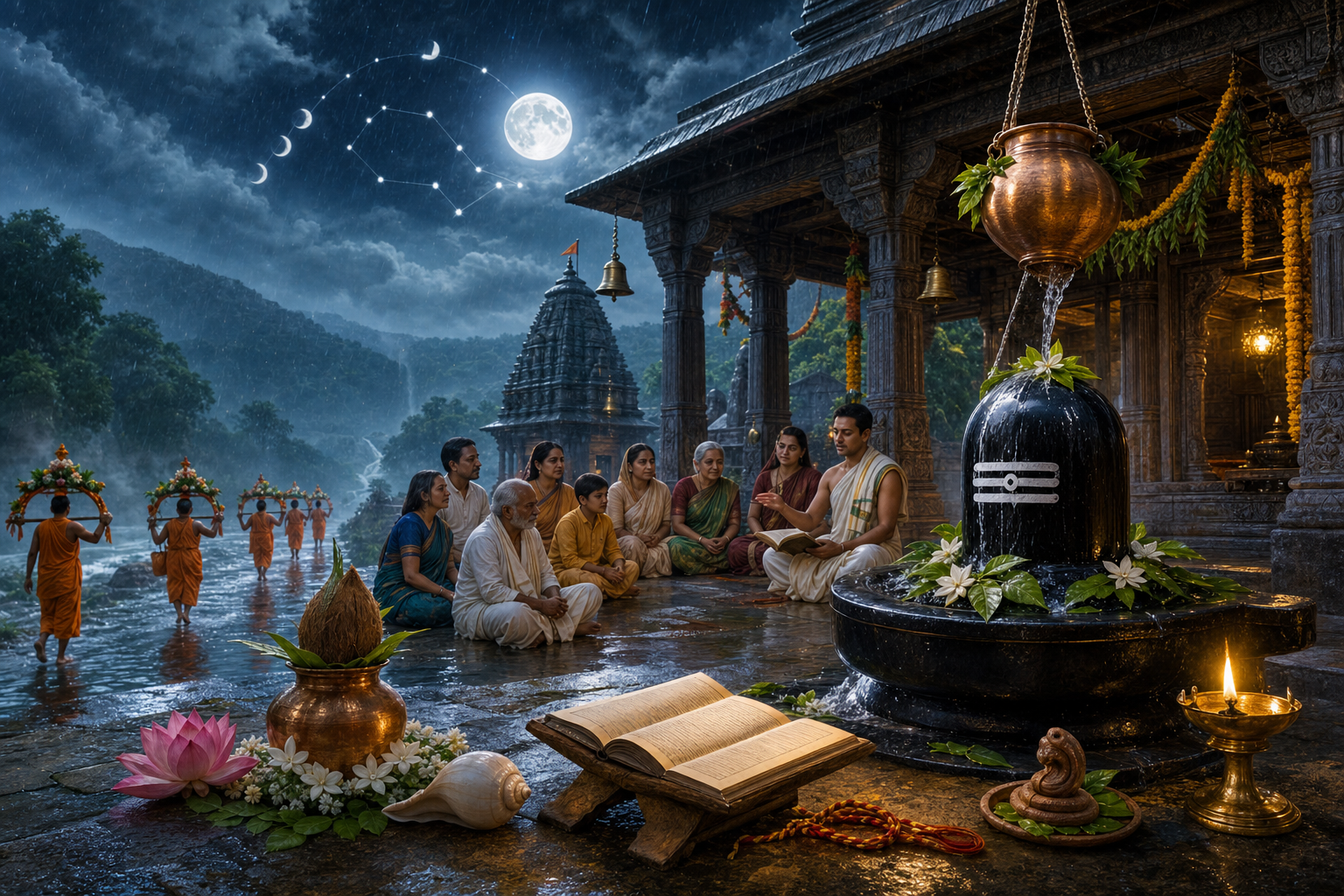
When monsoon clouds gather over the Indian subcontinent, Shravan Maas arrives with a distinctive religious atmosphere: temple bells sound through rain-washed streets, pilgrims carry sacred water, households simplify their meals, and families set aside time for prayer, fasting, scriptural recitation and service. Known variously as Shravan, Sawan, Śrāvaṇa, Shravana masam and Shravan Mahina, this period is especially associated with Lord Shiva, yet its observances also honour Goddess Parvati, Lakshmi, Vishnu, Krishna, Ganesha, the Nagas, Surya, Hanuman and other sacred forms. Its importance therefore lies not in sectarian exclusivity, but in the way an entire lunar month becomes a framework for disciplined and compassionate living.
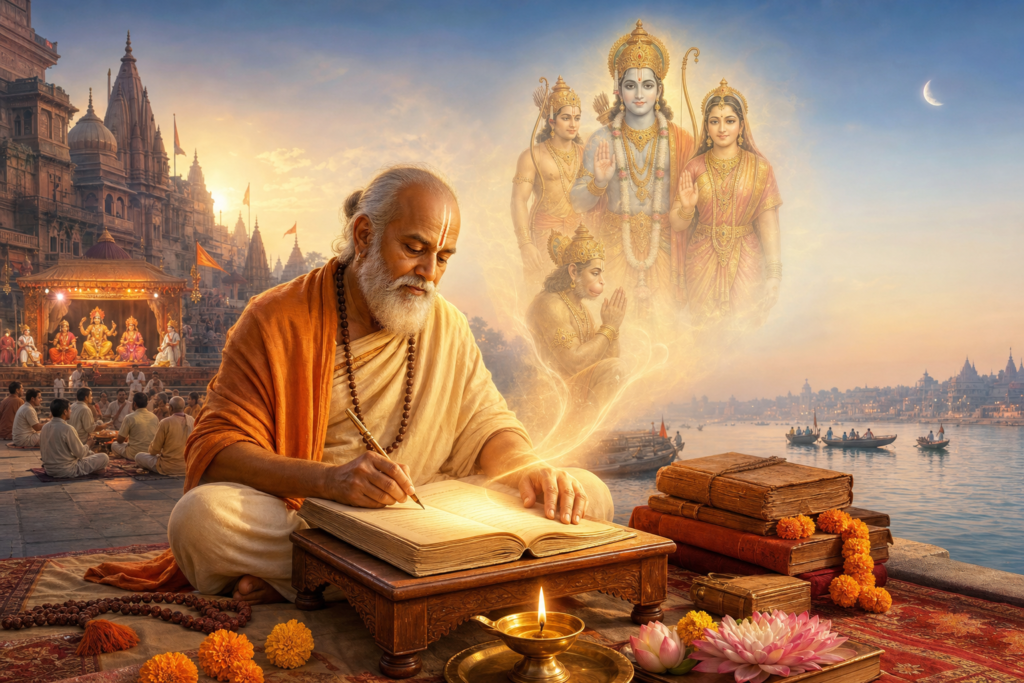
The Shravan Maas Mahatmya Katha gives this seasonal discipline a narrative form. It explains why the month is revered, identifies vratas connected with particular weekdays and tithis, and presents listening to sacred teaching as a religious practice in its own right. Read carefully, the tradition is not merely a catalogue of promised rewards. It is an invitation to restrain unnecessary consumption, regulate the senses, cultivate devotion, honour relationships and become more attentive to other living beings during the life-giving rains.
What exactly is Shravan Maas?
Shravan is commonly described as the fifth month of the Hindu year because it occupies that position in lunar calendars beginning with Chaitra: Chaitra, Vaishakha, Jyeshtha, Ashadha and then Shravan. That statement needs a qualification. Hindu timekeeping is regionally diverse, and not every community begins its ritual or civil year in Chaitra. Gujarati calendars commonly begin the year around Kartika, while Tamil, Malayalam, Bengali and other regional systems employ their own solar or lunisolar conventions. Shravan is consequently the fifth month within a particular calendrical sequence, not an absolute fifth month for every Hindu calendar in use.
The name Śrāvaṇa is connected with Shravana Nakshatra. Traditional lunar months are generally named for the nakshatra in or near which the full moon is expected to occur. Shravana is one of the twenty-seven lunar mansions and is traditionally associated with Vishnu. This astronomical and theological connection helps explain why Shravan, although strongly Shaiva in popular practice, also contains important Vaishnava observances. The Sanskrit root associated with śravaṇa also carries the sense of hearing or listening, which gives the month an especially appropriate symbolic link with katha, mantra, scriptural study and attentive reflection.
The supplied tradition also identifies Sawan with ‘Nabhas’. Vedic literature preserves an older cycle of seasonal month-names, including Nabhas and Nabhasya for the rainy season. Modern correlation tables often align Nabhas, sometimes transliterated as Nabha, with Shravan and Nabhasya with the following month. Such correlations are useful, but they should not be treated as proof that every Vedic reference employed the later lunar calendar in exactly its present form. The Vedic Heritage Portal’s Taittiriya Samhita collection and the calendrical study published in Tattvabodha preserve the relevant textual and historical context.
The astronomy behind Shravan dates
Shravan belongs to a lunisolar system. A synodic lunar month—the interval between equivalent lunar phases—averages approximately 29.53 days. A tithi is not an ordinary twenty-four-hour date; it is defined by each twelve-degree increase in the angular separation of the Moon and Sun. Because their apparent speeds vary, a tithi can begin or end at any hour, may touch two civil dates, or may be absent at one sunrise. A nakshatra is determined by the Moon’s position within twenty-seven conventional sectors of 13°20′ along the ecliptic. Festival decisions therefore depend on astronomical conditions and ritual rules, not merely on a printed Gregorian date.
Two principal lunar-month conventions account for the familiar difference between North Indian Sawan dates and the dates followed in much of western and southern India. In the amanta system, a month begins after Amavasya, proceeds through Shukla Paksha and Krishna Paksha, and ends at the next Amavasya. It is widely used in Maharashtra, Gujarat, Karnataka, Andhra Pradesh, Telangana and several other regions, although local details remain diverse.
In the purnimanta system, prevalent across much of the Hindi-speaking north, a month begins after Purnima. Krishna Paksha comes first, followed by Shukla Paksha, and the month ends at the next Purnima. Purnimanta Shravan therefore begins roughly a fortnight before amanta Shravan. Neither method is an error. They divide and name the same continuous sequence of lunar phases from different starting points.
This distinction explains several apparent contradictions. Shravan Purnima closes the month in a purnimanta calendar but occurs near its midpoint in an amanta calendar. Krishna Janmashtami may be called Bhadrapada Krishna Ashtami in a purnimanta calendar and Shravan Krishna Ashtami in an amanta calendar, even though the observance occurs at the same astronomical tithi. Similarly, the Shivaratri popularly called Sawan Shivaratri in the north can fall under the month-name Ashadha in an amanta reckoning.
Shravan shifts against the Gregorian calendar because twelve lunar months are roughly eleven days shorter than a solar year. Traditional calendars periodically insert an adhika masa when a lunar month contains no solar ingress into a new sidereal zodiac sign. Location, sunrise, tithi boundaries and sampradaya-specific rules can also affect the assigned observance date. For that reason, a local panchanga prepared for the devotee’s city and lineage should be consulted instead of applying one online date worldwide. Year-specific dates have not been imposed here because no single date range is correct for all regions.
What is the Shravan Maas Mahatmya Katha?
Mahatmya means a declaration or narration of greatness, while katha means a sacred account, teaching or story. A mahatmya normally combines theology, ritual instruction, illustrative narratives and a phalashruti describing the benefits of hearing or practising the teaching. Shravan Maas Mahatmya is therefore better understood as a cycle of teachings about the month than as one short legend with a single plot.
A widely circulated recension presents the Shravan Mahatmya as an Ishvara–Sanatkumara dialogue within the Skanda Purana. Its outer frame begins with Suta addressing Shaunaka and an assembly of sages. Within that frame, Sanatkumara asks Shiva to identify a month whose disciplines promote the welfare of the world. Shiva praises Shravan, explains its name through its association with Shravana Nakshatra, and describes it as a month in which every tithi can become an occasion for vrata, worship, study or self-restraint.
The commonly transmitted cycle contains thirty chapters. It moves from the qualifications of a sincere listener to monthly disciplines such as controlled eating, japa, Rudrabhisheka and voluntary renunciation. It then treats Sunday through Saturday, individual tithis, Nag Panchami, Ekadashi and Dwadashi, Purnima, Krishna Janmashtami, Pithori observance, Amavasya, Agastya Arghya and concluding rules for the vratas. The full thirty-chapter Shravan Mahatmya index makes clear that the work functions as a ritual calendar and ethical manual as well as a narrative.
The framing story praises humility, patience, cleanliness, devotion, freedom from pretence and willingness to listen without fault-finding. These qualities reveal the katha’s deeper logic. Sacred hearing is considered fruitful when it changes conduct. A person who recites many stories yet remains harsh, wasteful or dishonest has missed the discipline that the narrative is designed to cultivate.
Some passages use the elevated rhetoric characteristic of mahatmya literature, promising immeasurable merit or warning of severe consequences for neglected vows. In academic interpretation, such language belongs to the persuasive and devotional register of the genre. It expresses the seriousness with which a community values an observance; it should not automatically be converted into an empirical prediction, a threat against those unable to fast, or a basis for judging another person’s devotion.
The concluding narrative recalls Parvati’s devotion and presents Shravan as especially dear to Shiva. Significantly, it also recommends worship of both Shiva and Keshava and includes Krishna Janmashtami within the month’s sacred cycle. This internal plurality is important: the Mahatmya does not require hostility between Shaiva and Vaishnava traditions. It depicts several forms of worship as mutually enriching expressions of dharma.
Why Lord Shiva stands at the centre of Sawan
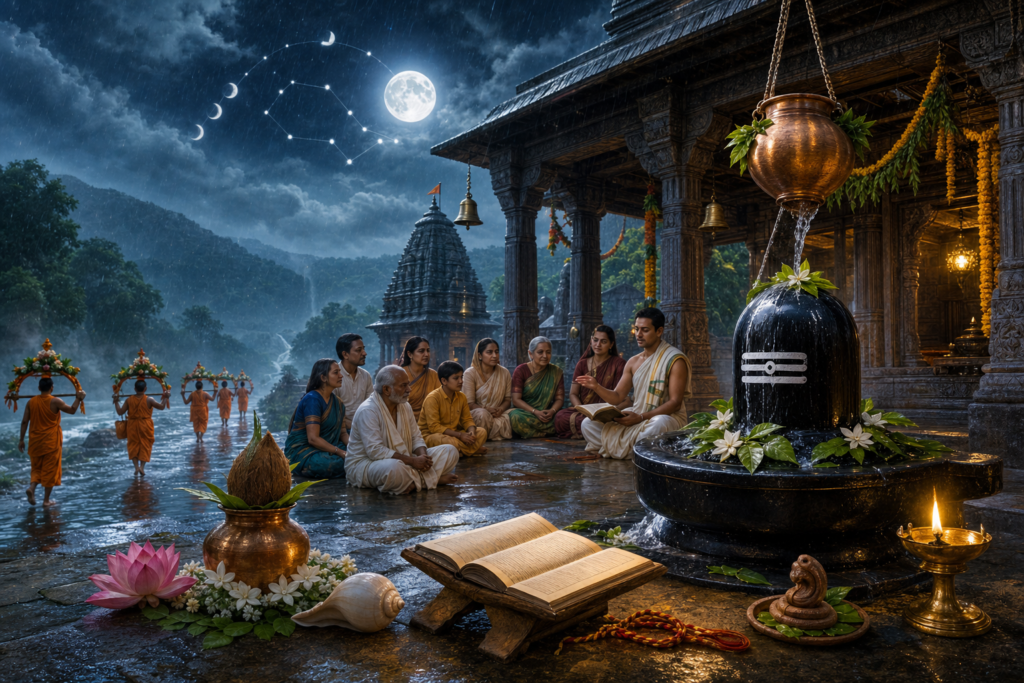
Popular devotion places Shiva at the heart of Shravan. Mondays become Shravan Somwar, Shiva lingas receive jalabhisheka, devotees recite ॐ नमः शिवाय, and temples conduct Rudrabhisheka or extended chanting. Shiva’s ascetic composure, simplicity and freedom from possessiveness suit a month devoted to reduced consumption and mastery of the senses. His residence in mountains and cremation grounds also supplies a powerful reminder that status and accumulation are temporary.
The most influential narrative association is the Samudra Manthan. In the Bhagavata Purana, the churning of the ocean first releases a destructive poison. Shiva accepts the Halahala to protect living beings and becomes celebrated as Nilakantha, the blue-throated one. The episode’s ethical centre is compassion joined with strength: power is used to absorb danger rather than pass it to the vulnerable. The primary Bhagavata Purana account in Canto 8, Chapter 7 narrates the act but does not itself provide a Shravan calendar date. The specific connection with Sawan belongs to later and living festival tradition, a distinction that preserves both textual accuracy and devotional meaning.
Water offered to Shiva is often interpreted as an expression of gratitude, cooling and purification. The Kanwar Yatra expands this act into a demanding pilgrimage: Kanwariyas collect Ganga water from places such as Haridwar, Gangotri and Gaumukh and carry it for Shiva abhisheka. The Government of Uttarakhand’s Haridwar account identifies the pilgrimage with the monsoon month of Shraawan. Its contemporary spiritual value is strongest when endurance is joined with road safety, cleanliness, courtesy toward local residents and protection of rivers from plastic and refuse.
Ritual bathing of a Shiva linga can include water, panchamrita, bilva leaves, flowers and other materials according to family or temple custom. Quantity is not a measure of devotion. Clean water offered with attention can carry greater ethical integrity than extravagant materials that are wasted or discharged into a river. Food-grade offerings should be handled hygienically, temple rules should be respected, and synthetic decorations should never enter soil or waterways.
Shravan also belongs to Vishnu, Lakshmi and the Divine Feminine
Shravana Nakshatra’s traditional association with Vishnu provides one basis for Vishnu and Lakshmi worship during the month. Vaishnava households may recite Vishnu Sahasranama, perform Satyanarayana Puja, honour Venkateswara, or observe the Ekadashis that occur during the relevant calendar period. Hayagriva Jayanti is observed by several communities on Shravan Purnima, and some Vaikhanasa traditions commemorate their sacred lineage during the same season.
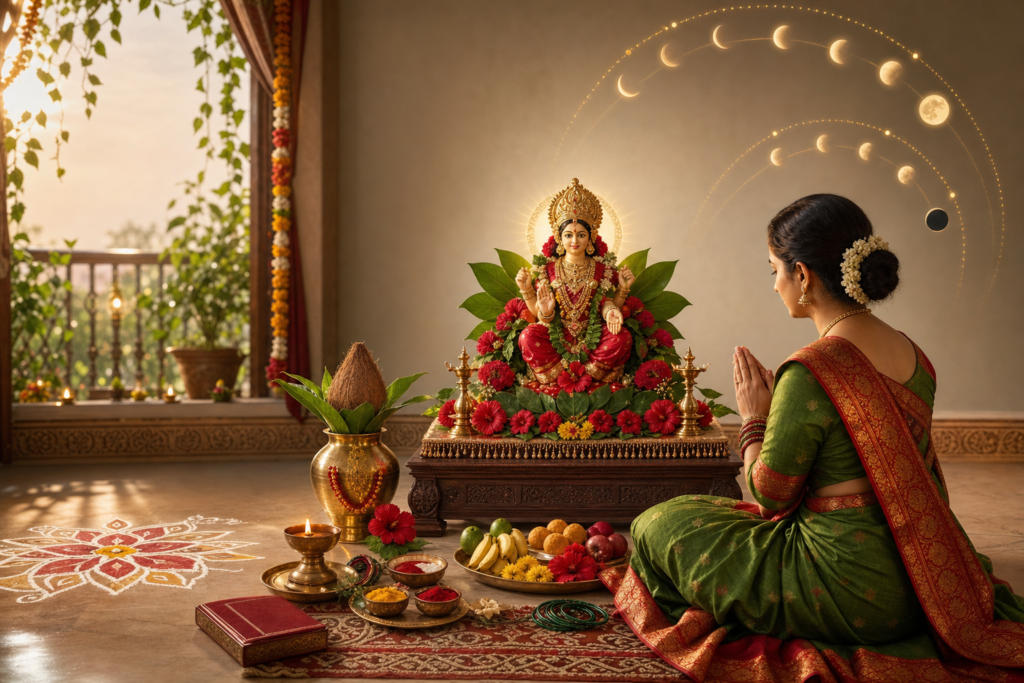
The Divine Feminine is equally visible. Mangala Gauri Vrat honours Parvati on Shravan Tuesdays, especially in Maharashtra and parts of southern India. Varalakshmi Vratam invokes Lakshmi as the source of auspiciousness, sustenance and household flourishing, commonly on the Friday preceding Shravan Purnima according to the relevant regional calendar. Jivantika or Jivati worship, local forms of Gauri devotion and other women-led traditions make Shravan an important setting for community memory, songs, games and intergenerational teaching.
These observances should not be reduced to the claim that women alone carry responsibility for a husband’s longevity or a household’s fortune. Historically gendered vratas can be honoured while emphasizing shared care, mutual fidelity, consent and equal responsibility within family life. Their communal dimension—women gathering, teaching younger participants and sustaining local arts—is culturally significant in its own right.
The weekly rhythm of Shravan vratas
Shravan Somwar Vrat is the most widely recognized weekly practice. Devotees may fast fully, take fruit or one simple meal, visit a Shiva temple, perform abhisheka, recite the Panchakshari mantra or read a Somwar Vrat Katha. The purpose is not to negotiate mechanically for a desired result. At its best, the repeated Monday observance creates a stable rhythm of restraint, attention and prayer across the month.
Shravan Mangalvar is associated with Mangala Gauri. In Maharashtra, newly married women have traditionally observed the vrata during the first years of marriage, combining worship with songs and energetic community games. Its contemporary meaning can include prayers for the well-being of the entire family, support among women and remembrance of Parvati’s strength, rather than anxiety about omens.
Shravan Shukravar carries several regional forms. Varalakshmi Vratam is prominent in Telugu, Kannada and Tamil communities, while Jivati or Jivantika worship has a strong presence in Maharashtra. Some households direct Friday worship toward Lakshmi, some toward a protective form of Devi, and others follow a family deity. The variation is evidence of a living tradition, not a defect requiring uniformity.
Saturday practices also vary. The supplied account emphasizes Vishnu and Venkatesha, whereas versions of the longer Mahatmya discuss Shani, Hanuman and Narasimha observances. Sunday may be connected with Surya, Wednesday with Budha and Thursday with Guru or Brihaspati. The source’s special attention to Tuesday, Friday and Saturday should therefore be read alongside the broader prominence of Monday and the Mahatmya’s treatment of all seven weekdays. No universal ranking applies to every region or sampradaya.
Major festivals within Shravan Mahina
Nag Panchami, generally observed on Shravan Shukla Panchami, honours Nagas and reflects the close relationship between agrarian communities, water, fertility and snakes that help control rodent populations. Shiva’s serpent, Vishnu’s Shesha and Krishna’s encounter with Kaliya give Nagas a substantial place in sacred narrative. Ethical celebration should use clay, wood, metal or painted images rather than capturing or displaying wildlife. Snakes do not naturally live on milk, and forcing milk into a live snake can cause suffering. Reverence is expressed more coherently through habitat protection and safe coexistence.
Shravan Purnima is not a single-purpose festival. Its full moon supports several overlapping regional traditions, revealing how one tithi can carry different meanings without contradiction. Raksha Bandhan emphasizes affection, responsibility and protection; Upakarma renews cycles of Vedic study; Narali Purnima honours the sea among western coastal communities; Hayagriva Jayanti celebrates Vishnu’s form associated with knowledge; and different lineages conduct additional rites according to their inherited calendars.
Raksha Bandhan is widely known for a sister tying a rakhi to a brother, accompanied by reciprocal expressions of care. The rite’s social meaning can extend beyond a one-sided promise of male protection. It can affirm mutual responsibility among siblings, relatives, friends and communities. A Government of India cultural account describes Raksha Bandhan as a bond capable of expressing solidarity across social boundaries, while regional practice preserves its intimate family character.
Upakarma, also called Avani Avittam or Jandhyala Pournami in particular communities, is an annual renewal connected with initiated students of specific Vedic branches. It commonly includes ritual purification, remembrance of rishis, renewal of the yajñopavita where applicable, and recommencement or rededication to Vedic study. It should not be represented as a scientifically proven cure for physical or psychological illness. Its demonstrable function is religious and educational: it marks responsibility toward a transmitted discipline. The extensive History of Dharmaśāstra hosted by IGNCA documents Upakarma’s relationship with the annual cycle of Vedic learning.
Narali Purnima is especially important to Koli and other coastal communities in Maharashtra and the Konkan. Coconuts are offered to Varuna or the sea, boats may be decorated, and prayers are made for safety and a sustaining fishing season. The observance joins livelihood, danger, gratitude and ecological dependence in one ritual moment. The Ministry of Tourism’s Narali Purnima account records its connection with Shravan Purnima and western coastal life.
Krishna Janmashtami belongs within Shravan in many amanta calendars and within Bhadrapada in purnimanta calendars. The difference is nomenclatural, not devotional. The longer Shravan Mahatmya includes Krishna’s birth narrative and even presents Janmashtami as dear to Shiva, offering a striking Hari–Hara bridge. The same month can therefore hold the austerity of Shiva worship and the joyous midnight celebration of Krishna without theological conflict.
Other observances can include Sawan Shivaratri, Pradosha, Ekadashi, Mangala Gauri, Hariyali Teej, Pithori Amavasya, Manasa Devi worship, Pola and local river or village festivals. Their month-labels and dates vary between calendars. A comprehensive understanding of Shravan respects these regional ecosystems instead of treating one state’s festival list as the standard for all Hindu communities.
A practical and responsible way to observe Shravan
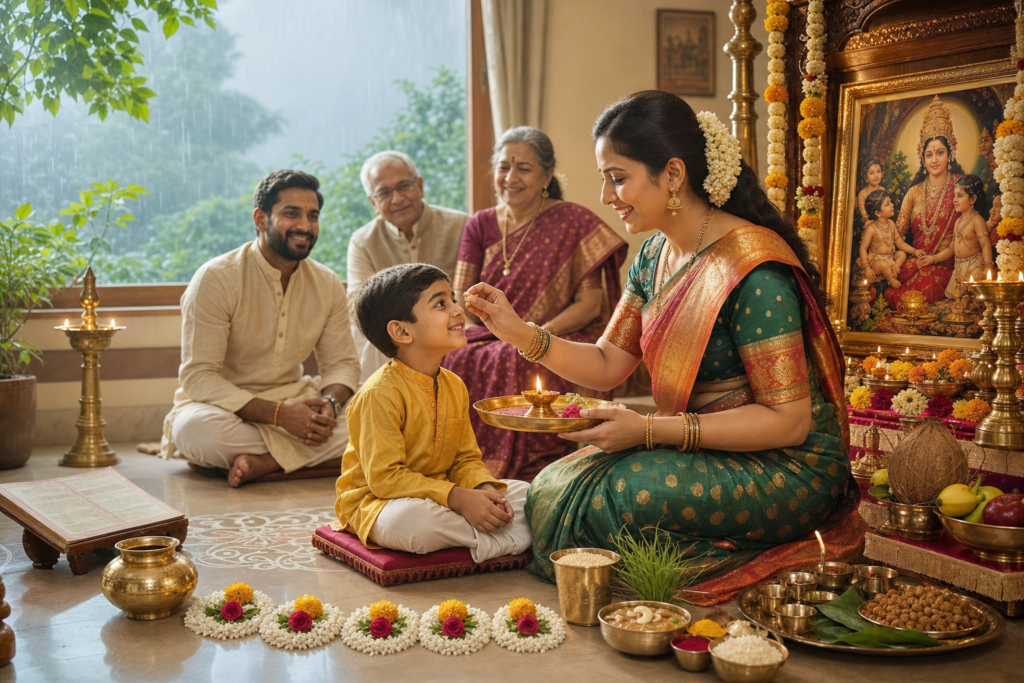
No single ritual programme is compulsory for every person. A modest household observance can begin with a realistic sankalpa: one daily period of prayer, one weekly vrata, a chosen text for study, a restrained habit and a form of service. The vow should be specific enough to guide conduct but proportionate to health, work, caregiving and financial circumstances. Consistency matters more than spectacle.
A simple daily pattern may include bathing and cleaning the worship space, lighting a lamp safely, offering water and flowers, remembering Shiva or the family’s ishta-devata, performing japa, reading a short passage of scripture, sitting quietly and dedicating one useful action to another being. Those without an image or elaborate altar can practise through mantra, meditation, ethical restraint and service. Sacred attention is not dependent on expensive materials.
Upavasa literally suggests remaining close to the sacred, although it is commonly expressed through fasting. Regional options include a complete fast, fruit and milk, one meal, or abstention from a selected food or indulgence. Rules concerning grains, salt, onion, garlic and meal timing differ considerably. A person should follow a trusted family or sampradaya discipline rather than combining incompatible instructions gathered from unrelated websites.
Fasting is not a test of worth. Children, older adults, pregnant or nursing people, those taking medication and anyone affected by a medical condition may need to modify or avoid it under qualified guidance. Hydration and prescribed treatment should not be abandoned for online fasting rules. A health-appropriate vow—such as refraining from anger, waste, intoxicants, gossip or unnecessary consumption—can preserve the vrata’s ethical purpose without causing harm.
A home Shiva puja may proceed through a short sequence: sankalpa, invocation, an offering of clean water, bilva leaves or flowers where available, recitation of ॐ नमः शिवाय, quiet contemplation, arati and distribution of safe prasada. A longer Rudrabhisheka should follow a competent priest, teacher or established liturgical manual. Pronunciation can be learned patiently; sincerity does not justify inventing claims about a mantra, while imperfect beginners need not be shamed.
Listening to Shravan Maas Mahatmya Katha is itself a traditional observance. Its value increases when narration is followed by discussion: What does Shiva’s acceptance of poison teach about responsibility? What does Parvati’s tapas teach about resolve? What does the seasonal pause reveal about consumption? What does Raksha Bandhan require beyond a decorative thread? Such questions turn inherited narrative into reflective practice without reducing it to either literalism or entertainment.
Charity and seva can give the month a visible social consequence. Appropriate actions include feeding people with dignity, assisting elderly neighbours, supporting education, volunteering at a temple or community kitchen, giving blood when eligible, planting native species, reducing single-use plastic and helping maintain clean pilgrimage routes. Service should respond to genuine needs and protect recipients’ dignity rather than function as a display of piety.
Common questions and claims that require careful qualification
Is marital intimacy forbidden throughout Shravan? There is no sound basis for asserting a universal ban for every Hindu householder. Some strict monthly disciplines recommend brahmacharya, and a couple may mutually include abstinence on vrata days as part of a chosen sankalpa. That voluntary rule should not be imposed coercively. The claim that conception during Shravan necessarily harms a child has no scientific foundation. Consent, mutual respect, health and the actual terms of the vow remain decisive.
Is Shravan automatically suitable for Griha Pravesh? The supplied source praises house entry during the month, but regional traditions are not unanimous. Some communities restrict major ceremonies during Chaturmas, while others recognize particular auspicious combinations. A valid muhurta depends on tithi, nakshatra, weekday, local sunrise, family custom and other calendrical considerations. The whole month should neither be declared universally favourable nor universally prohibited without examining the relevant panchanga.
Are people born in Shravan guaranteed exceptional honour? Mahatmya and astrological literature may praise births in a sacred period, and devotional narratives associate Krishna, Hayagriva or revered teachers with dates in or near Shravan under particular calendars. Such praise belongs to theology and astrology, not to an empirically established rule of personality or destiny. Character, opportunity, education and conduct cannot be inferred from a birth month alone.
Must every devotee abandon the same foods and activities? No. Dietary vows reflect region, climate, lineage, household capacity and the specific vrata. A personal renunciation is spiritually useful when it reduces attachment and supports clarity; it becomes counterproductive when it produces malnutrition, pride or hostility toward people following another custom. Cleanliness, moderation, truthfulness and non-harm are more widely shared principles than any single menu.
Is Shravan only for Shiva? Shiva is unquestionably central to contemporary Sawan devotion, especially through Somwar Vrat, abhisheka and Kanwar Yatra. Yet the month’s name is linked with a nakshatra associated with Vishnu, the Mahatmya includes worship of Keshava and Krishna, Fridays honour forms of Devi and Lakshmi, and Purnima supports several distinct traditions. A more accurate conclusion is that Shravan is predominantly Shaiva in many regions while remaining richly shared across Hindu sampradayas.
Shravan, the monsoon and the wider Dharmic world
Shravan falls within the broader rainy-season discipline of Chaturmas. In Hindu traditions, this season often encourages reduced travel, intensified worship, scriptural hearing and limits on consumption. The practical ecology is easy to recognize: monsoon travel was historically difficult, agricultural life demanded attention, and rain brought forth insects and other small organisms vulnerable to careless movement. Religious restraint translated seasonal conditions into an ethic of patience and non-injury.
Comparable rainy-season institutions developed across other Dharmic traditions without becoming identical to Shravan worship. Jain mendicants observe a caturmasa residence, limiting travel and engaging more intensively with lay communities; the practice is closely related to ahimsa. Buddhist monastics in traditions observing Vassa remain in residence during the rains for sustained discipline and study. Academic accounts of Jain caturmasa and the Buddhist rains retreat show a shared South Asian response to season, mobility and non-harm, even as their doctrines and monastic rules remain distinct.
Sikh tradition offers another careful point of connection through Barah Maha, the twelve-month poetic genre preserved in the Guru Granth Sahib. Its seasonal imagery turns changing weather into reflection on remembrance, separation and union with IkOankar. Gurmat does not require the claim that one month is inherently lucky while another is spiritually empty; rather, time becomes fruitful through remembrance and truthful living. The Guru Granth Sahib Project’s introduction to Barah Maha explains this distinction. Respectful Dharmic unity acknowledges the common use of seasonal time while refusing to erase theological differences.
This wider perspective prevents Shravan from becoming a competition among traditions. Shiva’s compassion, Jain ahimsa, Buddhist restraint and Sikh remembrance arise from distinct sources and cannot simply be declared interchangeable. They can nevertheless meet in an ethical field shaped by disciplined attention, reduced harm, care for living beings and resistance to spiritual arrogance. Unity becomes credible when difference is understood rather than flattened.
The enduring importance of Shravan Mahina
The deepest symbolism of Shravan may lie in learning to listen. Rain slows ordinary movement, katha interrupts habitual distraction, mantra steadies speech, and vrata exposes the difference between need and impulse. The month invites a person to listen to scripture, elders, family members, the body’s limits, the needs of neighbours and the natural world. In this sense, śravaṇa becomes more than the name of a nakshatra: it becomes a disciplined mode of attention.
Shravan also demonstrates how sacred calendars hold diversity together. One household pours water over a Shiva linga; another prepares a Varalakshmi kalasha; another renews Vedic study; a coastal family offers gratitude to the sea; siblings exchange rakhi; and a Vaishnava community celebrates Hayagriva or Krishna. These practices need not be forced into one ritual. Their convergence within the rainy season reveals a civilization capable of sharing time while preserving local forms.
The Shravan Maas Mahatmya Katha ultimately presents sacred time as an opportunity rather than a commodity. Its language of merit points toward transformed conduct: less waste, greater self-command, more compassionate strength and sustained remembrance of the divine. When worship is joined with textual understanding, health-conscious fasting, ecological care and respect for other paths, the importance of Shravan Mahina becomes both traditional and urgently contemporary.
Research note: This synthesis critically expands the supplied HinduPad source page by comparing its claims with Vedic calendrical material, the circulated thirty-chapter Shravan Mahatmya, the Bhagavata Purana’s Samudra Manthan narrative, historical research on Upakarma and official cultural accounts of Kanwar Yatra, Raksha Bandhan and Narali Purnima. Puranic recensions, regional panchangas and household customs can differ; descriptive statements about a tradition should therefore not be mistaken for universal commands or scientific claims.
Inspired by this post on Hindu Pad.




Leave a Reply
You must be logged in to post a comment.