

Among the many manifestations of Bhairava, Batuk Bhairava occupies an unusually tender yet formidable position. He appears as a divine boy, but he carries the vigilance, authority, and transformative force associated with Shiva’s fierce forms. This juxtaposition is not an inconsistency to be explained away. It is the theological key to Batuk Bhairava: ultimate power need not appear physically imposing, and innocence need not be powerless. His image brings childhood, danger, protection, discipline, mortality, and grace into a single sacred form.
A careful account of Batuk Bhairava must distinguish three overlapping layers of tradition. The first is sacred narrative, through which communities explain why the deity manifests and what his actions mean. The second is textual and iconographic prescription, preserved in Tantric compilations, ritual manuals, and works on image making. The third is living practice, which varies across regions, temples, households, and lineages. These layers illuminate one another, but they are not identical; no single modern retelling should be treated as the only universally accepted version.
Who Is Batuk Bhairava?
Bhairava is widely understood in Shaiva traditions as a fierce manifestation of Lord Shiva. His frightening appearance does not make him malevolent. Fierce divine imagery ordinarily signifies the concentrated destruction of disorder, delusion, pride, or forces that threaten the integrity of sacred life. Bhairava consequently appears both as a power of dissolution and as Kṣetrapāla, the guardian of a consecrated field, temple, settlement, or ritual boundary. The Institut Français de Pondichéry’s Bhairava research database documents this remarkable range, from terrifying cremation-ground forms to youthful and protective manifestations.
The name Batuk Bhairava is also written Baṭuka Bhairava or Vaṭuka Bhairava, while Batuk Bhairav is common in modern North Indian speech. Sanskrit lexicons give baṭuka the meanings of a boy, lad, or young Brahmin student. The relevant Sanskrit lexical entry also recognizes Batuka Bhairava as a particular form of Bhairava. The name therefore conveys more than biological youth. It can evoke a novice marked by discipline, receptivity, concentrated learning, and the readiness to enter sacred knowledge.
The ordinary lexical sense of bhairava belongs to the semantic field of the terrible, formidable, or fear-inspiring. Tantric exegesis also offers a theological interpretation of the syllables bha, ra, and va, connecting them with the maintenance, withdrawal, and projection of the universe. This is best understood as a contemplative or symbolic etymology rather than a modern historical derivation of the word. It presents Bhairava as the consciousness within which creation, continuity, and dissolution occur.
Batuk Bhairava is thus not a diminished Bhairava. He is Bhairava’s power expressed through youthfulness. Some traditions emphasize his accessibility and benevolence, while others retain distinctly fierce iconographic features. The child and the guardian are not two unrelated personalities; they are complementary dimensions of a deity whose gentleness makes protection intimate and whose fierceness makes that protection effective.
The Manifestation of Batuk Bhairava and the Crisis Named Āpad
The best-known Batuk-specific manifestation narrative is associated with the Kālīkhaṇḍa of the Śaktisaṅgama Tantra. In the widely transmitted summary of this account, a powerful being named Āpad acquires exceptional strength through austerity and becomes a source of suffering for divine and human communities. A condition attached to his invulnerability makes an ordinary military response ineffective: he can be defeated by a virtuous child of five years rather than by the established powers that confront him.
When the crisis reaches its height, divine radiance converges and assumes the form of a five-year-old boy. Shaiva interpretations identify the child with Shiva’s protecting power, while other retellings emphasize the combined energy of the devas. Although small in appearance, the newly manifested Batuk possesses the concentrated force required for the task. He confronts and defeats Āpad, restoring order where mature power, conventional rank, and familiar strategies had failed.
The narrative contains deliberate theological wordplay. The Sanskrit noun āpad already means misfortune, calamity, danger, or distress; the story personifies that condition as an adversary. The term uddhāraṇa conveys lifting up, rescuing, or delivering. Batuk Bhairava is therefore remembered as Āpaduddhāraka, the one who delivers beings from calamity. It would be linguistically inaccurate to claim that the ordinary word for calamity originated only after the demon’s defeat. The myth instead transforms an existing word into a vivid sacred personality and then dramatizes its overcoming.
A recent peer-reviewed study of the Sanskrit composition Śrī Vaṭukanātha likewise reports the Kālīkhaṇḍa tradition in which Vaṭuka Bhairava manifests to defeat Āpad. The study also places the deity within the wider concepts of Shiva, Tantra, and Kṣetrapāla. This provides useful scholarly corroboration while still leaving room for differences among textual recensions and oral explanations. The study is available through its journal DOI.
The story makes a striking claim about divine action: a form that appears least threatening can carry the precise power a crisis requires. Āpad prepares for force of a familiar kind, but the answer arrives as newness, clarity, and concentrated potential. The child does not prevail despite being a child; within the logic of the narrative, childhood is exactly what makes the intervention possible.
Batuk Bhairava and the Broader Origin of Bhairava
The story of Āpad should not be confused with the better-known Purāṇic account of Bhairava’s emergence in response to Brahma’s pride. In versions transmitted through Shaiva Purāṇic literature, Bhairava manifests from Shiva and severs Brahma’s fifth head. He then bears the skull and undergoes the consequences attached to Brahminicide until liberation is obtained at Kashi. This cycle explains Bhairava’s skull-bearing iconography, his association with accountability, and his role as the guardian or magistrate of the sacred city.
That Purāṇic cycle establishes important features of Bhairava in general, but it does not automatically constitute a complete account of Batuk Bhairava’s youthful form. A peer-reviewed survey of Bhairava’s literary iconography demonstrates how Purāṇic, Tantric, ritual, and artistic sources preserve multiple identities and forms. Responsible interpretation therefore distinguishes the broad mythology of Bhairava from specifically Batuk-centered narratives without isolating them from one another.
Some Shakta communities also transmit narratives in which Shiva assumes a child form in relation to the overwhelming fury of Kali. In popular versions, the vulnerable appearance of the child interrupts or pacifies destructive momentum. This account expresses an important Shakta insight: force cannot always be answered by greater force, and compassion may accomplish what confrontation cannot. It should nevertheless be presented as a regional or lineage-based sacred narrative rather than as a universally standardized biography accepted in precisely the same form everywhere.
The Āpad narrative, the Brahma cycle, and Kali-centered traditions need not be forced into one chronological sequence. Hindu sacred literature commonly allows a deity to manifest repeatedly, and different communities may organize the same divine reality through different relationships. Batuk may be described as a form of Shiva, a youthful Bhairava, a guardian associated with Devi, or a divine child within a particular ritual family. These descriptions reveal the priorities of their respective traditions more clearly than an artificial attempt to reduce them to a single modern storyline would.
The Philosophical Meaning of the Divine Child
The youthful form overturns the assumption that authority must display age, physical size, institutional status, or aggression. Batuk Bhairava embodies power before it hardens into self-importance. His form suggests alertness without cynicism, directness without accumulated pride, and courage without the need to perform domination. The symbolism is especially relevant to the Āpad story, in which conventional power has exhausted its options.
The secondary meaning of baṭuka as a young religious student deepens this interpretation. A student stands at a threshold: no longer wholly unformed, yet not burdened by the claim of complete knowledge. Batuk Bhairava can therefore symbolize disciplined beginner’s awareness—the capacity to meet reality freshly while remaining guided by sacred learning. This is an interpretive insight rather than a claim that every historical text states the symbolism in identical terms.
For devotees facing sudden upheaval, the image offers a relatable pattern of response. Crisis often creates the feeling that only greater control, louder assertion, or more complicated strategy can restore safety. Batuk Bhairava presents another possibility: clear perception, simplicity of purpose, and decisive action may be more powerful than panic. Such a reading does not turn mythology into clinical treatment, but it explains why an ancient protective form continues to carry emotional meaning.
His protection is also better understood as a demand for responsibility than as a promise that difficulty will never arise. Bhairava guards boundaries, exposes disorder, and confronts what has been avoided. Devotional traditions may affirm miraculous help, but their deeper ethical logic requires courage, discernment, and right action from the devotee. Faith in Āpaduddhāraka should never replace appropriate medical care, legal advice, emergency assistance, or practical security measures.
The divine child also prevents fierceness from becoming cruelty. Batuk Bhairava’s wrath is directed toward the condition represented by Āpad, not toward communities defined by birth, language, caste, or religious identity. In a dharmic interpretation, protection restores balance and safeguards life; it does not license prejudice or collective hostility. The union of tenderness and force is meaningful precisely because power remains accountable to protection.
The Three Iconographic Modes: Sāttvika, Rājasika, and Tāmasika
Batuk Bhairava has no single visual form that exhausts his identity. Medieval ritual and iconographic sources describe multiple contemplative images, or dhyānas, suited to different ritual aims. The Śāradātilaka Tantra is especially important because it presents sāttvika, rājasika, and tāmasika visualizations of Vaṭuka. A public-domain account based on earlier iconographic scholarship preserves these descriptions in its discussion of the iconography of Vaṭuka Bhairava.
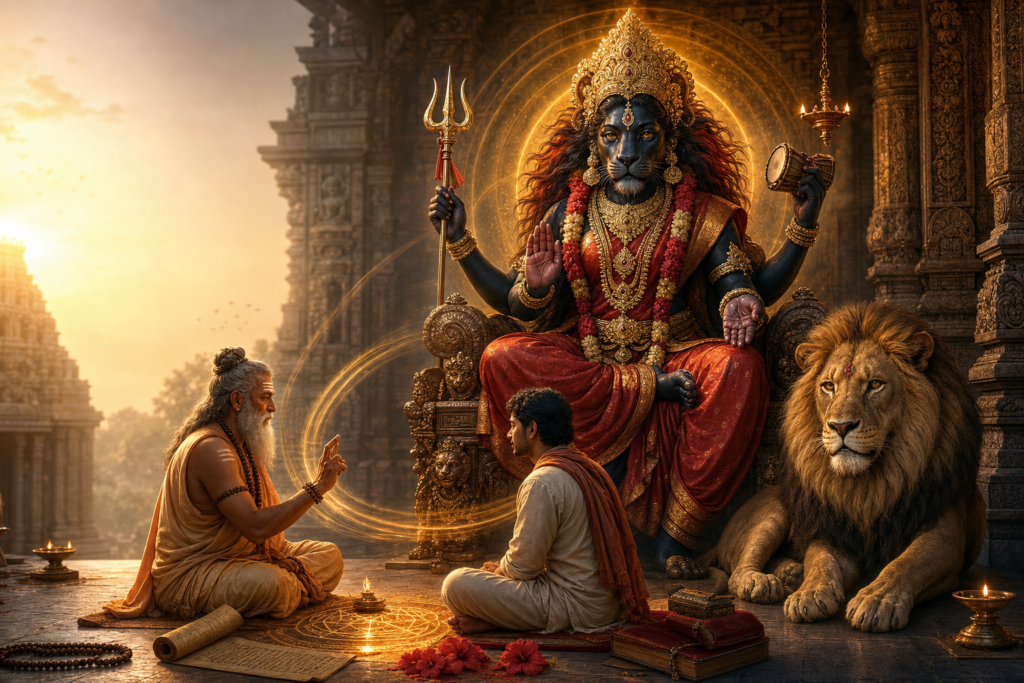
In the sāttvika visualization, Vaṭuka is youthful, joyful, pleasing, and adorned with beautiful ornaments. He carries a trident and staff in two hands. The emphasis falls on clarity, protection, auspiciousness, and the peaceful accessibility of the divine boy. This is the form most closely aligned with modern descriptions that stress innocence and household devotion, although even this gentle image retains Shiva’s emblems and authority.
In the rājasika visualization, the deity shines like the sun and wears a red garland. He has a smiling face, an elephant-skin garment, and four hands bearing the trident and skull while also displaying gestures of boon-giving and protection. The image communicates energetic engagement. It is neither entirely placid nor overwhelmingly terrifying; it visualizes divine power entering active relationship with the world.
The tāmasika visualization is darker and more formidable. The deity is compared to a blue mountain, wears a skull garland and serpent ornaments, displays fangs, and carries eight attributes that include a drum, goad, sword, noose, snake, bell, skull, and a gesture of protection. Even here, the protective gesture is significant. The terrible appearance does not erase benevolence; it indicates the intensity required to confront destructive or disintegrating conditions.
These three modes should not be converted into a racial hierarchy or a simplistic equation in which light color means good and dark color means evil. Sattva, rajas, and tamas are functional modalities of luminosity, activity, and inertia or dissolution. Tantric imagery uses color, posture, weaponry, and expression to communicate ritual function. Complexion in sacred art is symbolic and must never be used to assign spiritual worth to human skin color.
The Eight-Armed Form and Its Sacred Implements
The Rūpamaṇḍana, a work concerned with the construction and characteristics of sacred images, prescribes an eight-armed Vaṭuka Bhairava. Six hands hold a khaṭvāṅga or staff, a noose, a trident, a ḍamaru drum, a skull cup, and a serpent. Another hand carries flesh, while the remaining hand displays abhaya mudrā, the gesture that dispels fear. A dog of the same color as the deity is placed beside him. This description demonstrates how protective assurance and cremation-ground symbolism coexist within one icon.
The trident announces the deity’s Shaiva identity and is commonly interpreted through triads such as creation, preservation, and dissolution or the three fundamental modalities of nature. The ḍamaru evokes rhythm, vibration, manifestation, and the ordering of time. The staff signifies authority and disciplined movement, while the noose and goad can represent restraint, direction, and the power to arrest forces that have escaped proper limits.
The skull cup, skull garland, and cremation-ground associations do not turn Bhairava into a deity of gratuitous horror. They make impermanence impossible to ignore. The skull is a direct reminder that rank, beauty, possession, and ego cannot defeat mortality. Serpents similarly carry several layers of meaning, including danger mastered, vitality, cyclical renewal, and the energy that moves between concealment and revelation.
The gesture of fearlessness is crucial to reading all the other symbols. Weapons without abhaya could be mistaken for ungoverned violence; abhaya mudrā places them within a protective economy. Batuk Bhairava’s icon says, in visual language, that terrifying power is being held in service of refuge. The image is not asking the devotee to glorify fear but to recognize a consciousness capable of containing it.
Nudity appears in several textual prescriptions and sculptures. Within this iconographic language, it can signify a condition prior to social costume, rank, possession, and conventional identity. It should not be interpreted through an eroticized modern frame, particularly when the deity is explicitly youthful. The unadorned body presents divine presence as self-sufficient, while ornaments of serpents, bells, or skulls locate that presence beyond ordinary social respectability.
The Dog as Vāhana and Companion
The dog is one of Batuk Bhairava’s most recognizable companions, but its presence is not perfectly uniform in every textual prescription or surviving image. Some South Indian iconographic traditions make the dog explicit, whereas the Śāradātilaka descriptions do not require it. This difference is an important reminder that living iconography develops through dialogue among texts, artists, patrons, and local customs.
As a symbolic companion, the dog conveys vigilance, loyalty, responsiveness, and sensitivity to boundaries. Dogs move between domestic space, roads, village margins, wilderness, and cremation grounds, making them appropriate companions for a deity who guards thresholds. Their acute awareness of what approaches from outside reflects the alertness expected of a Kṣetrapāla.
The association also has an ethical implication. An animal that has often lived at the margins of human settlements is drawn into the immediate presence of the sacred. Contemporary customs of feeding or caring for dogs can therefore be interpreted as compassionate service rather than a transaction designed to purchase supernatural favor. Such care should use safe food, respect local animal-welfare guidance, and avoid practices that endanger either animals or people.
Material evidence confirms the dog’s importance while also displaying artistic variation. The Government of India’s museum portal records a brass figure of Batuka Bhairava at the Indian Museum, Kolkata, mounted on a dog and represented with four arms, a lasso, and a conch. A separate National Mission on Monuments and Antiquities record describes a thirteenth- to fourteenth-century sculpture from Konark in which Batuka Bhairava rides a dog and carries a sword and skull cup.
These objects do not reproduce every detail of a single manual. One is four-armed and holds a conch; another carries a sword and skull cup; other prescriptions demand two or eight arms. The differences are not necessarily mistakes. They demonstrate that sacred iconography possesses a stable grammar—youthfulness, Bhairava attributes, guardianship, and frequent canine association—while allowing regional artists to speak in distinct visual dialects.
Batuk Bhairava as Kṣetrapāla, Guardian of the Sacred Field
The Sanskrit compound Kṣetrapāla joins kṣetra, a field, domain, or consecrated territory, with pāla, a protector or keeper. Bhairava’s placement near gateways, boundaries, temple perimeters, and settlement margins gives spatial form to his theology. He does not merely occupy the center of worship; he safeguards the conditions under which worship can occur.
A boundary guardian is not simply a supernatural watchman. Sacred boundaries distinguish attention from distraction, responsibility from negligence, and disciplined practice from uncontrolled impulse. At a psychological level, Batuk Bhairava may therefore symbolize the capacity to decide what should be admitted into awareness, what requires examination, and what must be refused because it causes harm.
This function must not be distorted into hostility toward people considered outsiders. A dharmic boundary protects integrity without denying the dignity of others. The same guardian who prevents violation also restrains the community within the boundary from violating its own principles. Bhairava’s mythology of accountability, especially the skull-bearing consequence following Brahma’s decapitation, makes clear that even sacred power is not exempt from moral order.
Batuk or Vaṭuka also appears in Shakta ritual environments. Research on Malla-period protective imagery in Nepal identifies mandala systems that install Bhairava, Vaṭuka, Ganesha, and Yogini as guardians at the corners of an enclosure. Significantly, Vaṭuka and Bhairava can be listed as separate figures in this context. The evidence, discussed in the Bulletin of the School of Oriental and African Studies, cautions against assuming that every Tantric tradition classifies divine forms in exactly the same way.
Within other Shakta lineages, Batuk Bhairava may be understood as a form of Shiva who accompanies, guards, or serves Devi’s sacred power. Some communities describe him as a child of the Goddess, others as her guardian, and still others as Bhairava himself in youthful form. These relationships should be learned within their respective sampradāyas. Their diversity expresses the relational character of Tantra, in which divine identities are organized through ritual function as well as genealogy.
Kala Bhairava’s famous position as guardian of Kashi should likewise be distinguished from Batuk Bhairava’s specific identity. Both belong to the wider Bhairava complex, and their imagery may overlap, but they are not automatically interchangeable in every text or temple. Kala Bhairava emphasizes time, accountability, and Kashi’s sacred jurisdiction; Batuk Bhairava emphasizes youthful manifestation, immediate guardianship, and deliverance from āpad. A tradition may unite these functions, but scholarship should not presume that it always does.
Text, Sculpture, Music, and the Historical Reach of Vaṭuka
Batuk Bhairava’s history cannot be reconstructed from mythology alone. Textual prescriptions, dated sculpture, museum collections, temple practice, and music provide complementary evidence. The Śāradātilaka, usually placed in the medieval development of encyclopedic Tantric ritual literature, already contains carefully differentiated Vaṭuka visualizations. The Rūpamaṇḍana supplies another influential iconographic scheme, while later manuals continue to adapt the deity to particular ritual systems.
Surviving sculpture confirms that Batuk Bhairava was not merely an abstract figure in manuscripts. The Konark record securely places a recognizable Batuka image within the material culture of medieval Odisha. South Indian representations, museum objects, and scholarly catalogues document additional forms. The very variation among these images demonstrates the deity’s movement across artistic regions rather than the mechanical copying of a single prototype.
Music preserves another dimension of this history. Muttusvāmi Dīkṣitar’s Sanskrit composition Śrī Vaṭukanātha, set in the Carnatic rāga Devakriya, addresses Vaṭukanātha through Shaiva and guardian imagery. The composition’s association with Kṣetrapāla shows that Batuk Bhairava’s theology could be transmitted through sophisticated musical literature as well as temple sculpture and ritual manuals. Sacred sound thus becomes another form of iconography: attributes that stone presents visually are arranged by poetry, melody, and rhythm.
Nepal offers particularly rich evidence for Bhairava’s life across Hindu and Buddhist communities. A Smithsonian museum record describes Bhairava as a fierce manifestation of Shiva important to both Hindus and Buddhists in Nepal. Such shared reverence should be acknowledged without flattening theological difference. The same image can participate in neighboring ritual worlds whose interpretations overlap in some respects and diverge in others.
The Buddhist deity Vajrabhairava provides an instructive example of both connection and distinction. In Tibetan Buddhist interpretation, Vajrabhairava is a wrathful form of Mañjuśrī and an aspect of Yamāntaka, the conqueror of death. He is not simply the Buddhist name for Batuk Bhairava. The Smithsonian’s Vajrabhairava record identifies him through a specifically Buddhist cosmology of wisdom and liberation. Shared Sanskrit vocabulary and fierce imagery reveal centuries of cultural dialogue, but respectful comparison preserves each tradition’s doctrinal identity.
This precision supports unity among dharmic traditions more effectively than careless claims of sameness. Hinduism, Buddhism, Jainism, and Sikhism articulate distinct understandings of deity, liberation, scripture, and practice. Yet readers from all four traditions can recognize the ethical importance of courage, disciplined awareness, restraint of destructive impulses, compassion, and service. Batuk Bhairava need not be recast as a deity of every tradition in order for his story to contribute to a shared culture of fearlessness and mutual respect.
Worship, Mantra, and the Importance of Lineage
Batuk Bhairava worship ranges from accessible devotional acts to technically demanding Tantric practice. Public forms may include temple darśana, respectful prayer, hymns, remembrance of the deity’s name, lamps, and regionally customary offerings. Initiated systems may add bīja mantras, nyāsa, mandala construction, prescribed visualizations, fire rites, and carefully sequenced worship of associated deities. These two levels should not be confused.
The reputation of Batuk Bhairava as approachable does not mean that every esoteric formula can be detached from its textual and initiatory setting. Seed syllables are embedded in systems of pronunciation, bodily installation, visualization, ritual eligibility, and lineage transmission. Complex practices should therefore be learned from a qualified teacher within a trustworthy tradition rather than improvised from fragmented internet instructions.
A person seeking a simple devotional relationship can remain within non-esoteric forms: cleanliness, a calm space, respectful remembrance, prayer to Shiva or Batuk Bhairava, study of the sacred narratives, and conduct grounded in truthfulness and compassion. Family custom and temple guidance should take precedence over generalized formulas. No sincere devotee needs to imitate advanced Tantra in order to approach the protective meaning of the deity.
The quality of practice can be tested ethically. If devotion produces steadiness, courage, accountability, care for vulnerable beings, and greater respect for other paths, it is reflecting the guardian’s purpose. If it produces obsessive fear, claims of superiority, hostility toward imagined enemies, or avoidance of real-world responsibilities, the practice has lost its dharmic orientation. Bhairava’s fierceness is meant to confront delusion, including delusion within the devotee.
The title Āpaduddhāraka should similarly be interpreted with maturity. Devotional faith may understand Batuk Bhairava as responding swiftly in danger, but worship is not a contractual mechanism that guarantees a desired outcome. Its enduring value lies in the relationship it establishes between protection and awakened responsibility. The devotee seeks refuge while also becoming more capable of offering refuge to others.
Batuk Bhairava’s Relevance in Contemporary Life
Modern life generates forms of āpad that may not resemble a mythic adversary: sudden illness, unemployment, bereavement, displacement, social conflict, technological overload, or the collapse of familiar expectations. Batuk Bhairava does not offer a simplistic denial of these realities. His story provides a symbolic grammar for meeting them—name the crisis, refuse paralysis, recover clarity, and act without surrendering compassion.
The child form is particularly important in cultures that often equate maturity with emotional hardening. Batuk Bhairava suggests that vulnerability and power need not cancel one another. A person can recognize fear without becoming governed by it, remain tender without becoming passive, and establish boundaries without hatred. This is not a psychological technique attributed literally to an ancient Tantra; it is a contemporary ethical interpretation grounded in the deity’s visible paradox.
His guardianship also speaks to institutions and communities. A sacred field remains healthy only when its boundaries protect truth, accountability, learning, and the dignity of participants. Guardianship that merely controls access while ignoring abuse inside the boundary is incomplete. Batuk Bhairava’s association with both fearlessness and consequence invites communities to defend the vulnerable as seriously as they defend their symbols.
The deity’s canine companion extends this concern beyond human society. Care for animals, attention to beings at the margins, and practical service provide tangible forms of reverence. In this way, iconography can move from temple wall to ethical action. The dog beside Batuk is not only an identifying attribute; it challenges the observer to notice lives that social habit has made easy to overlook.
Frequently Asked Questions About Batuk Bhairava
Is Batuk Bhairava the same as Kala Bhairava? Both are related forms within the broad Bhairava traditions and may share Shiva’s emblems, the dog, skull imagery, and guardian functions. Texts and temples nevertheless distinguish them in many settings. Kala Bhairava is especially associated with time, Kashi, and sacred jurisdiction, while Batuk Bhairava is marked by youthfulness and the Āpaduddhāraka narrative.
Was Batuk Bhairava always described as five years old? Five years is central to the widely circulated Āpad narrative because the adversary can be defeated by a child of that age. Other textual and artistic sources simply characterize Vaṭuka as youthful or boy-like. A precise age should therefore not be imposed on every image or lineage.
Why does a gentle child carry frightening objects? The objects communicate function rather than personality in an ordinary human sense. The skull exposes impermanence, the trident declares Shaiva authority, the noose restrains disorder, the drum expresses cosmic rhythm, and abhaya mudrā assures protection. Their coexistence teaches that compassion sometimes requires the strength to confront what causes harm.
Why is Batuk Bhairava accompanied by a dog? The dog is a historically attested vāhana or companion in many regional images. It represents vigilance, loyalty, and movement across boundaries, although no single symbolic explanation is mandatory. Some texts and sculptures omit the dog, confirming that iconography remains diverse.
Can anyone worship Batuk Bhairava? Simple public devotion is widely accessible, subject to the customs of the temple, family, or community concerned. Esoteric mantra and ritual systems operate under different rules and may require initiation and supervision. Respecting that distinction protects both the practitioner and the integrity of the tradition.
Is there one canonical manifestation story? No single narrative governs every community. The defeat of Āpad is the most prominent Batuk-specific account, while the broader Bhairava mythology includes Brahma’s fifth head and the guardianship of Kashi. Shakta and regional traditions add further narratives, including the child form’s relationship with Kali. These accounts should be identified by context rather than collapsed into one supposedly uniform biography.
Does Bhairava’s fierceness represent evil? No. Within Shaiva and Shakta interpretation, fierce form is a mode of protective and transformative sacred power. It is directed against ignorance, disorder, destructive pride, and forces represented as threats to dharma. The recurring gesture of fearlessness confirms the protective purpose behind the terrifying exterior.
The Enduring Mystery of Batuk Bhairava
Batuk Bhairava remains compelling because he refuses easy categories. He is a child who bears weapons, a fierce deity who displays fearlessness, a guardian associated with marginal spaces, and a youthful student who embodies primordial authority. His theology is built through paradox, but the paradox is disciplined rather than confused. Each apparent opposition reveals that divine protection cannot be reduced to physical force alone.
The manifestation against Āpad provides the narrative center of this mystery. Calamity is overcome not by repeating the failed strategies of established power but by the appearance of a form that Āpad cannot comprehend or control. The child is fresh consciousness entering a situation exhausted by fear. Batuk Bhairava’s victory therefore speaks simultaneously of divine intervention, moral courage, and the transformative capacity to respond differently.
His most durable lesson is not that devotees will be insulated from every hardship. It is that tenderness can remain present within strength, that vigilance need not become hatred, and that boundaries can serve compassion. When textual precision, devotional reverence, and ethical reflection are held together, Batuk Bhairava emerges not as a curiosity at the edge of Shaivism but as one of its most profound images of protective consciousness.
Research Note: This account draws on the critical record of the Śaktisaṅgama Tantra, medieval iconographic traditions including the Śāradātilaka and Rūpamaṇḍana, the 2023 study of Bhairava in literary sources, the IFP Bhairava database, Government of India museum records, and comparative museum scholarship on Hindu and Buddhist fierce deities. Textual prescriptions, material objects, and living traditions have been distinguished wherever their evidence does not completely coincide.
Inspired by this post on Hindu Blog.










Leave a Reply
You must be logged in to post a comment.