
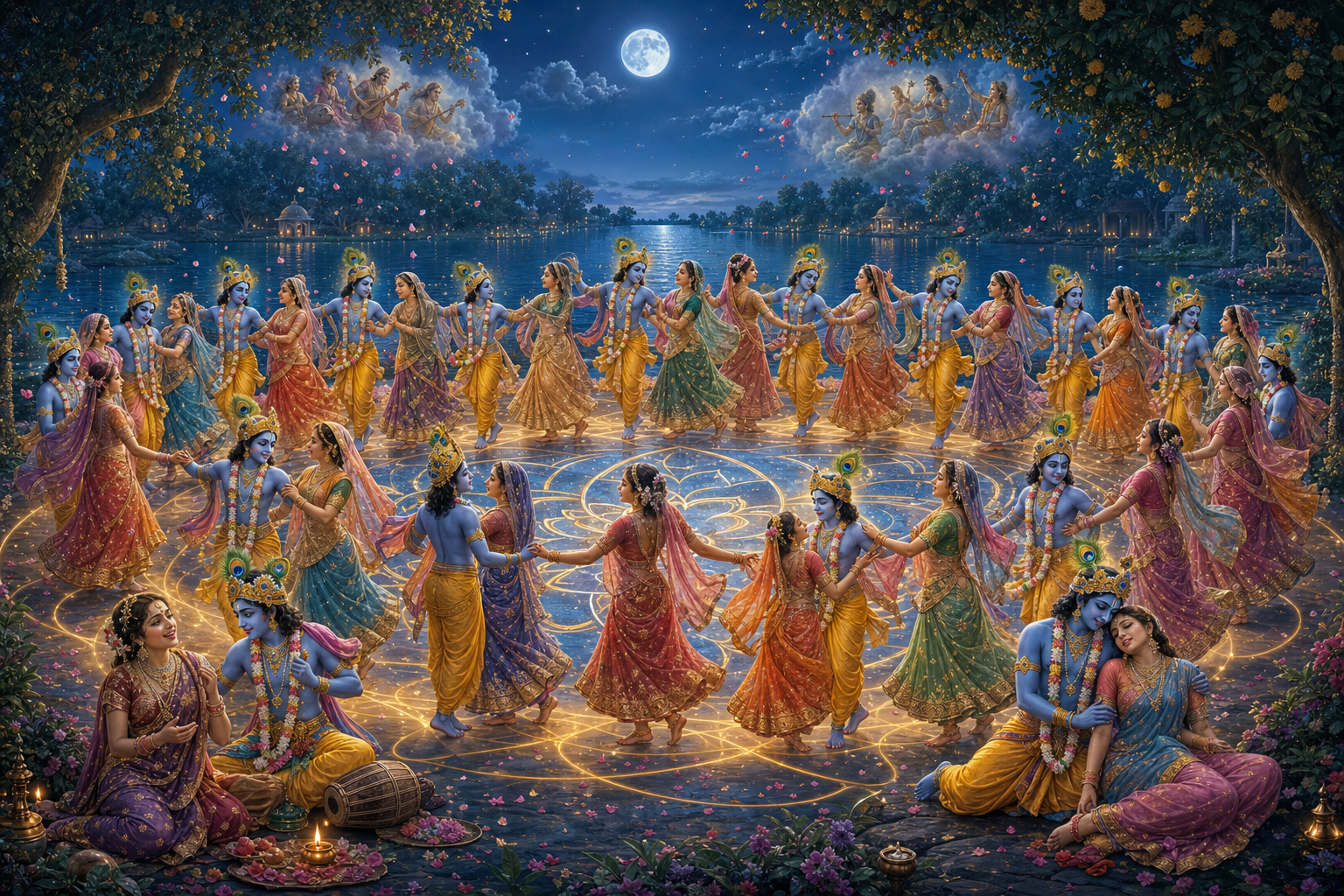

The Rāsa Līlā is among the most delicate and theologically ambitious narratives in the Śrīmad-Bhāgavatam. On the surface, it presents a moonlit circle dance in which Kṛṣṇa and the gopīs of Vraja sing, move, improvise and exchange intimate gestures. Within Vaiṣṇava theology, however, it is not ordinary romance magnified into mythology. It is a metaphysical drama about the relationship between the finite self and the infinite, the transformation of desire into devotion, and the capacity of divine love to be both completely personal and universally present.
This study concentrates on Śrīmad-Bhāgavatam 10.33.1–11, the opening movement of the Rāsa Dance itself. These verses describe the gopīs’ relief after separation, the formation of the dancing circle, Kṛṣṇa’s expansion between every pair of dancers, the celestial audience, the music of the gopīs and several moments of intimate reciprocity. A responsible interpretation must also consider the preceding chapters and the ethical questions raised later in Chapter Thirty-Three. Without that wider frame, the most important claims of the passage can easily be misunderstood.
The narrative begins before the first dance step
Chapters Twenty-Nine through Thirty-Three of the Tenth Canto are traditionally known as the Rāsa-pañcādhyāyī, the five chapters devoted to the Rāsa Līlā. The sequence begins on an autumn night when Kṛṣṇa plays the flute and the gopīs come to meet him. Kṛṣṇa initially advises them to return home, and they answer with a sophisticated devotional argument: the deepest duty of the self is directed toward the divine ground of every relationship. The first dance is interrupted when pride arises. Kṛṣṇa disappears, the gopīs search the forest, and their longing culminates in the Gopī-gīta, their celebrated song of separation.
Kṛṣṇa eventually returns and discusses several kinds of loving reciprocity. At the conclusion of Chapter Thirty-Two, he declares that he cannot adequately repay the gopīs for their sincere service, even over an immeasurably long life. Their own goodness must serve as its reward. This statement in Śrīmad-Bhāgavatam 10.32.22 reverses the expected hierarchy between an all-powerful deity and dependent worshippers: the divine becomes indebted to love. Chapter Thirty-Three therefore begins after longing, loss, searching, self-examination, reunion and an acknowledgement of unpayable devotion. The dance is the culmination of that interior journey, not an isolated nocturnal encounter.
Rāsa, rasa and the theology of relationship
The long vowel in rāsa identifies a form of circular group dance, while rasa can mean juice, essence, taste or the relishable emotional quality of an aesthetic experience. The terms should not be treated as mechanically identical, yet devotional interpretation deliberately hears a resonance between them. The rāsa dance becomes the dramatic arena in which spiritual rasa is embodied. Music, rhythm, gesture, fragrance, touch, color and emotion converge so that theology is experienced as relationship rather than reduced to an abstract proposition.
Later Gauḍīya Vaiṣṇava thinkers systematized five principal devotional relationships: śānta, peaceful reverence; dāsya, service; sakhya, friendship; vātsalya, parental affection; and mādhurya, the intimacy symbolized by love between beloveds. This is a graded account of relational intimacy within a particular theological tradition, not a scale for ranking the dignity of human beings or dismissing other authentic spiritual paths. Mādhurya-rasa is described as especially comprehensive because it can include reverence, service, friendship, protectiveness, trust and complete self-disclosure while adding the vulnerability of passionate love.
Passion in this context does not mean impulse released from ethical responsibility. It means that the whole affective life has become concentrated upon the divine. The gopīs do not approach Kṛṣṇa as a means to status, prosperity, liberation or self-confirmation. Their love is represented as having no external price and no bargaining condition. This explains why the narrative repeatedly brings them through the pain of separation: possessiveness must be exposed before intimacy can be understood as self-giving devotion.
Gauḍīya literature makes the distinction between self-centered desire and divine love unusually precise. Śrī Caitanya-caritāmṛta, Ādi-līlā 4.165 calls the desire to gratify one’s own senses kāma and the desire to please Kṛṣṇa prema. The external vocabulary of affection may overlap, but the intentional structure is reversed. Kāma asks what can be taken from the beloved; prema asks how the beloved may be served. This distinction is indispensable because physical imagery alone cannot determine the theological meaning of the scene.
A close reading of the dance as it begins
Verse 10.33.1 opens with healing. The gopīs hear Kṛṣṇa’s gracious words, touch him and become free from the heat produced by separation, viraha-jaṁ tāpam. This transition is not emotional amnesia. The separation has already deepened their awareness and stripped away the assumption that divine presence can be possessed. The return of touch now carries the memory of absence. In the poetics of bhakti, separation and meeting are often described as vipralambha and sambhoga: distinct but interdependent modes through which love becomes more fully conscious of its object.
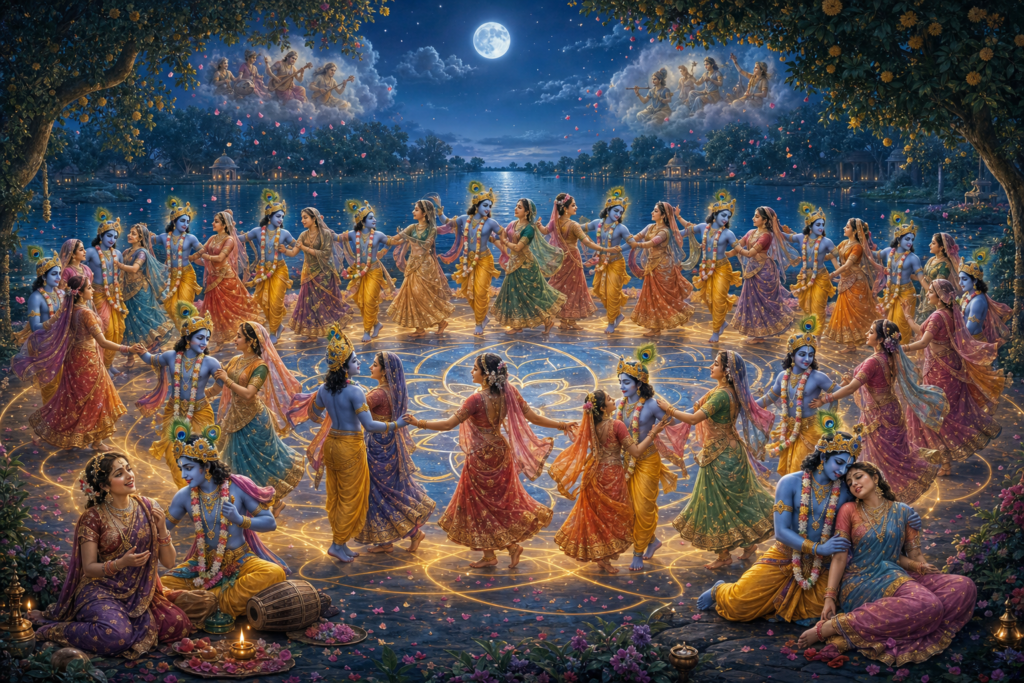
Verse 10.33.2 places the dance on the bank of the Yamunā. The gopīs joyfully link their arms, and Govinda begins the rāsa-krīḍā. The text calls the participants strī-ratna, jewels among women, and anuvrata, faithfully devoted. They are not described as an anonymous background for Kṛṣṇa’s performance. Their linked bodies create the circle, their voices generate its music, and their devotion gives the event its relational form. Kṛṣṇa initiates the pastime, but the gopīs actively constitute the dance.
The linked circle is the first major symbol. Before each gopī experiences Kṛṣṇa as personally present, the gopīs join one another. Individual intimacy thus arises inside a community rather than through the elimination of everyone else. The pattern offers a powerful spiritual insight: closeness to the divine need not depend upon rivalry, exclusion or the belief that another person’s grace diminishes one’s own. Unity here is not uniformity. Each participant retains a distinctive voice, movement and relationship while belonging to one shared maṇḍala.
Verse 10.33.3 supplies the theological center. Kṛṣṇa is called yogeśvara, the master of spiritual or mystic power. He expands and stands between every pair of gopīs, placing an arm around each, while every dancer experiences him as being beside her alone. The celestial spectators see the multiplicity that the gopīs do not perceive. The verse therefore presents two simultaneous perspectives: from within each relationship, divine attention is undivided; from the cosmic viewpoint, the one Kṛṣṇa is present in innumerable forms. The text does not solve unity by erasing plurality or solve plurality by dividing the divine into incomplete fragments.
This is a personalist account of infinity. Material attention appears scarce because one person normally cannot offer complete presence to everyone at the same moment. Kṛṣṇa’s expansion communicates a different kind of plenitude: the infinite can be wholly present to each without becoming absent to others. The image complements the principle of reciprocal response expressed in Bhagavad-gītā 4.11. Divine relationship is universal in scope but particular in experience. No gopī receives a statistical fraction of Kṛṣṇa.
Verses 10.33.4–6 widen the stage. Celestial kettledrums resound, flowers descend, and the Gandharvas sing with their companions. Within the literary world of the Bhāgavata, the heavenly audience identifies the event as cosmically significant rather than socially trivial. The sound of bracelets, ankle bells and waist bells rises from the circle, while Kṛṣṇa appears like a dark, exquisite gemstone set among golden ornaments. Sound, movement and color make the dance a form of embodied revelation. An academic reading can recognize these details as theological and poetic claims without presenting the celestial scene as a proposition established by modern empirical methods.
Verse 10.33.7 is technically rich. It describes precise placement of the feet, movements of the arms, playful eyebrows, smiles, bending waists, swinging earrings and perspiring faces. The traditional commentary associates the arm movements with mudrās, gestures capable of expressing the meaning of a song. Dance is therefore not ornamental decoration added to a verbal doctrine. The body itself becomes a medium of interpretation. Rhythm carries intelligence, gesture conveys emotion, and movement communicates what discursive language cannot fully contain.
The same verse notes the strain of sustained performance: faces perspire, garments move and carefully arranged hair and ornaments begin to loosen. These details acknowledge physical exertion rather than offering an antiseptic spirituality detached from embodiment. At the same time, the passage is openly sensuous and should not be flattened into disembodied allegory. Its distinctive claim is that the senses can be purified and reoriented. Beauty is not denied; it is removed from the economy of consumption and made part of reciprocal devotion.
Verse 10.33.8 turns attention from choreography to sound. The gopīs sing so powerfully that their music is said to pervade the universe. A traditional gloss cited in the commentary on this verse appeals to the Saṅgīta-sāra and attributes sixteen thousand principal rāgas to the gopīs. This number functions as a statement of inexhaustible musical abundance within devotional tradition. It should not be confused with a modern musicological catalogue supported by surviving notation from the narrative period. The distinction allows the traditional claim to retain its theological force without converting symbolic plenitude into an unsupported historical statistic.
Verse 10.33.9 depicts musical dialogue rather than passive praise. One gopī sings pure tones in harmony with Mukunda and rises above his melodic line. Kṛṣṇa responds with sādhu sādhu, an enthusiastic acknowledgement of excellence. Another gopī takes the melody into a special dhruva pattern and receives further honor. The divine does not silence accomplished human artistry; Kṛṣṇa listens, evaluates, delights in and praises it. Devotion reaches maturity not when personality disappears, but when distinctive ability is offered without egoistic ownership.
Verses 10.33.10–11 narrow the cosmic spectacle into intimate, tactile moments. A gopī becomes tired and rests her arm upon Kṛṣṇa’s shoulder. Traditional commentary understands the object held by Kṛṣṇa, described with the word gadā, as a baton appropriate to a dancing master. The following verse describes Kṛṣṇa placing his arm upon a gopī’s shoulder. Its natural fragrance of blue lotus mingles with sandalwood; the gopī’s hair stands on end, and she kisses the arm. The passage moves through sound, sight, touch and scent, presenting devotion as a total reorientation of perception.
The base text leaves these gopīs unnamed. The Gauḍīya commentary on verse 10, especially the interpretation attributed to Viśvanātha Cakravartī, identifies the tired dancer as Śrīmatī Rādhārāṇī and the two musicians of the preceding verse as Viśākhā and Lalitā. This distinction between textual statement and commentarial identification matters. A devotional reading may receive the identification as authoritative within its lineage, while an academic reading notes that the proper names are supplied by the interpretive tradition rather than by the wording of verses 9–11 themselves.
The ethical challenge is part of the scripture, not an objection imposed from outside
A first encounter with the Rāsa Līlā can make the gopīs appear irresponsible or Kṛṣṇa’s conduct appear ethically transgressive. The Bhāgavata anticipates precisely this reaction. Later in Chapter Thirty-Three, King Parīkṣit asks why Kṛṣṇa, who is understood to descend for the protection of dharma, would behave in a way that seems contrary to ordinary marital and social obligations. The question is significant because the text does not ask its audience to suspend moral intelligence. It stages the difficulty within the canonical conversation and requires Śukadeva to answer it.
Śukadeva’s response operates on two levels. The first is ontological: Kṛṣṇa is not treated as a powerful human seeking gratification but as the self-sufficient divine reality whose actions arise through spiritual potency. The second is hermeneutical: extraordinary divine acts are not automatically prescriptions for human imitation. The chapter compares such imitation to an ordinary person attempting to consume the poison borne by Lord Śiva. Whatever one concludes about the theological premise, the internal rule is unambiguous: no human leader, teacher or devotee may cite the Rāsa Līlā as authorization for sexual entitlement, deception or the suspension of ethical accountability.
The chapter further describes Kṛṣṇa as the indwelling witness within the gopīs, their husbands and all embodied beings. Śrīmad-Bhāgavatam 10.33.35 therefore places the scene within a theology of the divine Self rather than a contest between one embodied man and other embodied men. This metaphysical answer will persuade readers only to the degree that they accept the text’s account of Kṛṣṇa. It should be presented as the scripture’s theological logic, not disguised as a conclusion reached independently by secular ethics.
Modern ethical clarity reinforces rather than weakens the prohibition against imitation. Claims of divinity do not exempt a human being from consent, transparency, non-exploitation and responsibility. A teacher who uses sacred intimacy to obtain access to followers contradicts the chapter’s own distinction between Kṛṣṇa and the conditioned imitator. The narrative cannot legitimately be used to normalize coercion, infidelity, grooming or abuse of spiritual authority. Its devotional meaning depends upon the removal of self-serving desire; exploitative conduct reinstates precisely the kāma that the story is meant to overcome.
The text also supplies a practical test for interpretation. Its closing verse, Śrīmad-Bhāgavatam 10.33.39, states that faithful hearing or description of these pastimes leads toward parā-bhakti, sobriety and the removal of kāma, characterized as a disease of the heart. An interpretation that increases objectification, entitlement or restless fantasy fails the outcome named by the chapter itself. A reading that deepens reverence, self-restraint, service and steadiness is more consistent with its declared purpose.
Why transcendence through love does not abolish spiritual discipline
The gopīs’ path is sometimes contrasted with severe austerity, abstract speculation or the pursuit of yogic control. The contrast does not mean that bhakti celebrates undisciplined emotion. Their apparent spontaneity represents the culmination of concentration: memory is fixed on Kṛṣṇa, competing motives have fallen away, and every capacity is directed toward service. In this sense, passionate love accomplishes what ascetic discipline seeks—the decentering of the acquisitive ego—but it accomplishes it through positive absorption rather than negation alone.
For ordinary practitioners, this concentrated state is approached through durable forms of sādhana: hearing sacred texts, chanting divine names, serving others, ethical restraint, contemplative remembrance, association with trustworthy practitioners and honest examination of motive. The Rāsa Līlā is not a shortcut around character formation. It is a vision of what purified relationship means when no hidden demand remains. Emotional intensity without integrity is not prema; it is intensity still governed by the unexamined self.
The description of mādhurya as the highest intimacy is also best understood as a claim internal to a relational Vaiṣṇava theology. It need not entail contempt for knowledge, meditation, duty, renunciation or other devotional relationships. Those disciplines can prepare attention, reduce egocentric grasping and stabilize compassion. Gauḍīya theology considers them incomplete when isolated from loving relationship, but it also incorporates their mature qualities into bhakti. The highest love is not anti-intellectual or anti-ethical; it is knowledge, discipline and virtue reorganized around self-giving devotion.
Vyāsadeva’s meditation and the literary purpose of sacred beauty
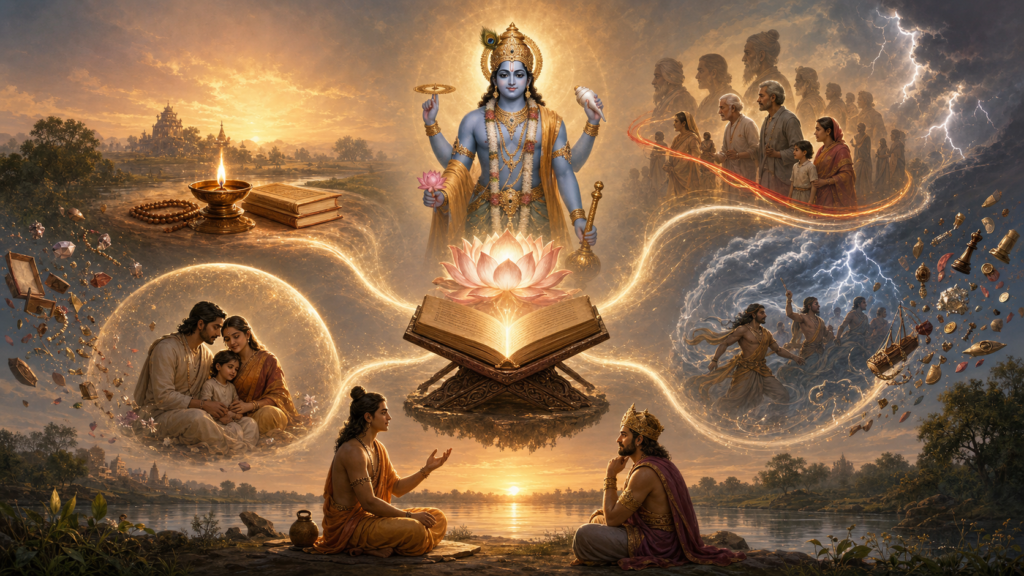
The Rāsa Līlā is sometimes described as the very scene Vyāsadeva was instructed to contemplate and share with the world. The textual relationship requires a small but important qualification. In Śrīmad-Bhāgavatam 1.5.13, Nārada instructs Vyāsadeva to remember the Lord’s activities in samādhi and describe them for liberation from bondage. Later, Śrīmad-Bhāgavatam 1.7.4 states that Vyāsadeva fixed his purified mind through bhakti-yoga and perceived the complete divine person together with the dependent material energy.
Nārada does not name the Rāsa Dance specifically in that instruction. Connecting the dance to Vyāsadeva’s meditation is therefore a canonical and theological inference: the Rāsa Līlā belongs to the divine activities that the completed Bhāgavata presents as spiritually liberating. The distinction does not diminish the scene. It makes the claim more precise and reveals a larger literary theory. Sacred narrative is meant to attract the same imaginative and emotional capacities that bind people to transient objects, then redirect those capacities toward freedom, relationship and the divine.
A respectful perspective across Dharmic traditions
The Rāsa Līlā belongs to a specifically Vaiṣṇava world of personal devotion, and its theology should not be imposed upon Hindu, Buddhist, Jain or Sikh traditions that use different metaphysical vocabularies. Respectful unity does not require false equivalence. At the comparative ethical level, however, these traditions repeatedly challenge possessive craving and the isolated ego: Vaiṣṇava bhakti distinguishes prema from self-serving kāma; Buddhist disciplines distinguish compassionate care from grasping; Jain teachings elevate aparigraha and ahiṁsā; and Sikh teachings confront haumai through nām, devotion and sevā. The doctrines remain distinct, but each offers resources for transforming desire into a less possessive mode of life.
This comparative lens also guards against sectarian triumphalism. A tradition may describe its own ideal as unsurpassed while still recognizing sincerity, discipline and wisdom elsewhere. The Rāsa circle itself can support such generosity: unity is achieved through relation, not by making every participant identical. Each gopī has a distinct expression, yet none must displace another to receive divine presence. That image offers a constructive model for Dharmic coexistence—shared reverence without erasure of lineage, language, practice or philosophical difference.
Psychological and relational insights
The emotional sequence of absence, searching, reunion and dance corresponds to recognizable human experiences. Separation reveals where attachment has become possession; longing shows what the mind repeatedly values; reunion tests whether love has matured beyond fear; and celebration asks whether joy can be shared without competition. The narrative does not offer a clinical psychological theory, but it displays a sophisticated understanding of how pride, exclusivity and insecurity can distort affection. Kṛṣṇa’s earlier disappearance exposes pride, while his multiplied presence in the circle reveals a love that is abundant rather than scarce.
Verse 10.33.9 adds an especially relatable insight: love recognizes excellence. Kṛṣṇa does not need to remain the only celebrated performer. He praises the gopīs’ musical skill and allows their voices to rise with and above his own line. Healthy devotion does not require the diminishment of the devotee, just as healthy human affection does not fear another person’s gift. Genuine appreciation gives attention without appropriation and celebrates another’s flourishing without turning it into a threat.
The fatigue described in verses 10–11 is equally meaningful. Spiritual literature often emphasizes extraordinary strength, yet this scene includes a dancer who tires and reaches for support. Her fatigue does not disqualify her from intimacy. Within the devotional frame, vulnerability becomes part of reciprocity. Readers who associate spiritual worth with constant productivity may find a gentler insight here: dependence need not be humiliation, and being supported can be as relationally significant as offering support.
The maṇḍala also joins two needs commonly treated as opposites: belonging and personal recognition. The gopīs form one circle, but each encounters Kṛṣṇa personally. Communities become unhealthy when belonging requires the loss of individuality, while individual spirituality becomes fragile when it refuses accountability and shared practice. The Rāsa image holds both together. The person is neither dissolved into the group nor isolated from it.
A responsible method for reading the Rāsa Līlā
A careful reader benefits from four interpretive disciplines. First, the whole five-chapter arc should be read rather than extracting erotic imagery from its narrative setting. Second, description must be distinguished from prescription; Kṛṣṇa’s līlā is not a behavioral template for ordinary persons. Third, the base Sanskrit text should be distinguished from later commentarial identification while allowing both to be studied on their proper levels. Fourth, the reading should be evaluated by the result named in the chapter itself: greater devotion, sobriety, ethical responsibility and freedom from possessive desire.
Several common reductions then become avoidable. The dance is not merely a historical folk performance, although it has inspired major performance traditions. It is not merely a coded sexual episode, although its poetry deliberately uses the language of intimate love. It is not merely an allegory in which bodies and emotions cease to matter. Nor is it permission for antinomian conduct. It is a layered sacred narrative whose aesthetic, theological, ethical and contemplative meanings depend upon one another.
The highest transcendence portrayed here is therefore not escape from passion but its purification. Desire ceases to revolve around acquisition and becomes attention, praise, service and shared joy. The gopīs sing rather than consume, dance rather than dominate, and link arms rather than compete for a scarce divine presence. Kṛṣṇa, in turn, does not remain remote. He multiplies his presence, honors their artistry, supports their fatigue and acknowledges a debt that power alone cannot repay.
The Rāsa Dance begins when love has passed through loss and relinquished its claim to ownership. Its circle offers a vision in which intimacy and community, embodiment and transcendence, distinction and unity are held together. Within the Vaiṣṇava understanding, passionate divine love is called highest because nothing remains outside the offering—not intellect, emotion, body, voice, memory or relationship. The resulting lesson is demanding rather than indulgent: love becomes spiritually transformative only when the desire to possess gives way to the freedom to serve.
Primary textual basis: Śrīmad-Bhāgavatam, Chapter 10.29; 10.32.22; Chapter 10.33; 10.33.39; Śrī Caitanya-caritāmṛta, Ādi-līlā 4.165; and Śrīmad-Bhāgavatam 1.5.13.
Inspired by this post on Dandavats.



Leave a Reply
You must be logged in to post a comment.