
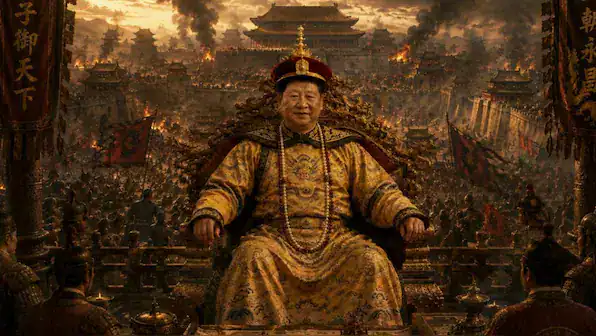
The central paradox is difficult to ignore. A ruler who can remove almost anyone may appear invulnerable, yet the repeated need to eliminate trusted appointees can also reveal a political system unable to produce durable trust. A Firstpost opinion essay published on July 8, 2026 interprets Xi Jinping’s widening military purge as evidence of fear beneath the performance of absolute authority. That argument captures an important feature of personalist rule, but it becomes more persuasive when stated with analytical precision: Xi’s private emotions cannot be observed directly, whereas institutional insecurity, persistent distrust and repeated failures of internal supervision can be documented. The purge therefore deserves attention not merely as a succession of disciplinary cases, but as a test of how power, corruption, political loyalty and military effectiveness interact inside the Chinese Communist Party.
The latest episode was politically significant, although its formal meaning requires care. In late June 2026, China stripped six senior People’s Liberation Army officers of their seats in the National People’s Congress. Reuters identified them as Xu Xueqiang, Li Fengbiao, Guo Puxiao, Wang Kangping, Zhang Minghua and Yin Hongxing. Their backgrounds reached into equipment development, the Air Force, theatre-level political work, logistics, cyberspace operations and ground-force command. Removal from the legislature is not, by itself, a criminal conviction or a complete public account of an officer’s military status. In the choreography of elite Chinese politics, however, the loss of an NPC seat frequently precedes or confirms deeper disciplinary action. The event was therefore more consequential than an ordinary personnel reshuffle, even though the evidence does not justify treating every unresolved case as a proven act of treason.
The numerical scale is extraordinary, but the numbers must be read according to their methodology. Anushka Saxena’s ChinMil Tracker reported in early July 2026 that at least 104 generals had been purged over roughly four years, including 47 full generals, while 62 cases were recorded in 2025 alone. In the PLA, full general is the highest active rank and is represented by three stars; descriptions of these officers as four-star generals usually indicate a foreign functional equivalence rather than the Chinese insignia. More importantly, the tracker’s broad use of purge encompasses several conditions: formal expulsion, prosecution, investigation, removal from office and prolonged disappearance without an official explanation. Those categories all signal political trouble, but they do not carry identical evidentiary weight.
A separate dataset confirms the breadth while illustrating the uncertainty. The CSIS Database of Chinese Military Purges, updated through February 20, 2026, catalogued 101 senior officers who had been purged or potentially purged since 2022. It classified 36 generals and lieutenant generals as officially purged and another 65 as missing or potentially purged. It also assessed that 41 of the 47 officers who held full-general rank in 2022, or were promoted to that level afterward, had been purged or potentially purged. Differences between the CSIS and Takshashila totals reflect their dates, definitions and rank thresholds rather than necessarily representing a factual contradiction. In an opaque political system, responsible analysis must preserve the boundary between confirmed removal and informed inference.
The hollowing out of the Central Military Commission is even more revealing than the aggregate total. The seven-member CMC selected after the 20th Party Congress in October 2022 consisted of Xi as chairman; Zhang Youxia and He Weidong as vice-chairmen; and Li Shangfu, Liu Zhenli, Miao Hua and Zhang Shengmin as members. Li Shangfu was removed and subsequently expelled. In October 2025, official announcements confirmed the expulsion of He Weidong and Miao Hua along with other senior officers. In January 2026, the Chinese Ministry of National Defense announced investigations into Zhang Youxia and Liu Zhenli for suspected serious violations of discipline and law. Five of the six uniformed commanders Xi had chosen for the commission had therefore been removed, expelled or placed under investigation within little more than three years.
That outcome creates the most damaging version of the loyalty problem. These were not inherited rivals occupying posts against Xi’s wishes. They were officers elevated under a personnel system he dominated, after years of political rectification intended to guarantee obedience. By early 2026, only Xi and Zhang Shengmin remained active from the original seven-person commission. Zhang’s career was rooted in military discipline inspection, and he had been promoted to vice-chairman in October 2025. A supreme command effectively narrowed to a political leader and an anti-corruption specialist may still issue orders, but it is a poor substitute for a stable forum containing operational, personnel, procurement and service-level expertise. Xi’s capacity to destroy elite careers demonstrates coercive strength; the collapse of his own carefully assembled command team demonstrates the limits of that strength.
The rebuilding effort began quickly but did not erase the underlying problem. On July 3, 2026, Xi promoted Zhang Shuguang and Air Force commander Wang Gang to full general. The official announcement presented the ceremony as an orderly exercise of military authority, while subsequent reporting suggested that the promotions could prepare both officers for higher responsibilities. Yet promotion to full general does not automatically confer CMC membership, and two appointments cannot instantly replace years of institutional knowledge lost across the Joint Staff Department, political work system, theatre commands and military services. The appointments are best understood as an attempt to stabilize the leadership before the 21st Party Congress in 2027, not as proof that the purge has ended.
The current campaign is the second major military purge of Xi’s tenure. After becoming general secretary and CMC chairman in 2012, Xi pursued former CMC vice-chairmen Xu Caihou and Guo Boxiong and dozens of other officers. That first wave weakened entrenched patronage networks, strengthened Xi’s authority and helped clear the way for the sweeping military reforms of 2015–2016. Seven military regions were replaced by five joint theatre commands; the former general departments were reorganized into CMC departments and commissions; service headquarters were rebalanced; and the Rocket Force was elevated. Political rectification at the 2014 Gutian conference reinforced the principle that the Communist Party, rather than a professionally autonomous officer corps, must exercise absolute control over the gun.
The second wave began in a more technically sensitive part of the force. In July 2023, the Equipment Development Department solicited information about procurement misconduct dating back several years. The leadership of the PLA Rocket Force soon fell under scrutiny, followed by former defence minister Li Shangfu, who had previously led the equipment department. Investigations then spread into political work, the theatre commands, the services, military justice, defence-industrial enterprises and the CMC itself. October 2025 brought the formal expulsion of nine senior officers, and January 2026 brought the investigations of Zhang Youxia and Liu Zhenli. As a detailed China Leadership Monitor study explains, the campaign progressively moved from corruption-prone procurement systems into the core institutions responsible for personnel selection, supervision and operational readiness.
The PLA’s constitutional identity helps explain why loyalty receives such extraordinary emphasis. It is not designed as a politically neutral national military accountable to an independently elected civilian government. It is the armed wing of the Chinese Communist Party. The Party Constitution affirms absolute Party leadership over the armed forces, while the CMC chairman responsibility system concentrates ultimate command authority in Xi. Political commissars, Party committees, discipline inspectors and organizational departments operate alongside conventional commanders. This dual architecture is intended to ensure that every important military decision remains politically supervised. Combat effectiveness is essential, but it is institutionally subordinate to the requirement that the PLA obey the Party centre and its core leader.
This arrangement produces a classic principal-agent problem. Xi, as the political principal, needs generals who are competent enough to manage complex military organizations and loyal enough never to challenge Party supremacy. The generals, as agents, possess technical knowledge that the political centre cannot easily verify. They know more about procurement quality, training results, unit morale, missile reliability and war planning than civilian political leaders do. If promotion and survival depend on reporting success, officers acquire an incentive to conceal failures. If every disclosure of weakness can be interpreted as disloyalty, truthful information becomes personally dangerous. The ruler consequently receives more affirmations of obedience while becoming less certain that those affirmations are genuine.
Political science often describes this condition as the dictator’s information dilemma. An authoritarian ruler requires accurate intelligence to govern effectively, but repression discourages subordinates from delivering unwelcome facts. Additional surveillance can expose some misconduct, yet it can also make officials more guarded and intensify rivalry among competing monitoring agencies. Repeated purges deepen the problem by teaching survivors that yesterday’s loyalty offers no protection against tomorrow’s investigation. The result may be outward unanimity combined with private hedging, bureaucratic passivity and increasingly distorted reports. The command system grows louder in its declarations of loyalty precisely as the ruler becomes less able to distinguish conviction from self-preservation.
Personalization magnifies this dilemma. When institutions distribute authority predictably, subordinates can rely on rules, retirement norms and collective procedures. When authority becomes concentrated around one leader, access to that leader becomes a valuable political resource, and elite networks compete to control appointments and information. Each successful purge removes one network but also increases the importance of the remaining gatekeepers. Loyalty becomes personalized rather than institutional, while fear of association encourages officials to abandon colleagues as soon as an investigation begins. A system designed to eliminate factions can therefore recreate them around new patrons, because careers still depend on protection, sponsorship and proximity to power.
The claim that Xi is personally afraid should nevertheless remain an interpretation, not a clinical diagnosis. No open source can establish his private emotional state. The observable evidence supports a narrower conclusion: the leadership behaves as though political loyalty cannot be assumed, internal reporting cannot be fully trusted and corruption threatens strategically important capabilities. In March 2026, Xi publicly demanded stronger political loyalty, strict oversight of fund flows, quality control and the exercise of power. The official account of that speech emphasized that neither disloyal personnel nor corrupt elements could be tolerated in the military. Such language does not prove personal panic, but it does document institutional anxiety at the highest level.
Corruption remains a serious and credible explanation for many cases. The PLA expanded rapidly, reorganized repeatedly and absorbed enormous investment in missiles, aircraft, ships, space systems, cyber capabilities and command infrastructure. Those changes created large procurement streams, technically complex contracts and promotion opportunities that were difficult to audit from outside the military. Earlier investigations exposed the sale of positions, bribery in promotions, misuse of land and housing, and illicit influence over procurement. There is therefore no need to assume that every corruption allegation is fabricated. The more difficult question is whether genuine anti-corruption enforcement is being applied impartially or is simultaneously serving political and factional objectives.
The equipment system is particularly vulnerable to hidden failure. Weapons acquisition links operational requirements, research institutes, state-owned defence companies, testing organizations, logistics departments and senior approval authorities. Corruption at any point can inflate costs, lower quality, falsify trials or reward equipment that performs well in demonstrations but fails under wartime stress. Li Shangfu’s earlier leadership of the Equipment Development Department made his downfall especially important. The late-June 2026 removal of Xu Xueqiang, another senior figure associated with equipment development and China’s crewed space programme, suggested that the investigation had not exhausted the procurement chain. For Xi, unreliable equipment would represent both financial corruption and a direct threat to the promise that the PLA can fight and win modern wars.
The Rocket Force cases were more sensitive still. The force manages China’s land-based conventional missiles and a major share of its nuclear deterrent. Its effectiveness depends on rigorous maintenance, secure communications, reliable launch infrastructure, accurate targeting and confidence in the chain of command. Corruption or manipulated readiness data in such an organization cannot be treated as ordinary administrative misconduct. It may distort the political leadership’s understanding of deterrence, escalation and survivability. Public allegations about specific missile defects have not always been independently verified, but the repeated removal of Rocket Force leaders shows that Beijing considered the underlying governance problem serious. Purging those responsible may improve reliability over time, yet repeated turnover also disrupts technical oversight and weakens continuity in one of China’s most consequential commands.
Personnel corruption creates a second pathway from graft to military weakness. When promotions can be purchased or secured through patronage, rank no longer provides dependable information about competence. An officer may owe advancement to a sponsor rather than operational performance, and that dependence can persist after promotion. Senior leaders then protect networks of subordinates who control contracts, assignments and evaluations. Removing a patron exposes an entire chain of clients, which helps explain why an investigation can expand far beyond its initial target. It also explains why officers once regarded as Xi loyalists may still be vulnerable: loyalty to Xi did not prevent them from constructing networks of their own.
Anti-corruption, readiness and political consolidation are not mutually exclusive explanations. A single purge can remove an officer who accepted bribes, concealed deficiencies, belonged to a rival network and appeared politically unreliable. The official system has little transparency, so outside observers often select one motive and present it as exclusive. A more defensible model is multi-causal. Xi appears determined to correct genuine military weaknesses before the PLA’s centenary benchmarks, but he is also using a disciplinary apparatus that reinforces his personal authority and destroys autonomous bases of influence. The same campaign can strengthen control in the immediate political sense while weakening organizational confidence and command expertise.
The deepest institutional indictment concerns the failure of the watchdogs themselves. Xi’s reforms created or strengthened multiple mechanisms intended to supervise the armed forces: the CMC Discipline Inspection Commission, the Political Work Department, military courts, political and legal bodies, audit functions and an expanded system of inspections. Yet leaders associated with political work, personnel management and military justice have themselves been removed. That pattern suggests that oversight did not merely miss isolated misconduct; parts of the supervisory architecture may have become entangled in the same patronage networks they were meant to police. Concentrating even greater authority in the surviving discipline apparatus may accelerate investigations, but it also risks creating a new bureaucratic centre whose information and incentives are difficult for Xi to verify independently.
The purge therefore sharpens the trade-off between loyalty and competence. Political leaders naturally prefer commanders they trust, especially in a one-party system concerned about coups and elite defection. Modern warfare, however, requires officers capable of exercising judgment under uncertainty, coordinating different services and communicating bad news upward. Excessive loyalty screening can select for conformity, caution and rhetorical skill rather than operational imagination. It can also discourage mission command, because a subordinate who acts independently risks being judged politically suspect if the result is imperfect. The PLA has attempted to cultivate joint command and technologically sophisticated warfare, but those ambitions require precisely the initiative and candour that a highly punitive political environment can suppress.
Fear changes the quality of information before it changes the formal chain of command. A commander who expects punishment for missed targets may downgrade an exercise, script its outcome or report that a unit achieved standards it did not actually meet. A procurement official may conceal a failed component to protect superiors. A political commissar may interpret honest professional disagreement as insufficient loyalty. Individually, each act can appear rational; collectively, they create a dangerous picture of readiness that is more favourable than reality. The supreme leader may then possess more surveillance reports than any predecessor while understanding the real condition of the force less accurately. This is the practical, rather than psychological, meaning of the dictator’s paradox.
Vacancies at the top impose measurable organizational costs. Senior military posts are not interchangeable ceremonial appointments. The CMC Joint Staff Department integrates planning and operations; theatre commands translate national objectives into regional campaigns; service headquarters organize forces and develop capabilities; political departments manage personnel and ideological control; and logistics organizations sustain deployments. When leaders disappear, deputies can maintain routine functions, but major decisions may be delayed or escalated upward for political protection. Rapid replacements also create cascading vacancies as promoted officers leave previous posts. The resulting churn reduces institutional memory, complicates accountability and makes it harder to distinguish temporary acting arrangements from durable command relationships.
Joint warfare is especially sensitive to leadership disruption. A high-intensity operation against Taiwan, or a confrontation involving India, Japan, the Philippines or the United States, would require synchronization across land, naval, air, missile, space, cyber, information and logistics forces. Jointness is not produced simply by placing different uniforms in one headquarters. It depends on shared procedures, repeated exercises, trusted communications, realistic planning and commanders who understand one another’s capabilities. China’s theatre-command reforms were designed to overcome long-standing service stovepipes. Purges that repeatedly remove theatre leaders, Joint Staff officers and service commanders risk interrupting that learning process even when the formal organizational chart remains intact.
The impact reaches beyond conventional formations. China dissolved the Strategic Support Force in 2024 and redistributed its functions among the Information Support Force, Aerospace Force and Cyberspace Force. A Takshashila study of the new structure describes the importance of these organizations to networks, information dominance, space support and cyber operations. The removal of an officer such as Zhang Minghua, associated with the Cyberspace Force, matters because these capabilities connect sensors, commanders and precision weapons across the force. Similarly, disruption in logistics or equipment development can produce operational effects far from the office in which misconduct occurred. Modern military power is a system of systems; weakness in data, maintenance or supply can neutralize impressive platforms.
Hardware should therefore not be confused with combat effectiveness. China continues to commission ships, field advanced aircraft, expand missile forces, develop unmanned systems and conduct complex exercises. The PLA is not rendered incapable merely because its leadership is unstable. Industrial capacity, trained personnel and standing operational plans do not vanish with one general. At the same time, weapons are only one component of military power. Readiness also depends on maintenance, realistic training, command judgment, logistics, morale and the ability to adapt when an adversary disrupts the original plan. The purge raises doubts about those less visible dimensions, especially because the PLA has limited recent experience of large-scale combat from which to test its assumptions.
A balanced assessment must acknowledge possible long-term benefits. If investigations remove officers who falsified readiness reports, accepted bribes or approved defective equipment, the campaign could eventually produce a more professional force. It may deter the sale of promotions, improve quality control and demonstrate that even powerful patrons cannot guarantee immunity. New commanders may also bring technical expertise suited to information-age warfare. The July 2026 promotions suggest that Beijing is trying to rebuild rather than abandon modernization. The central uncertainty is whether reform can become rule-bound and institutional, or whether periodic purges will remain the principal instrument for correcting problems after they have already spread.
The short-term effects are more clearly disruptive. Newly promoted commanders need time to master portfolios, establish working relationships and earn the confidence of subordinates. Officers who survive a sweeping purge may prioritize personal safety over experimentation. Investigators can uncover hidden defects, but their presence may also encourage units to avoid documenting failure. Senior commanders nearing the next Party Congress may focus on political positioning rather than difficult training reforms. These effects do not necessarily prevent routine patrols, exercises or coercive demonstrations. They matter most in a prolonged conflict, when plans fail, communications are degraded and commanders must make consequential decisions without waiting for political reassurance from Beijing.
The frequently cited year 2027 requires particular precision. It is the centenary of the PLA and a formal milestone in China’s military modernization programme. Official Party documents describe objectives for achieving the PLA’s centenary goals by 2027, completing basic defence modernization by 2035 and developing world-class forces by the middle of the century. The official historical resolution setting out those stages does not declare 2027 to be a fixed invasion date for Taiwan. Foreign intelligence assessments have argued that Xi wants the PLA to possess credible options by then. Capability, intent and a final political decision remain distinct. Treating the year as an automatic countdown risks replacing analysis with fatalism.
The Taiwan implications run in two opposing directions. Leadership disruption, uncertainty about equipment and the loss of experienced operational advisers could make Xi more cautious about authorizing a blockade or invasion. Failure in such an operation would threaten the regime’s prestige and Xi’s historical legacy. Yet the same purge could increase danger if surviving officers exaggerate readiness, suppress dissent or tell Xi what they believe he wants to hear. A leader surrounded by politically selected subordinates may receive fewer warnings about escalation, logistics and foreign intervention. Purges can therefore reduce the probability of a deliberately chosen war while increasing the risk of miscalculation within a crisis. Neither outcome should be assumed without additional evidence.
Nuclear and conventional deterrence are also affected by uncertainty. An adversary that believes the PLA is weakened may become less cautious, while Beijing may intensify demonstrations to disprove that perception. More exercises, missile launches or patrols can then be interpreted as preparation for war, even when their immediate purpose is political reassurance. Conversely, Chinese leaders who doubt their own forces may rely more heavily on long-range missiles, coercive signalling and rapid escalation to compensate for uncertainty in conventional operations. The purge thus changes not only actual capability but also perceptions of capability, which are central to deterrence. Strategic stability can deteriorate when each side is unsure whether the other is strong, weak or attempting to conceal weakness.
India has direct reasons to follow the personnel upheaval. Several affected officers have served in the Western Theatre Command, Tibet-related formations, equipment organizations or strategic support structures relevant to the Line of Actual Control. Turnover may complicate continuity in planning and local command relationships, but it does not justify complacency. A politically pressured PLA could continue infrastructure construction, patrol activity, surveillance and coercive signalling even while senior leadership is unsettled. India’s prudent response is sustained readiness: improved intelligence, resilient logistics, integrated air and missile defence, secure communications and close observation of command changes opposite the border. Assuming that internal turmoil automatically makes China harmless would repeat the same error as assuming that every purge proves preparation for immediate war.
The broader Indo-Pacific should adopt the same disciplined caution. China retains substantial naval, missile, air, cyber and industrial capacity. The leadership crisis may delay some reforms without reversing the long-term shift in regional power. Taiwan, Japan, the Philippines, India, Australia and the United States therefore have incentives to strengthen deterrence while avoiding rhetoric that could encourage an insecure Beijing to demonstrate resolve. Reliable crisis communications, distributed military posture, economic resilience and careful intelligence analysis are more useful than speculation about imminent coups. The central strategic problem is not simply whether Xi is strong or weak; it is that a highly capable state may make decisions through an increasingly narrow and opaque command structure.
Historical comparisons illuminate the scale but can also distort it. Descriptions of the campaign as the most extensive Chinese military cleansing since the Cultural Revolution convey the depth of elite turnover. The present process is not, however, a repetition of the mass social violence and institutional collapse of Mao’s Cultural Revolution, nor is it identical to Stalin’s destruction of the Soviet officer corps. Contemporary China uses Party discipline bodies, closed investigations, personnel decisions and legal-administrative procedures rather than a comparable mass movement. The relevant similarity lies in the political logic: rulers who personalize authority can come to regard autonomous expertise and independent networks as potential threats. The differences in institutional form and social scale remain essential.
Does the purge prove that Xi has lost control? The evidence supports neither a simple yes nor a simple no. Removing vice-chairmen, service leaders and politically connected generals shows that Xi retains formidable command over the disciplinary machinery. A leader who had completely lost power could not so readily dismantle the upper ranks. Yet control should not be measured only by the capacity to punish. Effective control also means constructing institutions that select competent officials, detect corruption early, transmit accurate information and implement policy without recurrent political convulsions. By that standard, the need to purge so many of Xi’s own appointees reveals a serious failure of governance.
Several indicators will show whether the crisis is stabilizing. The first is whether the CMC is rebuilt with a balanced mix of operational, political, technological and service expertise before or at the 2027 Party Congress. The second is whether theatre commands and service headquarters receive durable leaders rather than a succession of acting appointments. The third is whether procurement rectification produces visible improvements in quality assurance and accountability. The fourth is whether major exercises demonstrate unscripted joint problem-solving rather than only larger formations and more dramatic imagery. The fifth is whether official notices become more transparent about charges, evidence and institutional remedies. Continued unexplained disappearances would suggest that uncertainty remains embedded in the system.
The treatment of bad news may be the most important indicator of all. Militaries learn through failure in training, candid after-action reviews and the willingness of junior personnel to challenge faulty assumptions. If the post-purge PLA rewards accurate reporting even when results are embarrassing, the campaign could support genuine professionalization. If it rewards ideological certainty and punishes unwelcome evidence, the next generation of commanders may become more politically reliable but less useful in a crisis. No satellite image of a new ship or missile can reveal that command climate. It must be inferred from exercises, doctrinal discussions, personnel patterns and the regime’s tolerance for internal criticism.
The organizational lesson is relatable far beyond China. Any institution becomes fragile when employees believe that acknowledging a problem is more dangerous than allowing the problem to continue. In a private company, that culture can produce defective products or financial loss. In a military controlling missiles, nuclear forces and millions of personnel, the consequences can include failed deterrence and war. Absolute authority may accelerate a decision because fewer people can object, but speed is not the same as accuracy. A command system that inspires obedience without trust can look exceptionally orderly until it encounters a situation that was not anticipated in the official plan.
The most defensible conclusion is therefore more consequential than a claim about one leader’s psychology. Xi Jinping’s purges reveal a system caught between political control and military effectiveness, between the need for loyalty and the need for truth. They demonstrate his power to remove senior officers while exposing the failure of repeated rectification to prevent corruption, patronage and unreliable reporting. The PLA may ultimately emerge cleaner and more capable, but the present transition carries substantial risks for command continuity and strategic judgment. The spectacle of absolute power is real; so is the insecurity that makes its repeated demonstration necessary. That contradiction, rather than any unverifiable rumour, is the perilous paradox at the heart of Xi’s military rule.
Inspired by this post on Hindu Post.









Leave a Reply
You must be logged in to post a comment.