
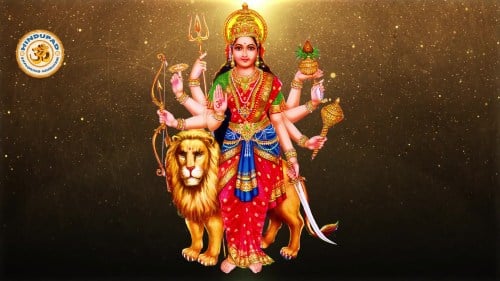
Few images in Hindu iconography are as immediately compelling as Goddess Parvati accompanied by a lion. The animal’s strength, alertness and sovereign bearing seem at first to contrast with Parvati Mata’s calm, maternal presence. Yet that contrast is precisely what gives the image its theological force. The sacred lion is not merely a means of transport: it expresses disciplined power, courageous protection and instinct brought into the service of dharma.
A careful study of this subject must distinguish devotional narrative, textual history and symbolic interpretation. Purāṇic accounts communicate theology through sacred story rather than through modern historiography, and different texts or regional traditions do not always narrate an episode in the same way. The familiar story of Parvati Mata and the hungry lion is therefore best understood alongside closely related accounts involving a tiger, the Goddess Kauśikī and the lion of Durgā. These versions need not be forced into a single chronology; together, they reveal how Hindu traditions have contemplated divine power, mercy and transformation.
The received legend: when hunger encounters stillness
In the popular account of Parvati Mata’s holy vehicle, Ma Parvati obtains Lord Shiva’s permission to leave Kailash and travels into the sacred Himalayan landscape. There she begins a period of concentrated penance directed toward Shiva. The purpose of this tapas is described as the deepening of her spiritual power. Removed from royal comfort and ordinary distraction, the Goddess becomes completely absorbed in contemplation.
A starving lion enters the place where Ma Parvati is meditating. Driven by hunger, it initially regards the motionless figure as prey. The narrative deliberately begins with the most basic biological impulse: a predator sees an opportunity to eat. The lion has not yet become a noble emblem or divine companion; it approaches under the pressure of appetite and with the intention to kill.
As the lion comes near, however, it encounters the brilliance surrounding Parvati Mata. Her radiance does not destroy the animal. Instead, the lion’s aggression subsides. It becomes quiet, sits before her and begins to guard the place of penance. The story’s decisive movement is therefore not a physical battle between the Goddess and the beast. It is an inward transformation in which threatening force becomes protective force.
When Ma Parvati eventually opens her eyes, she looks upon the lion mercifully and gently touches it with her lotus-like hands. The received legend describes this contact as spiritually liberating: hunger and thirst cease to torment the animal, its former nature is purified, and it begins to shine with a brightness resembling that of the Goddess. In devotional language, proximity to the sacred changes not only outward conduct but also the quality of consciousness.
After several months, Parvati Mata completes her penance and returns toward the divine abode, taking the lion with her. Lord Shiva and Ma Parvati welcome it as a cherished member of their household. The account compares its honored position with that of Lord Nandikeswarar, or Nandin, Shiva’s devoted bull. The former predator is no longer defined by the intention with which it arrived; it is known by the faithful service it subsequently performs.
The popular narrative extends this lesson to the vehicles of Hindu gods and goddesses generally. A vahana shares in the sacred work of the deity, serves willingly and becomes an object of devotional respect. The story presents such service as spiritually elevating and even liberating. It also explains why devotees may acknowledge a deity’s vehicle before approaching the principal image: the vahana represents perfect attentiveness to the divine presence.
A textual map: lion, tiger and multiple sacred traditions
The popular lion story has a particularly close literary parallel in the Śiva Purāṇa, although the translated text identifies the approaching animal as a tiger rather than a lion. This distinction is important because the Sanskrit terms are different: siṃha denotes a lion, whereas vyāghra denotes a tiger. Academic accuracy requires preserving that difference even though devotional art and later retellings sometimes associate Parvati or Durgā with either great cat.
The wider setting appears in the Śiva Purāṇa, Vāyavīya-saṃhitā 1.24. Śiva and Parvati are residing on Mount Mandara while Śumbha and Niśumbha oppress the gods. A divine feminine power capable of defeating them must emerge. Within this cosmic drama, a remark about Parvati’s complexion prompts her to undertake penance in the Himalayas and eventually assume the form called Gaurī, while Kauśikī emerges from her discarded outer sheath.
The color language in this episode belongs to the symbolic and social world of the text. It should not be converted into a modern judgment that one human skin tone is spiritually superior to another. The theological action concerns manifestation: Parvati’s transformation releases Kauśikī for a cosmic mission. Śiva later declares that his love concerns her innermost being rather than her complexion, and that their apparent separation serves the welfare of the worlds.
In Śiva Purāṇa, Vāyavīya-saṃhitā 1.25, a huge tiger approaches the meditating Goddess with a harmful intention. Its body becomes stiff and powerless in the presence of her tapas. It remains before her, overwhelmed by hunger and fixed upon what it imagines to be its prey. Parvati does not abandon her meditation or react with ordinary fear.
The Goddess then interprets the animal’s prolonged attention in a radically different way. She regards it as one-pointed contemplation and recognizes that its presence is keeping other dangerous creatures away. Mercy arises in her, the tiger’s impurities disappear, its hunger recedes and its aggressive disposition is replaced by contentment. It begins to move around the penance grove as a protector. The sacred transformation occurs through grace, but it becomes visible through changed conduct.
The account becomes ethically more demanding in Śiva Purāṇa, Vāyavīya-saṃhitā 1.26. Brahmā questions why compassion should be given to the tiger and discloses its violent past. Parvati does not deny that past. Her answer rests instead on refuge: the being has now resorted to her and therefore will not be abandoned. Mercy here is not amnesia, sentimentality or approval of wrongdoing. It is the acceptance of responsibility for a life that has genuinely turned toward protection and devotion.
Brahmā acknowledges the force of this devotion and affirms that the Goddess’s blessing can grant the tiger a higher attainment. When Parvati leaves, she places the transformed animal at the head of her returning party and regards it affectionately as a son. This detail closely parallels the popular account in which Shiva and Parvati receive the lion into their household as a beloved being rather than as disposable property.
The next chapter provides a precise conclusion. In Śiva Purāṇa, Vāyavīya-saṃhitā 1.27, Parvati presents the tiger to Shiva and asks that it be stationed at the entrance to the divine household under Nandin’s supervision. Shiva grants it the form and office of a guardian and names it Somanandin. In this recension, therefore, the transformed tiger becomes an honored gatekeeper rather than being explicitly designated as Parvati’s riding animal.
The same narrative cycle contains a separate origin for a lion vahana. After Kauśikī manifests, Brahmā gives her a powerful lion as her vehicle and assigns her the mission associated with Śumbha and Niśumbha. This suggests that the popular story of Parvati’s lion may preserve a devotional synthesis: the transformed guardian episode involving vyāghra is combined with the firmly established lion mount of the Goddess in her martial manifestations. This is an inference from the parallel texts, not a claim that every tradition follows one standardized version.
The lion’s scriptural position is especially clear in the Devī Māhātmya, also known as the Durgā Saptaśatī. In Durgā Saptaśatī 2.29, Himavat presents the Goddess with a lion as her vahana, along with various jewels. The lion subsequently participates in her battles, so it is neither incidental decoration nor a passive throne. It belongs to the narrative action through which disordered power is confronted and cosmic balance restored.
Scholarly analysis helps explain why these identities overlap. David Kinsley’s study of the Devī Māhātmya identifies several goddess traditions within the work, including the mountain-dwelling consort of Śiva, the warrior Durgā, Kālī and the Mothers. Devotional theology may understand these names as forms of one supreme Shakti, while individual narratives still assign them distinct appearances and functions. A sound reading respects both unity and contextual difference.
What a vahana technically represents
The Sanskrit word vāhana is related to the verbal root vah, meaning to carry, bear, draw or convey. In ordinary lexical terms, it can denote a vehicle, conveyance, riding animal or draught animal. Within sacred art, however, the term acquires a specialized meaning: a vahana is the being associated with a deity as mount, emblem, companion and participant in divine activity.
The concept operates on several levels. First, the vahana identifies the deity in visual art. Second, it expresses qualities related to the deity’s power. Third, it appears as a loyal servant with agency of its own. Fourth, in temple festivals, a vahana can also refer to the ceremonial form on which a processional image is carried. These meanings overlap, but they should not be treated as identical in every artistic or ritual setting.
The Metropolitan Museum of Art’s guide to recognizing Hindu deities explains that a vahana functions as an iconographic identifier: Shiva is associated with the bull, Vishnu with Garuda and Parvati with the lion. Even when the deity is not shown physically riding, the animal at the feet or beside the figure can identify the sacred person represented. The vahana is therefore comparable to a visual name or theological signature.
The National Museum of Asian Art defines a vahana as an animal mount honored as the deity’s most loyal devotee. That description guards against reducing the relationship to domination. The animal is not simply a conquered beast beneath a superior rider. It is a companion whose complete orientation toward the deity becomes exemplary for worshippers.
Material evidence confirms the antiquity and variety of the association. A tenth-century sandstone figure of Pārvatī in the British Museum depicts the Goddess in an ascetic context, with fire pits near her head, a lion and a deer reclining below, and devotees around her. The lion appears in a sculptural program that joins tapas, divine sovereignty, protection and the natural world.
A different British Museum drawing from the Kangra tradition, dated approximately 1775–1800, shows Shiva and Parvati with their family on Mount Kailasa. Parvati’s smiling lion rests near Shiva’s dignified bull Nandi. Here the vahanas help construct the image of a divine household: power is present, but it is rendered peaceful through intimacy, belonging and mutual trust.
Iconographic relationships can also depend on the form and setting of the Goddess. A twentieth-century Ravi Varma Press image depicts Parvati in the form of Minakshi riding Nandi, Shiva’s bull. Such evidence cautions against treating every image as though it must conform to one inflexible chart. Vahana iconography is systematic enough to communicate identity, yet capacious enough to express shared divine households, regional forms and specific theological compositions.
Lion and tiger: a difference worth preserving
The distinction between lion and tiger is not a trivial zoological correction. The Devī Māhātmya explicitly uses the lion as the Goddess’s vehicle, while the closely related penance episode in the translated Śiva Purāṇa repeatedly calls the transformed guardian vyāghra, a tiger. Art and living devotion may portray Durgā or Parvati with either animal, but a technical discussion should state which creature a particular textual passage names.
This distinction also clarifies the popular story’s structure. Its opening, in which a hungry predator becomes immobilized before the meditating Goddess, closely resembles the Śiva Purāṇa tiger episode. Its conclusion, in which the animal becomes the divine vahana of Parvati Mata, resembles the broader lion tradition of Simhavahini Durgā and Kauśikī. The retelling is spiritually coherent, but it should be described as a received devotional version rather than presented as a verbatim translation of one chapter.
The lion as dharma, courage and governed power
The lion’s symbolism is not limited to modern associations with bravery. In verses 30–31 of the Vaikṛtika Rahasya, the lion positioned before the Goddess is identified with mighty dharma, the principle sustaining what moves and what does not move. Its power is therefore legitimate because it supports order. The sacred lion is not aggression without restraint; it is strength aligned with a sustaining moral purpose.
At the narrative level, the lion embodies formidable natural energy. Seated upon or accompanied by such an animal, the Goddess does not become gentle by lacking power. She is gentle because power is fully governed. Her composure shows mastery without anxiety, while the alert animal shows that peacefulness does not require helplessness. Together they hold maternal care and fierce protection within one visual field.
This is why the image carries such emotional force for devotees facing fear, anger or responsibility. It does not teach that intense energy must always be suppressed. It suggests that energy can be educated, disciplined and assigned a just purpose. Courage becomes sacred when it protects rather than terrorizes; authority becomes dharmic when it serves rather than consumes.
Tapas as the technology of transformation
The narrative places transformation in the presence of tapas, a term associated with heat, austerity, disciplined concentration and spiritual practice. Parvati Mata does not argue with the approaching animal or overpower it through visible weapons. Her unwavering state creates the decisive condition. The predator encounters a consciousness that cannot be pulled into the ordinary cycle of threat and reaction.
The animal’s original fixation is directed toward prey, but prolonged stillness changes the meaning of its attention. In the Śiva Purāṇa, Parvati interprets that attention as contemplation and the animal’s presence as protection. This does not imply that harmful intention is automatically virtuous. It shows that intention can be redirected until conduct confirms a new orientation.
For contemporary readers, the psychological insight is readily recognizable. Anger can become moral courage; restlessness can become vigilance; ambition can become disciplined service; and fear can become careful protection. The myth does not deny the first impulse. It asks what that impulse may become when placed before a higher aim and sustained by practice.
Compassion joined to accountability
Parvati Mata’s mercy is especially significant because the narrative does not portray the animal as harmless from the beginning. It arrives with predatory intent, and the Śiva Purāṇa version gives it a morally troubling past. Compassion becomes meaningful precisely because danger is acknowledged. The Goddess sees the possibility of transformation without pretending that no transformation is needed.
Her response also includes responsibility. The transformed being is not merely forgiven and released without direction. It guards the grove, accompanies the Goddess and eventually receives a defined protective office. Grace is followed by vocation. The animal’s new status is demonstrated through sustained service, making the story a sophisticated reflection on rehabilitation rather than a simple cancellation of consequences.
The principle of refuge deepens this interpretation. Parvati refuses to abandon one who has genuinely resorted to her, yet refuge entails a changed relationship and changed conduct. Devotional surrender is not passivity. It is a reorganization of instinct, loyalty and action around the divine center.
Why the guardian stands at the threshold
The Śiva Purāṇa conclusion places Somanandin at the entrance to the divine household under Nandin. A threshold is neither wholly outside nor wholly inside. It marks transition, tests readiness and protects sacred space. The transformed tiger is suited to this position because its own story is one of crossing a threshold: it moves from appetite to attention, from threat to guardianship and from isolation to belonging.
The same logic helps explain the devotional importance of vahana images near temples and shrines. The vehicle directs attention toward the deity and embodies unwavering orientation. A worshipper encountering the vahana is invited to pause before proceeding, just as undirected impulses must be gathered before deeper contemplation becomes possible.
The claim that every devotee must always worship the vehicle before the deity should nevertheless be qualified. Temple customs differ by region, deity, lineage and ritual manual. Many communities honor the vahana before approaching the principal shrine, but the exact sequence is not a universal rule for every Hindu temple. The broader principle is more stable: the vahana is sacred, worthy of respect and inseparable from the deity’s iconographic world.
In festival practice, the term also has a technical processional sense. A deity’s movable festival image may be installed on a lion, bull, bird, elephant or another ceremonial vahana and carried beyond the inner sanctuary. The vehicle then makes divine presence publicly mobile, allowing the sacred image to enter the shared space of the community. Symbol, sculpture and ritual transport become parts of one religious action.
Simhavahini and the devotional invocation
The epithet Simhavahini identifies the Goddess as the one associated with or borne by the lion. The popular account closes with the invocation “OM MA SIMHAVAHINI NAMAHA”. In ordinary devotional understanding, it offers reverence to the Divine Mother who rides the lion. The wording has been preserved exactly as transmitted in the source; pronunciation and formal liturgical variants may differ across lineages.
The invocation condenses the narrative into a memorable spiritual image. “Ma” evokes maternal nearness, while “Simhavahini” evokes fearless and disciplined power. Their conjunction is central: the Goddess who receives the vulnerable with compassion is the same Goddess whose lion confronts disorder. Protection and tenderness do not cancel each other.
A contemporary reading without reducing the sacred story
The legend remains relevant because human life repeatedly presents forms of ungoverned energy. Hunger may appear as greed, fear as hostility, wounded pride as aggression or strength as domination. Parvati Mata’s sacred lion offers a different possibility: powerful impulses need not be denied, but they must cease treating the world as prey. Their mature form is guardianship.
The story also gives patience a more active meaning. Parvati’s stillness is not weakness, and the animal’s waiting is not empty delay. Stillness creates the space in which intention can change. The narrative therefore joins contemplative practice with ethical consequence: inner transformation becomes credible when it produces safer and more protective action in the world.
Its animal imagery should not be mistaken for practical wildlife guidance. Real lions and tigers are powerful wild animals whose habitats and boundaries must be respected. Sacred symbolism calls for ecological responsibility, not reckless physical proximity. Reverence for the vahana can support respect for living creatures without romanticizing predatory behavior or ignoring conservation science.
At a comparative ethical level, the narrative can also contribute to unity among Dharmic traditions without erasing their differences. Hindu, Buddhist, Jain and Sikh teachings possess distinct scriptures, disciplines and theological vocabularies, yet each contains serious reflection on disciplined consciousness, compassion, ethical restraint and service. Parvati Mata’s transformation of threatening energy into protection can therefore be appreciated as a specifically Hindu story with a broadly relatable Dharmic concern: power reaches its highest dignity when guided by wisdom and used for the welfare of life.
The enduring meaning of Parvati Mata’s sacred vahana
Parvati Mata’s lion is far more than an ornamental animal beside a goddess. In popular legend, it is a hungry predator pacified by divine radiance, awakened by compassion and welcomed into sacred service. In the Śiva Purāṇa parallel, a tiger becomes a devoted guardian named Somanandin. In the Devī Māhātmya, Himavat’s lion carries the Goddess into the struggle to restore cosmic order. Art brings these strands together by repeatedly placing the lion beside Parvati, Durgā and the divine family.
The most durable lesson lies in the direction of power. The animal is not annihilated; it is transformed. Its strength remains, but its purpose changes. Hunger becomes attentiveness, aggression becomes courage, and fearsome capacity becomes protection. In that transformation, the sacred vahana reveals a central insight of Shakti: genuine spiritual power does not merely defeat what is dangerous. It can reorder danger itself into a guardian of dharma.
Inspired by this post on Hindu Pad.









Leave a Reply
You must be logged in to post a comment.