
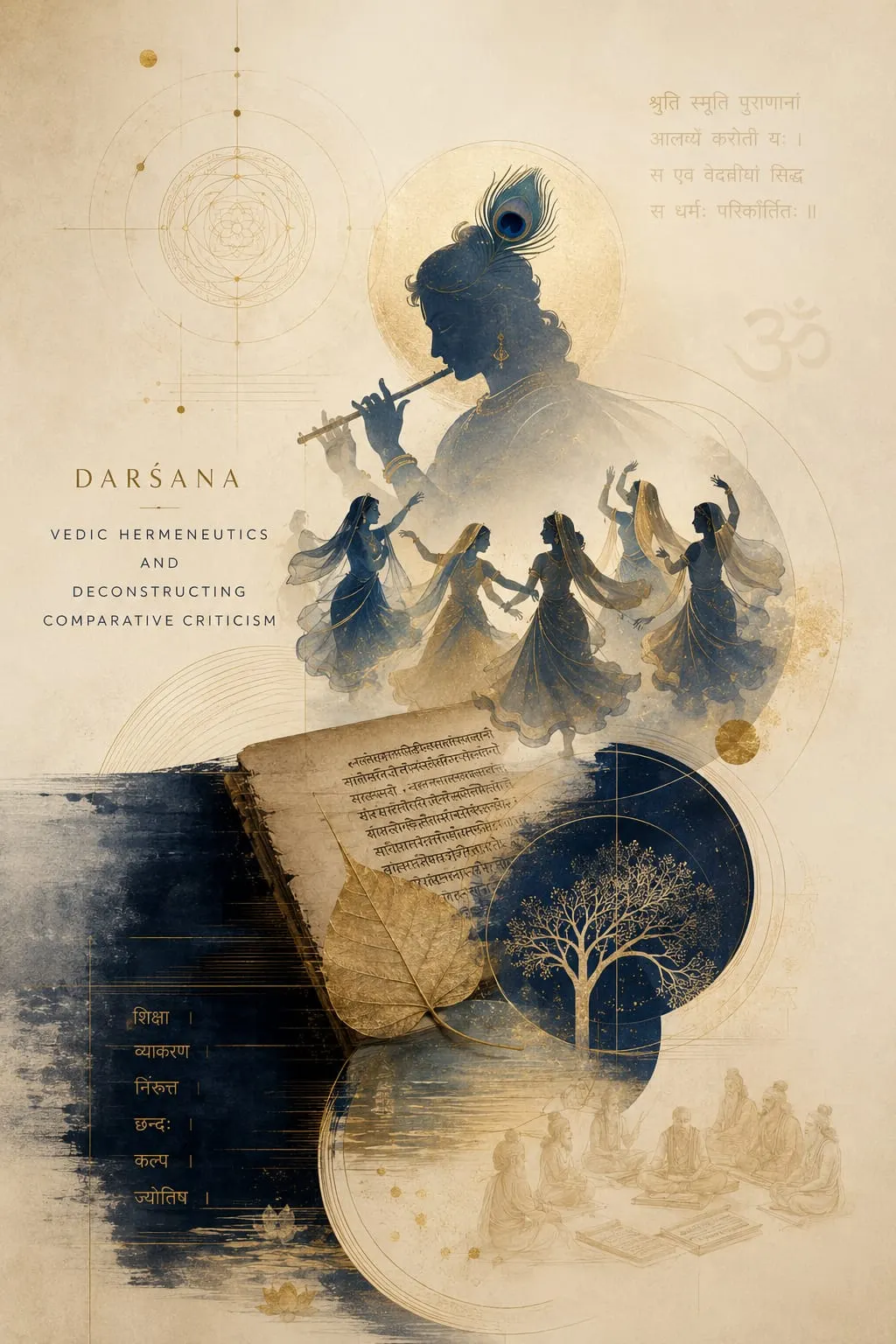
Darśana is frequently translated as philosophy, worldview, doctrine, or school of thought. Each rendering captures something, yet none captures the whole. The term points not only to an arrangement of propositions but also to a disciplined mode of seeing: a cultivated orientation through which reality, knowledge, conduct, and liberation become intelligible. This distinction matters whenever Hindu texts are interpreted through categories developed elsewhere. A translation may appear precise while quietly replacing the conceptual world of the text with that of the interpreter. The resulting account can remain grammatically competent and historically informed while still missing what the discourse is trying to accomplish.
The central methodological issue is therefore not whether texts should be examined critically. Hindu intellectual traditions have never lacked argument, disagreement, refutation, or disciplined commentary. The issue is whether criticism first reconstructs the text’s own vocabulary, genre, epistemology, purpose, and history of reception. A responsible interpretation must be able to explain a tradition from within its conceptual grammar before comparing, evaluating, or translating it into another one.
This approach does not require intellectual isolation. Philology, manuscript studies, archaeology, sociology, philosophy, and historical criticism can illuminate dimensions that a strictly confessional reading may overlook. Conversely, Sanskrit learning, sampradāya-based commentary, ritual competence, and sustained engagement with living communities can expose assumptions that external analysis may fail to recognize. The strongest method is neither an uncritical insiderism nor a supposedly neutral external gaze. It is a form of double accountability: fidelity to the evidence and fidelity to the conceptual integrity of the tradition being studied.
Darśana as disciplined seeing
“The word darśana derives its meaning from the Sanskrit root – dṛś ‘to look at’, ‘to view’, ‘experience.’” That etymological field is significant. Darśana may denote seeing, a vision, an encounter with a sacred presence, a perspective, or a systematic philosophical orientation. In the intellectual context, it is commonly used for a structured account of reality and the means by which reality may be known. In devotional life, it can describe the reciprocal encounter between devotee and deity. Treating all these uses as interchangeable would be careless, but separating them absolutely would be equally misleading. The common thread is a way of seeing that changes the position of the one who sees.
That transformative dimension distinguishes darśana from a purely abstract theory. A classical system ordinarily joins metaphysics, epistemology, ethics, disciplined practice, and a conception of the highest human end. Questions about what exists are connected to questions about how valid knowledge arises, why error occurs, how suffering or bondage is sustained, and what form liberation takes. A darśana is therefore not merely an opinion about the world. It is an organized relationship among vision, reasoning, practice, and human flourishing.
The designation āstika also requires care. In classifications of the classical Hindu schools, it generally signals recognition of Vedic authority rather than a simple belief in a creator God. Mīmāṃsā, for example, developed a powerful defense of Vedic authority without making divine authorship necessary to that defense. The familiar grouping of six āstika darśanas is useful, but it should not be mistaken for a single creed. Sāṅkhya, Yoga, Nyāya, Vaiśeṣika, Mīmāṃsā, and Vedanta differ substantially in their ontologies, accepted means of knowledge, theories of causation, accounts of selfhood, and understandings of liberation.
Nor were these systems sealed compartments. Their positions developed through commentaries, subcommentaries, public debate, pedagogical exchange, and sustained engagement with Buddhist, Jain, materialist, grammatical, ritual, and theological arguments. A darśana is best understood as a historically extended practice of reasoning. Its continuity lies not in the absence of change but in the disciplined ways change is argued, authorized, and connected to foundational sources.
Hermeneutics begins with discourse, not isolated sentences
Hermeneutics concerns the mediation of understanding. A discourse makes thought shareable, but language never carries thought without shaping it. Words acquire meaning through grammar, convention, genre, context, prior usage, and the expectations of a community. Reading is therefore not the passive extraction of information from a verbal container. It is a relation among text, transmitted vocabulary, interpretive history, and reader.
This relation is often described as a hermeneutic circle. A passage is understood through the whole text, while the whole is reconstructed from its passages. A technical term is interpreted through its tradition, yet the tradition itself is known through texts that use the term. The circle is not a logical defect that can simply be eliminated. It becomes methodologically productive when assumptions are declared, tested against evidence, and revised as the inquiry proceeds.
The quiet frustration many readers experience when a familiar sacred term appears strangely diminished in translation reveals this problem in practical form. Dharma may become religion, law, morality, duty, or social order; ātman may become soul; brahman may become God or absolute; yajña may become sacrifice; and śraddhā may become belief or faith. Such glosses can help a beginner, but none is a complete equivalence. Each imports associations that may be absent from the source while concealing relations that are central to it.
The institutional ecology of interpretation
Interpretation was historically sustained by more than access to manuscripts. It depended upon teachers, students, recitation lineages, debate conventions, grammatical training, ritual knowledge, memorization, and bodies of commentary. A compact sūtra often presupposed oral explanation. A mantra could be inseparable from accent and performance. A philosophical objection might make sense only when placed within a long sequence of pūrvapakṣa, response, counter-response, and siddhānta. Text and institution were therefore mutually supporting.
Changes in patronage, colonial systems of education, the displacement of Sanskrit and regional scholarly languages, and modern disciplinary boundaries weakened parts of this ecology. The result was not the total disappearance of traditional learning; many lineages, institutions, and scholars endured and adapted. The more precise conclusion is that access became uneven. Printed and digital texts grew easier to obtain while the interpretive training assumed by those texts often became harder to acquire.
Romanticizing the past would not solve this problem. Traditional institutions could contain exclusions, local limitations, sectarian assumptions, and historically conditioned judgments. Modern universities can contribute critical editions, comparative linguistic work, material history, and transparent peer review. Renewal requires collaboration: traditional competence without immunity from evidence, and academic criticism without contempt for inherited forms of knowledge.
There is no single undifferentiated Hindu canon
The phrase Hindu canonical texts can conceal a layered and internally differentiated textual world. Śruti, smṛti, Itihāsa, Purāṇa, Dharmaśāstra, Āgama, Tantra, sūtra, bhāṣya, ṭīkā, devotional poetry, ritual manuals, and regional retellings do not possess identical authority or invite identical reading strategies. Their standing also varies among sampradāyas. A text treated as central in one lineage may be secondary, differently classified, or rarely used in another.
Genre determines interpretive expectations. An injunction is not read like a hymn, a metaphysical dialogue, a genealogy, a legal digest, a devotional lyric, or an epic narrative. A Purāṇic account may perform theological, ritual, genealogical, pedagogical, and sacred-geographical functions simultaneously. An episode in Itihāsa may preserve moral ambiguity precisely because its task is to cultivate judgment rather than supply a context-free rule. Genre-blind interpretation turns literary and theological complexity into apparent contradiction.
Orality further complicates any exclusively book-centered model. Vedic transmission preserves sound, accent, sequence, and embodied discipline. Epic and Purāṇic traditions have circulated through recitation, performance, regional adaptation, temple practice, and vernacular retelling. The physical manuscript is indispensable evidence, but it is not always the entire cultural object. A method designed only for silent reading can miss how meaning is generated through hearing, performance, memory, and participation.
Mīmāṃsā as a technical science of interpretation
Mīmāṃsā, associated foundationally with Jaimini’s Mīmāṃsā Sūtra and the extensive commentary of Śabara, developed one of the world’s most intricate traditions of scriptural interpretation. Its primary concern was the ascertainment of dharma from Vedic discourse, especially in relation to ritual action. That focus generated sophisticated theories of language, sentence meaning, textual unity, injunction, authority, and knowledge. A detailed academic overview of this wider intellectual setting appears in the Stanford Encyclopedia of Philosophy’s survey of language and testimony in classical Indian philosophy.
The Mīmāṃsā account of Vedic authority is frequently reduced to a generalized claim of revelation. Its logic is more specific. The Veda is treated as apauruṣeya, not authored by a human person and therefore not vulnerable to the ordinary defects attributed to fallible speakers. Meaning does not depend upon recovering the psychological intention of an individual composer. This differs from interpretive models that make authorial intention the final court of appeal. It also explains why āstika cannot simply be translated as theistic.
Mīmāṃsā distinguishes the functions performed by different kinds of Vedic expression. Vidhi enjoins; niṣedha prohibits; mantra participates in ritual articulation and recollection; nāmadheya designates; and arthavāda may praise, censure, explain, narrate, or reinforce an injunction. These are not merely labels attached after reading. They influence what kind of meaning a passage can reasonably bear and how apparently independent statements relate to operative ritual discourse.
A celebrated group of interpretive indicators includes śruti, liṅga, vākya, prakaraṇa, sthāna, and samākhyā. In this technical context, śruti refers to an explicit statement; liṅga to an indicative force or semantic sign; vākya to sentence-level connection; prakaraṇa to the governing context or topic; sthāna to position or sequence; and samākhyā to a name or designation. They are often ordered as progressively less direct grounds of determination when evidence conflicts. The point is procedural: interpretation should be justified by ranked textual evidence rather than intuition alone.
Classical semantic analysis also asks what allows words to form a unified sentence. Ākāṅkṣā concerns mutual expectancy, yogyatā concerns semantic fitness, and sannidhi or āsatti concerns appropriate proximity. These criteria prevent a reader from assembling a preferred meaning out of words that are grammatically near but conceptually incompatible. Related traditions of grammar, Nyāya, poetics, and Mīmāṃsā disagreed about the details, but the shared debate demonstrates sustained attention to how linguistic understanding actually occurs.
The Bhāṭṭa and Prābhākara branches illustrate the depth of that disagreement. The Bhāṭṭa account commonly associated with abhihitānvaya holds that words first convey their individual meanings, which are subsequently connected into sentence meaning. The Prābhākara theory of anvitābhidhāna holds that words communicate meanings already apprehended as connected. This is not an ornamental dispute. It affects how context, syntax, implication, and textual unity are understood.
Interpretation is also embedded in pramāṇa theory—the analysis of reliable sources of knowledge. Perception, inference, comparison, postulation, testimony, and non-cognition are recognized in different combinations by different schools. Bhāṭṭa Mīmāṃsā classically accepts six, while Prābhākara Mīmāṃsā does not treat non-cognition as a separate pramāṇa. These disagreements show that scriptural exegesis was tied to explicit standards of justification. Native hermeneutics is therefore not a request to suspend reason in favor of inherited assertion; it is an invitation to understand a different architecture of reason.
Uttara Mīmāṃsā and the plurality of Vedanta
Uttara Mīmāṃsā, conventionally identified with Vedanta, turns sustained attention toward the Upaniṣadic inquiry into brahman, self, world, bondage, and liberation. Its later scholastic corpus is often organized around the Upaniṣads, the Brahma Sūtras, and the Bhagavad Gītā, collectively described as the prasthāna-trayī. Yet these texts do not interpret themselves. Bhāṣyas and subcommentaries establish connections, resolve tensions, delimit figurative readings, answer rival positions, and identify the governing purpose of a passage.
Vedantic interpreters often invoke six tātparya-liṅgas, or indicators of a text’s principal purport: agreement between opening and conclusion through upakrama-upasaṃhāra; repetition through abhyāsa; distinctiveness or novelty through apūrvatā; the stated result through phala; explanatory praise through arthavāda; and reasoned support through upapatti. These criteria require the interpreter to examine a teaching as an organized whole rather than elevate an isolated phrase into a complete theology.
Native interpretation is nevertheless plural. Advaita, Viśiṣṭādvaita, Dvaita, Bhedābheda, Śuddhādvaita, and Acintya-bhedābheda traditions may work with overlapping corpora while differing over reference, hierarchy, direct and figurative meaning, the relation between brahman and the world, and the nature of liberation. The existence of multiple disciplined readings does not prove that every reading is equally defensible. It proves that the expression native hermeneutics cannot honestly be reduced to one modern spokesperson or one supposedly self-evident Hindu view. Research in the Journal of Hindu Studies on philosophical hermeneutics within a darśana documents how later understandings were connected to earlier sources through identifiable interpretive devices.
It is also too broad to say that all foundational Vedantic, epic, and later Purāṇic literature is governed solely by Uttara Mīmāṃsā. Vedanta supplies essential theological and metaphysical frameworks for many communities, but Itihāsa and smṛti require attention to narrative form, dharma deliberation, reception history, performance, regional recension, sectarian commentary, and literary theory. Purāṇic interpretation may additionally depend upon cosmological conventions, ritual calendars, sacred geography, temple traditions, and relations among different cycles of narration.
Historical and textual criticism remain indispensable here. Manuscripts differ; passages may circulate in multiple recensions; scribal errors occur; commentaries preserve variant readings; and vernacular retellings may deliberately reshape narrative emphasis. A critical edition can establish the history of transmission without deciding every theological question. Conversely, theological interpretation can explain why a community receives a passage as sacred without settling its earliest recoverable textual form. Confusing these tasks produces avoidable conflict.
What comparative criticism gets wrong
There is no single Western hermeneutic method. Biblical exegesis, classical philology, Romantic hermeneutics, historical criticism, phenomenology, philosophical hermeneutics, structuralism, post-structuralism, and reception theory differ substantially. Treating the West as a monolith would reproduce the same simplification that a native-centered approach seeks to correct. The legitimate criticism concerns unexamined dominance: one historically situated framework is sometimes presented as universal while the categories of the studied tradition are treated as local data requiring translation.
The first recurring error is category substitution. Brahman is placed into the slot reserved for God, ātman into the slot reserved for soul, mokṣa into the slot reserved for salvation, and darśana into the slot reserved for philosophy or religion. Comparison then begins only after the Indic term has already been transformed. A more rigorous process preserves the source term, maps its range of uses, identifies disagreements about it, and only then asks where comparison clarifies and where it distorts.
The second error is scale mismatch. A verse detached from its narrative or ritual setting may be compared with an entire theological system reconstructed from centuries of commentary. A contemporary practice may be compared with an ancient ideal, or a prescriptive text with observed social behavior. Such comparisons can produce dramatic conclusions because the units were never equivalent. The comparison must state whether it concerns concepts, arguments, institutions, practices, historical developments, or normative claims.
The third error is asymmetric suspicion. A traditional explanation may be treated as apologetic by definition, while an external theory is presented as neutral. Yet every method selects evidence, defines relevance, and carries assumptions about language, agency, religion, society, and truth. Symmetry does not require abandoning criticism. It requires that both inherited claims and modern analytical categories be open to examination.
Deconstruction, properly used, does not mean dismissing comparative study or reversing a hierarchy so that anything indigenous becomes automatically correct. It examines how categories were produced, what oppositions organize them, whose testimony counts, and what becomes invisible when one vocabulary claims universality. The goal is a more accountable comparison, not an insulated one.
Comparative philosophy can be constructive when it distinguishes several activities. It may archive and reconstruct traditions, identify carefully bounded analogies and contrasts, bring multiple traditions to a shared philosophical problem, or map the broader conceptual possibilities revealed by their encounter. This layered model is developed in Jessica Frazier’s study of comparative philosophy in Religious Studies. Comparison becomes most valuable when it transforms the questions on both sides instead of forcing one side to answer questions already settled by the other.
A productive contemporary method may therefore be called methodological bilingualism. It need not imply fluency in only two spoken languages. It means learning to reason with at least two conceptual vocabularies without prematurely collapsing either into the other. The researcher should be capable of describing a claim in the categories of its sampradāya and in the categories of a modern discipline, while making the gains and losses of each description visible.
Dharmic dialogue without homogenization
The distinction between āstika and nāstika should not become a moral ranking of communities. In classical debate it often marks differing relations to Vedic authority. Buddhist and Jain traditions rejected that authority while developing their own rigorous accounts of knowledge, language, interpretation, discipline, and liberation. Their arguments also shaped the positions defended by Hindu philosophers. Classical Indian thought grew through disagreement across these boundaries, not through intellectual isolation.
Many Buddhist traditions distinguish teachings that state a definitive meaning from those requiring interpretation, often expressed through the categories nītārtha and neyārtha. Considerations of audience, pedagogical purpose, and upāya complicate any assumption that every discourse functions identically. Buddhist epistemologists also developed exacting analyses of perception, inference, exclusion, testimony, and conceptual construction. These resources deserve reconstruction on their own terms rather than treatment as incomplete versions of Vedanta.
Jain traditions contribute anekāntavāda, nayavāda, and syādvāda to the analysis of complex objects and perspectival claims. These doctrines are sometimes flattened into the slogan that every view is true. Their more disciplined force lies in recognizing that claims may disclose conditioned aspects of a many-sided reality and must be qualified according to standpoint. That insight is especially valuable for comparative criticism because it combines openness to multiple perspectives with logical responsibility.
Sikh interpretation likewise must not be absorbed into a generic Vedic framework. Gurbani is approached through gurmat, the canonical organization of the Guru Granth Sahib, linguistic register, musical rāga, historical context, and lived disciplines of nām, seva, and sangat. Shared civilizational vocabulary can support dialogue, but shared vocabulary does not erase theological distinction. Respect begins by allowing Sikh categories to perform their own interpretive work.
Unity among Hindu, Buddhist, Jain, and Sikh traditions is strongest when it does not demand sameness. These traditions share histories of debate, ethical discipline, contemplative practice, teacher-student transmission, and inquiry into bondage, suffering, knowledge, and liberation. They also disagree about selfhood, authority, ontology, and the status of particular texts. Dharmic solidarity can preserve these differences while opposing the habit of reducing every Indian tradition to a derivative or deficient form of an external model.
A rigorous research protocol for reading darśana
1. Establish the textual object. The inquiry should identify the work, edition, recension, manuscript basis, language, approximate historical setting, and translation being used. A quotation without this information may be rhetorically effective but academically unstable. When versions differ, the difference should be reported rather than silently resolved.
2. Preserve the source vocabulary. Important Sanskrit, Prakrit, Pali, Punjabi, or vernacular terms should remain visible beside any English gloss. Morphology, syntax, compound structure, semantic history, and technical usage should be examined before a doctrinal conclusion is drawn. Yāska’s Nirukta and later traditions of grammar and semantics show that questions of literal, figurative, and contextual meaning were already objects of sustained analysis; the Stanford Encyclopedia of Philosophy’s study of literal and nonliteral meaning in classical India provides a useful scholarly orientation.
3. Classify genre and authority. The passage should be located within its textual layer and literary function. Is it śruti, smṛti, Itihāsa, Purāṇa, sūtra, commentary, ritual direction, philosophical argument, praise, prohibition, narrative, or poetry? How does the relevant community rank it? A later commentary cannot automatically be treated as the plain meaning of an earlier text, but neither can its centuries of reception be dismissed as irrelevant.
4. Reconstruct the governing question. A text may be answering a problem different from the one posed by a modern reader. The sequence of topics, opening and conclusion, stated result, repeated claims, objections, and intended audience should be mapped. This protects against extracting a sentence that sounds familiar while ignoring the intellectual problem to which it responds.
5. Read the commentarial chain comparatively. Major bhāṣyas and subcommentaries should be studied not merely for agreement but for the places where they diverge. Each position should be connected to its grammatical, epistemological, and theological premises. The structure of pūrvapakṣa and siddhānta must also be respected; a position introduced for refutation should not be quoted as the text’s settled conclusion.
6. Identify the pramāṇa structure. Every major claim should be paired with the kind of justification offered for it. Is the passage appealing to perception, inference, analogy, postulation, testimony, absence, tradition, ritual efficacy, or contemplative realization? Disagreement over conclusions often begins with disagreement over what can count as knowledge.
7. Account for practice and embodiment. Some texts describe realities that are connected to ritual, meditation, devotion, ethical formation, or disciplined perception. Practice does not make historical or logical criticism unnecessary, and personal experience cannot settle every public argument. It can, however, supply forms of competence without which a discourse is only partially understood. Academic work on Sri Aurobindo’s hermeneutics, for example, examines the claim that philological sensitivity and spiritually grounded practice may cooperate in scriptural interpretation.
8. Apply external criticism transparently. Manuscript comparison, historical chronology, archaeology, sociology, gender analysis, and material history should be used where relevant. Their assumptions, scope, and evidentiary limits should be stated. An external explanation may disclose a causal history without exhausting a text’s philosophical or theological meaning.
9. Compare only after reconstruction. The axis of comparison must be explicit. A concept should be compared with a concept, a practice with a practice, an argument with an argument, or a historical institution with a historically comparable institution. Similar vocabulary should be treated as a hypothesis of relation rather than proof of identity.
10. Report uncertainty and positionality. The final account should distinguish textual evidence, commentarial interpretation, historical inference, and contemporary application. It should disclose unresolved variants and credible rival readings. Consultation with traditionally trained scholars and practitioners can improve accuracy, but no participant should be treated as the sole voice of an internally diverse tradition.
How the protocol changes an actual reading
Consider the common translation of dharma as religion. A hurried comparison may ask whether a text supports religious freedom, religious law, or religious identity. A more careful reading first asks what dharma denotes in that passage: ritual obligation, ethical norm, social responsibility, sustaining order, defining property, teaching, or another context-dependent sense. It then identifies genre, speaker, audience, commentary, and practical effect. Only after that reconstruction does comparison with religion, law, ethics, or natural order become analytically meaningful.
A similar caution applies to morally difficult episodes in Itihāsa. A single action cannot be evaluated adequately without identifying the recension, narrative frame, prior obligations, competing dharmas, consequences, later commentary, and the possibility that the episode is designed to stage a conflict rather than endorse a simple rule. Native contextualization should not become a device for evading ethical questions. Its purpose is to ensure that the ethical question is directed at the actual narrative rather than a fragment manufactured by extraction.
Digital editions and artificial intelligence raise new hermeneutical risks
Digital access can revive textual study, but it can also accelerate decontextualization. Optical character recognition may corrupt diacritics, sandhi, metre, accent, and compound boundaries. Search engines privilege isolated matches over argumentative sequence. Machine translation may normalize several technical terms into one English word. Generative systems may combine Advaita, Dvaita, Yoga, Tantra, and modern universalist interpretations into a smooth answer that corresponds to no identifiable sampradāya.
A reliable digital workflow should record edition and verse identifiers, preserve the original script, display transliteration beside translation, link quotations to their context, separate commentarial voices, and flag uncertain readings. Automated analysis should be checked against dictionaries, grammars, critical editions, and identifiable commentaries. Artificial intelligence may assist collation, search, and comparison, but it cannot substitute for source criticism or silently decide among rival theological premises.
Rebuilding a living hermeneutical culture
A contemporary curriculum in Hindu Studies and Indian Knowledge Systems should integrate language, philosophy, textual criticism, intellectual history, and engagement with living traditions. Students need enough Sanskrit to recognize when a translation has already decided the philosophical issue. They also need exposure to Buddhist, Jain, and Sikh sources so that Indian intellectual history is not mistaken for a conversation conducted by one community alone.
Institutional renewal should support critical editions, oral archives, digitization with accurate metadata, translations produced by collaborative teams, and sustained dialogue between paṇḍitas, monastics, granthis, practitioners, historians, linguists, and philosophers. Community participation is not a concession opposed to scholarship; it is one form of evidence about reception, practice, and technical vocabulary. Academic independence remains essential, but independence should not be confused with distance from every bearer of inherited knowledge.
Darśana and the ethics of understanding
Reading darśana responsibly requires intellectual humility. A text may resist the questions brought to it, and a familiar English category may prove inadequate. That resistance is not an obstacle to understanding; it is often the beginning of understanding. The reader learns not merely to collect claims but to recognize a different arrangement of knowledge, action, authority, and human purpose.
Vedic hermeneutics is therefore neither an antiquarian curiosity nor a defensive refusal of comparison. It offers a disciplined apparatus for determining textual function, resolving conflict, ranking evidence, and connecting language to knowledge and action. Modern critical methods can test and extend that apparatus, while native categories can expose the historical provincialism of methods that mistake themselves for universal reason.
The deconstruction of comparative criticism reaches its constructive end when comparison becomes reciprocal. Hindu traditions are permitted to define their own problems before being evaluated; Buddhist, Jain, and Sikh traditions retain their distinct interpretive grammars; and external scholarship is welcomed without being granted automatic conceptual supremacy. Unity then emerges not from erasing difference but from cultivating a shared ethic of careful listening, reasoned disagreement, and fidelity to evidence.
Darśana finally returns interpretation to the act of seeing. Clearer sight requires more than looking at a translated sentence. It requires attention to language, lineage, genre, argument, practice, historical transmission, and the limits of the observer’s own frame. When those disciplines converge, reading becomes more than commentary on a distant tradition. It becomes an encounter capable of transforming the terms through which knowledge itself is understood.
This expanded analysis is grounded in Reading Darśana: Vedic Hermeneutics and Deconstructing Comparative Criticism, published June 20, 2026, and developed through the additional academic sources linked throughout the discussion.
Inspired by this post on Hindu Post.








Leave a Reply
You must be logged in to post a comment.