

On 17 June 2026, a Division Bench of the Chhattisgarh High Court refused to terminate a criminal case against eleven petitioners accused of making inflammatory remarks at a public meeting in Kunkuri, Jashpur district. Chief Justice Ramesh Sinha and Justice Ravindra Kumar Agrawal dismissed the petition in Sunil Kumar Xalxo v. State of Chhattisgarh, CRMP No. 1532 of 2026, holding that the allegations and investigative material disclosed a prima facie case that required adjudication at trial. The practical result is straightforward: the petitioners must present their freedom-of-speech, intent and evidentiary defences before the trial court. The complete order is available in the reported text of the Chhattisgarh High Court judgment.
The most important qualification is equally straightforward. Refusing to quash a prosecution is not the same as convicting the accused. The High Court did not determine that the alleged words were actually spoken by every petitioner, that the recordings were authentic and admissible, or that the required criminal intention had been proved. It decided only that these disputed matters could not be resolved through a threshold petition invoking the High Court’s inherent jurisdiction. The presumption of innocence therefore remains intact, and the prosecution must still establish every ingredient of every charge in accordance with law.
The public meeting and the allegations
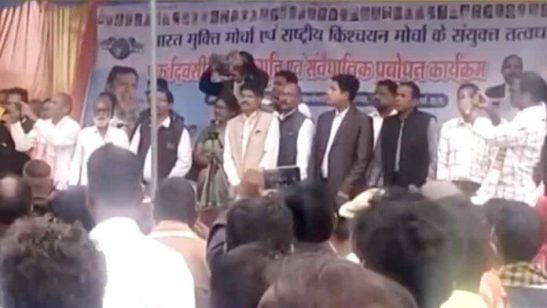
According to the order, the dispute arose from a public meeting held on 27 February 2024 at Saliyatoli Mini Stadium in Kunkuri. The event was described as having been organized by Bharat Mukti Morcha and Rashtriya Christian Morcha and was attended by a large gathering. A complainant identified in the judgment as a member of the Vishwa Hindu Parishad submitted a written complaint at Kunkuri Police Station. FIR No. 32/2024 was registered on 28 February 2024 against persons allegedly associated with the meeting.
The FIR attributed several statements to speakers at the gathering. It alleged that they said “Hindu is not a religion but an abuse” and represented the word Hindu as meaning “thief, dacoit, robber and slave.” It further alleged that derogatory comments were directed at religious preacher Dhirendra Shastri and the Chief Minister of Chhattisgarh. The prosecution also referred to an alleged exhortation that electronic voting machines should be broken and that elections should not be conducted through EVMs. These remain allegations recorded in the FIR and summarized by the High Court; they are not judicial findings that the statements were made as alleged.
The State maintained that the speeches could not be assessed as isolated sentences. It argued that their meaning and legal effect depended on the setting, the size and composition of the audience, the speakers’ tone, the surrounding political and religious discussion, and the probable effect on communal harmony and public order. That contextual dimension became central to the High Court’s conclusion that the dispute required evidence rather than summary adjudication.
How the case reached the High Court
Following the FIR, the petitioners were arrested and the investigating agency filed a charge-sheet. On 19 September 2025, the Judicial Magistrate First Class at Kunkuri framed charges under Sections 153A, 153B, 295A, 294 and 505(2), read with Section 34 of the Indian Penal Code. The petitioners challenged that decision through Criminal Revision No. 07/2025, but the First Additional Sessions Judge at Kunkuri dismissed the revision on 24 January 2026.
The eleven petitioners then approached the High Court under Section 528 of the Bharatiya Nagarik Suraksha Sanhita, 2023. They sought the quashing of the charge-framing order, the revisional order, the charge-sheet and the resulting proceedings in Criminal Case No. 1472/2025. The prayer reproduced in the High Court’s decision also referred to Section 109 of the IPC while describing the FIR, although the judgment’s account of the charges actually framed lists Sections 153A, 153B, 295A, 294 and 505(2), read with Section 34.
The use of both the IPC and the BNSS can appear unusual to a general reader, but it reflects the procedural record presented in the judgment. The alleged conduct and FIR date belong to February 2024, and the substantive accusations were framed under the IPC. The inherent-jurisdiction petition filed in 2026 invoked Section 528 of the BNSS, which the High Court described as the successor to Section 482 of the Code of Criminal Procedure for this purpose.
What the petitioners argued
The petitioners characterized themselves as social activists associated with organizations working among socially and economically disadvantaged communities. Their counsel argued that the statements attributed to them arose during discussion of social, political and religious questions and represented dissent, rational inquiry and advocacy for social reform. On that account, the speech was said to fall within Article 19(1)(a) of the Constitution, which guarantees freedom of speech and expression.
The defence also invoked Article 51A(h), the fundamental duty to develop scientific temper, humanism and a spirit of inquiry and reform. Reliance was placed on the constitutional emphasis on tolerance expressed in Bijoe Emmanuel v. State of Kerala. The underlying contention was that criticism of beliefs or institutions, even when forceful or unpopular, should not automatically be transformed into a criminal offence merely because listeners find it offensive.
On the statutory elements, counsel argued that the record did not disclose an intention to promote hostility between communities, an attempt to undermine national integration, or a deliberate and malicious intention to outrage religious feelings. The alleged statements were also said not to constitute rumours or alarming news for the purpose of Section 505(2). According to this position, there was no reported communal riot or public disorder following the meeting, and there was no material demonstrating a prior meeting of minds or common intention among all eleven petitioners.
The petitioners relied on the familiar principles associated with State of Haryana v. Bhajan Lal. They submitted that a High Court may intervene when the allegations, even if accepted at face value, fail to disclose an offence or when continuing the case would amount to an abuse of judicial process. They therefore asked the High Court to examine the essential ingredients of the charged provisions and end the prosecution before a full trial.
The State’s response
The State opposed the petition on the ground that the case was supported by more than a bare accusation. Its counsel referred to the written complaint, statements of persons who allegedly attended the meeting, event pamphlets and videographic recordings. The recordings were said to have been accompanied by a certificate under Section 65B of the Indian Evidence Act, the provision traditionally associated with the admissibility of electronic records.
The prosecution argued that these materials were sufficient to support a prima facie assessment at the charge-framing stage. It emphasized that neither a court framing charges nor a High Court considering quashing is expected to conduct a meticulous evaluation of witness credibility, electronic evidence or competing explanations. Those exercises belong to the trial, where the evidence can be introduced, challenged and tested through the ordinary adversarial process.
The State further contended that the absence of completed violence did not conclusively answer whether the alleged speech had the prohibited intention or tendency. Several of the invoked offences concern the promotion, attempted promotion or likely promotion of disharmony, hatred or ill-will. In the State’s view, the nature of the words, the audience and the surrounding circumstances therefore had to be considered together.
The narrow legal question before the High Court
Section 528 of the BNSS preserves the High Court’s inherent authority to make orders needed to give effect to the procedural code, prevent abuse of a court’s process or secure the ends of justice. The official provision can be reviewed through the India Code text of the Bharatiya Nagarik Suraksha Sanhita, 2023. Although this power is broad, precedent requires it to be used with restraint because a quashing court is not meant to replace the investigating agency or the trial court.
The question was consequently not whether the petitioners were guilty. It was not even whether the prosecution was more likely than the defence to prevail after a trial. The question was whether the allegations and collected material, provisionally accepted at face value, disclosed a cognizable offence and a prima facie basis for continuing the proceedings. That procedural distinction explains much of the judgment.
The High Court referred to the Supreme Court’s framework in Bhajan Lal and Neeharika Infrastructure Pvt. Ltd. v. State of Maharashtra. Those decisions recognize the power to quash plainly untenable cases while cautioning that criminal investigations and prosecutions ordinarily should not be stopped at their inception. A court considering quashing does not determine the reliability or ultimate truth of the accusation, conduct a mini-trial, or resolve contested factual defences.
The Bench also discussed Pradeep Kumar Kesharwani v. State of Uttar Pradesh, decided by the Supreme Court in September 2025, and the four-part approach associated with Rajiv Thapar v. Madan Lal Kapoor. Under that approach, defence material capable of ending a case at the threshold must be reliable and unimpeachable, must rule out the factual basis of the accusation, must remain effectively unrefuted, and must demonstrate that continuing the trial would abuse the court’s process rather than serve justice. The High Court concluded that the present petition did not meet that exceptional standard.
What the charged IPC provisions require
The statutory language matters because hurt feelings, political disagreement and criminal liability are not interchangeable concepts. The relevant provisions can be examined in the official India Code edition of the Indian Penal Code, 1860. Each provision has distinct elements, and the prosecution will ultimately have to prove the elements applicable to each accused rather than rely on a generalized assertion that the meeting was objectionable.
Section 153A addresses words, representations and conduct that promote or attempt to promote disharmony, enmity, hatred or ill-will between specified groups, including religious, racial, linguistic, regional, caste and community groups. It also covers acts prejudicial to harmony that disturb or are likely to disturb public tranquillity. The statutory inquiry is therefore more demanding than asking whether language was rude. It includes the character of the communication, the relevant groups, the surrounding circumstances and the required connection to disharmony or public tranquillity.
Section 153B concerns imputations and assertions prejudicial to national integration. Its clauses address claims that a class of persons cannot bear true faith and allegiance to the Constitution, assertions that a class should be deprived of citizenship rights, and certain appeals concerning the obligations of a class that cause or are likely to cause disharmony, enmity, hatred or ill-will. The trial court will have to determine whether the proved words, if any, fit the precise statutory language rather than merely resemble political or religious criticism in a broad sense.
Section 295A applies to deliberate and malicious acts intended to outrage the religious feelings of a class by insulting or attempting to insult its religion or religious beliefs. Its mental element is significant. The provision does not convert every disagreement, historical argument, satire or careless expression into an offence. Deliberate and malicious intention must be established from admissible evidence and legitimate inferences. The High Court did not decide that this intention existed; it held that the issue could not be conclusively resolved without examining the evidence at trial.
Section 505(2) addresses the making, publication or circulation of a statement or report containing rumour or alarming news with the intent, or legally relevant likelihood, of creating or promoting enmity, hatred or ill-will between religious, racial, linguistic, regional, caste or community groups. The petitioners argued that the alleged remarks did not satisfy this formulation. The High Court treated that submission as a matter requiring examination of the actual speech, its form, its context and its probable effect.
Section 294 concerns obscene acts in a public place and obscene words, songs or recitations uttered in or near a public place to the annoyance of others. Its requirements differ from those of the religious-harmony provisions and must be proved separately. Section 34, meanwhile, is a principle of joint liability for a criminal act performed by several persons in furtherance of their common intention; it is not a free-standing substantive offence. Its application will require evidence connecting each petitioner to the alleged common intention and conduct.
At the stage of framing charges, the court asks whether the material supplies sufficient grounds for presuming that the accused may have committed the offences. That is a substantially lower threshold than proof beyond reasonable doubt. The difference protects both sides of the criminal process: an accused cannot be convicted on a prima facie assessment, while a prosecution supported by legally relevant material is not ordinarily terminated merely because the defence offers a plausible competing interpretation.
Why the High Court allowed the trial to continue
The Bench found that the prosecution was based on specific allegations and identified categories of evidence. The complaint, witness statements, pamphlets and video recordings prevented the case from being characterized at that stage as wholly conjectural, absurd or inherently improbable. Whether those materials will survive objections and prove the case is a separate issue, but their existence was sufficient to make summary termination inappropriate.
The court considered context indispensable. Determining whether the statements represented legitimate social criticism or crossed a criminal threshold would require examination of the full speeches, the subjects under discussion, the tone in which the words were used, the people to whom they were addressed and their likely impact. Extracting a sentence from its setting could either exaggerate its danger or conceal it. A trial provides procedures for establishing that setting through complete recordings, witnesses and cross-examination.
The High Court also rejected the proposition that the absence of an actual riot or completed communal disturbance was, by itself, enough to quash the case. At the threshold stage, the Bench treated the alleged nature and tendency of the speech as relevant alongside any consequences. This does not mean that the absence of disorder is irrelevant to the final evaluation. It means only that the point did not conclusively negate every charged offence before the evidence had been tested.
Similarly, describing the petitioners as activists, rationalists or advocates of scientific temper did not automatically determine the legal character of the disputed speech. Social reform and constitutional dissent receive substantial protection, but a person’s stated mission cannot substitute for an examination of what was said, with what intention and in what setting. The court classified the petitioners’ explanation of their purpose as a defence to be assessed with the complete record.
By the same reasoning, the Bench declined to decide the disputed mental elements in the quashing proceeding. The existence of deliberate or malicious intent, an intention to promote hostility, knowledge of likely consequences and a common intention among multiple accused ordinarily must be inferred from proved facts. Resolving those matters at the threshold would have required the High Court to choose between rival factual accounts without the evidentiary safeguards of a trial.
What the ruling does not establish
The decision does not declare the eleven petitioners guilty of hate speech, religious insult, obscenity or any other offence. It does not authenticate the videos, endorse every statement in the complaint, or find that all petitioners uttered the same words. It also does not decide that the prosecution’s witnesses are reliable. Those matters remain open for proof, objection and cross-examination.
The order does not establish a general rule that criticism of Hinduism, another religion, a religious leader or the government is criminal. Nor does it hold that subjective hurt alone satisfies Section 295A. The statutory requirement of deliberate and malicious intention remains, just as the distinct requirements of Sections 153A, 153B, 505(2) and 294 remain. The court simply found that the allegations and collected material were sufficient to place those questions before the competent trial court.
The ruling also does not reject rationalism, scientific temper or social reform as constitutional values. It holds that invoking those values cannot conclusively resolve disputed questions about particular words and their context during a quashing proceeding. Protected inquiry may be searching and uncomfortable, while criminal liability still depends on satisfaction of the governing statute.
Most decisively, the High Court expressly directed that its observations should not be treated as an opinion on the merits. The trial court must decide the case independently and solely on the evidence placed before it. That reservation is not ceremonial language. It preserves the accused persons’ ability to challenge attribution, admissibility, intention, statutory interpretation and every other element of the prosecution case.
Freedom of speech and the limits of criminal regulation
Article 19(1)(a) gives citizens the fundamental right to freedom of speech and expression. Article 19(2) permits reasonable restrictions imposed by law on specified grounds, including the sovereignty and integrity of India, security of the State, friendly relations with foreign states, public order, decency or morality, contempt of court, defamation and incitement to an offence. The current constitutional text is available from the Legislative Department of the Government of India.

The existence of Article 19(2) does not mean that any controversial statement may be punished. A restriction must be grounded in law, and the prosecution must prove the applicable statutory conditions. Conversely, Article 19(1)(a) is not an automatic mechanism for terminating every speech-related prosecution before the facts have been established. The constitutional question often depends on careful distinctions among criticism, advocacy, insult, group vilification and incitement.
Article 51A(h) strengthens the civic legitimacy of inquiry, humanism and reform. Its invocation in this case highlights an important democratic tension: established beliefs must remain open to evidence-based examination, yet criticism need not describe an entire community through degrading or criminalizing labels. Intellectual rigour is usually enhanced, rather than weakened, when arguments identify a doctrine, institution, practice or historical claim precisely instead of imputing a single negative character to millions of people.
For people who hear a deeply held identity reduced to a slur, the injury can feel immediate and personal. For people who fear that criminal prosecution may silence unpopular scholarship or dissent, the anxiety is also genuine. Constitutional adjudication has to hold both concerns without presuming that either automatically answers the legal question. The trial process is intended to convert those competing perceptions into findings based on defined offences, admissible evidence and individual responsibility.
A Dharmic and interfaith perspective centred on unity
A unity-oriented approach to Hindu, Buddhist, Jain and Sikh traditions does not require insulating beliefs from criticism. These traditions contain extensive histories of debate, commentary, disagreement and internal reform. Their shared intellectual strength is better served by precise engagement with ideas than by collective humiliation. The same standard should extend to Christian, Muslim and other communities: doctrines and institutions may be scrutinized, but adherents should not be reduced to hostile stereotypes.
The identity of an organization named in an allegation cannot justify blaming an entire religious or social community. Criminal law is directed at proved acts and legally attributable intentions of individuals, not inherited or collective guilt. Nothing in the High Court’s order supports hostility toward Christians, Adivasis, activists or any other class. Equally, concern for minority rights does not require dismissing the dignity and religious sentiments of Hindus. Neutrality requires consistent protection and consistent evidentiary standards.
Durable communal harmony is not produced by suppressing every disagreement. It is produced by combining freedom of inquiry with disciplined language, reciprocal respect and equal application of law. Public discourse becomes more credible when participants challenge factual propositions and social practices without dehumanizing communities, and when authorities distinguish genuine criticism from conduct satisfying narrowly defined criminal elements.
What the trial will need to determine
The first evidentiary question is attribution. The trial court will need to identify which person allegedly made which statement, whether each petitioner spoke at all, and whether participation in or organization of the meeting is sufficient to connect a particular accused to a particular criminal act. General references to several speakers cannot relieve the prosecution of proving the case against each individual.
The electronic evidence will require its own examination. Relevant issues may include the provenance and completeness of the recordings, whether they have been edited, the continuity of the speech, the devices and processes through which they were obtained, and compliance with the applicable rules governing electronic records. A certificate accompanying a recording may support its introduction, but the weight, interpretation and legal effect of the material remain matters for adjudication.
The court must then reconstruct context. A complete recording may show whether a disputed expression was an assertion, quotation, historical claim, rhetorical device, rebuttal or exhortation. Witnesses may provide evidence about the audience, sequence of speakers and reaction at the venue. Cross-examination may reveal whether recollections are reliable and whether later social-media circulation accurately reflected the original event.
The prosecution must also address mens rea. For Section 295A, that includes the alleged deliberate and malicious intention. For the group-harmony provisions, the court must examine the intention or legally relevant tendency associated with the proved communication. For Section 34, it must assess whether a common intention linked the accused to the criminal act. These requirements cannot be replaced by proof that some listeners were offended.
The defence, meanwhile, remains free to argue that the statements were misattributed, extracted from context, mistranslated, misunderstood or constitutionally protected. It may contest whether the relevant groups and harms identified in the statutes are present, whether the recordings are reliable, whether the prosecution obtained any required authorization, and whether the evidence establishes individual participation. The High Court’s dismissal did not foreclose permissible factual or legal defences.
Why the decision matters beyond this case
The ruling illustrates the difference between a procedural threshold and a final constitutional judgment. Quashing protects people from prosecutions that are legally impossible, manifestly frivolous or abusive. Trial, by contrast, is the forum for cases in which material exists but its truth, context, intention or legal significance remains disputed. Confusing these stages can produce either premature condemnation of the accused or premature dismissal of a complainant’s legally cognizable grievance.
The distinction is especially important in speech cases because the process itself carries serious costs. Accused persons may face reputational injury, expense and prolonged uncertainty even before a verdict. Complainants may feel that their identity and dignity have been publicly attacked. Those realities make careful threshold review essential, but they do not authorize a quashing court to decide contested evidence as though it had already conducted a trial.
Responsible reporting is therefore crucial. Headlines may accurately state that the eleven petitioners must face trial, but they should not imply that the High Court found the alleged remarks proved or pronounced the petitioners guilty. Terms such as “alleged,” “prima facie” and “refused to quash” are substantive legal safeguards, not empty qualifications. They preserve the difference between accusation and adjudication.
Public speakers and event organizers can draw a different lesson. Social criticism is usually more persuasive when claims are sourced, institutions and practices are identified precisely, and communities are not assigned degrading collective traits. Maintaining complete recordings, publishing accurate transcripts and establishing clear standards against incitement can help preserve both the integrity of public debate and the evidentiary record if controversy follows.
Law-enforcement agencies and courts carry a corresponding duty of neutrality. The same statutory thresholds should apply regardless of whether the targeted identity is Hindu, Buddhist, Jain, Sikh, Christian, Muslim or another community, and regardless of the speaker’s ideological affiliation. Selective enforcement undermines both religious equality and confidence in legitimate public-order regulation.
A measured reading of the outcome
The Chhattisgarh High Court’s decision is best understood as a procedural ruling, not an ideological verdict. The Bench found enough specificity and supporting material to prevent the case from being extinguished through inherent jurisdiction. It left the central questions—what was said, who said it, what was intended, whether the evidence is reliable and whether the statutory thresholds are met—entirely open for trial.
That measured interpretation protects the integrity of both free expression and due process. It acknowledges the seriousness of allegations that a religious identity was publicly demeaned while refusing to convert those allegations into guilt without proof. The eventual judgment must depend on evidence and the exact language of the law, not on partisan expectations generated outside the courtroom.
Source and verification note: This analysis expands upon the source report concerning the Chhattisgarh High Court order and checks its central legal and procedural claims against the full judgment, official statutory texts and the Constitution. It is an academic explanation of a reported judicial proceeding, not a prediction of the trial’s outcome or individualized legal advice.
Inspired by this post on Struggle for Hindu Existence.






Leave a Reply
You must be logged in to post a comment.