
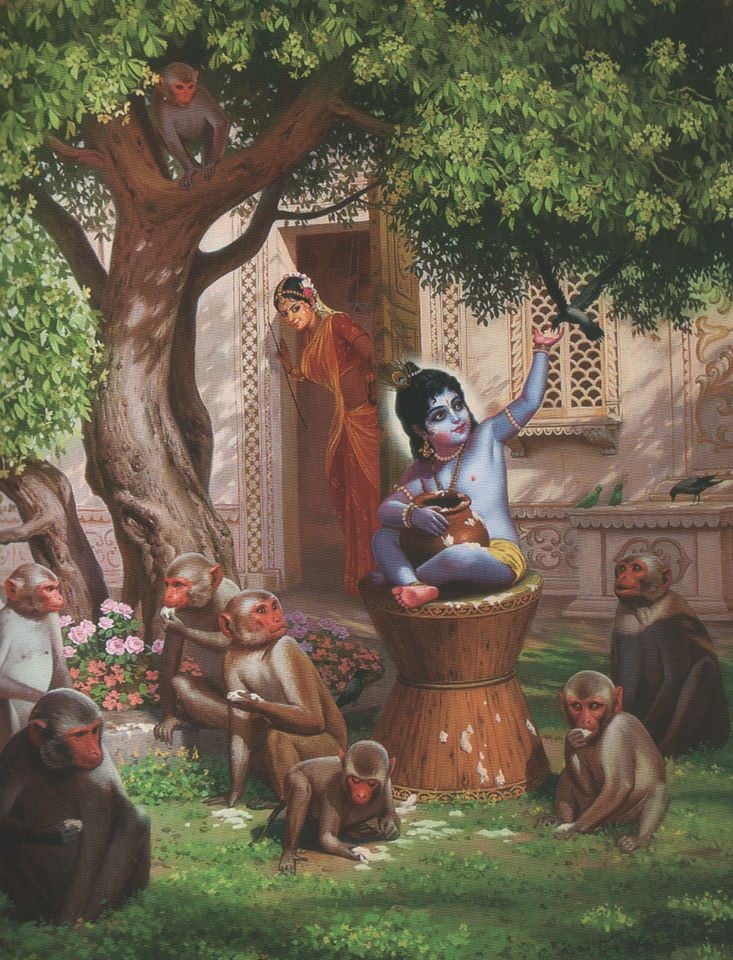
The Mahamantra as a theology of divine relationship
The Hare Krishna Mahamantra is among the most recognizable sacred formulas in the Vaishnava traditions of Hinduism. Its words are simple enough to be remembered after a single hearing, yet its theological interpretations extend into profound reflections on divine love, sacred sound, remembrance, service, and spiritual transformation. In the Gaudiya Vaishnava tradition, the mantra is not treated merely as a sequence of names or as a technique for producing calm. It is approached as a direct invocation of the Divine and of the Divine’s spiritual energy.
The mantra consists of sixteen names arranged in thirty-two syllables:
Hare Krishna Hare Krishna Krishna Krishna Hare Hare
Hare Rama Hare Rama Rama Rama Hare Hare
Its repetition may initially appear uncomplicated, but devotional exegesis finds a complete spiritual drama within its sixteen names. Each occurrence of Hare, Krishna, and Rama can be contemplated as a distinct movement of attraction, separation, reunion, compassion, or bliss. The mantra consequently becomes both prayer and narrative: it calls to the Divine while recalling the loving relationship between Sri Radha and Sri Krishna.
This understanding belongs specifically to the devotional world of Gaudiya Vaishnavism. It should therefore be presented as a theological interpretation rather than as the only possible explanation of the names. Hindu traditions have developed several complementary readings of Rama, Krishna, Hari, and the power of nama, or the sacred name. Recognizing that diversity preserves the plural character of dharmic thought while allowing the distinctive depth of the Radha-Krishna interpretation to be appreciated on its own terms.
Srila Jiva Gosvami and the sixteen-name interpretation
The interpretation presented here is traditionally associated with Srila Jiva Gosvami and a work known as the Mahaa-mantrartha Dipika. Jiva Gosvami was one of the principal theologians of the Gaudiya Vaishnava school and played a major role in systematically articulating its philosophy of bhakti. In this interpretive framework, the mantra’s words do not remain static definitions. Their meanings unfold through Krishna’s pastimes in Vraja and, above all, through the mutual attraction of Radha and Krishna.
The repeated names may sound identical to the ear, but each occupies a different position in the mantra. Devotional interpretation uses that structure to illuminate a new aspect of divine relationship at every step. The resulting explanation is best understood as contemplative theology: scriptural narratives, sacred names, and devotional emotions are brought together so that chanting becomes attentive remembrance rather than mechanical recitation.
1. Hare: Radha as the one who captivates Krishna
Krishna captivates the minds of all beings, yet Sri Radha’s divine love is said to captivate even Him. She is therefore addressed as Haraa. The name expresses a striking theological reversal. The Supreme, who attracts everyone, freely allows Himself to be conquered by devotion. Divine power is thus revealed not only through majesty but also through responsiveness to pure love.
2. Krishna: the all-attractive sound of the flute
Krishna draws Sri Radha through the sweetness of His flute. He is consequently known as Krishna, the one endowed with all-attractive qualities. In Vaishnava poetry, the flute is more than a musical instrument. Its call symbolizes an invitation that reaches beneath ordinary thought and awakens the soul’s desire for relationship with the Divine.
3. Hare: Radha drawn into the secluded rasa-lila
During the rasa-lila, Krishna takes doe-eyed Radha away from the company of the other participants so that they may meet in a secluded forest bower. In this interpretation, She is called Haraa because She is taken away into an intimate exchange with Krishna. The episode emphasizes the singular intensity of Her devotion while remaining part of the sacred symbolic language of Gaudiya theology.
4. Krishna: the meeting of golden and dark complexions
When Krishna and Radha meet in loving pastimes, Her golden hue is poetically described as taking on the darkness of Krishna’s complexion. He is therefore remembered as Krishna. The imagery conveys more than physical color. It represents intimacy so complete that the qualities of lover and beloved seem to enter one another without erasing their individual identities.
5. Krishna: the manifestation of Syama-kunda
To please Sri Radha, Krishna manifests Syama-kunda in Vrndavana and summons the sacred rivers to fill it. He is called Krishna because this extraordinary act arises from His desire to delight Her. Within the sacred geography of Vraja, Syama-kunda is not regarded as an ordinary body of water. It is revered as a visible expression of Krishna’s love and a place where landscape, lila, and remembrance converge.
6. Krishna: the Divine enchanted by Radha’s love
Sri Radha’s unsurpassed love charms Krishna, the performer of wonderful lilas on the banks of the Yamuna. Those grounded in devotional understanding therefore know Him as Krishna. This explanation again places love at the center of divine life. Krishna’s perfection does not make Him emotionally distant; it allows Him to participate fully in reciprocal affection.
7. Hare: Radha’s heartfelt call after Aristasura’s defeat
After Sri Hari defeats the demon Aristasura in Gokula, Radha calls to Him with intense feeling. Her cry steals His mind, and She is therefore called Haraa. The scene highlights the devotional importance of calling the divine name with bhava, or heartfelt spiritual emotion. The transformative element is not vocal volume alone but the love carried by the invocation.
8. Hare: Radha singing the glories of Hari
Filled with ecstatic love, Radha sings of Hari’s activities, sometimes quietly and sometimes aloud. Those familiar with the subtleties of divine sentiment call Her Haraa. Quiet remembrance and public Sankirtana are not presented as rivals here. Both become valid expressions of bhakti when they arise from sincere absorption in the Divine.
9. Hare: the love that makes Krishna release His flute
Krishna becomes so captivated by Sri Radha’s love that His flute falls from His hand. Radha then takes it, desiring loving pastimes with Him in the forest bowers, and is celebrated as Haraa. Because the flute ordinarily represents Krishna’s power to attract, its loss carries a delicate implication: the supreme attractor has Himself been overcome by devotion.
10. Rama: Krishna as the source of loving delight
Krishna enjoys loving pastimes with Radha in forest groves and in the caves of Govardhana. He is therefore called Rama, the one who delights and who participates in divine enjoyment. In this context, Rama refers to Krishna as the source and object of spiritual joy. Other Vaishnava traditions may also understand Rama as Sri Ramachandra or Balarama, demonstrating the name’s rich range of devotional associations.
11. Hare: Radha’s compassion for devotees
Sri Radha is called Haraa because She removes the suffering of Her devotees and continually bestows spiritual happiness. This interpretation expands the mantra beyond the intimate lilas of Vraja and connects it with the practitioner’s own need for grace. Radha is contemplated not only as Krishna’s supreme beloved but also as an accessible source of mercy.
12. Rama: the beauty that immerses devotees in joy
The minds of devotees become immersed in an ocean of spiritual joy while contemplating Krishna’s beautiful dark form. He is therefore known as Rama. The imagery suggests absorption rather than momentary entertainment. Devotional pleasure is understood as a reorientation of consciousness in which attention rests in the remembered presence of the Divine.
13. Rama: joy within the companionship of Radha and Krishna
Radharani is associated with Rama because She enjoys loving pastimes with Acyuta, Krishna, within a secluded forest pavilion. Krishna, always beside Her in this sacred exchange, is likewise known as Rama. The name here points to shared spiritual delight rather than isolated pleasure. Bliss is relational, arising through perfect reciprocity between Radha and Krishna.
14. Rama: the joy of deliverance from the forest fire
When the residents of Gokula cry out in fear of a forest fire, Krishna swallows the flames and restores their happiness. He is therefore called Rama. This meaning introduces the protective dimension of divine joy. Relief, safety, and trust become forms of spiritual happiness when devotees experience the Divine as their refuge amid danger.
15. Hare: Radha’s love drawing Krishna back from Mathurapuri
Sri Krishna departs for Mathurapuri to defeat oppressive forces, but Radha’s love continues to bind His heart to Vraja. In the devotional reading presented by the source tradition, His return demonstrates Her captivating power, and She is therefore known as Haraa. The episode expresses a central mood of Gaudiya devotion: physical separation intensifies remembrance and reveals the enduring force of love.
16. Hare: Hari removes suffering and steals Radha’s heart
When the son of Maharaja Nanda returns to Vraja, He removes the sorrow of the Vrajavasis. Through His extraordinary activities, He also steals the heart of Sri Radha and is therefore known as Hari. The mantra ends with Hare, the vocative form through which Hari or Haraa is invoked. The conclusion gathers together two complementary movements: the Divine removes suffering, and divine beauty draws the heart toward loving remembrance.
The three names at the heart of the Mahamantra
Although the sixteen positions support a detailed contemplative reading, the mantra is formed from only three names: Hare, Krishna, and Rama. Each carries a broad semantic and theological field. Their repetition does not make the mantra empty or redundant. Repetition allows meaning to deepen as attention moves from sound to remembrance, from remembrance to relationship, and from relationship to service.
Hare functions as a direct address. In Gaudiya Vaishnava interpretation, it is commonly understood as the vocative of Haraa, the spiritual energy of the Lord personified as Sri Radha. It can also be related to Hari, a name of Krishna meaning the one who takes away suffering, ignorance, or the heart itself. Chanting Hare is therefore interpreted as an appeal to divine energy and grace: the practitioner asks to be drawn away from self-centered absorption and into loving service.
Krishna names the Supreme Personality of Godhead in the theology of this tradition. Devotional etymology emphasizes His all-attractive character: beauty, knowledge, strength, compassion, fame, wealth, and renunciation are understood to exist in Him without limit. The name consequently directs attention not toward an abstract force but toward a personal Divine reality capable of knowing, attracting, and reciprocating with devotees.
Rama signifies the reservoir or source of spiritual pleasure. The name is connected with delight, repose, and participation in divine joy. In the immediate Radha-Krishna interpretation, it describes Krishna as the one who delights Radha and the devotees. In the wider Vaishnava world, it can simultaneously evoke Sri Ramachandra, the revered hero of the Ramayana, or Balarama, Krishna’s elder brother. These meanings need not be treated as mutually destructive; sacred names often gather several layers of memory within a single sound.
Sacred sound and the presence of the named
A foundational principle of nama-bhakti is that the divine name is not merely an arbitrary label. Ordinary language usually points toward an object that remains separate from its name. Vaishnava theology, however, teaches a non-difference between the purified divine name and the Divine who is named. From this standpoint, chanting is an encounter mediated by sacred sound rather than a conversation about an absent deity.
This claim belongs to the metaphysical framework of the tradition and cannot be reduced to a laboratory proposition. Its significance is experiential and theological. A practitioner is invited to approach the mantra with respect, listen carefully to every name, and observe how sustained remembrance affects attention, conduct, relationships, and the capacity for service.
The sound itself remains important. Philosophical study may clarify why the mantra is chanted, but conceptual analysis cannot substitute for attentive practice. Conversely, repetition without listening can become habitual and distracted. Gaudiya teachers therefore emphasize both understanding and disciplined hearing: the tongue articulates the names, the ear receives them, and the mind is repeatedly brought back whenever it wanders.
Japa and nama-sankirtana
The Mahamantra is commonly practiced through japa and nama-sankirtana. In japa, the mantra is repeated personally, often with prayer beads used to maintain a steady count. The comparatively quiet setting makes distraction easy to notice. Each return to the sound becomes a small exercise in humility, because the practitioner learns that attention cannot simply be commanded once and then taken for granted.
Nama-sankirtana is congregational chanting, frequently supported by melody and instruments. Its communal form demonstrates that devotion need not remain private or solitary. Voices with different pitches, strengths, and levels of training join around the same names. This creates a relatable image of spiritual community: unity is established through shared orientation, not through the erasure of individual distinction.
Quiet japa and public Sankirtana cultivate overlapping but distinct dispositions. Japa encourages careful listening, regularity, and personal accountability. Sankirtana emphasizes participation, mutual encouragement, and the generous sharing of sacred sound. Neither form should be reduced to a performance designed to display musical talent or spiritual status. Their central purpose is remembrance and service.
How the mantra is approached in practice
Traditional guidance encourages chanting with deep feeling, full faith, and firm determination. These qualities should not be confused with forced emotion. Deep feeling may emerge gradually through regular practice, study, ethical conduct, and association with sincere practitioners. Faith can likewise develop as considered trust rather than unexamined credulity, while determination means returning to the practice through both inspiration and dryness.
A simple practice begins by pronouncing each name clearly and listening to the complete mantra. When attention moves toward plans, memories, anxieties, or self-judgment, it is gently returned to the next audible name. The aim is not to wage war against thought but to give the mind a sacred center. Over time, the familiar sequence can become an anchor during joy, uncertainty, grief, or ordinary daily work.
The tradition also warns against treating the mantra as a commercial formula for acquiring wealth, prestige, control, or instant emotional relief. The prayer is fundamentally oriented toward seva, or service. Its deepest petition is not that the world conform to personal desire, but that desire itself be purified and directed toward the good of the Divine and other beings.
Such an orientation gives chanting an ethical dimension. If practice increases contempt, vanity, or indifference to suffering, its purpose has been misunderstood. Attention to the names is expected to support humility, compassion, truthful conduct, patience, and respect. Devotional absorption and responsible life are therefore complementary rather than separate domains.
Radha-Syamasundara within the mantra
Within the Gaudiya understanding, the chanter is encouraged to remember that Radha-Syamasundara are present in the maha-mantra with Their transcendental beauty, qualities, relationships, and pastimes. This remembrance explains why the sixteen-name commentary repeatedly moves between Radha and Krishna. Hare invokes divine energy and compassionate mediation; Krishna invokes the all-attractive Divine; Rama invokes the bliss arising from loving communion.
The theology does not portray Radha as a secondary decorative figure. Her love reveals the highest possibilities of devotion, and Her presence safeguards the relational character of the mantra. The Supreme is not contemplated only as ruler or creator but as one who participates in mutual affection. Radha embodies devotion so complete that even Krishna desires to experience and respond to it.
The forest bowers, the flute, the Yamuna, Govardhana, Syama-kunda, Gokula, and Vraja therefore operate as a sacred imaginative geography. They allow abstract ideas such as grace, intimacy, separation, surrender, and bliss to be contemplated through places and events. For devotees, these are not merely literary ornaments; they belong to the revealed and remembered world of lila. Academic clarity nevertheless requires distinguishing the tradition’s theological affirmations from claims established through modern historical methods.
From repetition to Krishna-prema
The desired culmination of nama-sankirtana is Krishna-prema, pure love for Krishna. This goal is more demanding than a pleasant meditative state. Krishna-prema implies a transformation of motivation in which possessiveness gives way to service, forgetfulness gives way to remembrance, and self-importance gives way to loving dependence on divine grace.
The sixteen-name interpretation traces that transformation through the language of stealing and attraction. Krishna steals the minds of all, Radha steals Krishna’s mind, sacred sound steals the practitioner away from distraction, and divine compassion removes suffering. These images do not celebrate coercion. They poetically describe the voluntary surrender produced by beauty and love.
Chanting may bring moments of peace or joy, but the tradition cautions against measuring spiritual depth by emotional intensity alone. Some sessions may feel concentrated, while others expose restlessness. Both can become instructive. Joy encourages gratitude, and distraction reveals the need for patience, discipline, and grace. The durable sign of practice is a gradual improvement in character and devotion rather than a continuous sequence of dramatic experiences.
A dharmic perspective on unity and diversity
The Mahamantra belongs to a particular Vaishnava lineage, yet several of its practical themes resonate across dharmic traditions. Hindu paths employ mantra, nama, meditation, puja, study, yoga, and seva in diverse combinations. Buddhist traditions cultivate recollection, ethical discipline, compassion, and attentive awareness. Jain traditions emphasize self-restraint, nonviolence, purification, and liberation, while Sikh tradition gives a central place to Naam, remembrance, kirtan, and selfless service. These traditions should not be collapsed into a single system, but their distinctive practices can be discussed with mutual respect.
Unity does not require claiming that every sacred term has precisely the same theological meaning. More durable harmony emerges when differences are represented accurately and practitioners remain open to shared values such as disciplined remembrance, compassion, truthfulness, service, and the transformation of self-centered desire. The Mahamantra can contribute to that conversation as a specifically Gaudiya Vaishnava expression of the wider dharmic conviction that spiritual practice should reshape both consciousness and conduct.
The enduring meaning of the Mahamantra
The Mahamantra’s apparent simplicity is one of its greatest strengths. A child can repeat it, a musician can sing it, a philosopher can analyze it, and a lifelong practitioner can continue discovering meaning within it. Its three names hold a complete devotional movement: an appeal to divine energy, remembrance of the all-attractive Lord, and entry into the reservoir of spiritual joy.
Srila Jiva Gosvami’s sixteen-name interpretation deepens that movement by presenting every name as a distinct window into Radha and Krishna’s relationship. The mantra begins and ends with invocation, while its center repeatedly turns toward attraction and delight. The chanter is thereby invited to move from sound to presence, from presence to service, and from service toward Krishna-prema.
Its most practical teaching is equally profound: sacred repetition becomes transformative when joined with attentive hearing, humility, faith, perseverance, and compassionate action. The Mahamantra is therefore not merely something to be explained. Within its living tradition, it is a path to be practiced, a relationship to be remembered, and a prayer through which the heart is gradually educated in divine love.
Inspired by this post on Dandavats.





Leave a Reply
You must be logged in to post a comment.