
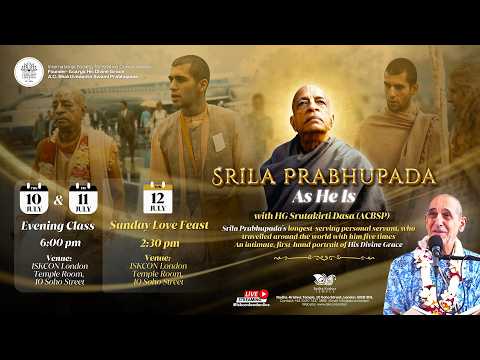

A living witness to an extraordinary spiritual life
“Srila Prabhupada As He Is,” presented as a special evening class by HG Srutakirti Das on 10 July 2026, offers an opportunity to encounter A. C. Bhaktivedanta Swami Prabhupada through the recollections of a disciple who served him at close quarters. The recording was published by the ISKCON London Radha-Krishna Temple, linking a contemporary audience with the formative decades of the Hare Krishna movement and the transmission of Gaudiya Vaishnavism beyond India.
The phrase “As He Is” carries particular significance in this setting. It suggests a portrait grounded not merely in institutional titles or polished biography but in observed conduct: how a spiritual teacher spoke, worked, corrected disciples, received visitors, maintained a demanding routine and responded to ordinary human situations. Such memories can make a historical personality more intelligible without reducing the sacred importance assigned to that personality within a religious tradition.
Srutakirti Das occupies a distinctive position in this history. Accounts of his service record that he became Srila Prabhupada’s personal servant in 1972 and remained in that role for more than two years. His responsibilities placed him near the practical rhythm of Prabhupada’s daily life. This was not proximity for its own sake. Within the guru-shishya tradition, personal service is understood as a disciplined form of learning in which instruction is absorbed through attention, responsibility and repeated contact with a teacher’s example.
Why eyewitness recollections matter
Religious history is preserved through several kinds of evidence: texts, letters, photographs, institutional records, audio recordings and oral testimony. Eyewitness recollections contribute something that formal documents often cannot. They preserve tone, gesture, humour, atmosphere and the moral texture of routine encounters. A schedule may establish that a lecture occurred, while a personal memory may reveal how the teacher treated an anxious disciple immediately before it.
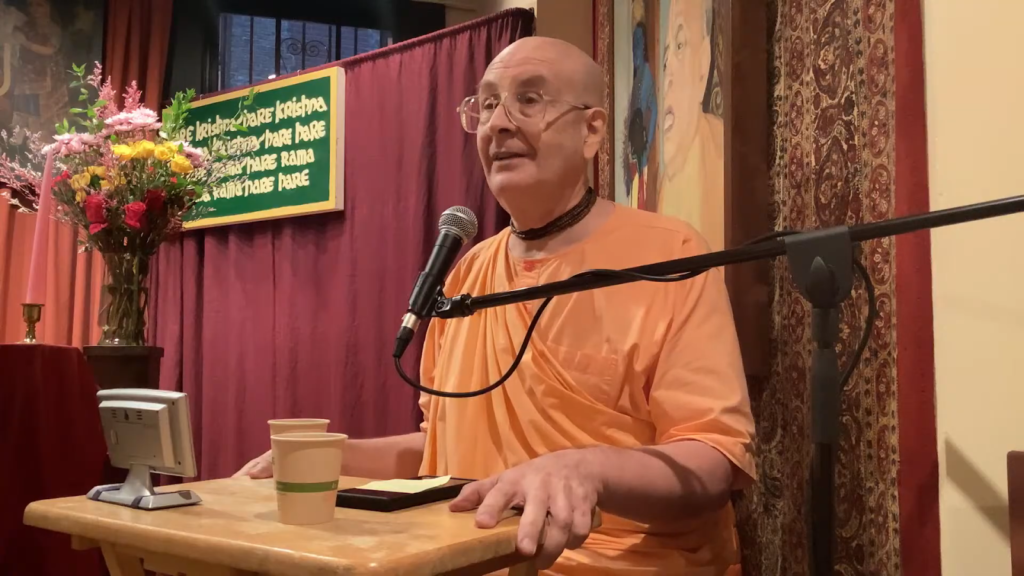
Srutakirti Das’s published reminiscences frequently concentrate on precisely these small encounters. In one early account, he recalled beginning his service with almost no formal training beyond the instruction to respond promptly whenever Prabhupada rang a bell. When the bell sounded, he hurried into the room, only to discover that Prabhupada was testing how quickly he would respond. The episode is remembered for its gentleness and humour, but it also illustrates the technical character of seva: alertness, readiness and responsibility are cultivated through action rather than abstract discussion alone.
Other recollections portray a teacher who combined strict standards with patience. The details matter because they prevent spiritual leadership from being interpreted only through extremes. Discipline need not imply emotional coldness, just as affection need not require the abandonment of standards. A listener may recognize this balance from relationships with parents, teachers or mentors whose most enduring lessons were communicated through consistent conduct.
Eyewitness testimony must nevertheless be approached with intellectual care. Human memory is selective and reconstructive. Later understanding can influence the way an earlier experience is narrated, while devotion can shape the significance assigned to a remembered event. This does not make testimony useless. It means that responsible interpretation compares personal recollections with contemporaneous letters, recorded conversations, published lectures and independent timelines.
The result is a richer form of historical understanding. Devotional memory explains what a relationship meant to the witness; documentary evidence helps establish when and where events occurred; philosophical texts clarify the ideas that governed the participants’ actions. Each source answers a different question, and none should be expected to perform the work of all the others.
Srila Prabhupada in historical context
Srila Prabhupada was born Abhay Charan De in Calcutta in 1896. His meeting with Bhaktisiddhanta Sarasvati in 1922 became decisive because the Gaudiya Vaishnava teacher urged him to communicate the teachings of Krishna in English. After decades of preparation, writing and spiritual practice, Prabhupada travelled aboard the cargo ship Jaladuta in 1965 and arrived in the United States at an age when most people would have been considering retirement rather than the creation of a global religious institution.
In July 1966, he formally established the International Society for Krishna Consciousness in New York City. The official ISKCON history describes how a modest Lower East Side storefront became the starting point for an international movement. During the following eleven years, Prabhupada travelled extensively, established temples and communities, trained disciples and oversaw a rapidly expanding programme of translation and publication.
His literary work remains central to his legacy. Major publications include Bhagavad-gita As It Is, the multi-volume Srimad-Bhagavatam and Sri Caitanya-caritamrita. These works combine Sanskrit or Bengali source passages, transliteration, word-for-word analysis, translation and theological commentary. That structure is technically important: it allows readers to examine the textual basis of an interpretation rather than encountering only an unreferenced modern paraphrase.
Prabhupada’s historical achievement therefore involved more than organizational expansion. It joined textual translation, public teaching, congregational practice, temple worship, community formation and everyday ethical discipline. The movement’s global growth cannot be understood adequately by isolating any one of these elements. Books supplied a doctrinal foundation, kirtan provided a participatory practice, temples created stable communities and personal instruction trained people to carry the tradition into new cultural settings.
The technical meaning of guru, acharya and seva
Within Gaudiya Vaishnavism, a guru is not simply a motivational speaker or a source of private inspiration. The guru transmits a received body of teaching, guides practice and helps the disciple align conduct with spiritual knowledge. The related term acharya emphasizes one who teaches through personal example. These concepts explain why recollections of apparently ordinary behaviour—working, resting, eating, correcting mistakes or receiving guests—carry theological weight for disciples.
Seva, commonly translated as service, is likewise more precise than casual helpfulness. It involves intentional action offered for a sacred purpose and without a demand for personal recognition. Personal service to a spiritual teacher can include practical duties, but its formative purpose is the reorientation of attention. The practitioner gradually learns to replace self-centred calculation with careful responsiveness.
This discipline can be understood through three connected dimensions. The first is external accuracy: a task must actually be completed well. The second is relational awareness: the servant must understand what is needed rather than merely perform a preferred activity. The third is internal intention: service is weakened when it becomes a strategy for prestige, control or proximity to authority. Mature seva therefore requires competence, humility and ethical self-examination.
The model also contains an important safeguard. Reverence should not eliminate moral judgment, historical scrutiny or personal responsibility. A healthy guru-shishya relationship is directed toward truth, disciplined practice and the welfare of the disciple; it is not a licence for manipulation. For contemporary audiences, this distinction is essential whenever traditional structures of spiritual authority are discussed.
Bhakti as a system of practice
Prabhupada presented Krishna consciousness as a form of bhakti-yoga centred on loving devotional service to Krishna. Bhakti is sometimes mistaken for unstructured religious emotion, but classical Vaishnava practice is highly organized. It includes hearing sacred teachings, chanting divine names, remembering Krishna, worship, prayer, service and the cultivation of conduct that supports sustained attention.
Hearing, or shravana, has a foundational role because spiritual understanding is received before it can be critically assimilated or practised. Kirtana includes the vocal recitation and congregational singing of divine names and teachings. Smarana develops remembrance, preventing spiritual ideas from remaining confined to a weekly class. Seva then translates remembrance into concrete conduct. Together, these practices connect cognition, emotion, speech and action.
The Hare Krishna maha-mantra—Hare Krishna, Hare Krishna, Krishna Krishna, Hare Hare / Hare Rama, Hare Rama, Rama Rama, Hare Hare—is central to this discipline. In Gaudiya Vaishnava theology, the chanting is not treated merely as a relaxation technique. It is understood as direct devotional engagement through sacred sound. At the experiential level, regular repetition also demands patience, attentional stability and the willingness to observe the mind’s tendency toward distraction.
Prabhupada’s approach joined this contemplative practice to ethical regulation. Spiritual experience was not presented as a substitute for character. Truthfulness, self-control, compassion, cleanliness and responsibility were treated as conditions that support clarity. This relationship between inner practice and outward behaviour helps explain why eyewitness stories about daily discipline remain valuable to followers: they test whether philosophy was embodied in ordinary life.
Humility without passivity
One of the most striking features of Prabhupada’s life is the coexistence of humility and enormous initiative. He understood himself as serving the instruction of his spiritual master, yet that service produced translations, international journeys, institutions and communities. Humility in this framework does not mean inertia, poor self-respect or fear of responsibility. It means that ability and achievement are not treated as private possessions detached from duty.
This distinction has broad practical relevance. A student can work with determination without believing that academic success establishes personal superiority. A professional can lead decisively without treating colleagues as instruments. A spiritual practitioner can accept correction without collapsing into shame. Humility becomes intellectually serious when it improves perception and action rather than functioning as ceremonial self-deprecation.
Srutakirti Das’s memories are especially effective in illuminating this point because personal service exposed both aspiration and inadequacy. Mistakes were not romanticized, yet they could become material for learning. Viewers may find emotional reassurance in that pattern. Spiritual development is rarely a straight progression from ignorance to perfection; it is more often a disciplined cycle of attention, error, correction and renewed service.
Leadership through consistency
Prabhupada’s public role required the simultaneous management of teaching, writing, travel, correspondence and institutional decisions. Personal testimony adds another level to this record by asking whether public principles remained visible in private settings. The credibility of spiritual leadership depends partly on this continuity. A leader who advocates simplicity but privately demands luxury creates a contradiction; one who maintains a consistent discipline gives practical force to the teaching.
Consistency should not be confused with inflexibility. Effective teaching requires the ability to respond to different levels of understanding while preserving the core of a tradition. Prabhupada communicated through books, formal lectures, informal conversations, music, food, festivals and personal guidance. The medium changed according to circumstances, while the central emphasis on devotion to Krishna remained stable.
This combination of fidelity and adaptation is one reason the history remains relevant to the study of religion in a global age. A tradition entering a new language and culture faces several risks: excessive accommodation may dissolve its identity, whereas rigid transplantation may make it socially unintelligible. Prabhupada’s work can be studied as an attempt to preserve a defined theological centre while creating accessible forms of participation.
Dharmic unity without erasing difference
Gaudiya Vaishnavism has its own theology, scriptures, lineage and devotional vocabulary. Respectful dialogue does not require those distinctions to be blurred. Hindu, Buddhist, Jain and Sikh traditions differ on significant questions concerning the self, ultimate reality, liberation, divine personhood and scriptural authority. Unity becomes durable when it is based on informed respect rather than the inaccurate claim that every tradition says exactly the same thing.
At the same time, these dharmic traditions provide substantial grounds for constructive solidarity. They have developed rigorous practices of ethical restraint, contemplation, compassion, disciplined learning and service. Ahimsa receives different formulations across traditions, but the shared concern with reducing harmful conduct remains important. Likewise, the training of attention appears in distinct theological and philosophical forms while challenging the same human tendencies toward distraction, anger and compulsive desire.
The ISKCON interfaith framework affirms respect for traditions and cultures that cultivate charity, nonviolence, spiritual education, humility, tolerance, compassion and integrity. This offers an appropriate context for the present video. Appreciation for Srila Prabhupada need not depend on hostility toward another dharmic path. It can instead encourage deeper study, more disciplined conduct and a stronger commitment to peaceful cooperation.
How to watch the class critically and receptively
The class rewards more than passive viewing. A careful listener can distinguish among several layers of material: direct recollection, interpretation of an event, theological explanation and practical application. Keeping these layers separate does not diminish devotion. It helps viewers understand exactly what kind of claim is being made and what evidence would be appropriate for evaluating it.
When a specific historical episode is described, the date, location and participants can be noted for comparison with archival sources. When a spiritual lesson is drawn from that episode, the listener can ask how the lesson relates to Prabhupada’s published teachings. When an emotional response arises, it can be acknowledged without being mistaken for proof. This approach brings devotion and disciplined inquiry into a productive relationship.
Viewers may also listen for the qualities revealed through apparently minor details. Does an account illustrate patience, clarity, humour, courage, compassion or careful use of time? How did correction occur? What made service difficult? Which habits transformed a philosophical ideal into a daily practice? These questions turn biography into a resource for ethical reflection.
A second viewing can focus on application. One lesson may be translated into a specific practice: listening without interruption, completing a neglected responsibility, establishing a regular period of mantra meditation, studying a primary text or offering practical service without seeking praise. The value of a spiritual memory is not exhausted by admiration; it becomes most effective when it alters attention and conduct.
The enduring value of “as he is”
Srila Prabhupada’s global legacy is visible in institutions, publications and communities, but institutional scale alone cannot explain why disciples experienced his presence as transformative. Personal recollections help recover the relational dimension of that history. They show how a large mission was carried through countless acts of teaching, listening, correction, writing, travelling and service.
Srutakirti Das’s perspective is valuable precisely because it emerged from service rather than distant observation. It does not replace Prabhupada’s books, recorded lectures or historical documentation. It supplies a complementary form of evidence: the remembered experience of watching principles become behaviour. Read responsibly, that testimony brings emotional immediacy to the study of Gaudiya Vaishnavism while preserving the need for factual care.
The deepest benefit of the class lies in its invitation to look beyond a simplified image of spiritual greatness. A spiritual teacher’s influence is not confined to dramatic public achievements. It is also communicated through consistency, attention, disciplined work, compassionate correction and the capacity to direct ordinary life toward a sacred purpose. That understanding makes the video relevant not only to established members of ISKCON but to anyone studying spiritual leadership, guru-shishya tradition, bhakti-yoga or the demanding relationship between conviction and conduct.
Inspired by this post on Dandavats.







Leave a Reply
You must be logged in to post a comment.