
A profile, a rebuttal and a battle over credibility
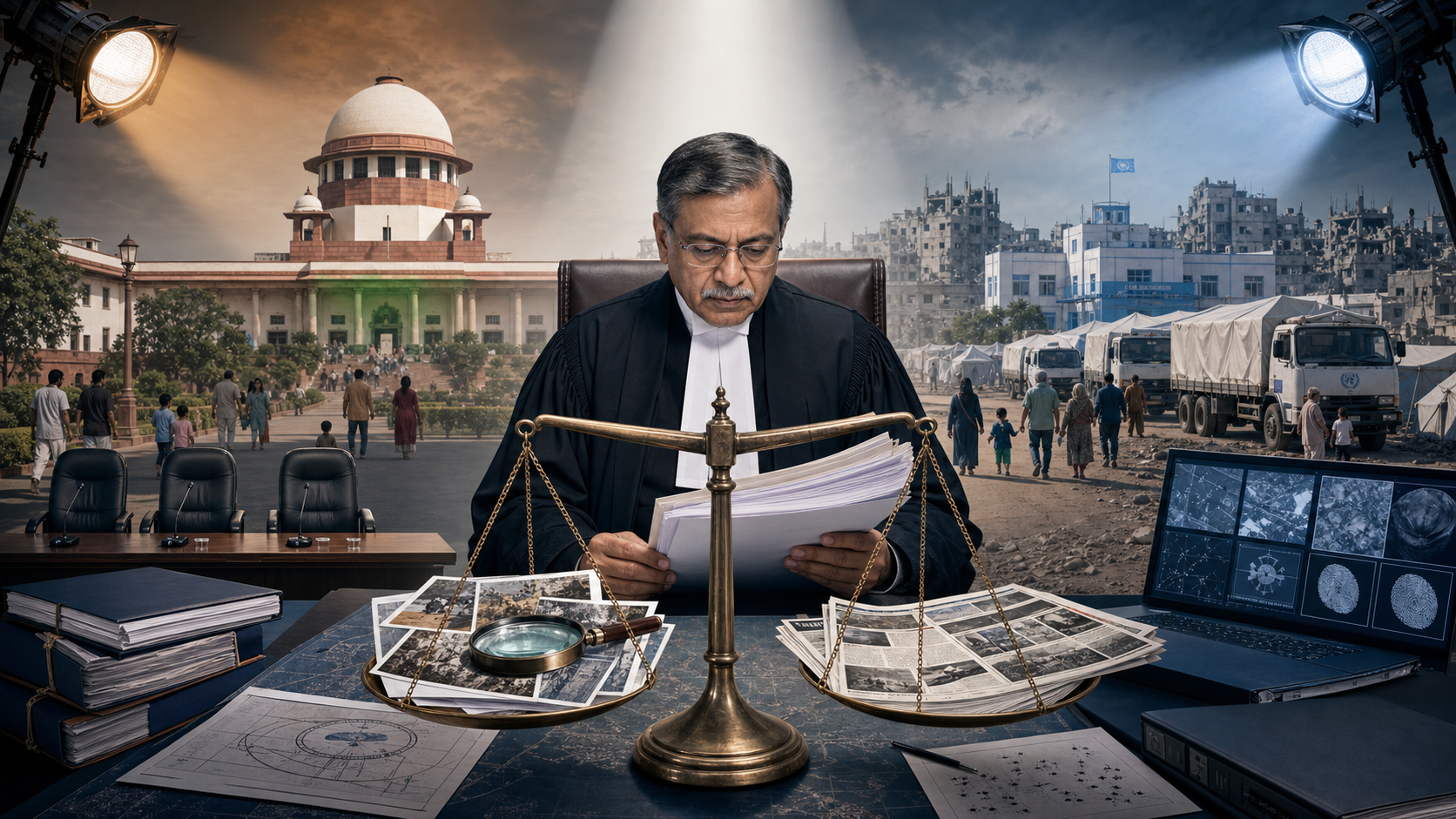
The controversy surrounding Justice S. Muralidhar and the United Nations inquiry on Gaza illustrates how quickly a legal document can become material for competing political narratives. A July 2026 The News Minute “Let Me Explain” profile portrayed the retired judge as a distinguished constitutional jurist whose Indian career prepared him to lead an investigation into grave violations against Palestinian children. In response, The Commune argued that the profile omitted ideological and institutional questions that might complicate this heroic presentation.
The criticism of The News Minute contains an important journalistic insight: a profile can mislead without inventing facts if it selects only flattering episodes, assigns motives without adequate evidence and fails to present serious objections to the institution being celebrated. Yet the rebuttal creates its own evidentiary problem when it treats liberal or rights-oriented legal positions as proof of personal bias, describes disputed inferences as established facts and attributes a three-member commission’s findings almost entirely to its chair. A rigorous assessment therefore has to separate four distinct questions: what Justice Muralidhar actually did, how The News Minute framed his record, how the UN Commission reached its conclusions, and whether contrary evidence received fair consideration.
This distinction matters emotionally as well as intellectually. Reports involving dead, injured or abducted children naturally produce moral urgency. That urgency should deepen scrutiny rather than suspend it. Palestinian children harmed in Gaza and the West Bank, Israeli children murdered or abducted on 7 October 2023, and families living with permanent trauma must not be reduced to props in a contest between media brands, political camps or national loyalties.
What The News Minute’s profile actually does
The News Minute begins with the UN inquiry’s most disturbing findings and then constructs a biographical explanation for Justice Muralidhar’s appointment. It highlights the Naz Foundation decision concerning Section 377, the convictions arising from the 1984 anti-Sikh violence and the Hashimpura massacre, litigation over judicial asset disclosure, welfare and housing cases, and the urgent proceedings held during the 2020 Delhi violence. This selection presents a coherent public image: a judge associated with constitutional rights, institutional accountability and remedies for people with limited political power.
Many of these events are genuine and significant. The Delhi High Court’s official biography records that Muralidhar worked with the Supreme Court Legal Services Committee, represented victims of the Bhopal gas disaster and people displaced by the Narmada dams, served as counsel for the National Human Rights Commission and the Election Commission, and became a Delhi High Court judge in 2006. He later served in the Punjab and Haryana High Court, became Chief Justice of the Orissa High Court and retired in 2023.
The difficulty lies less in the cases selected than in the certainty of the surrounding narrative. The News Minute calls his transfer “unceremonious,” connects its implementation to his questioning of the Delhi Police, suggests that India denied him the respect he deserved, and treats his UN role as a form of professional vindication. These are interpretations, not self-proving facts. The presentation also calls him the “driving force” behind the Gaza report, language that obscures the Commission’s collective authorship, investigative staff and previously established institutional mandate.
There is also a clear factual correction. The profile states that Muralidhar was appointed to chair the Commission in 2024. The official UN announcement says that he, Florence Mumba and Chris Sidoti were appointed on 27 November 2025, with Muralidhar serving as chair. The error does not decide the larger debate, but it is material in a video presented as an explanatory account.
The 2020 transfer: documented chronology versus inferred motive
The transfer controversy requires unusually careful chronology. The Supreme Court Collegium’s published statement confirms that it recommended Muralidhar’s transfer from the Delhi High Court to the Punjab and Haryana High Court on 12 February 2020. The Union government issued the transfer notification on 26 February, the same date on which a bench involving Muralidhar questioned the police response to inflammatory speeches and communal violence in Delhi. The Department of Justice subsequently published a corrigendum, and the Delhi High Court records that he assumed office in Chandigarh on 6 March 2020.
These facts support two conclusions, neither of which should be exaggerated. First, the transfer recommendation predated the February 2020 hearing, so it was not conceived overnight in response to that proceeding. Second, the timing of the government’s notification understandably generated questions because implementation followed the hearing with striking immediacy. The public record establishes sequence, but sequence alone does not prove retaliatory intent.
The News Minute presents the episode in a manner that encourages viewers to infer persecution. The Commune moves to the opposite extreme by describing the transfer as “accountability.” That characterization is also unsupported by the published Collegium resolution, which gives no disciplinary reason. A factually responsible formulation would acknowledge the earlier recommendation, the controversial timing, later testimony from retired members of the judiciary and the absence of a publicly available institutional record conclusively establishing why the transfer was sought or implemented when it was.
Similar caution applies to claims about elevation to the Supreme Court. There is no cited public Collegium resolution showing that Muralidhar was formally selected for elevation and then rejected specifically because of his ideology. Nor is there public evidence proving The Commune’s suggestion that the judiciary concluded he was ideologically unsuitable. The opacity of the appointments system permits speculation, but opacity cannot convert speculation into fact.
The Gautam Navlakha order and the difference between procedure and exoneration
The Commune places considerable weight on a 2018 Delhi High Court order involving Gautam Navlakha, who had been arrested in connection with the Bhima Koregaon investigation. A bench involving Muralidhar quashed the transit-remand order because constitutional and statutory arrest requirements had not been satisfied. The subsequent Supreme Court record confirms that Navlakha had challenged the transit remand through a habeas corpus petition.
Quashing a defective remand is not an acquittal, a declaration of innocence or judicial approval of an accused person’s politics. Transit remand concerns the lawful movement and custody of an arrested person before production in the competent court. Requirements involving the grounds of arrest, access to relevant documents, legal representation and production before a magistrate remain operative even when allegations concern terrorism or national security. Treating enforcement of those safeguards as proof that a judge “protected” a political ally assumes the very motive that must first be demonstrated.
This does not place such an order beyond criticism. Commentators may examine whether the bench applied procedural law too strictly, misunderstood the record or granted an inappropriate remedy. The technically relevant questions concern the statutory text, the material supplied to the magistrate and the governing standard of review. The political identity of the accused cannot substitute for that analysis.
Post-retirement views do reveal a philosophy—but not automatic disqualification
Muralidhar’s public interventions provide legitimate material for understanding his constitutional philosophy. In 2025, he described state anti-conversion laws as “anti-choice” and argued that notice, disclosure and burden-shifting provisions can intrude upon privacy and freedom of conscience. That position can be challenged from a dharmic and public-policy perspective. Supporters of such statutes argue that fraud, coercion, material inducement and organized pressure are real problems, particularly among economically vulnerable and tribal communities.
A serious analysis, however, must compare the actual provisions of each state law. It should distinguish voluntary conversion from conversion obtained by force or fraud, examine who bears the burden of proof, evaluate mandatory notice requirements, and consider Article 25’s protection of conscience alongside its public-order limitations. Describing Muralidhar’s position as missionary propaganda may express political disagreement, but it does not answer these constitutional questions or establish that his conclusions about Gaza were predetermined.
His comments on the Ayodhya judgment likewise belong to a continuing legal debate. He questioned the relationship between the Supreme Court’s findings about unlawful acts and its use of Article 142 to fashion “complete justice.” That criticism may be considered unpersuasive, and defenders of the unanimous judgment argue that Article 142 was properly used to resolve an exceptional title dispute and provide relief. Yet criticism of a Supreme Court judgment is neither an attempt to reopen the dispute nor evidence of hostility to Hindus. Constitutional judgments remain legitimate subjects of scholarly evaluation after they become binding law.
In a 2021 lecture, Muralidhar also said that the contributions of left-wing lawyers to Indian constitutional law had not been documented adequately. The fuller context is important: he argued that different legal ideologies should coexist and enrich constitutional development. The remark supports the conclusion that he regards left-oriented legal work sympathetically. It does not, by itself, prove membership in a political organization, allegiance to a party or inability to assess evidence.
The broader methodological point is decisive. Judicial ideology can influence which rights, precedents and institutional dangers a jurist emphasizes. It is therefore fair to study patterns across judgments and speeches. But ideological classification is an inference, not a substitute for identifying factual errors in a particular report. A conservative jurist is not discredited merely by conservative reasoning, and a liberal jurist is not discredited merely by liberal reasoning. The analysis must return to evidence, legal standards and transparent treatment of contrary material.
What the UN Commission is—and what it is not
The Independent International Commission of Inquiry was created by Human Rights Council Resolution S-30/1 in May 2021. Its mandate covers alleged violations of international humanitarian law and international human rights law in Israel and the Occupied Palestinian Territory from 13 April 2021 onward, as well as underlying causes of recurrent conflict. The mechanism is continuing rather than limited to a single incident. The official voting record shows that the resolution passed by 24 votes to nine, with 14 abstentions; India abstained.
That history supplies a legitimate basis for institutional criticism. The United Kingdom, for example, has objected to the Commission’s open-ended nature and broadly framed mandate, arguing that the Human Rights Council places disproportionate attention on Israel. Such objections are more substantial than an ad hominem claim about a commissioner because they address mandate design, comparative treatment, duration and governance.
At the same time, it is inaccurate to imply that the Commission is simply Muralidhar’s personal tribunal. The three commissioners were appointed to an institution created four years before his arrival. Reports draw upon investigators, lawyers, analysts, forensic specialists, witnesses and previously accumulated material. The chair presents findings and carries influence, but the resulting document is institutionally attributed to the Commission.
A commission of inquiry is also not a criminal court. It does not conduct a trial, determine individual criminal guilt beyond reasonable doubt or issue a binding conviction. Its June 2026 conference-room paper repeatedly uses the investigatory formulation “reasonable grounds to conclude.” That standard is consequential and may inform accountability processes, but it must not be reported as though a court has delivered a final judgment after adversarial testing of evidence.
What the June 2026 report says
The Commission’s paper, A/HRC/62/CRP.2, covers alleged violations against Palestinian children between 7 October 2023 and 31 March 2026, with particular attention to Gaza. The official text and summary report at least 20,179 children killed and 44,143 injured. The paper examines direct shootings, explosive weapons in populated areas, detention, alleged torture and sexual violence, attacks affecting health and education, displacement, malnutrition, family separation and long-term psychological injury.
The report reaches grave conclusions. It says that investigators found a pattern in which Palestinian children were directly targeted in circumstances where they posed no threat. It identifies particular military formations that may bear responsibility for specified incidents and concludes on “reasonable grounds” that acts against children formed part of a deliberate strategy to destroy the future of Palestinians in Gaza. These are findings of the Commission, not neutral facts immune from dispute, and responsible reporting should preserve that attribution.
The methodology is more developed than the phrase “UN narrative” suggests. The Commission says it collected and verified thousands of open-source items, conducted remote and in-person interviews, consulted healthcare workers, journalists, lawyers and academics, and reviewed medical reports, X-rays, CT scans, photographs, videos and audio statements. Two independent forensic pathologists assessed evidence. Digital material was reportedly subjected to authentication, geolocation, chrono-location, metadata extraction, cross-referencing and, where relevant, facial recognition. The Commission also describes consent and “do no harm” procedures for interviews involving children.
These methods do not guarantee correct conclusions. Remote investigation creates limitations; confidential source files restrict outside replication; casualty classifications can change; digital evidence can be incomplete; and the inference of specific intent demands especially careful reasoning. Nevertheless, criticism must engage with these procedures rather than assume that the chair wrote a political conclusion first and collected material afterward.
The report says the Commission sent 13 requests for information or access to Israel, four to the State of Palestine and one to Gaza’s Ministry of Health. It states that Israel did not respond to those requests, while Palestinian authorities supplied information. Israel’s lack of cooperation may have constrained the inquiry’s access to operational evidence, intelligence, targeting decisions and military investigations. It also creates an analytical tension: the Commission was required to assess allegations without the participation of the state whose conduct formed the principal subject of the paper.
Israel’s response and the missing adversarial dimension
Israel formally rejects the Commission’s legitimacy and conclusions. In a 14 June 2026 response published by its Ministry of Foreign Affairs, Israel challenged the Commission’s composition, mandate and methodology and alleged errors and omissions in the draft paper. Israeli statements argue that UN investigations insufficiently account for Hamas’s use of civilian areas and infrastructure, problems in Gaza casualty data, the operational information available to commanders, precautions taken by the Israel Defense Forces, and crimes against Israeli children.
These objections deserved meaningful treatment in The News Minute’s explainer. A profile that announces a report “stacked with evidence” should tell viewers what evidence the accused state says is missing, whether investigators requested it, why it was not supplied, and how non-cooperation affected confidence in particular findings. Without that discussion, the video moves from biography to endorsement too easily.
Israel’s criticism must also be tested against the report rather than repeated uncritically. Paragraphs 4 and 5 of the UN paper explicitly refer to earlier Commission findings concerning Israeli children. Those earlier investigations concluded that Hamas and other Palestinian armed groups committed war crimes and crimes against humanity, killed and injured children, abducted children, mistreated hostages and used images of vulnerable captives for propaganda. The June 2026 paper’s central focus on Palestinian children can be criticized as asymmetrical framing, but it is not accurate to say the Commission’s broader work erased Hamas’s crimes altogether.
The strongest institutional question is therefore narrower and more technical: whether earlier treatment of crimes against Israelis adequately balances a continuing mechanism whose mandate, reporting volume and current recommendations concentrate heavily on Israeli conduct. That question can be debated by comparing reports, evidentiary thresholds, legal characterizations and recommendations. It cannot be resolved merely by calling the UN anti-Israel or by treating every institutional finding as conclusive.
Where The News Minute’s account falls short
The News Minute’s profile is selective in at least six material respects. It gives little attention to criticism of the Commission’s continuing mandate; does not seriously explain Israel’s formal response; blurs a commission of inquiry’s “reasonable grounds” standard with judicial adjudication; attributes collective findings disproportionately to Muralidhar; presents disputed interpretations of his transfer and non-elevation with considerable certainty; and incorrectly dates his UN appointment to 2024.
The video also uses emotionally affirmative language at moments when attribution and qualification are needed. Phrases suggesting that the government denied him deserved respect or that the UN role proves the value India failed to recognize transform an explainer into a redemptive biography. The result is not necessarily false in every particular, but it is incomplete as an account of a contested international investigation.
Where The Commune’s rebuttal overreaches
The Commune correctly identifies the profile’s celebratory structure, but its own language repeatedly exceeds the available evidence. It describes Muralidhar as a judge “with an agenda,” claims he is using the UN to rehabilitate his image, interprets procedural protection in the Navlakha case as ideological assistance, and presents disagreement with anti-conversion laws and the Ayodhya reasoning as proof that his Gaza work cannot be impartial. None of those conclusions follows automatically from the facts cited.
The assertion that the government’s pursuit of his transfer represented “accountability” is particularly weak because no public transfer record supplies that rationale. The suggestion that his non-elevation proves judicial recognition of ideological unsuitability is likewise speculative. These claims mirror the same causal storytelling criticized in The News Minute: ambiguous institutional events are arranged into a morally satisfying narrative and then presented as though their motives were known.
The claim that the Gaza paper is the “predictable output” of one judge also understates the Commission’s pre-existing mandate, collective membership and documented methodology. A persuasive rebuttal would identify mistranslated evidence, unreliable casualty categories, flawed forensic reasoning, missing exculpatory material, incorrect legal tests or inconsistent treatment of comparable conduct. Biographical ideology may justify heightened scrutiny, but it cannot perform that evidentiary work.
A better technical framework for evaluating media bias
A fair media analysis should begin with selection. Which judgments and speeches were included, which were omitted, and would the omitted material materially alter the audience’s understanding? The News Minute selected rights-expanding and accountability-oriented decisions. The Commune selected episodes likely to appear progressive, anti-government or critical of Hindu concerns. Each selection reveals editorial purpose, but neither collection alone proves the total character of a long judicial career.
The second test is attribution. Claims by the Commission should be identified as Commission findings; Israeli objections should be identified as the state’s position; testimony from retired judges should be distinguished from published Collegium records; and commentary about ideology should be marked as interpretation. Removing these labels causes allegations, findings and facts to collapse into one another.
The third test is evidentiary symmetry. Symmetry does not require pretending that every party caused identical harm. It requires applying comparable standards of sourcing, corroboration, legal characterization and skepticism to all parties. Crimes by Hamas do not excuse unlawful Israeli conduct, and alleged Israeli violations do not diminish the murder, injury and abduction of Israeli civilians. Each allegation must be assessed independently under the applicable law.
The fourth test is correction. The mistaken date of Muralidhar’s appointment, the transfer chronology and the Commission’s actual treatment of crimes against Israeli children are all verifiable matters. Correcting such points is more valuable than escalating adjectives because it gives readers a stable factual foundation from which to assess disputed motives and conclusions.
The fifth test is institutional analysis. Questions about an open-ended mandate, voting history, access restrictions, non-cooperation, confidential evidence and the “reasonable grounds” threshold are more probative than political labels. They reveal how the inquiry was designed, what information it could obtain and what its conclusions can legally establish.
Pluralism, dharmic responsibility and the discipline of restraint
A pluralistic public sphere benefits from examining ideological influence without turning ideological disagreement into personal delegitimization. Hindu, Buddhist, Jain and Sikh traditions contain varied approaches to justice, state power, non-violence, duty and protection of the vulnerable. Their unity is strengthened by a shared commitment to truthfulness, disciplined inquiry and human dignity—not by suppressing difficult evidence or assigning collective guilt.
That principle permits simultaneous concern for religious freedom in Bharat, skepticism toward coercive conversion, scrutiny of judicial power, recognition of Israel’s security obligations, condemnation of Hamas’s atrocities and serious engagement with evidence of harm to Palestinian civilians. These positions are not mutually exclusive. Intellectual consistency requires that children, minorities and victims be protected regardless of which political narrative benefits from their suffering.
Conclusion: an incomplete profile answered by an incomplete prosecution
The News Minute’s presentation is best understood as an admiring profile rather than a comprehensive examination of Justice Muralidhar or the UN Commission. It foregrounds achievements, minimizes institutional objections and transforms disputed episodes into a story of persecution followed by international vindication. The omissions are substantial enough to justify criticism of its media framing.
The Commune’s response, however, does not establish that Muralidhar manipulated the inquiry, used it to rehabilitate himself or produced conclusions dictated by personal ideology. It raises legitimate questions about selection, political sympathy and UN institutional credibility, but weakens them through speculation and motive attribution. A stronger critique would examine the Commission’s evidence incident by incident, compare its legal standards across parties, test Israel’s rebuttal and distinguish demonstrable error from ideological disagreement.
The most defensible conclusion is therefore more demanding than either media narrative. Justice Muralidhar’s public record reflects a recognizable rights-oriented constitutional outlook. The News Minute presented that outlook as uncomplicated heroism. The UN inquiry’s findings remain grave and evidence-based claims produced under an investigatory standard, not final criminal adjudications. Israel’s objections and the Commission’s institutional limitations require serious examination, but neither political labeling nor biographical suspicion can replace engagement with the underlying evidence.
Inspired by this post on Hindu Post.










Leave a Reply
You must be logged in to post a comment.