
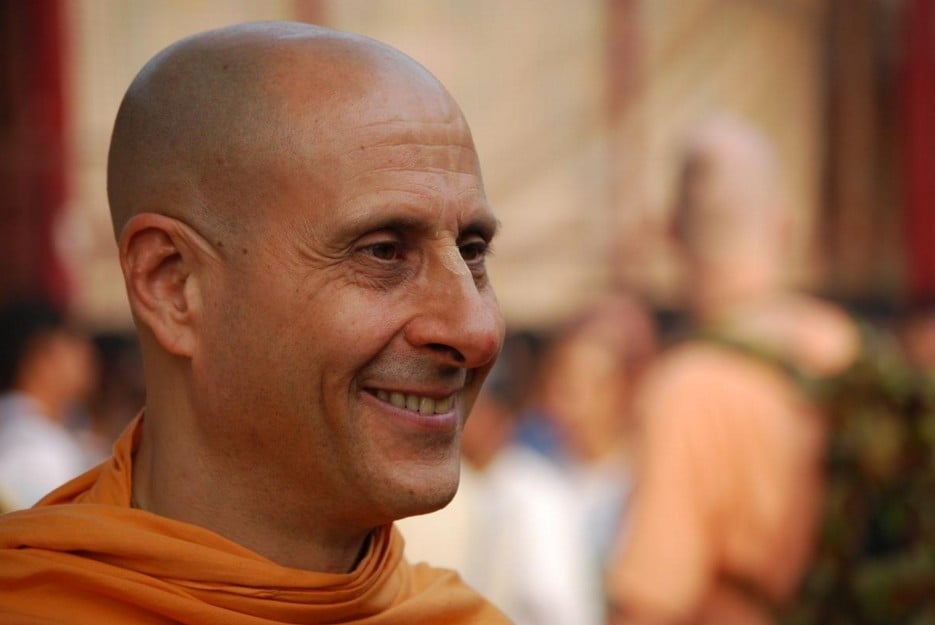
A spiritual encounter recounted by Radhanath Swami
On a sweltering summer morning in the Florida panhandle, an ordinary flight delay became the setting for an extraordinary study of grief, moral judgment, spiritual identity, and the human search for meaning. Heat pressed against the expansive windows of the departure lounge while passengers checked their watches, rearranged connecting flights, and waited for information. A young airline employee, dressed in a blue vest over a pressed white shirt, approached the counter and announced that the flight would be delayed for an hour because the aircraft’s air-conditioning system had failed.
Most passengers responded with weary resignation. One woman did not. Her name, as she later disclosed, was Dorothy. She appeared to be in her late middle age, with carefully arranged reddish-brown hair and clothing that suggested refinement and material comfort. When she heard the announcement, however, her composure collapsed. She threw down her boarding pass, confronted the employee, and demanded immediate passage. Her language became insulting, her gestures aggressive, and her distress so public that the entire lounge turned to watch.
At first sight, Dorothy appeared entitled and abusive. That impression was understandable, but radically incomplete. The episode illustrates a central problem in human perception: behavior is visible, while the suffering that produces it often remains concealed. Anger may be morally unacceptable in expression and still be psychologically intelligible in origin. Acute fear narrows attention, intensifies threat perception, and can transform a manageable inconvenience into evidence that the world has become uncontrollable. None of this excuses verbal aggression toward an airline employee, but it does explain why compassionate inquiry can reveal more than immediate condemnation.
Radhanath Swami was sitting alone in a corner of the lounge, dressed in saffron robes after an exhausting week of lectures and meetings. When Dorothy noticed him, she approached and demanded to know whether he was a monk. He quietly answered that he was “something like that.” She then presented the question beneath her anger: “Why is my flight late? Why is God doing this to me?”
The question was not really about aircraft maintenance. It was an expression of protest against suffering itself. Dorothy was asking why an apparently meaningful moral order had failed her and whether the divine could remain good in a world that had become unbearable. The technical term for this problem is theodicy: the attempt to understand how suffering can exist if ultimate reality is governed by goodness, justice, or divine compassion. Yet Dorothy did not need an abstract debate. She needed someone willing to hear what had happened to her.
Radhanath Swami invited her to sit and asked a simple pastoral question: what was in her heart? The effect was immediate. Dorothy began to weep. She said that she was fifty-seven years old and had once lived happily with her family on the East Coast. According to her account, she had then lost her husband of thirty years and all three of her children. Financial betrayal followed bereavement: her home went into foreclosure, she was displaced, and the handbag she carried contained nearly everything she still possessed.
Her crisis was also medical. Dorothy reported that she had terminal cancer and had been told that she might have only a month to live. She was traveling to a clinic in Mexico that had suggested the possibility of treatment, and she believed admission had to occur that day. Missing her connection in Washington, D.C., therefore appeared to mean losing her final opportunity for survival. The clinic’s claims and Dorothy’s prognosis cannot be evaluated from the remembered conversation, and the story should not be treated as medical evidence or an endorsement of an unverified cancer treatment. Its significance lies in the psychological and spiritual encounter that followed.
The suffering concealed beneath anger
Dorothy’s carefully maintained exterior now looked different. Her face was pale, her eyebrows tense, and her mouth marked by exhaustion. The same behavior that had seemed like arrogance could now be seen as a desperate attempt to exert control after repeated experiences of helplessness. She believed that she had tried to live honorably as a wife, mother, churchgoer, and charitable person, yet everything she valued had been taken from her. Her delayed flight seemed to confirm a terrifying conclusion: no one cared whether she lived or died.
The change in understanding also changed the emotional quality of the encounter. Minutes earlier, Radhanath Swami had wanted to avoid Dorothy. Once her history became visible, judgment gave way to sympathy. She noticed tears in his eyes and said, “It seems maybe you care.” That observation became the first turning point. No philosophical doctrine had yet been accepted, no practical crisis had been solved, and no flight had departed. Nevertheless, the experience of being heard had begun to reduce her isolation.
This is one of the most important principles of spiritual care. Presence precedes explanation. A person facing grief, trauma, or death rarely benefits from being treated as an intellectual problem to be solved. Care begins through attention, truthful acknowledgment, and respect for the sufferer’s dignity. It does not require pretending that pain is pleasant or that every tragedy has an easily identifiable purpose. It requires refusing to let suffering erase the person beneath it.
Radhanath Swami told Dorothy that she was a special soul. She initially rejected the phrase because her circumstances made her feel disposable. Yet she also recognized that it had been spoken sincerely. The statement did not deny her losses; it challenged the conclusion she had drawn from them. A person’s worth, in the Bhakti framework, is not determined by wealth, social usefulness, physical health, or the length of remaining life. Dignity belongs to the conscious being and therefore survives changes in circumstance.
He then distinguished between events and responses. Dorothy could not reverse bereavement, foreclosure, or illness by force of thought. She retained, however, some agency over how she would meet the present moment. This distinction must be handled carefully. It does not mean that grief, clinical depression, or trauma can be eliminated by choosing gratitude, nor does it transfer responsibility for injustice to its victims. It means that even under severe constraint, a person may retain a limited but morally significant capacity to direct attention, seek support, and choose the values by which the next action will be shaped.
Fear of death and the question of identity
Dorothy’s anger eventually gave way to a more vulnerable admission: she was afraid of dying. She asked what death meant. Radhanath Swami responded that death could not be examined without first asking what it means to be alive. He therefore posed a foundational question: “Who are you?”
Dorothy answered with her name and nationality. Those answers were socially valid, but the inquiry went deeper. She had existed before receiving the name Dorothy. Her body had changed continuously from infancy to adulthood, as had her desires, memories, intellectual capacities, and social roles. She could look at a childhood photograph and truthfully say, “That is me,” even though almost every observable feature had changed. What, then, supplied continuity across those transformations?
Within Vedantic and Bhakti philosophy, the answer is the conscious self, commonly described as atman or soul. The body and mind are instruments through which experience is organized, but the self is presented as the enduring subject that undergoes those experiences. The Bhagavad Gita develops this analysis in several stages. Bhagavad Gita 2.13 compares bodily change across childhood, youth, and old age with the transition associated with death. Bhagavad Gita 2.20 describes the self as unborn and undying, while 2.22 compares the exchange of bodies to replacing worn garments.
These passages express a theological and metaphysical position rather than a conclusion established by laboratory measurement. Academic accuracy requires preserving that distinction. Neuroscience can investigate correlations among consciousness, cognition, and brain activity, but the philosophical question of whether consciousness is entirely produced by matter remains debated. Bhakti begins from the conviction that consciousness belongs fundamentally to the soul and is expressed through the embodied mind and senses.
Radhanath Swami used the traditional analogy of a vehicle and its driver. Eyes, ears, tongue, nose, nervous system, and brain provide channels of perception and processing, just as a vehicle supplies mechanisms for movement. The conscious person is compared to the one who receives, interprets, and directs those functions. Like every analogy, this has limits: a living body is far more intimately related to consciousness than a driver is to a car. Its purpose is not to provide a biological model but to distinguish the experiencer from the changing instruments of experience.
For Dorothy, the distinction had existential importance. If identity were exhausted by bodily condition, terminal illness would appear to announce the approaching destruction of the entire person. If conscious identity were deeper than the body, death could instead be interpreted as transition. The fear of pain, separation, and uncertainty would remain real, but it would no longer require the conclusion that personal existence was meaningless or that love had been erased.
Such spiritual teaching should not be used to minimize physical needs. Bhakti does not require neglect of medicine, palliative care, psychological treatment, nutrition, or social support. The body is temporary within the tradition, but it is also a sacred field of responsibility. Care for the soul and care for the body address different dimensions of the same person and can proceed together.
Free will, responsibility, and human agency
The conversation then turned to free will. Radhanath Swami emphasized that human beings possess a distinctive capacity for moral deliberation. The original illustration contrasted human ethical choice with animal instinct. Modern studies of animal cognition reveal more behavioral complexity than a simple instinct-versus-reason division allows, so the comparison is best understood philosophically rather than as a complete biological classification. Its central point remains that human beings can reflect on impulses, imagine consequences, formulate duties, and accept responsibility for choices.
Freedom and responsibility are inseparable in this account. The ability to choose compassion, exploitation, courage, or avoidance gives moral action its significance. Yet human freedom is neither absolute nor evenly distributed. Biology, social conditions, trauma, poverty, illness, coercion, and past decisions all limit the available field of action. A mature doctrine of agency therefore avoids two extremes: fatalism, which treats people as powerless, and moral simplification, which assumes that every outcome was freely chosen.
Bhakti places responsibility within relationship. Freedom is not merely permission to satisfy desire; it is the capacity to orient life toward service, truth, and love. That orientation makes humility essential. A person may be responsible for present conduct without possessing enough knowledge to explain another person’s suffering. This limit becomes especially important when discussing karma.
Karma without guilt or victim-blaming
Dorothy recognized that the discussion was approaching karma, but she was troubled by it. Radhanath Swami explained karma as a moral law connecting actions with consequences across time. He compared it to familiar teachings such as sowing and reaping, as well as the everyday expression that what goes around comes around. Helpful actions cultivate constructive consequences, while actions that inflict harm generate suffering for oneself and others.
Dorothy immediately identified the ethical danger. If suffering is attributed to karma, observers may become callous. Poverty can be interpreted as deserved, illness as punishment, and trauma as evidence of hidden wrongdoing. That use of karma converts a doctrine of responsibility into a mechanism of accusation. It also permits comfortable observers to avoid compassion by claiming that justice is already being administered.
Her objection was philosophically serious. No one in the airport possessed knowledge of Dorothy’s past lives, the complete causes of her losses, or the moral history of every person involved. The Bhagavad Gita itself warns that the nature of action is difficult to understand. Karma therefore cannot responsibly be used to infer a victim’s guilt from present suffering. A visible event may arise from many interacting causes: personal choices, the choices of others, social institutions, natural processes, chance as ordinarily understood, and consequences beyond present knowledge.
Radhanath Swami accordingly reframed karma as an invitation to responsible action rather than a verdict on Dorothy’s past. Its practical question was not, “What secret offense made her deserve this?” The useful question was, “What compassionate and truthful action is possible now?” In devotional ethics, another person’s suffering creates a duty of service. Even if karma is accepted as a metaphysical law, it never releases anyone from the obligation to relieve pain where possible.
Dorothy still feared that karma would drown her in guilt. The response was that guilt should not become her spiritual identity. Remorse can be constructive when it identifies a specific harmful act and supports repair. Generalized shame is different: it declares the whole person worthless and often prevents change. Bhakti redirects attention from obsessive self-condemnation toward grace, accountability, and renewed conduct.
Self-forgiveness in this framework is not denial. It acknowledges imperfection while refusing to reduce a human life to its failures. Compassion begins close to home because a person incapable of meeting personal imperfection honestly may alternate between harsh judgment of others and desperate defense of the self. Spiritual maturity allows responsibility without self-hatred and compassion without moral indifference.
Radhanath Swami described a Himalayan recluse’s analogy of two grain silos. One farmer had previously stored wholesome grain and later poured rotten grain on top. Because the silo emptied from below, good grain continued to emerge for a time, creating the appearance that present misconduct had no consequence. Another farmer had stored rotten grain but later began adding wholesome grain. Poor grain continued to emerge temporarily, making present reform seem useless. In both cases, the visible result reflected a sequence longer than the most recent action.
The analogy addresses the apparent prosperity of wrongdoers and the suffering of those presently trying to live well. It argues that moral causation may be delayed. Its purpose is to preserve motivation for ethical conduct when results are not immediate. It should not be stretched into a tool for calculating why a particular tragedy occurred. The silo illustrates temporal complexity; it does not grant omniscience.
The airport itself supplied another analogy. A traveler may freely choose to board a flight, but after takeoff the destination is substantially determined by the route already chosen. Past decisions condition present options without eliminating all future agency. In the same way, karma is presented as structured freedom: action creates conditions, and those conditions form the setting in which the next response must be made.
At that moment, the airline announced another hour of delay. The interruption transformed philosophy into an immediate experiment. Dorothy could not repair the aircraft or command the schedule. She could decide where to place her attention while waiting. That was not total freedom, but it was not nothing.
Love, suffering, and the limits of explanation
Radhanath Swami returned to the Bhagavad Gita’s teaching that the soul is deeper than karmic circumstance. A person may experience painful consequences while remaining spiritually capable of awareness, devotion, and love. This distinction prevents karma from becoming the ultimate definition of anyone. Actions matter, but the soul is not merely the sum of its errors, achievements, diagnoses, or social status.
Dorothy was asked what her heart desired beneath fear and argument. Her answer was direct: “My heart aches for love.” That response shifted the discussion from abstract justice to relationship. Grief is painful precisely because attachment and love have mattered. The death of loved ones leaves not only absence but also affection with no familiar place to go. Spiritual traditions often respond by widening the horizon of relationship beyond the visible and immediate.
Radhanath Swami recalled a teaching he associated with Mother Teresa: material hunger is not humanity’s only deprivation; people also suffer from a hunger of the heart. Wealth does not automatically prevent loneliness, and poverty does not eliminate spiritual dignity. The point was not that divine love replaces food, housing, medical treatment, or companionship. Rather, material provision and relational meaning address different forms of need, both of which deserve care.
Dorothy then asked an interfaith question. She was Christian, while Radhanath Swami was a Hindu monk. Which God did he mean? He answered with the image of the sun: in English it is called the sun, in Spanish, sol, and in Sanskrit, surya. Different names do not create different stars. Likewise, distinct traditions may use different theological vocabularies while orienting practitioners toward humility, gratitude, forgiveness, service, compassion, faith, and love.
The analogy supports interfaith respect, but academic care also requires acknowledging differences. Religions do not make identical claims about God, revelation, selfhood, salvation, ritual, or history. Unity does not require erasing those distinctions. It requires the disciplined ability to encounter difference without hostility and to recognize ethical and contemplative resonances without forcing every tradition into a single conceptual system.
For Radhanath Swami, the universal test of spiritual development was transformation of character: arrogance toward humility, greed toward benevolence, envy toward gratitude, vengeance toward forgiveness, selfishness toward service, complacency toward compassion, doubt toward faith, and lust toward love. This standard shifts attention from religious labels to lived qualities. A doctrine that increases contempt for others has failed the ethical purpose that the conversation assigned to religion.
Dorothy remained unwilling to accept a sentimental answer. Someone had told her that God allowed her suffering in order to experience the world through her pain, and she found the idea morally repellent. Radhanath Swami did not defend it. He observed that people frequently project speculative ideas onto God. This was an important restraint: not every religious explanation deserves acceptance merely because it uses spiritual language.
Guru, sadhu, and shastra as a method of discernment
Bhakti traditions commonly speak of three mutually corrective sources of spiritual understanding: guru, sadhu, and shastra. Guru means a spiritual teacher capable of transmitting and embodying a tradition. Sadhu refers to spiritually disciplined people whose lives and insights provide communal testing. Shastra refers to authoritative sacred texts. The three are intended to prevent private preference, isolated charisma, or selective interpretation from becoming the sole basis of doctrine.
This model can be understood as a traditional epistemology, or theory of knowledge. Texts supply inherited teachings, teachers interpret them within a lineage, and communities examine whether those interpretations produce wisdom and integrity in practice. The model does not automatically prevent error or abuse; teachers and institutions remain human and must be evaluated ethically. Its constructive principle is that serious spiritual claims require more than personal invention.
Ritual forms may vary across time, place, community, and temperament. The Bhakti position presented in the conversation held that underlying spiritual aims can remain stable amid that diversity. This is especially relevant to unity among Dharmic traditions. Hinduism, Buddhism, Jainism, and Sikhism contain internal diversity and important doctrinal disagreements, yet all preserve disciplined methods for examining conduct, attachment, suffering, compassion, and liberation. Respectful dialogue becomes possible when similarities are neither ignored nor exaggerated.
Why freedom is necessary for love
Dorothy next asked why God would grant free will if freedom made cruelty possible. Radhanath Swami answered that obedience can be forced, but love cannot. If a person had no possibility of refusal, consent would lose much of its meaning. Freedom makes love possible because love involves voluntary orientation toward another. The same freedom also permits indifference, exploitation, and violence.
This answer does not solve every dimension of theodicy. It may explain moral evil produced by choice, but it does not by itself explain cancer, earthquakes, genetic disease, or every form of natural suffering. Its more limited contribution is to show why a world containing meaningful relationship may also contain risk. Bhakti supplements that argument with karma, the soul’s continuity, divine grace, and the possibility of spiritual growth, while admitting that complete causal knowledge lies beyond ordinary human perception.
The conversation described forgetfulness of the soul through the term maya. Dorothy compared it to a veil. In Bhakti philosophy, maya is not merely the claim that the world does not exist. It refers to misperception: the tendency to treat temporary identities and objects as ultimate, to mistake possession for security, and to seek permanent satisfaction through conditions that continually change. The veil is sustained by habits of attention as much as by abstract belief.
Dorothy remarked that she seemed to be wearing many veils. The statement showed growing self-awareness. Her fear, bereavement, anger, and urgent hope for treatment had narrowed the world to a single delayed flight. That focus was understandable, yet it prevented her from seeing any meaning beyond the threatened itinerary. Spiritual practice would not guarantee a favorable medical outcome, but it might loosen the conviction that the outcome alone determined the value of her existence.
Queen Kunti and the transformation of adversity
When Dorothy asked how suffering could become an opportunity, Radhanath Swami introduced Queen Kunti. Her story appears within the Mahabharata’s narrative world and the prayers preserved in the Bhagavata Purana. Widowed while responsible for five sons, Kunti endured political dispossession, exile, attempted assassination, humiliation, war, and repeated uncertainty. Her family eventually survived and her eldest son was established as king, but her spiritual importance lies in how she interpreted adversity.
In Bhagavata Purana 1.8.25, Kunti offers the startling prayer that calamities may come again because danger had compelled continuous remembrance of Lord Krishna. The prayer does not establish a general duty to seek pain, remain in abusive conditions, or reject safety. Kunti was not praising cruelty. She was recognizing retrospectively that dependence on the divine had become most vivid when worldly protections failed.
The distinction is critical. Suffering is not automatically ennobling. It may traumatize, embitter, isolate, or destroy. Growth depends on the resources available, the meaning constructed, the support received, and the choices that remain possible. The spiritual claim is therefore modest but powerful: adversity can become a site of transformation without becoming good in itself.
Radhanath Swami also referred to patients who later regarded a heart attack as a wake-up call because it compelled them to reconsider habits, relationships, priorities, and neglected gratitude. Such retrospective meaning should never be imposed from outside. A clinician, relative, or spiritual adviser should not tell a suffering person that illness is secretly beneficial. The person undergoing the crisis must retain authority over how it is interpreted.
Bhakti does not promise that devotion will remove every material crisis. It offers another object of attention and another framework of identity. Bitterness need not become the only available response. In Dorothy’s circumstances, turning toward God did not mean approving of her losses. It meant refusing to let loss possess the entire field of consciousness.
Mantra Meditation as disciplined attention
Dorothy eventually asked whether Bhakti offered a meditation through which she could turn toward God. Radhanath Swami introduced mantra meditation. In the traditional explanation he gave, man refers to the mind and tra to liberation. More broadly, a mantra is a sacred sound formula used to organize attention, remembrance, prayer, and devotion. Its significance is not limited to the dictionary meaning of its components; it arises from sound, intention, repetition, and transmission within practice.
The mind was compared to a mirror obscured by dust. Misconceptions, desires, resentments, and fears accumulate until a person identifies with the obscuration rather than the clear awareness beneath it. Chanting is presented as a method of cleaning that mirror. The image does not imply that difficult emotions are morally dirty or that trauma can be erased through repetition. It suggests that habitual mental content need not be mistaken for the whole self.
Mantra practice operates simultaneously at several levels. Repetition gives attention a stable object. Audible chanting engages breath, hearing, speech, and rhythm. Sacred names carry theological meaning, while repeated return after distraction develops concentration. For a believer, the mantra is not merely a psychological device; the divine is understood to be present through the holy name. Psychological and devotional descriptions may overlap, but they are not identical.
Repetitive prayer and contemplative recitation can help some people regulate attention and breathing, especially when practiced slowly and willingly. Responses vary, and mantra meditation should not be represented as a cure for cancer, trauma, major depression, or anxiety disorders. It may complement appropriate medical and psychological care, but it does not replace them. In Dorothy’s case, its immediate role was to provide a meaningful focus amid uncertainty.
Another announcement reported that the air-conditioning system was still not repaired and that the delay would continue. Dorothy responded by asking to learn the mantra immediately. Radhanath Swami recited the sacred names phrase by phrase: “Hare… Krishna… Hare… Krishna… Krishna… Krishna… Hare… Hare… Hare… Rama… Hare… Rama… Rama… Rama… Hare… Hare…”
Dorothy doubted that she could remember it, so she produced a pen and a slip of paper. Before accepting the practice, she wanted to understand its meaning. Radhanath Swami explained that Krishna means the all-attractive, Rama means the reservoir of all pleasure, and Hare invokes the compassionate, feminine divine energy. These explanations reflect Gaudiya Vaishnava devotional theology, in which the names are understood as direct addresses to the one Supreme Reality and its compassionate energy.
The mantra’s relational grammar matters. It is not principally a proposition to be analyzed but an invocation. It turns attention away from solitary rumination and toward divine relationship. In Bhakti, sound becomes a form of encounter: the practitioner calls, listens, remembers, and gradually learns to associate consciousness with service rather than control.
Dorothy began repeating the mantra while Radhanath Swami stepped away to use her cellular phone and notify a friend about the delay. When he returned, she was sitting with her eyes closed, breathing deeply. Her external circumstances had not improved. The aircraft remained unavailable, her connection remained endangered, and her medical uncertainty remained unresolved. What had begun to change was the way attention related to those circumstances.
The delay acquires a new meaning
Dorothy asked where Radhanath Swami lived and learned that he spent much of his time in Mumbai, India. She asked about his lectures and discovered that thousands sometimes attended his programs and pilgrimages. He was traveling to a temple in Hartford, Connecticut, where approximately one hundred people were waiting for a lecture. The same delay that threatened Dorothy’s connection also threatened his first opportunity in several years to address that community.
After reflecting on this, Dorothy said, “Now I understand.” She reasoned that many people would value even a brief conversation with the swami, whereas the delay had given her hours of uninterrupted companionship. What she had interpreted as pure obstruction now appeared capable of carrying an unexpected gift. The schedule had not changed; the meaning assigned to it had.
This was not evidence that every delay is divinely arranged or that favorable meaning must always be discovered in catastrophe. It was a specific act of reframing. Dorothy’s attention expanded beyond what the delay threatened to include what the same interval had made possible. Gratitude emerged not from denial but from a wider account of reality.
Radhanath Swami answered that the delay had also become his good fortune. He told Dorothy that there was nowhere he would rather be at that moment. The response established reciprocity. Dorothy was not merely a distressed stranger receiving wisdom from a spiritual authority. Her vulnerability had called forth compassion and taught the monk something about judgment, service, and presence. Each had become meaningful to the other.
After six hours, the airline finally invited passengers to board. A further complication was announced: while repairing the air conditioner, the maintenance process had left the toilets unusable. Everyone was instructed to use the airport restroom before departure. Families hurried away, including a mother trying to persuade her four-year-old son, Timmy, to go even though he insisted that he did not need to.
The fifty-seat commuter aircraft did fly, but conditions were worse than promised. The toilets were sealed, the cabin lighting failed, and the air conditioning still did not work. On a day of approximately ninety-five degrees Fahrenheit, the cabin became hot, dark, and muggy. Timmy soon discovered that he did need the restroom and cried through much of the journey. By arrival, virtually every passenger was miserable.
Dorothy was the striking exception. She had requested a wheelchair and was sitting on the tarmac smiling and waving while other passengers hurried toward the terminal. The contrast attracted attention because all had shared the same physical discomfort. Her happiness did not arise from superior conditions. She had spent the flight chanting and reported that she had not felt such peace in a long time.
She handed Radhanath Swami the paper containing the mantra and asked him to write a message by which she could remember their meeting. After receiving a brief prayer and expression of appreciation, she pressed the note to her heart. Her final statement summarized the transformation: “Now, living or dying is only a detail. I know that God is with me. Thank you.”
The statement should not be mistaken for indifference to life. Dorothy had been desperately seeking treatment and still intended to continue her journey. Her words expressed a reordering of ultimate and immediate concerns. Living remained valuable, treatment remained worth pursuing, and death remained serious. Yet neither outcome would determine whether she was abandoned by God or stripped of spiritual identity.
An ending without biographical closure
Radhanath Swami hurried into the terminal and found one final flight to Hartford scheduled to leave from another concourse in ten minutes. As he ran through the airport in saffron robes, a bystander jokingly asked why he was not using a magic carpet. He reached the gate only seconds before it closed.
During that hurried transfer, he realized that he had failed to obtain Dorothy’s telephone number. There was consequently no way to learn whether she reached the clinic, what treatment she received, or how long she lived. The absence of closure is part of the story’s integrity. It prevents the encounter from becoming a conventional miracle account in which devotion is validated by a medically dramatic ending.
The reported transformation was inward and immediate, not a documented cure. Dorothy moved from public rage and existential abandonment toward composure, relationship, and trust. Whether that change lasted cannot be established. What can be examined is the sequence through which it occurred: attentive listening, recognition of dignity, philosophical dialogue, interfaith respect, devotional practice, and a new interpretation of uncontrollable events.
At the Hartford cultural center, the hosts had adjusted the schedule to permit a late lecture. When asked to choose a subject, Radhanath Swami announced a talk titled “Why I am so late for the lecture.” The delayed arrival had itself become the teaching.
Dharmic resonances without erasing differences
Dorothy’s encounter arose specifically within Bhakti and Gaudiya Vaishnava theology, yet several practical themes resonate across Dharmic traditions. Jain philosophy gives karma a distinctive metaphysical structure and joins liberation to disciplined conduct, non-attachment, and ahimsa. Buddhist traditions analyze dukkha, impermanence, craving, and compassionate awareness, while generally rejecting the idea of an eternal, unchanging self. Sikh practice emphasizes remembrance of the divine Name, humility, equality, seva, and trust in the divine order. These traditions should not be collapsed into one doctrine, but their shared concern with transforming attention and conduct creates space for meaningful dialogue.
The account’s emphasis on the soul belongs most directly to Hindu traditions and differs sharply from Buddhist teachings on anatta or anatma. That disagreement need not produce hostility. Both frameworks ask practitioners to loosen identification with transient bodily and mental states, although they explain what remains in fundamentally different ways. Intellectual honesty about such distinctions strengthens unity because it replaces superficial sameness with informed respect.
Mantra and sacred repetition also appear in different forms across Hindu, Buddhist, Jain, and Sikh communities. Their theology, language, ritual authority, and intended realization vary. What they share at the practical level is disciplined recollection: attention is repeatedly redirected from distraction toward a sacred teaching, name, virtue, or reality. The commonality lies in method without requiring doctrinal identity.
Compassion provides the strongest point of unity. Dorothy’s transformation did not begin when a doctrine was asserted; it began when her pain was heard. Bhakti calls this orientation service and devotion. Sikhism gives seva a central communal expression. Jainism joins compassion to nonviolence and restraint. Buddhism makes compassion inseparable from insight into suffering. Across these traditions, spiritual realization is tested by how vulnerability is met.
The sun analogy similarly supports respectful relations beyond Dharmic communities. Dorothy did not need to become Hindu for the conversation to matter, and Radhanath Swami did not need to deny his own lineage. Their dialogue succeeded because conviction and hospitality were held together. Genuine interfaith engagement allows participants to speak from within their traditions while treating the other person as a subject of dignity rather than an object of conversion or debate.
Practical lessons from Dorothy’s transformation
The first lesson concerns judgment. Harmful behavior should be addressed, especially when directed at workers with limited power, but judgment based only on a visible outburst is epistemically incomplete. Asking what suffering may be present does not excuse misconduct. It permits accountability to be joined with compassion.
The second lesson concerns listening. Spiritual care is most effective when it begins with the sufferer’s actual question rather than a prepared answer. Dorothy challenged karma, questioned divine mercy, rejected dogma, and demanded sincerity. Her objections improved the conversation by preventing easy formulas from substituting for thought.
The third lesson concerns agency. People cannot choose every circumstance, and severe grief can reduce emotional and cognitive capacity. Even so, a small choice of attention may matter. Dorothy could not repair the plane, but she could chant, converse, breathe, and reconsider what the delay contained. Limited agency is not omnipotence; it is the space in which one meaningful response remains possible.
The fourth lesson concerns karma. It should guide self-examination, not speculation about another person’s guilt. If belief in karma produces indifference to suffering, it has been ethically misapplied. Its constructive use is prospective: present actions shape character, relationships, and future conditions, so compassion should be chosen now.
The fifth lesson concerns spiritual practice. Mantra Meditation can provide structure when the mind is overwhelmed by rumination. Sound, breath, repetition, and meaning create a disciplined alternative to uncontrolled mental cycling. The practice is strongest when entered voluntarily, understood within its tradition, and integrated with appropriate medical, psychological, and social care.
The sixth lesson concerns interfaith unity. Dorothy and Radhanath Swami did not resolve every theological difference. They discovered that honest questions, shared vulnerability, and the language of love could sustain dialogue across those differences. Unity became a relationship of respect rather than a demand for uniformity.
The seventh lesson concerns the meaning of hope. Hope is not always confidence that events will end favorably. Dorothy’s flight remained miserable, her prognosis remained uncertain, and her later history remained unknown. Her hope consisted in the conviction that suffering did not make her worthless or spiritually alone.
Finally, the encounter demonstrates that inner peace is not the same as comfortable conditions. Every passenger experienced the same heat and mechanical failures, but Dorothy related to them differently after chanting. The narrative does not prove that perception controls reality. It shows that perception influences how reality is endured, interpreted, and integrated into a life.
From interruption to spiritual insight
Dorothy entered the encounter believing that a delayed flight confirmed divine abandonment. She left the aircraft interpreting the delay as the circumstance through which companionship and spiritual practice had arrived. Between those positions lay neither a miracle cure nor a simplistic explanation of suffering. There was instead a sequence of humane acts: someone listened, grief was named, questions were permitted, dignity was affirmed, and a contemplative practice was offered.
The most enduring power of the story lies in its reversal of perspective. Dorothy initially appeared to be the disruptive passenger from whom everyone wished to escape. Once her history became known, she emerged as a person carrying nearly unimaginable sorrow. By the end, the passenger who had displayed the most anger had become the only one visibly peaceful. The transformation challenges every observer to look beneath behavior without abandoning ethical clarity.
Bhakti did not make Dorothy’s illness, bereavement, poverty, or uncertainty disappear. It gave her a way to understand herself as more than those conditions and to experience divine companionship within them. Her concluding conviction—that living or dying had become secondary to knowing that God was with her—expressed the heart of the encounter. The aircraft delay remained an inconvenience, but it no longer possessed the authority to define her life.
Inspired by this post on Dandavats.







Leave a Reply
You must be logged in to post a comment.