

First published in the August 1977 issue of Back to Godhead, this account attributed to Saksi Gopala Dasa records an unusual encounter among five Hare Krsna devotees, plainclothes police officers, and a London magistrate. It is both a devotional testimony and a narrative about public religion, civic order, evidence, and judicial discretion. Because the published version does not supply a docket number, a transcript, or the year of the arrest, its dialogue and procedural details are best understood as the recollections presented in the source rather than as independently verified court records.
The episode remains compelling because its central conflict is immediately recognizable. A group regarded congregational chanting as a sacred duty, while police officers treated the same activity as a possible obstruction of a crowded pavement. The encounter could easily have hardened into mutual hostility. Instead, music accompanied the detainees to the police station, philosophical discussion entered the courtroom, the charge was dismissed, and a copy of Sri Isopanisad was accepted for the court library. The movement from confrontation to dialogue gives the story its lasting emotional and spiritual force.
Christmas crowds, sacred sound, and an uncertain route
The arrest took place on the Thursday before Christmas, when Oxford Street was crowded with late-season shoppers. The source describes the road as the longest shopping street in the world, a familiar promotional description rather than a precise legal or geographical category. What matters to the episode is the density and mood of the setting: shopfronts illuminated the winter evening, pedestrians moved in large numbers, and the devotees entered one of London’s most commercially intense public spaces with drums, hand cymbals, dancing, and the Hare Krsna maha-mantra.
Police had already arrested chanting devotees twice earlier that week. The five participants therefore chose a different route in an effort to avoid another confrontation. They passed through Piccadilly Circus and Regent Street, continued toward Oxford Circus, and then stopped the public chanting before beginning the return journey toward their temple. Their caution is significant. The narrative does not present them as seeking arrest for publicity; it presents them as trying to fulfill a religious practice while remaining aware of the practical limits imposed by a busy city.
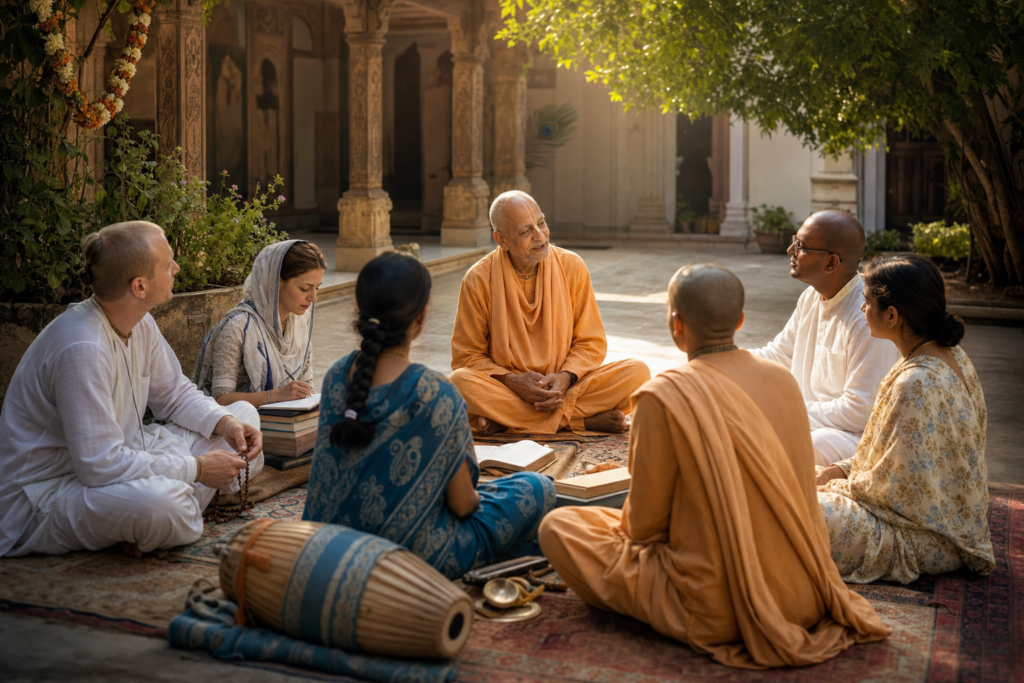
The quiet return did not last. The group carried karatalas, the small hand cymbals that provide a bright rhythmic pulse, and a mrdanga, the double-headed drum central to many forms of Gaudiya Vaishnava kirtan. They also chanted softly on beads. In the account’s emotional logic, the instruments were not merely equipment waiting to be used; they represented a devotional obligation temporarily held in restraint. The surrounding material bustle intensified the devotees’ desire to make the holy name audible.
Sankirtana means congregational glorification, especially through the shared chanting of divine names. In the Gaudiya Vaishnava tradition, it is at once worship, meditation, teaching, and public service. Unlike solitary japa, which is commonly performed on beads, sankirtana is collective and outward-facing. Voice, rhythm, movement, and attentive hearing work together. The practice does not depend on a silent interior alone; it creates a temporary community among participants and anyone willing to listen.
Lord Caitanya, who appeared in Bengal in the late fifteenth century, is revered in Gaudiya Vaishnavism as the divine teacher who made the chanting of Krsna’s names widely accessible. Lord Nityananda is honored as His intimate associate and as a personification of expansive mercy. The tradition therefore reads public chanting not simply as a cultural performance but as the continuation of a sacred mission. This theological background explains why the Oxford Street episode was remembered as more than a minor dispute over pedestrian movement.
When the group resumed singing, the sound expanded along the corridor of tall buildings. The devotees moved in single file near the edge of the pavement, according to the source, and saw Tottenham Court Road Underground station ahead. Shoppers paused, bus passengers turned toward the rhythm, and the city’s ordinary commercial soundtrack was briefly interrupted by devotional music. Some faces registered delight, others curiosity, and still others uncertainty. Such mixed reactions are typical when an unfamiliar religious practice enters a shared public space.
The group had nearly completed the route when three plainclothes officers blocked the way. One displayed police identification and announced the arrest. The stated ground was obstruction. The devotees objected that the pavement was wide, that they had kept to its edge, and that pedestrian numbers had already diminished. They also contrasted the police response to their chanting with the far more serious social harms visible in a large city. The protest was emotionally charged, but the officers maintained that the group was under arrest and began escorting it to the station.
At this point, the account originally uses harsh devotional language to characterize the officers. A more constructive reading avoids reducing public servants or religious practitioners to moral caricatures. The police believed they were regulating a public thoroughfare; the devotees believed a sacred and socially beneficial act was being suppressed. Both positions existed within a tense encounter shaped by incomplete trust. Recognizing that tension does not require endorsing every claim made by either side.
An arresting procession changes its emotional direction
As the escorted group walked toward the station, the devotees softly began chanting prayers to Lord Nrsimhadeva, Krsna’s half-man, half-lion incarnation, whom Vaishnavas invoke for protection. The mrdanga gradually marked the rhythm and the karatalas followed. The volume increased when the police offered no immediate objection. What had begun as a restrained prayer became another audible procession through the London street.
The striking detail is not that the devotees continued chanting; that response was consistent with their convictions. The surprise was the officers’ reaction. When the devotees looked back, the three policemen were smiling. Within the theological interpretation offered by the source, repeated contact with the holy name had softened earlier opposition and allowed the officers to experience some pleasure in the chanting. From a social perspective, the shared rhythm may also have interrupted the adversarial roles of arrestor and arrested, creating a brief moment of human recognition.
The distinction between those interpretations should be preserved. A devotional account may reasonably identify Lord Caitanya’s mercy as the decisive cause; historical analysis can observe the visible change in behavior without claiming access to the officers’ inner states. The two readings need not be treated as enemies. One describes sacred meaning from within the tradition, while the other describes interpersonal dynamics available to external observation.
Near a large bus queue, the police guide told the group to stop because the pavement had narrowed and obstruction was now a practical concern. The devotees complied. Once the crowded section had been passed, however, the same officer instructed them to begin again: “Okay, start chanting again.” The command reversed the expected pattern of the arrest. Police authority was no longer used only to silence the chant; for part of the route, it regulated where the chanting could continue safely.
The result was an almost theatrical entrance. The five detainees, still accompanied by three officers, chanted through the police station doors, along the hallway, and into the charging room with drum and cymbals. The scene joined institutions that ordinarily appear far apart: devotional procession and police custody, sacred music and administrative procedure. The smiles of the escorting officers did not eliminate the arrest, but they changed its emotional atmosphere.
The duty sergeant reacted with anger. A charging room depends on order, clear communication, and institutional control, and an amplified religious procession challenged all three. After the devotees apologized, the atmosphere moderated. Some constables asked philosophical questions while the sergeant completed the paperwork and charged each member with obstruction. The episode thus moved repeatedly between conflict and curiosity, demonstrating how quickly the meaning of public conduct can change according to place and context.
The group was told to appear in Magistrates Court the following morning. On leaving the station, the devotees encountered a senior plainclothes detective-inspector. Instead of rebuking them, he reportedly offered encouragement: “Don’t be discouraged, lads; keep up the good work!” That remark mattered because it separated institutional duty from personal hostility. Even within one police station, officials could interpret the same public religious activity in markedly different ways.
At the first hearing, the five defendants entered pleas of not guilty. The case was deferred to February 2. Only afterward did they connect the date with the appearance day of Lord Nityananda, whose role in spreading Lord Caitanya’s sankirtana movement is central to Gaudiya Vaishnava memory. The scheduling therefore acquired sacred significance: an ordinary court date became, within the participants’ devotional worldview, a sign of protection and mercy.
The trial at Great Marlborough Street Magistrates Court
On Lord Nityananda’s appearance day, the five devotees fasted through the morning, chanted His glories, attended arati, and then broke the fast with a feast. This sequence is important for understanding their mental preparation. They did not approach the trial merely as anxious defendants trying to escape a penalty. They approached it after worship, communal discipline, and remembrance of a figure associated with fearless compassion.
They then travelled to Great Marlborough Street Magistrates Court, a historically prominent central London court that remained in operation until the late twentieth century. Reverend Norman Morehouse, described in the source as a senior Anglican churchman and an enthusiastic new visitor to the temple, accompanied them and entered the public gallery. His presence introduced an interfaith dimension before any formal defense had begun. A Christian clergyman had come to observe Vaishnava devotees defend their public chanting.
The arresting officers arrived in uniform and waited near the defendants. The devotees offered them hazelnut cookies that had first been offered to Lord Nityananda. The officers accepted cautiously. This small act carried theological and interpersonal meaning. In the Vaishnava tradition, food offered with devotion becomes prasadam, or divine grace shared through food. In ordinary social terms, offering food to those responsible for an arrest is a gesture that refuses to let legal opposition become personal enmity.
When the devotees entered the dock in saffron robes with shaven heads, the courtroom reacted visibly. Their appearance identified them as religious practitioners before testimony began. The magistrate, described as a portly man wearing gold-rimmed spectacles and a red rose in the lapel of a dark gray suit, surveyed the group and heard the renewed pleas of not guilty. One constable was sworn and gave the prosecution account of the arrest.
According to the narrative, the constable’s numbers changed during his evidence. Five devotees became seven and then eight when he claimed that three others had escaped. He also described a far denser pedestrian scene than the defendants remembered, alleging that people had been forced into the road and exposed to traffic. The magistrate listened and then invited a response because the group had no lawyer.
The defendants focused on the internal inconsistency rather than attacking the officer’s character. They observed that human perception is imperfect and that the count of participants had changed within the evidence. The magistrate characterized the problem as “a mathematical error,” prompting laughter in the courtroom. This was more than comic relief. Credibility in an obstruction case depends on reliable observation of numbers, position, movement, crowd density, and risk. A numerical contradiction could weaken confidence in the larger description.
The absence of counsel made the exchange especially consequential. Unrepresented defendants must understand both the allegation and the evidentiary points that answer it. The group’s response was simple and effective: it isolated a concrete inconsistency that a magistrate could assess without accepting the entire devotional interpretation of events. Their spiritual vocabulary supplied a principle about imperfect senses, but the practical argument concerned the reliability of testimony.
Saksi Gopala Dasa, selected to speak for the group, then entered the witness box. The usher provided a copy of the Bhagavad-gita for the oath, and the testimony was sworn in the name of Sri Krsna. The moment placed a foundational Hindu scripture within the formal machinery of an English court. It also signaled that truthful testimony could be solemnized through the witness’s own religious commitment.
The defense began by acknowledging that police officers had a duty to perform. It then asserted that devotees also had a duty, received through spiritual discipline and scripture, to glorify God by chanting divine names. The argument referred not only to the Vedas but also to the Koran, the Torah, and the Bible. Whether God was addressed as Allah, Jehovah, Rama, Govinda, or Krsna, the defense maintained that the divine reality was one.
This interfaith claim requires careful reading. It did not erase the substantial theological differences among religious traditions. Instead, it established a moral basis for reciprocal respect: public devotion should not be dismissed merely because its language, clothing, or music is unfamiliar. That principle also supports unity among Hindu, Buddhist, Jain, and Sikh communities. These Dharmic traditions are distinct, yet each has developed disciplined forms of recitation, remembrance, ethical restraint, and communal practice that deserve fair treatment in plural societies.
The spokesman next cited the Brhan-Naradiya Purana in the form preserved by the source:
harer nama harer nama harer namaiva kevalam
Kalau nasty eva nasty eva nasty eva gatir anyatha.
The magistrate asked for an English explanation. The defense presented the verse as teaching that, in Kali, the age of materialism and quarrel, no path is as effective for spiritual advancement as repeated chanting of the divine name. The threefold repetition gives the statement rhetorical force and doctrinal urgency. Within Gaudiya Vaishnavism, the verse does not treat chanting as a decorative accompaniment to religion; it identifies sacred sound as the principal discipline for the age.
Technically, the practice combines several processes. Chanting trains attention through repetition; hearing makes the practitioner receptive rather than merely expressive; rhythm coordinates a group; and movement engages the body in worship. The mantra is understood as sacred sound, not as a secular slogan. The claim that the holy name purifies consciousness belongs to the tradition’s theology, while the observable effects of synchronized singing—attention, emotional regulation, belonging, and collective focus—help explain why the practice can be powerful even to an unfamiliar listener.
The court reportedly became attentive as the testimony moved from the arrest to a broader diagnosis of modern life. Material achievement, the defense argued, had not removed dissatisfaction, addiction, exploitation, violence, or crime. These problems were interpreted as symptoms of spiritual disorientation and uncertainty about the purpose of life. An academic reading should treat that diagnosis as a normative religious claim, not as a complete social-scientific explanation. Economic, medical, psychological, and institutional causes also matter. Yet the argument remains relevant because technical progress alone does not answer questions of meaning, responsibility, or human flourishing.
The defense also referred to a passage attributed to historian Arnold Toynbee and published in the London Observer in October 1972. Its central idea was paraphrased as follows: the world’s disorder had a spiritual cause because human beings had committed themselves to goals that were morally mistaken and practically unattainable; peace required a reconsideration of those goals. The reference gave the courtroom statement an intellectual bridge between scriptural teaching and twentieth-century criticism of material civilization.
Four ethical principles were then emphasized: mercifulness, truthfulness, cleanliness, and austerity. In the argument, these were not private virtues with no civic relevance. Mercifulness restrains cruelty; truthfulness sustains trust; cleanliness addresses both conduct and environment; and austerity limits destructive excess. The defense presented the cultivation of these qualities as a form of social welfare and described literature distribution and congregational chanting as practical methods for encouraging them.
This was the most technically important feature of the testimony. The devotees did not ask the magistrate to decide the truth of Vaishnava theology. They explained why the conduct mattered to them, acknowledged the police function, challenged inconsistent evidence, and framed the chant as an ethical contribution rather than a nuisance. The defense therefore joined fact, conscience, and public benefit without requiring the court to become a theological authority.
A minor obstruction, a dismissed case, and an unexpected book
After the testimony ended, the magistrate delivered the decision reported in the account. In legal terms, he regarded the group as responsible for obstruction, but only to a very minor degree. Taking that limited impact and the devotees’ evident sincerity into consideration, he dismissed the case. The outcome relieved the defendants without turning their religious conviction into an unlimited exemption from ordinary rules governing shared space.
That distinction is essential. Public religious expression and pedestrian access are not inherently incompatible. The police guide had already demonstrated a workable form of accommodation by pausing the chant near a bus queue and allowing it to resume where space opened. The court’s reported response likewise balanced the existence of a technical interference against its small scale and the character of the conduct. The story’s practical lesson is not that devotion cancels civic responsibility, but that regulation should remain proportionate and attentive to context.
The source does not identify the exact statutory provision, reproduce the charge sheet, or provide a judgment. It would therefore be unsound to present the result as a binding precedent on religious freedom or street performance. A magistrate’s dismissal in one fact-specific case does not automatically establish a general right to chant at any volume or in any location. Its significance lies instead in the reported exercise of judgment: minimal interference, sincere purpose, weak or inconsistent evidence, and peaceful conduct were treated as reasons for restraint.
Before leaving, the spokesman asked whether the court maintained a library and offered a book for its collection. The magistrate replied that the court could accommodate it. A copy of Srila Prabhupada’s Sri Isopanisad was given to a clerk for delivery. The gesture completed the transformation of the encounter. What entered the legal system as noise alleged to obstruct the pavement left behind a philosophical text offered for reading and reflection.
Outside, Reverend Morehouse greeted the group with “Hare Krsna!” and congratulated the devotees. He reportedly expressed surprise because the magistrate had dealt severely with earlier cases that day and interpreted the different outcome as divine intervention. His reaction mattered for more than celebration. It showed an observer from another religious tradition recognizing sincerity and rejoicing in the peaceful resolution of a Vaishnava case.
What the episode reveals about law, religion, and evidence
An obstruction allegation concerns the use of common space. A pavement must remain meaningfully available to pedestrians, but a city pavement is not only a channel for movement. It is also a place of encounter, speech, performance, witness, protest, commerce, and celebration. Conflict arises when one use materially impairs another. The relevant factual questions include how much space was occupied, for how long, at what level of crowding, with what effect on passersby, and whether a less restrictive response could manage the problem.
The narrative supplies evidence on both sides. Oxford Street was busy before Christmas, and amplified group activity can affect movement. At the same time, the devotees said they walked single file near the edge of a wide pavement, and traffic had diminished. The police later allowed chanting except where a bus queue narrowed the available space. That conduct may suggest that the officers themselves saw the risk as situational rather than constant. Because no transcript or independent map of the exact scene is provided, firm reconstruction remains impossible.
The constable’s changing count illustrates why precision matters. Eyewitnesses can be sincere and still mistaken. Stress, movement, divided attention, expectations, and the passage of time influence memory. The devotees’ phrase about imperfect senses came from a philosophical tradition, but it also anticipated a basic evidentiary principle: testimony should be tested against internal consistency and external circumstances. Humility about perception protects both defendants and institutions.
The case also illustrates religious neutrality. A court need not accept the metaphysical claim that sacred names purify consciousness in order to recognize that chanting is a serious religious exercise. Conversely, sincerity does not by itself prove that every practical restriction is unjust. Neutral treatment requires institutions to understand the nature of a practice, apply ordinary rules consistently, and choose proportionate measures when accommodation is feasible.
For religious communities, the reciprocal duty is equally important. Public witness gains credibility when participants remain peaceful, respond to genuine safety concerns, and distinguish principled firmness from contempt for officials. In this story, the devotees objected strongly to the arrest, yet they stopped near the bus queue, apologized after entering the charging room, answered questions, attended court, and offered food and literature. Their conduct made dialogue possible even while they disputed the charge.
The emotional shift among the officers is central to the narrative’s account of mercy. Mercy did not appear as victory over humiliated enemies. It appeared as the softening of relationships: an escort smiled, a chant was permitted to resume, constables asked questions, a detective encouraged the group, and arresting officers accepted offered food. None of those moments erased institutional disagreement. They showed that disagreement need not exhaust the moral possibilities of an encounter.
This understanding is especially valuable for unity among Dharmic traditions. Hindu, Buddhist, Jain, and Sikh practices vary greatly in theology, ritual, authority, and ultimate goals. Unity should never flatten those differences. It can instead rest on shared commitments to non-hatred, disciplined conduct, truth-seeking, compassion, and the protection of sincere spiritual practice. A Vaishnava procession, a Sikh Nagar Kirtan, Buddhist chanting, and Jain recitation are not interchangeable, but all demonstrate how sacred sound can form ethical communities.
Sankirtana also complicates the modern assumption that religion is most authentic when private. For the devotees, sound was relational. A name was chanted so that it could be heard, and hearing created the possibility of participation. Public practice therefore served both devotion and outreach. The challenge for a plural city is to protect that visibility while ensuring that shared spaces remain accessible to people who may not share the belief.
The instruments contributed to this relational character. The mrdanga established a rhythmic foundation; the karatalas marked the cycle; voices carried the mantra; and bodily movement transformed recitation into procession. Each element increased audibility and collective focus, but also increased the practical need for spatial awareness. The same features that make kirtan powerful can make careful coordination with crowds and public authorities necessary.
Seen through the lens of spiritual psychology, the episode moves from threat to composure through remembered practice. The devotees responded to fear by chanting Lord Nrsimhadeva’s glories, fasted and worshiped before trial, and framed uncertainty through Lord Nityananda’s mercy. These practices gave coherence to events they could not control. Even readers outside the tradition can recognize the human value of entering conflict with a disciplined moral center rather than with panic alone.
Seen through the lens of civic ethics, the episode demonstrates the power of de-escalation. The bus queue produced a concrete problem; chanting paused; the problem passed; chanting resumed. The station sergeant became angry; the devotees apologized; conversation replaced escalation. Court evidence conflicted; the defense identified the inconsistency without personal abuse. These are modest actions, but they reveal how disputes become manageable when participants respond to the actual point of friction.
Seen through the lens of bhakti, however, the pattern is more than conflict management. The holy name reaches people who did not seek it, food offered to Lord Nityananda crosses a line of opposition, and scripture enters a court library. Mercy operates through contact rather than coercion. No one is compelled to profess belief. The transformation occurs through sound, hospitality, explanation, and the willingness to see an opponent as a possible participant in grace.
Source limits and responsible historical reading
The account’s devotional purpose should be acknowledged openly. It was published for a religious readership and interprets coincidence, emotion, and legal outcome through the theology of Lord Caitanya and Lord Nityananda. Its polished dialogue may compress or reconstruct speech from memory. The absence of a precise arrest year, case number, police file, and court transcript limits independent verification. These limitations do not make the account worthless; they define what kind of source it is.
As a primary devotional narrative, it offers valuable evidence about how early members of the Hare Krishna Movement in London understood public chanting, official resistance, interfaith recognition, and divine protection. It also preserves the sensory geography of Piccadilly Circus, Regent Street, Oxford Circus, Oxford Street, Tottenham Court Road, a police station, and Great Marlborough Street Magistrates Court. Its strongest historical claims concern experience and interpretation; its legal particulars should remain qualified unless corroborating records emerge.
Responsible reading also avoids romanticizing arrest. Police custody can be frightening, especially for minority religious communities whose appearance or worship is unfamiliar to officials. Nor should the dismissal be used to imply that every official intervention is persecution. The lasting value of this episode lies in its refusal to end with either fear or triumphalism. The devotees maintained conviction, the officers displayed moments of flexibility, and the magistrate reportedly exercised restraint.
The story consequently offers a mature model of religious courage. Courage is not measured only by volume or defiance. It includes the capacity to explain a practice clearly, submit claims to evidence, recognize legitimate civic duties, accept proportionate limits, and continue without hatred. That combination is relevant to any community seeking freedom of worship in a diverse society.
The loving network of Lord Caitanya
On the journey back to the temple, the experience was interpreted through a verse from Srila Prabhupada’s Caitanya-caritamrta. The non-English text is preserved exactly as it appeared in the supplied source:
aparadha ksamaila, dubila prema-jale
keba edaibe prabhura prema-mahajale
The verse describes Lord Caitanya forgiving offenders and drawing them into an ocean of divine love from which no one can escape. In the London episode, that “loving network” did not abolish law, difference, or uncertainty. It connected people across them. Devotees, police officers, a magistrate, a court clerk, and an Anglican clergyman all became participants in a single remembered event.
The final lesson is therefore both spiritual and civic. Sacred conviction can remain firm without becoming dehumanizing. Public authority can preserve order without treating unfamiliar devotion as a threat. Evidence can correct confident perception. Hospitality can cross an adversarial boundary. A chant can become a conversation, and a courtroom can become a place where religious meaning is heard with seriousness.
For followers of Lord Caitanya, the dismissal and the acceptance of Sri Isopanisad revealed Lord Nityananda’s mercy on His appearance day. For a wider readership, the account shows how patience, disciplined devotion, factual argument, and respect can transform a collision between law and faith. That is why the incident still resonates: the most remarkable victory was not merely that a charge disappeared, but that opposition briefly gave way to understanding.
References: The narrative was published in Back to Godhead, Volume 12, Number 8 (August 1977). The cited teachings can be consulted in Caitanya-caritamrta, Adi-lila 17.21 and Caitanya-caritamrta, Adi-lila 7.37.
Inspired by this post on Dandavats.






Leave a Reply
You must be logged in to post a comment.