
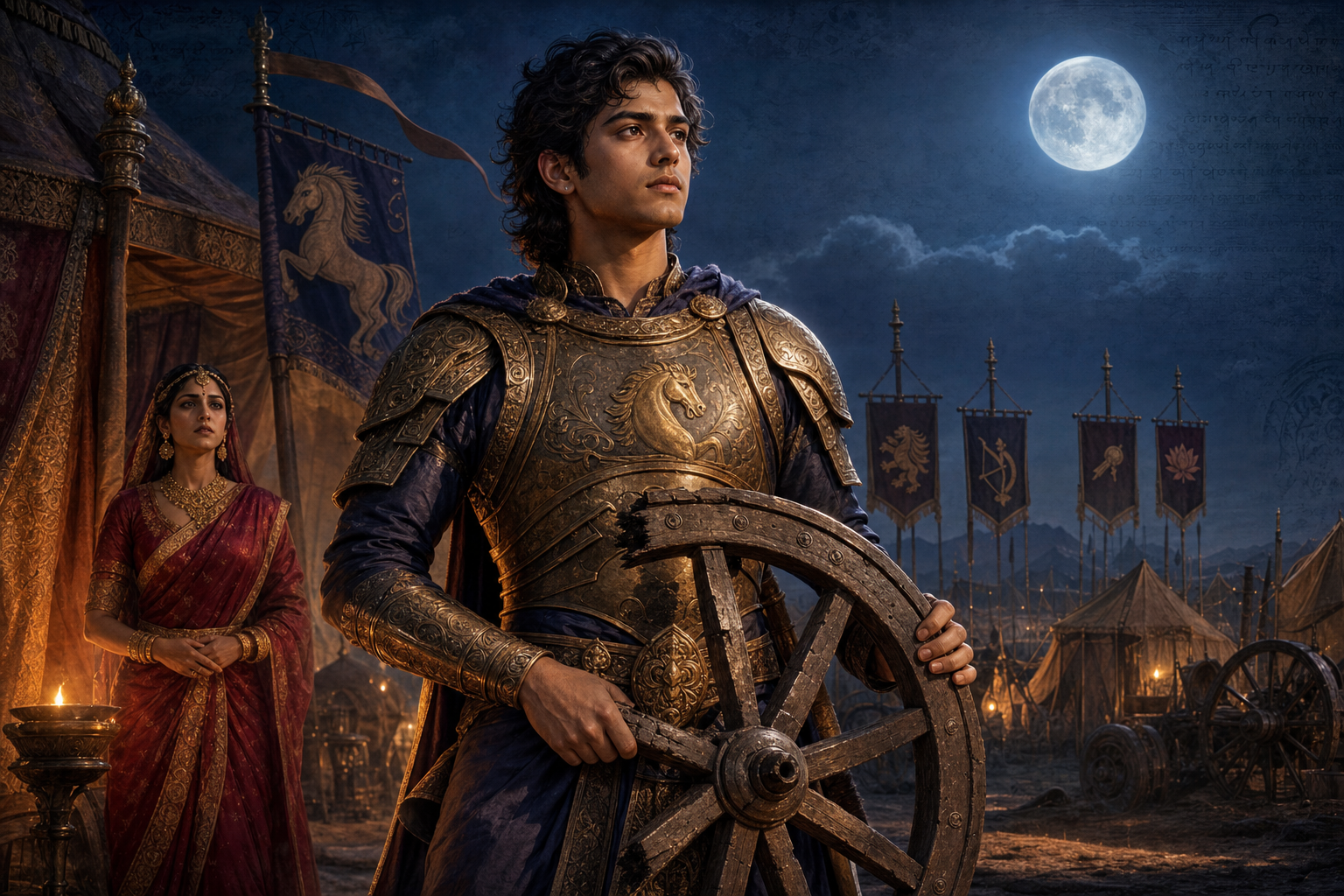
Shatanika, the son of Nakula and Draupadi, occupies a brief yet emotionally significant place in the Mahabharata. He is not among the epic’s most elaborately developed characters, yet his presence brings together several important strands of the narrative: the continuity of the Kuru line, the shared motherhood of Draupadi, the martial inheritance of the Pandavas, and the devastating cost of the Kurukshetra War. His life is remembered less through long speeches or independent episodes and more through lineage, duty, battlefield courage, and tragic loss.
In the Mahabharata, Shatanika belongs to the group often called the Draupadeyas or Upapandavas, the five sons born to Draupadi from the five Pandava brothers. The traditional list gives Prativindhya as the son of Yudhishthira, Sutasoma as the son of Bhima, Shrutakarman or Shrutakirti as the son of Arjuna depending on the recension, Shatanika as the son of Nakula, and Shrutasena or Shrutakarman as the son of Sahadeva in different textual traditions. This variation itself is a reminder that the Mahabharata is a living epic tradition, preserved through manuscripts, recitations, regional retellings, and commentarial memory.
Shatanika’s father, Nakula, was the fourth Pandava and the elder twin of Sahadeva. Born to Madri through the grace of the Ashvins, Nakula is repeatedly associated with beauty, elegance, skill in arms, knowledge of horses, and refined discipline. These qualities shape the way Shatanika is understood within the epic imagination. As Nakula’s son, Shatanika inherits not merely royal status but a disciplined Kshatra identity, one rooted in service, courage, loyalty, and restraint.
Draupadi’s role as Shatanika’s mother is equally important. She is not only the queen of the Pandavas but also one of the most powerful moral presences in the Mahabharata. Born from the sacrificial fire of King Drupada’s yajna, Draupadi stands at the intersection of dignity, suffering, political destiny, and dharma. Through Shatanika and his brothers, Draupadi’s story becomes not only the story of a queen wronged in the Kuru court but also the story of a mother whose sons entered the war shaped by the responsibilities of their lineage.
The name Shatanika is usually understood in relation to martial strength, often interpreted as one connected with many troops or formations. The name itself carries the sound of command and battlefield organization. In the world of the Mahabharata, names frequently preserve destiny, lineage, virtue, or heroic aspiration. Shatanika’s name therefore suits a prince born into a generation expected to defend the honor of the Pandavas and the wider cause of dharma.
Yet the epic gives Shatanika a quiet distinction rather than a dominant narrative arc. This is one of the more poignant features of his character. The Mahabharata often allows secondary figures to carry enormous emotional weight through small but decisive appearances. Shatanika is remembered as a young warrior of the Pandava camp, a prince who fought in the shadow of legendary figures such as Arjuna, Bhima, Abhimanyu, Satyaki, Dhrishtadyumna, and his own father Nakula. His limited textual space does not diminish his importance; instead, it reflects how the war consumed even those whose lives had barely unfolded.
The Draupadeyas represent the next generation of Pandava hopes. They are born after the marriage of Draupadi to the five brothers and before the full catastrophe of exile and war reaches its end. In them, the royal houses of Kuru and Panchala are joined. Through their fatherhood, the Pandavas extend their lineage; through their motherhood, Draupadi gives continuity to the cause that was repeatedly attacked through humiliation, dispossession, and injustice.
Shatanika’s identity therefore cannot be separated from the political and dharmic alliance between the Pandavas and Panchala. Draupadi was the daughter of Drupada, and her brother Dhrishtadyumna became the commander of the Pandava forces in the Kurukshetra War. Shatanika, as Draupadi’s son, belonged naturally to this network of Kuru-Panchala loyalty. His presence in the war camp reflects not only filial duty toward the Pandavas but also the shared fate of families bound together by vows, alliances, and unresolved wrongs.
In the Kurukshetra War, Shatanika is remembered as a warrior on the Pandava side. The Mahabharata’s battle books are dense with chariot duels, troop formations, heroic vows, and sudden reversals. Within this vast martial canvas, younger warriors like Shatanika appear as part of the terrible machinery of war. They are trained for valor, yet their lives reveal the moral burden of conflict: even a righteous cause brings grief when it moves through the field of weapons.
Shatanika’s battlefield role is especially important when viewed through the broader theme of inherited dharma. He does not fight as an isolated adventurer. He fights as Nakula’s son, Draupadi’s son, a prince of the Pandava house, and a representative of the younger Kuru generation. His courage is not merely personal bravery; it is a continuation of family duty. This is one reason his memory remains meaningful even though the epic does not give him the elaborate characterization given to Abhimanyu or Ghatotkacha.
The comparison with Abhimanyu is unavoidable, but it must be handled carefully. Abhimanyu receives a dramatic and extended heroic episode in the Chakravyuha, while Shatanika and the other Draupadeyas are remembered more collectively. This difference is not a judgment of worth. Rather, it reflects the narrative design of the Mahabharata, where certain figures become symbols through expansive episodes and others through concentrated moments of lineage and loss. Shatanika belongs to the second category.
One of the most striking references to Shatanika comes in the Sauptika Parva, the tenth book of the Mahabharata. After the fall of Duryodhana and the effective end of the great war, Ashwatthama, accompanied by Kripa and Kritavarma, attacks the Pandava camp at night. This episode is among the darkest in the epic because it violates the expected ethics of warfare. The assault is not a fair battle between alert warriors on an open field; it is a night raid upon a camp exhausted by war.
During this night attack, the sons of Draupadi awaken and confront Ashwatthama. The episode shows that they were not passive victims in the moral imagination of the text. Shatanika, specifically identified as Nakula’s son, is described as taking up a chariot wheel and striking Ashwatthama with force. The image is brief but powerful. A prince deprived of the orderly conditions of battle still reaches for what is available and resists. In that single act, Shatanika’s courage becomes visible.
Ashwatthama then kills Shatanika, and the deaths of the Draupadeyas become one of the final emotional wounds of the war. The Pandavas have won the kingdom, yet Draupadi has lost her sons. The victory is therefore not simple triumph; it is victory hollowed by grief. This is central to the Mahabharata’s moral depth. The epic does not permit readers to celebrate war without confronting its cost.
Shatanika’s death also exposes the difference between dharma-yuddha and revenge. The Mahabharata repeatedly debates the ethics of warfare, the limits of retaliation, and the consequences of anger. Ashwatthama’s act is driven by grief over Drona’s death, loyalty to Duryodhana, and rage against the Pandavas. Yet the text presents the night slaughter as morally disturbing. Shatanika’s killing is therefore not just the death of a young prince; it is part of the epic’s larger warning about revenge when it escapes the discipline of dharma.
Draupadi’s grief after the massacre is among the most human moments in the later Mahabharata. She has endured humiliation in the Kuru court, exile, political uncertainty, and war. The death of her sons adds maternal bereavement to her long suffering. In this grief, the epic invites reflection on how women bear the consequences of political and martial decisions. Shatanika’s memory is therefore inseparable from Draupadi’s sorrow and from the broader emotional history of the Pandava household.
At the same time, Draupadi’s response is not presented as helplessness. She demands accountability for Ashwatthama’s deed. The Pandavas pursue him, and the episode leads to the confrontation involving the Brahmashirastra, Arjuna’s restraint, Krishna’s intervention, and the protection of the future lineage through Parikshit. Thus, the death of Shatanika and his brothers becomes part of the transition from destruction to survival. The old generation is shattered, but the lineage continues through a single rescued heir.
From a dharmic perspective, Shatanika’s story teaches that even lesser-known figures in sacred literature may carry great symbolic meaning. Not every hero receives a grand speech. Not every warrior is remembered through a famous duel. Some are remembered because their lives reveal the fragility of hope, the burden of inheritance, and the pain hidden behind political victory. Shatanika stands precisely in this space.
His story also helps readers appreciate Nakula more deeply. Nakula is sometimes overshadowed by Yudhishthira’s moral dilemmas, Bhima’s strength, Arjuna’s archery, and Sahadeva’s wisdom. Through Shatanika, Nakula’s lineage receives its own tragic dignity. The son reflects the father’s disciplined warrior identity, while the father’s grief remains largely absorbed into the collective sorrow of the Pandavas. This understated grief is typical of the Mahabharata’s emotional realism.
For modern readers, Shatanika’s life offers a way to read the Mahabharata beyond its most famous episodes. The epic is not only about Krishna’s counsel, Arjuna’s crisis, Bhishma’s vows, Karna’s anguish, or Draupadi’s humiliation. It is also about the many sons, brothers, teachers, allies, and dependents whose lives were drawn into a conflict larger than themselves. Shatanika reminds readers that history and epic memory are built not only by central figures but also by those who stand faithfully within inherited duties.
His place among the Upapandavas also offers a lesson in unity. The five sons of Draupadi are born from five fathers yet share one mother, one household, one cause, and one fate. Their collective identity becomes a symbol of shared belonging within diversity. In a broader dharmic reading, this is especially meaningful: unity does not require sameness. The Mahabharata repeatedly shows that different temperaments, lineages, strengths, and responsibilities can gather around a common commitment to dharma.
This insight resonates with the wider family of dharmic traditions. Hindu, Buddhist, Jain, and Sikh traditions each approach duty, suffering, self-discipline, compassion, and liberation through distinct philosophical and devotional paths. Yet all place moral seriousness at the center of life. Shatanika’s story, though rooted in the Hindu epic tradition, can be read as a reminder that courage without hatred, duty without arrogance, and grief without moral collapse remain timeless concerns across dharmic civilizations.
Academically, it is important not to exaggerate Shatanika’s role beyond the evidence of the text. The Mahabharata does not give him an independent biography comparable to the major warriors. His significance must be reconstructed from his lineage, his identification among the Draupadeyas, his participation in the Pandava side, and his final resistance during Ashwatthama’s night attack. This careful approach preserves accuracy while still honoring the literary and spiritual importance of his presence.
Shatanika’s story is therefore best understood as a study in quiet heroism. He is a warrior prince of the Kuru line, the son of Nakula and Draupadi, a member of the Upapandavas, and a casualty of the Sauptika Parva’s tragic night. His life embodies promise; his death reveals the cost of vengeance; his memory deepens the reader’s understanding of Draupadi’s grief and the Pandavas’ incomplete victory. In the Mahabharata, such figures ensure that the epic remains not merely a story of kings but a profound meditation on family, duty, loss, and dharma.
For textual orientation, this discussion follows the public-domain K. M. Ganguli translation of the Mahabharata, especially the Adi Parva account of the Pandava sons and the Sauptika Parva account of Ashwatthama’s night raid, available through the Internet Sacred Text Archive: Adi Parva, Section XCV and Sauptika Parva, Section 8. These sources are used as textual anchors while recognizing that names and ordering may vary across recensions and regional traditions.
Inspired by this post on Hindu Blog.
