
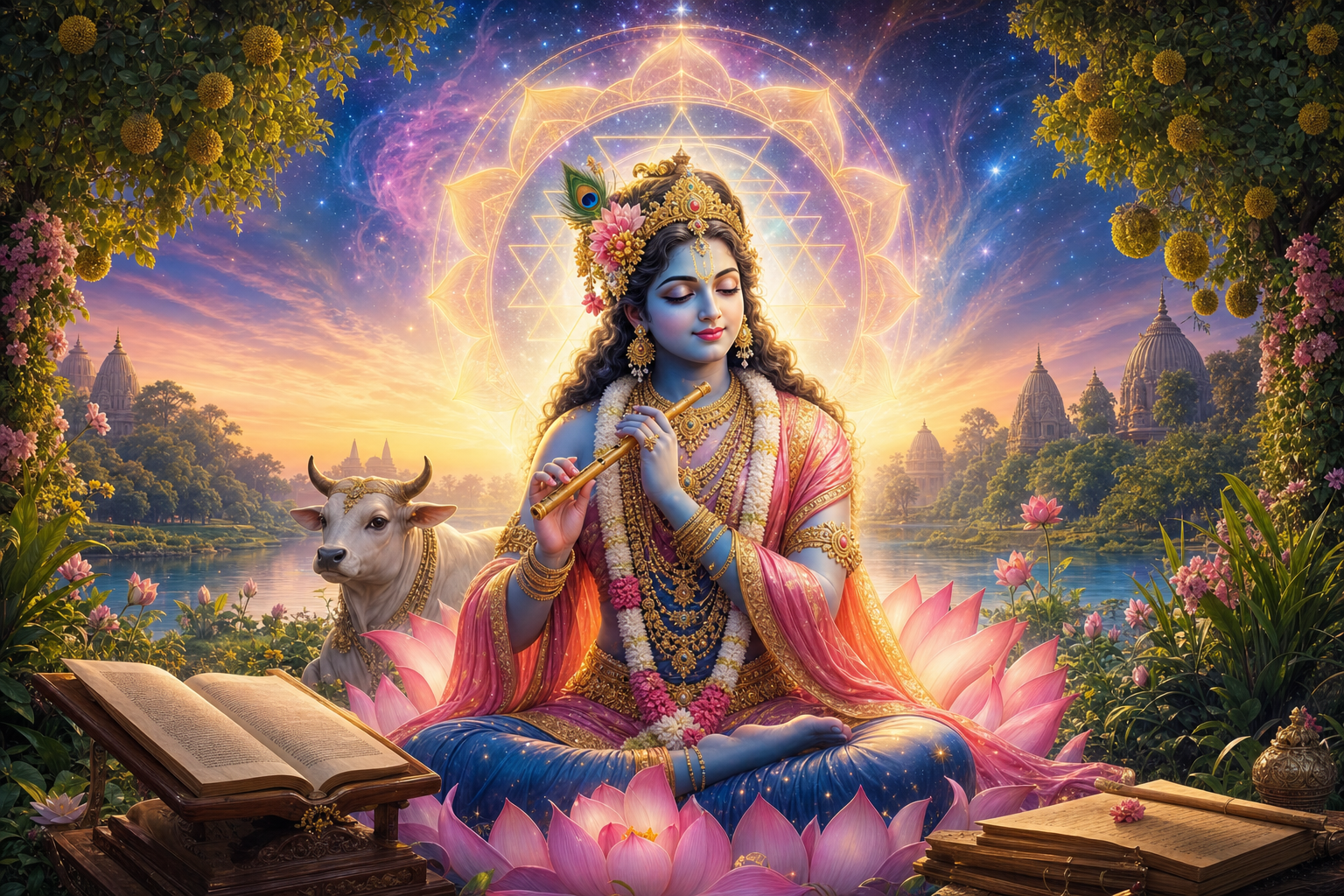
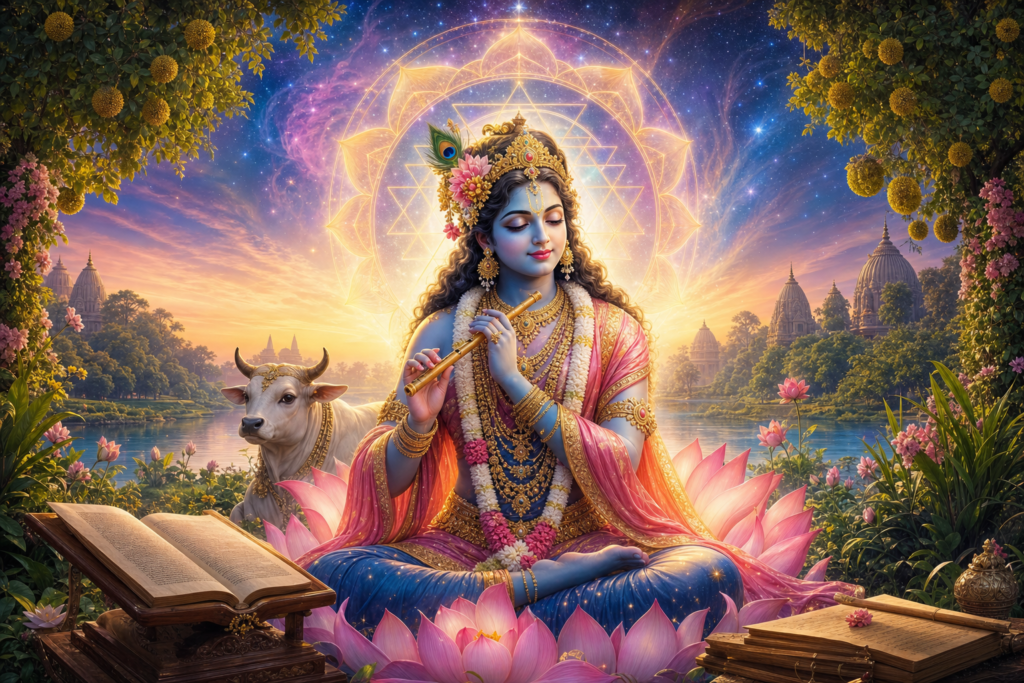
Gopala Sundari stands at one of the most subtle meeting points of Hindu spirituality: the place where Krishna, Shakti, beauty, motherhood, love, and supreme consciousness are contemplated as one reality rather than separate divine personalities. The name itself carries a layered theological meaning. “Gopala” evokes Krishna as the cowherd protector, the beloved of Vrindavan, the divine child, and the supreme source of devotional sweetness. “Sundari” evokes beauty, auspiciousness, and in many Shakta and Tantric contexts, the radiant wisdom of the Divine Mother, especially the tradition of Tripura Sundari. When these two names are brought together, the result is not merely a poetic title. It becomes a profound statement about the unity of Vaishnava bhakti and Shakta metaphysics.
In this understanding, Gopala Sundari is not approached as a goddess placed beside Krishna, nor as a consort who completes him from outside. The form points toward a deeper insight: the divine beloved and the cosmic mother are not ultimately two. Krishna is not separate from Shakti, and Shakti is not separate from Krishna. The power that creates, sustains, nourishes, enchants, protects, and liberates is the same supreme reality experienced through different devotional languages.
This is why Gopala Sundari is such a compelling subject for Hindu philosophy. She requires a reader to move beyond simplified categories such as male deity and female deity, god and goddess, consort and lord, worshipper and worshipped. Hindu thought repeatedly refuses to reduce the Divine to a single fixed image. The Vedas, Upanishads, Puranas, Agamas, Tantras, and bhakti traditions all preserve a vast language of divine plurality. Yet beneath that plurality lies a recurring intuition: the many forms of worship are not contradictions but gateways into a truth too expansive for one image alone.
Gopala Sundari belongs to this expansive vision. The form is best understood through the larger Hindu principle that the Divine may be adored as Brahman, Bhagavan, Devi, Shiva, Vishnu, Krishna, Rama, Durga, Lakshmi, Radha, Saraswati, Kali, Tripura Sundari, or countless other manifestations. Each form carries a distinct devotional mood, ritual grammar, and philosophical emphasis. Yet the deeper purpose of these forms is not fragmentation. It is intimacy. The Infinite becomes approachable through names, images, stories, mantras, and sacred relationships.
The theological key to Gopala Sundari lies in the inseparability of the possessor of power and power itself. In Sanskritic theological language, this is often expressed through the relationship between shaktiman, the one who possesses power, and Shakti, the power itself. The two can be distinguished for the sake of devotion and analysis, but they cannot be truly separated. Fire and heat, sun and light, fragrance and flower, word and meaning: such metaphors are frequently used in Hindu traditions to suggest how divine essence and divine energy are related.
Within Vaishnava theology, Krishna is adored as Svayam Bhagavan, the supreme personality of Godhead, especially in the Bhagavata Purana and later bhakti traditions. Within Shakta theology, Devi is revered as the supreme reality, the womb of worlds, the consciousness-force from which gods, beings, worlds, and liberation arise. Gopala Sundari does not require one tradition to defeat the other. Instead, the form allows both claims to be contemplated together: the supreme beloved of Vrindavan and the supreme mother of the cosmos are two modes of one indivisible divine fullness.
This unity has deep roots in Hindu sacred literature. The Devi Mahatmya presents the Goddess as the supreme power behind all gods, the one who manifests whenever cosmic balance requires restoration. The Bhagavad Gita presents Krishna as the source of all worlds, the inner self of all beings, and the foundation of both the manifest and unmanifest. The Bhagavata Purana presents Krishna not merely as a historical or mythic hero but as the irresistible center of divine love. When read together, these traditions reveal a shared grammar of supremacy, compassion, protection, and cosmic intimacy.
Gopala Sundari therefore becomes a theological bridge. She allows the devotee to see Krishna not only as the flute-playing beloved but also as the maternal power that nourishes the universe. She allows the Shakta practitioner to recognize the cosmic mother not only as awe-inspiring sovereignty but also as sweetness, play, tenderness, and bhakti rasa. The result is a vision in which power is not cold domination and love is not passive sentiment. Divine power becomes loving, and divine love becomes cosmically creative.
The word “Gopala” is itself rich with devotional significance. It refers to Krishna as the protector of cows, the guardian of the pastoral world, and the beloved child of Gokula. In the Krishna tradition, this form is intimate rather than distant. Gopala is not primarily encountered as an abstract cosmic ruler seated beyond the universe. He runs through Vrindavan, steals butter, plays the flute, protects the vulnerable, charms the gopas and gopis, and reveals that the highest divinity may appear in the simplicity of village life. This is a radical theological claim: the supreme reality can be approached through affection.
The word “Sundari” adds another dimension. It means “the beautiful one,” but in sacred usage beauty is not merely physical charm. Beauty is the radiance of truth, order, compassion, and consciousness. In Sri Vidya and related Shakta traditions, Tripura Sundari represents the beauty that pervades the three worlds, the wisdom that shines through creation, and the blissful power of consciousness. Sundari is not ornamental. She is metaphysical beauty: the beauty by which existence becomes meaningful, luminous, and lovable.
When “Gopala” and “Sundari” are brought together, the name suggests a remarkable synthesis. Krishna’s sweetness is read through the language of Shakti, and Shakti’s splendor is read through the language of Krishna. The pastoral and the cosmic meet. The child and the mother meet. The beloved and the sovereign meet. The flute of Vrindavan and the mantra of Devi are not treated as competing sounds but as different vibrations of the same sacred truth.
This synthesis is not unusual within the broader Hindu imagination. Hindu traditions have long allowed forms to overlap, merge, and reveal one another. Harihara unites Vishnu and Shiva. Ardhanarishvara unites Shiva and Shakti in a single form. Lakshmi-Narayana, Radha-Krishna, Sita-Rama, and Uma-Maheshvara express inseparable divine pairs. Such forms teach that divinity cannot be fully understood through rigid separation. Gopala Sundari belongs to this family of integrative visions, but with a distinctive emphasis on Krishna and the Divine Mother.
The form also invites reflection on Radha. In many Krishna traditions, Radha is not simply a beloved companion of Krishna. She is understood as Krishna’s highest Shakti, the embodiment of hladini shakti, the bliss-giving power of divine love. The love between Radha and Krishna is not merely romantic symbolism. It is theological language for the relationship between divine consciousness and divine bliss. In this sense, Gopala Sundari can be understood as a related contemplative expression of the truth that Krishna and his Shakti are one indivisible reality.
At the same time, Gopala Sundari should not be reduced to only one sectarian interpretation. The strength of Hindu spirituality lies in its capacity for layered meanings. A Vaishnava may see in this form the supreme Krishna revealed through his own internal potency. A Shakta may see the Divine Mother choosing to appear as Krishna’s sweetness. A Vedantin may see the non-dual Brahman expressed through both personal and cosmic symbolism. A practitioner of bhakti may simply feel that the heart’s longing for the beloved and the soul’s longing for the mother are finally the same longing.
This last point is spiritually important. Human experience often separates love into categories: the love of a mother, the love of a child, the love of a friend, the love of a teacher, the love of a beloved, the love of the Divine. Hindu bhakti literature, however, transforms these relationships into sacred pathways. Vatsalya rasa approaches God as child. Madhurya rasa approaches God as beloved. Sakhya rasa approaches God as friend. Dasya rasa approaches God through service. Shanta rasa approaches God through contemplative peace. Gopala Sundari gathers several of these moods into one contemplative center.
For many devotees, this is not an abstract philosophical exercise. The image of the Divine as both mother and beloved speaks to a deep human need. The soul seeks protection, but it also seeks intimacy. It seeks guidance, but it also seeks beauty. It seeks liberation, but it also seeks love. Gopala Sundari answers these needs through a form that is at once tender and transcendent. The same Divine who nourishes the universe also plays the flute of attraction within the heart.
Academically, this form can be situated within the broader Hindu logic of theological inclusivity. Hindu traditions frequently distinguish between ultimate reality and its modes of manifestation. Saguna Brahman is the Divine with attributes, accessible through name and form. Nirguna Brahman is the Divine beyond attributes, beyond conceptual limitation. The same reality can be meditated upon as personal, impersonal, masculine, feminine, both, neither, immanent, transcendent, playful, terrifying, maternal, or formless. Gopala Sundari is one such saguna doorway into the inexpressible.
The Shakta dimension of Gopala Sundari is especially significant because Shakti is not merely “energy” in a vague modern sense. Shakti is the dynamic power of consciousness. Without Shakti, the Divine remains unmanifest; through Shakti, creation becomes possible, devotion becomes possible, mantra becomes effective, and liberation becomes embodied. In Shakta traditions, the Goddess is not secondary to a male deity. She is the very power by which all deities act, appear, bless, and dissolve the universe.
The Krishna dimension is equally significant because Krishna is not merely a charming pastoral figure. In the Bhagavad Gita, Krishna reveals the Vishvarupa, the cosmic form containing all beings, all gods, all time, and all destiny. In the Bhagavata Purana, Krishna’s childhood play is not a limitation of divinity but its most intimate revelation. The highest reality does not only overwhelm through grandeur; it also captivates through sweetness. Gopala Sundari unites these two registers: cosmic sovereignty and intimate beauty.
This is why the phrase “When the Mother Becomes the Beloved” carries theological force. It does not imply that the Divine Mother abandons motherhood in order to become something else. Rather, it suggests that motherhood and belovedness are two devotional ways of experiencing the same compassionate absolute. The mother gives life; the beloved gives meaning. The mother protects; the beloved attracts. The mother nourishes; the beloved awakens longing. In Gopala Sundari, these functions converge.
The form also has implications for understanding gender in Hindu theology. Modern readers sometimes impose rigid gender categories on divine forms, assuming that masculine and feminine images must represent separate powers or social roles. Hindu sacred symbolism is more fluid and philosophically subtle. The Divine may be male in one context, female in another, both in another, and beyond gender altogether in the highest metaphysical sense. Gopala Sundari challenges the assumption that Krishna and Shakti must be kept apart because of their iconographic gendered associations.
In this way, Gopala Sundari also deepens the meaning of unity among dharmic traditions. Hinduism, Buddhism, Jainism, and Sikhism each preserve distinctive disciplines, doctrines, and sacred histories, yet all value transformation of consciousness, ethical refinement, disciplined practice, and liberation from ignorance. Within Hinduism itself, the plurality of Shaiva, Shakta, Vaishnava, Smarta, Tantric, Vedantic, and folk traditions demonstrates that unity need not require uniformity. A form such as Gopala Sundari models a sacred pluralism rooted in reverence rather than dilution.
The unity expressed here is not a shallow claim that all traditions are identical. It is a more careful recognition that different paths may illuminate different dimensions of reality. Vaishnava devotion emphasizes surrender, grace, divine personality, and loving service. Shakta practice emphasizes the sacred power of the Mother, mantra, embodiment, and the transformation of energy into wisdom. Vedanta emphasizes the nature of consciousness and the identity or relation between self and ultimate reality. Gopala Sundari provides a contemplative space where these insights can converse.
Ritually, one may understand Gopala Sundari through the convergence of mantra, murti, bhava, and dhyana. Mantra gives sound to the form. Murti gives visual presence. Bhava gives emotional and devotional mood. Dhyana gives contemplative depth. Hindu worship is rarely only symbolic in the modern literary sense. It is participatory. The devotee does not merely think about the Divine; the devotee enters a relationship with the Divine through disciplined attention, offering, remembrance, and transformation of the heart.
Theologically, the form also clarifies the relationship between beauty and liberation. In some philosophical systems, beauty may be treated as secondary to truth. In Hindu devotional traditions, beauty often becomes a vehicle of truth. Krishna’s beauty attracts the mind away from fragmentation. Devi’s beauty reveals the splendor of consciousness. Sundara, the beautiful, is not superficial when it points the heart toward satya, the real. Gopala Sundari therefore represents beauty as a path of knowledge, devotion, and liberation.
This point is especially visible in bhakti. The devotee is not transformed only by doctrinal correctness but by loving absorption. The remembrance of Krishna’s form, the repetition of divine names, the contemplation of Devi’s radiance, and the offering of daily actions into sacred awareness all reshape the inner life. Gopala Sundari is meaningful because the form does not remain outside the devotee as an object of curiosity. It becomes a way of seeing: the world itself begins to appear as a field of divine beauty and maternal presence.
Such a vision also resists sectarian rivalry. A narrow reading may ask whether Krishna is higher than Devi or Devi is higher than Krishna. A more mature reading asks what the tradition is revealing through their unity. The Hindu scriptural world contains many declarations of supremacy because each devotional stream speaks from the fullness of its own realization. Rather than treating these declarations as contradictions, Gopala Sundari encourages a hermeneutic of fullness: each form reveals the whole through a particular doorway.
This is consistent with the lived reality of Hindu practice. A household may worship Krishna, Durga, Ganesha, Shiva, Lakshmi, Hanuman, and the family deity without experiencing this as theological confusion. The same person may recite the Bhagavad Gita, celebrate Navaratri, chant Vishnu Sahasranama, visit a Shiva temple, and honor local forms of Devi. Such practice reflects an inherited understanding that the sacred is relational, layered, and generous. Gopala Sundari gives philosophical dignity to this lived pluralism.
From a metaphysical perspective, Gopala Sundari can also be read through the relation between consciousness and manifestation. Krishna represents the conscious center of divine love, the attractive principle that draws all beings toward their source. Shakti represents manifestation, dynamism, creativity, and the power through which the unmanifest becomes knowable. Their unity means that consciousness is never truly inert and energy is never truly unconscious. Reality is living, aware, beautiful, and purposeful.
This insight has practical significance. Devotion to such a form can encourage the integration of tenderness and strength. The devotee is invited to cultivate love without weakness, power without harshness, beauty without vanity, and knowledge without arrogance. Krishna’s playfulness softens the heart. Shakti’s sovereignty steadies it. The mother protects the vulnerable self; the beloved awakens the soul’s courage to surrender.
There is also an ethical dimension. If the same Divine is mother, beloved, child, protector, and inner self, then the world cannot be treated merely as an object for consumption. The cowherd imagery of Gopala carries ecological tenderness: protection, nourishment, community, and reverence for life. The Shakta imagery of the Cosmic Mother carries responsibility toward the earth, body, society, and sacred feminine. Gopala Sundari therefore supports an ethic of care rooted in spiritual perception.
For contemporary readers, this form is valuable because it counters two modern errors. The first error is reductionism, which treats Hindu deities as simple myths, cultural artifacts, or psychological projections. The second error is sectarian literalism, which treats each deity as a rival claimant in a closed hierarchy. Gopala Sundari requires a more refined approach. The form is mythic, theological, symbolic, devotional, and metaphysical at once. Its meaning unfolds only when these dimensions are held together.
The study of Gopala Sundari also reminds readers that Hindu spirituality is not static. It has always generated new syntheses while remaining rooted in ancient principles. Puranic storytelling, Tantric visualization, temple worship, philosophical commentary, regional devotion, and personal sadhana all contribute to the living texture of Sanatana Dharma. A form such as Gopala Sundari may appear rare or esoteric, yet it expresses a familiar Hindu truth: the Divine reveals itself according to the capacity, longing, and love of the devotee.
In devotional experience, the distinction between seeking the mother and seeking Krishna can soften. The heart that cries for protection may discover the flute-player. The heart that longs for beauty may discover the mother of worlds. The heart that seeks wisdom may discover love. The heart that seeks love may discover non-dual truth. Gopala Sundari names this convergence with unusual elegance.
Ultimately, Gopala Sundari should be approached as a contemplative revelation of divine wholeness. She is Krishna understood through Shakti. She is Shakti radiant as Krishna. She is the Cosmic Mother becoming the beloved without ceasing to be mother. She is the beloved revealing that love itself is the mothering power of the universe. In her, bhakti and tantra, sweetness and sovereignty, beauty and wisdom, intimacy and infinity meet.
This is the enduring significance of Gopala Sundari for Hindu spirituality. The form teaches that the Divine cannot be imprisoned in one category, one gender, one relationship, or one theological vocabulary. The same supreme reality may be adored as the child of Yashoda, the beloved of Vrindavan, the source of the Bhagavad Gita, the radiance of Devi, the power of Shakti, and the compassionate mother of all beings. To contemplate Gopala Sundari is to stand before a mystery where Krishna and the Cosmic Mother are not two competing truths, but one overflowing presence of divine love.
Inspired by this post on Hindu Blog.





Leave a Reply
You must be logged in to post a comment.