
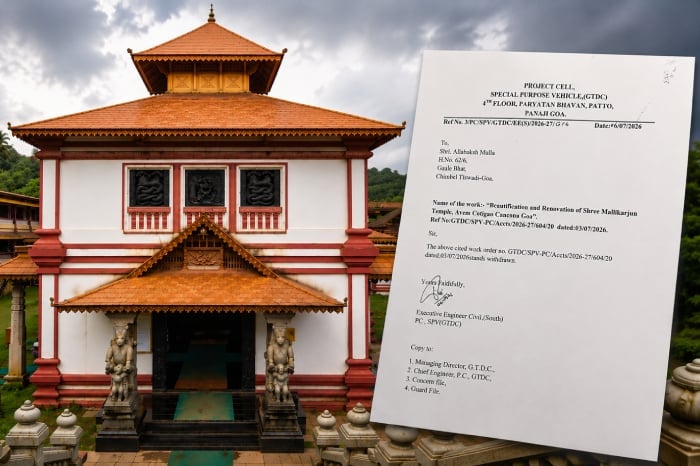
The reported cancellation of the Shri Mallikarjun Temple renovation contract in Goa has become more than a local administrative update. It has opened a wider discussion on temple governance, heritage restoration, public procurement, and the emotional responsibilities attached to sacred Hindu institutions. According to the source material provided, the Goa Tourism Development Corporation cancelled the renovation contract after objections were raised by the Gomantak Mandir Mahasangh and devout Hindus over the award of the work to a non-Hindu contractor.
The case concerns Shri Mallikarjun Temple at Avem-Cotigao in Canacona, a site associated with Lord Shiva and deeply embedded in Goa’s religious and cultural landscape. Public reporting on the renovation project noted that the Goa Tourism Development Corporation had undertaken beautification and renovation work at an estimated cost of ₹5.42 crore, with a 240-day completion schedule. The later cancellation, as described in the provided content, therefore raises a serious question: how should a modern state balance transparent tendering with the ritual, cultural, and devotional sensitivities of a living temple?
This question cannot be treated as a routine dispute over a government contract. A temple is not merely an old structure requiring civil repairs. In the Hindu understanding, it is a consecrated space, a ritual organism, a community memory, and a living center of worship. Renovation of such a space involves more than masonry, flooring, painting, or beautification. It touches the sanctum, the pathways of devotees, the symbolism of architecture, the continuity of local customs, and the confidence of worshippers who approach the deity with reverence.
For many Hindus, the concern is not simply the personal religion of a contractor in isolation. The deeper concern is whether those entrusted with temple work understand and respect the sacred protocols, ritual boundaries, and inherited traditions of the institution. Temple renovation often requires sensitivity to Agamic principles, local sampradaya, priestly guidance, community expectations, and the difference between ordinary construction and religious conservation. When these concerns are not addressed in advance, even a technically valid contract can generate social distrust.

At the same time, an academically serious reading must avoid reducing the issue to hostility between communities. India’s civilisational strength has long rested on coexistence, plurality, and the capacity of different traditions to live beside one another without erasing their distinctiveness. Hinduism, Buddhism, Jainism, and Sikhism each preserve sacred spaces with their own disciplines, ritual ethics, and institutional norms. Respecting the integrity of a Hindu temple does not require disrespect toward any other faith. It requires a governance model that recognizes the distinctive character of dharmic institutions.
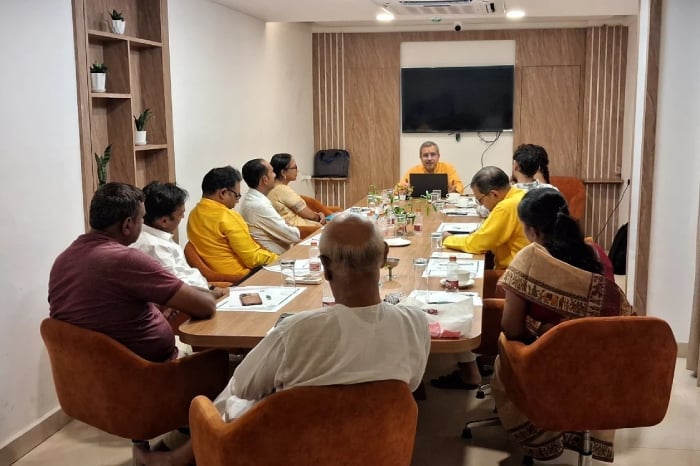
The objections raised by the Gomantak Mandir Mahasangh and devotees must therefore be understood within the broader debate on temple autonomy and religious endowments. Across India, Hindu communities have repeatedly argued that temples should not be treated merely as public assets under bureaucratic control. They are religious institutions sustained by centuries of devotion, donation, ritual practice, and community stewardship. When state agencies manage or finance temple-related projects, they carry a heightened duty to consult temple bodies, priests, traditional stakeholders, and devotees before finalizing major decisions.

Good governance in such cases demands clarity at every stage. If a project involves only outer beautification, landscaping, drainage, access roads, lighting, or visitor amenities, the criteria may be different from work affecting the garbhagriha, mandapa, ritual objects, deity-facing structures, or spaces used for worship. Public authorities should distinguish between civil tourism infrastructure and sacred renovation. Without that distinction, an avoidable administrative decision can become a cultural flashpoint.
The Shri Mallikarjun Temple controversy also shows why temple restoration should not be framed solely through tourism. Goa’s temples are not decorative heritage sites maintained for visitor consumption; they are living institutions of Hindu Dharma. Their festivals, processions, rituals, oral histories, and community obligations form part of a wider cultural ecosystem. Tourism may support infrastructure, but it should not become the defining lens through which a sacred place is managed. The first stakeholders are the deity, the tradition, the temple community, and the devotees.

There is also a practical lesson here for procurement policy. Government departments and public corporations can prevent future disputes by writing temple-sensitive eligibility and compliance conditions into tenders from the beginning. These may include mandatory consultation with temple committees, prior experience in heritage or temple conservation, agreement to follow ritual restrictions, supervision by approved religious authorities where required, and clear separation between secular construction tasks and sacred ritual areas. Such conditions need not be discriminatory when they are narrowly tailored to protect religious practice and heritage integrity.

The cancellation, if implemented as reported, should ideally lead not to triumphalism but to institutional learning. A mature dharmic response values firmness without bitterness. Devotees are justified in expecting that temples be renovated with reverence, transparency, and cultural competence. Equally, public discourse should avoid language that turns administrative accountability into social suspicion against ordinary members of another community. The issue is best framed as one of sacred trust, not communal antagonism.
From a constitutional perspective, the matter also sits near the intersection of equality, religious freedom, and denominational rights. India’s legal framework allows religious communities to manage their own affairs in matters of religion, while public bodies are expected to act fairly and transparently. The challenge is to design processes that respect both principles. A temple renovation policy that protects ritual sanctity, involves devotees, and uses objective heritage criteria can reduce conflict while remaining compatible with public accountability.
The emotional reaction of devotees should not be dismissed as mere sentiment. In dharmic traditions, emotion and reverence are not irrational residues; they are part of the relationship between devotee, deity, and sacred space. A temple courtyard where families have prayed for generations carries memories of vows, festivals, grief, gratitude, and renewal. When devotees feel excluded from decisions about such spaces, the administrative wound becomes cultural and personal.
Shri Mallikarjun Temple’s significance also reminds policymakers that local temples are often repositories of regional identity. Goa’s Hindu heritage survived periods of political disruption, cultural pressure, and historical upheaval. Temples in the region preserve stories of resilience, migration, reconstruction, and continuity. Renovating them responsibly is not a cosmetic exercise; it is a form of cultural preservation. Every pillar, ritual route, festival practice, and local custom deserves careful treatment.
The broader path forward should involve a structured temple conservation framework for Goa and other states. Such a framework would identify the ritual status of each site, document traditional practices, consult mahajans and temple committees, create approved panels of conservation experts, and ensure that contractors understand the sacred obligations attached to the work. This approach would protect Hindu temples while also setting a professional standard for Buddhist, Jain, Sikh, and other dharmic heritage sites that require similar sensitivity.
The controversy ultimately offers a powerful lesson: public institutions cannot treat sacred spaces as ordinary project sites. Temple governance requires competence, consultation, transparency, and reverence. When these elements are present, renovation strengthens faith and preserves heritage. When they are absent, even development work can appear intrusive. The Shri Mallikarjun Temple episode should therefore be remembered not only as a cancelled contract, but as a call for a more thoughtful, dharmic, and accountable model of heritage governance.
Inspired by this post on Hindu Jagruti Samiti.







Leave a Reply
You must be logged in to post a comment.