
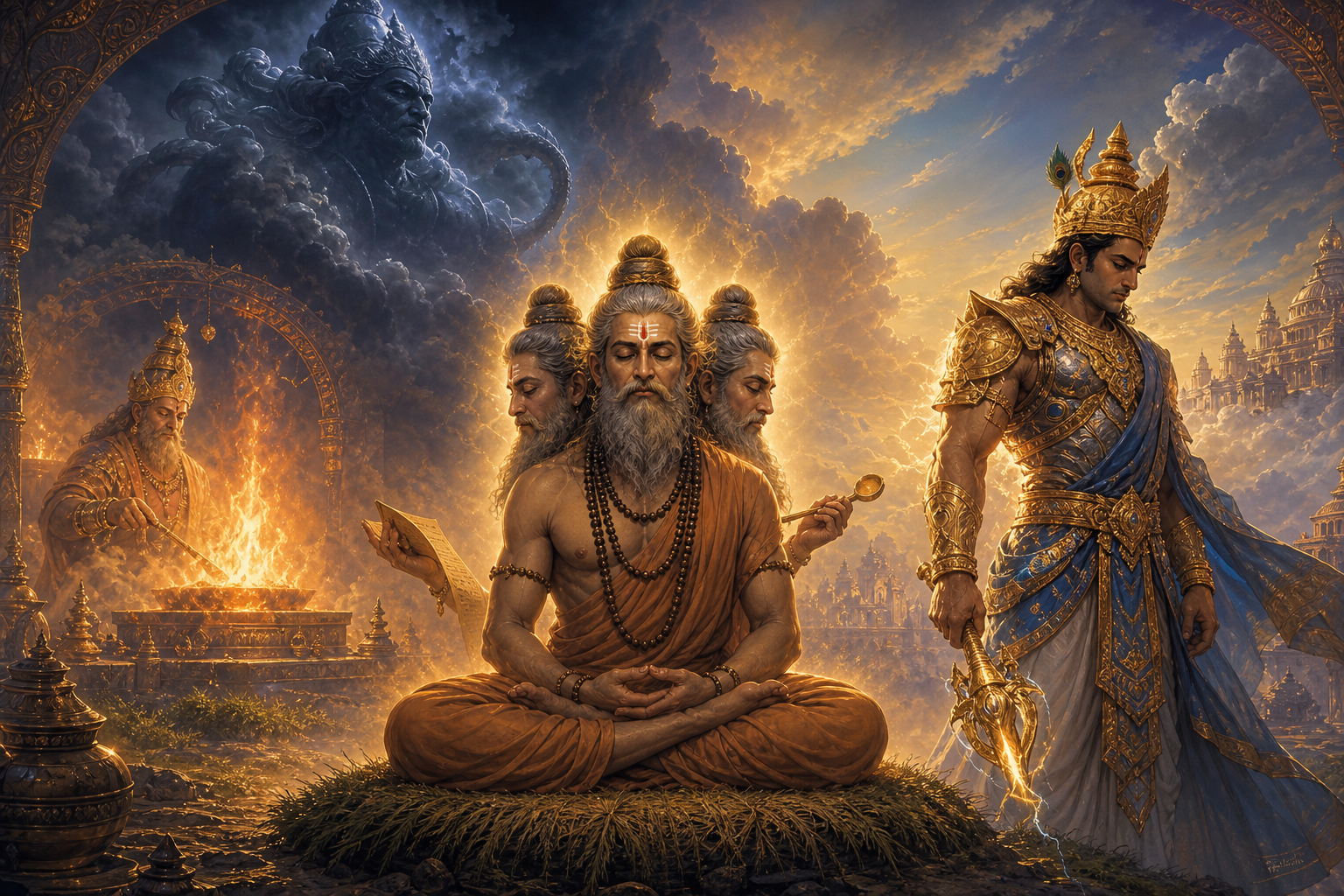
Indra and Trishira in the Udyoga Parva
The episode of Indra and Trishira belongs to the Udyoga Parva of the Mahabharata, where it is narrated by Shalya to Yudhishthira. Its placement is important. The Udyoga Parva is not merely a book of diplomacy before the Kurukshetra war; it is also a book of moral instruction, political warning, and psychological exposure. By recounting the story of Trishira, Shalya draws attention to the fragile line between authority and insecurity, between divine responsibility and personal fear, and between tapas and the power it generates in the moral universe of the epic.
Trishira, also known in many traditions as the three-headed son of Tvashta, stands at the beginning of a chain of events that eventually leads to the birth of Vritra and to one of Indra’s gravest crises. The story therefore should not be read as an isolated mythological conflict. It is a carefully structured account of cause and consequence. A single act born from suspicion and envy produces a karmic reaction that destabilizes heaven itself. In that sense, the Mahabharata presents this narrative as a study in dharma, power, austerity, and the cost of acting before wisdom has matured.
The figure of Trishira: tapas, knowledge and restraint
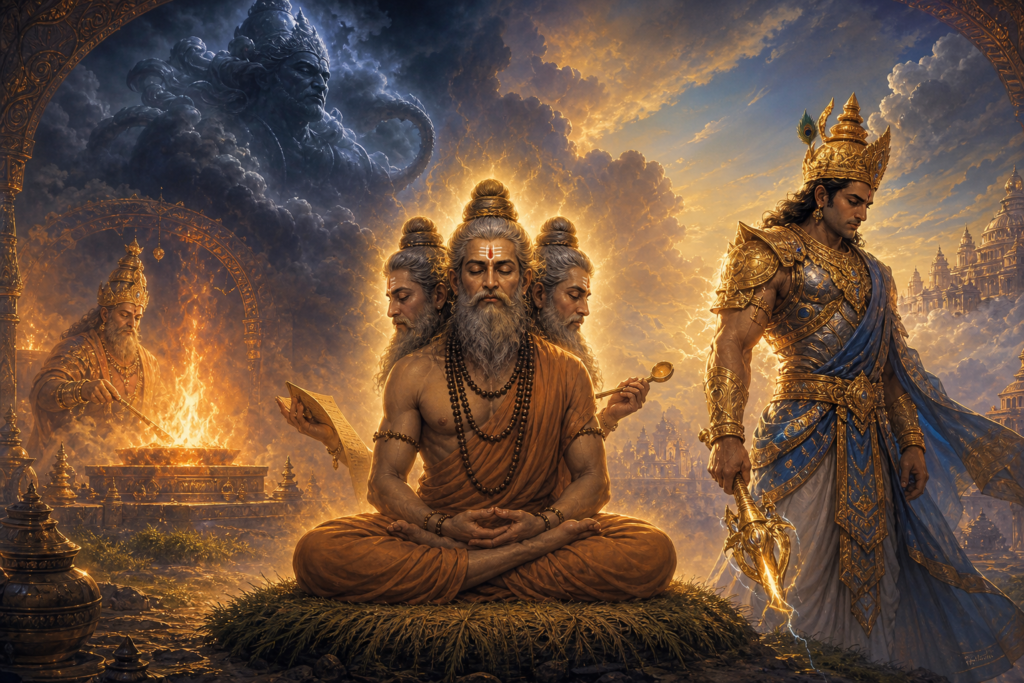
Trishira is described as a sage of extraordinary discipline. His very name points to his unusual form: he possesses three heads. In traditional accounts, each head has a distinct function, often associated with Vedic recitation, the drinking of soma, and the observation of the world. This symbolism is not accidental. The three heads suggest a being whose consciousness is turned simultaneously toward ritual knowledge, spiritual absorption, and cosmic awareness. He is not presented as a crude threat but as a practitioner of intense austerity, a tapasvin whose growing spiritual power unsettles the established hierarchy of the devas.
Tapas in the Mahabharata is not simple physical hardship. It is the concentration of will, restraint, knowledge, and inner heat. Austerity becomes power because it gathers scattered energy into one disciplined intention. The itihasa tradition repeatedly shows that such power can be acquired by devas, rishis, kings, asuras, and human beings alike. This is one of the profound features of Hindu thought: spiritual force is not the monopoly of birth, office, or title. It is generated by discipline and alignment with deeper principles. Trishira’s tapas therefore becomes meaningful because it reveals a universe governed by law, not by arbitrary privilege.
Yet the same tapas that inspires reverence also provokes anxiety. Indra, king of the devas, sees Trishira’s growing radiance and fears that the sage may one day challenge his position. The Mahabharata often portrays Indra as both a powerful guardian of cosmic order and a figure vulnerable to jealousy. This complexity is essential. The epic does not flatten divine characters into one-dimensional moral examples. Instead, it uses them to examine how even great beings can falter when authority becomes tied to insecurity.
Indra’s fear and the psychology of power
Indra’s reaction to Trishira is rooted in fear of displacement. The king of the devas has seen, across many narratives, how tapas can alter the cosmic balance. A rishi’s austerity may win boons. An asura’s discipline may shake heaven. A king’s sacrifice may expand sovereignty beyond ordinary limits. From Indra’s perspective, Trishira’s penance is not private spirituality; it is a possible political event. The anxiety is understandable, but the ethical problem lies in how that anxiety is handled.
The Mahabharata is deeply attentive to the inner life of power. It knows that rulers rarely fall only because of external enemies. They also fall when suspicion, pride, and fear distort judgment. Indra does not first seek dialogue, counsel, or a dharmic assessment of Trishira’s intent. Instead, he allows insecurity to become policy. This movement from fear to preemptive violence is the moral center of the episode. The danger is not merely that Indra misreads Trishira; it is that he acts from a mind already conquered by envy.
In contemporary terms, the story remains strikingly relevant. Institutions, communities, and individuals often respond to another person’s discipline or success with suspicion rather than admiration. A person engaged in sincere sadhana, scholarship, service, or self-improvement may be perceived as a rival simply because their growth exposes another’s insecurity. The Mahabharata turns this familiar human pattern into a cosmic drama. It teaches that envy is not harmless emotion; when joined to power, it becomes destructive action.
The killing of Trishira and the violation of dharma
Indra eventually kills Trishira. The act is grave because Trishira is not shown as an aggressor in the moment of his death. He is a being of tapas, a son of Tvashta, and a figure connected with sacred knowledge. The slaying therefore carries the weight of adharma. In the ethical world of the Mahabharata, the status of the victim matters, but so does intent. Violence committed from fear, jealousy, and self-preservation carries a different moral quality from violence undertaken as a last resort in protection of dharma.
Some versions of the tradition describe Indra as first trying to disturb Trishira’s austerities, including through temptations, before resorting to killing. This pattern appears elsewhere in Puranic and epic literature: intense tapas threatens established power, and celestial strategies are deployed to interrupt it. The repeated motif should not be misunderstood as a rejection of tapas. Rather, it dramatizes the tension between spiritual ascent and political authority. The deeper warning is that any authority, even divine authority, becomes unstable when it cannot tolerate the rise of genuine merit.
After Trishira is slain, the narrative does not permit the act to disappear into victory. The Mahabharata is not interested in a simple account where the powerful eliminate a perceived threat and restore order. Instead, it follows the moral consequence. Indra’s deed generates a response from Tvashta, Trishira’s father, whose grief and anger become the next force in the story. This is one of the epic’s most consistent teachings: actions do not end at the moment of performance. They move outward through relationships, obligations, vows, curses, rituals, and memory.
Tvashta’s grief and the birth of Vritra
Tvashta, the divine artisan and father of Trishira, responds to the killing with a sacrificial act intended to create an avenger. From his ritual power emerges Vritra, the formidable being who becomes Indra’s great adversary. The story thus links Indra’s fear of losing power to the creation of a far greater threat than the one he imagined. Trishira’s tapas had unsettled him; Vritra nearly overwhelms him. This progression is central to the moral architecture of the tale.
Vritra is not merely an enemy in a heroic battle. He is the embodied consequence of an earlier injustice. The Mahabharata often constructs conflict in this way. Wars, curses, and disasters rarely arise without a history. A visible crisis is usually the fruit of hidden causes. In the case of Indra and Trishira, the killing of a sage produces grief; grief, when joined to ritual power and anger, produces Vritra; Vritra then brings Indra into a struggle that exposes the limits of kingship without dharma.
This sequence also reflects a technical point about yajna and intention. Ritual in the Vedic and epic imagination is powerful, but its outcome is shaped by precision, purpose, and the condition of the sacrificer. Tvashta’s rite is born from anguish. It seeks correction through retaliation. The result is cosmically significant but morally complex. The Mahabharata does not reduce grief to weakness; it recognizes grief as a force. Yet it also shows that grief directed into vengeance may extend suffering rather than heal it.
Why Shalya tells this story to Yudhishthira
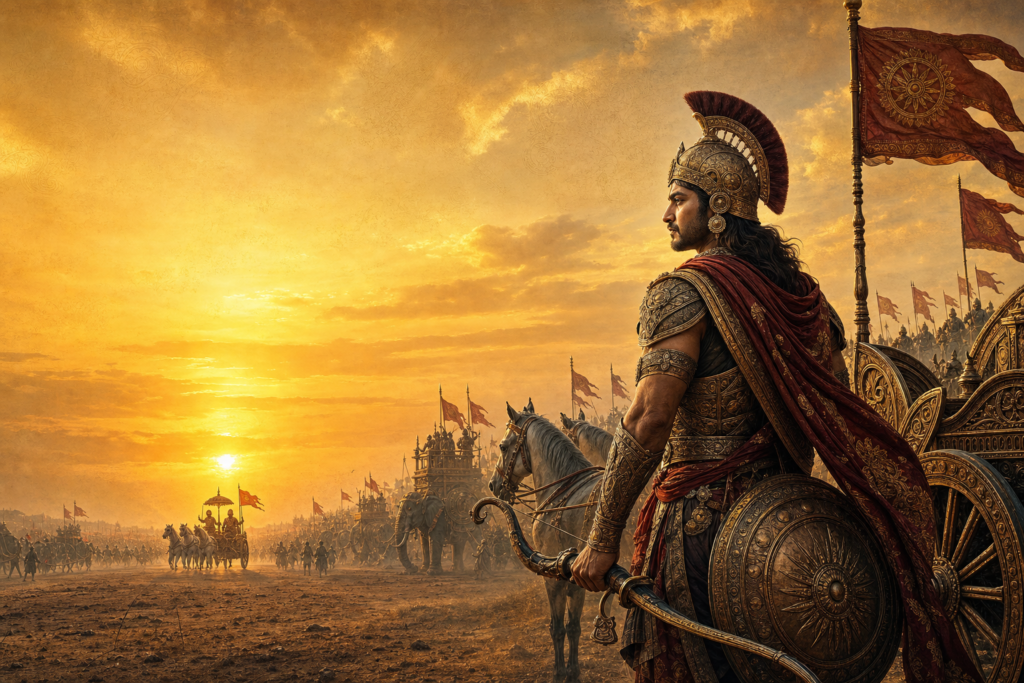
The narrative setting matters as much as the narrative itself. Shalya tells this story to Yudhishthira in the Udyoga Parva, when the pressure of war is gathering around the Pandavas and Kauravas. Yudhishthira is a king committed to dharma, yet he stands at the threshold of catastrophic violence. By invoking Indra, Trishira, Tvashta, and Vritra, Shalya places before him a pattern: actions taken from insecurity and pride create consequences that even the powerful cannot easily control.
Yudhishthira’s situation is not identical to Indra’s, but the moral lesson is relevant. The Udyoga Parva repeatedly asks whether war can be avoided, whether rightful claims can be settled through negotiation, and whether power can submit to justice. Duryodhana’s refusal to yield even a small portion of land shows the destructive nature of possessiveness. Against that background, the story of Indra and Trishira becomes a warning about what happens when fear of losing status overrides fairness, restraint, and moral clarity.
The Mahabharata’s genius lies in its refusal to treat dharma as a slogan. Dharma is tested in concrete situations: in courtrooms, battlefields, family assemblies, forests, vows, friendships, and moments of anger. Indra’s failure is not ignorance of cosmic order. His failure is the inability to embody that order when his own position feels threatened. This distinction is important. Knowledge of dharma is not the same as steadiness in dharma.
The symbolism of the three heads
Trishira’s three heads invite layered interpretation. On one level, they mark him as extraordinary, a being whose form signals unusual capacities. On another level, they may be read as symbolic of three modes of sacred engagement: ritual, knowledge, and perception. A head that recites the Veda suggests disciplined speech; a head associated with soma suggests sacrificial participation; a head that surveys the directions suggests awareness of the world. Together they form an image of integrated spiritual power.
This symbolism becomes poignant when Indra kills him. The act is not merely the destruction of a body; it is an assault on concentrated knowledge and austerity. The story therefore asks a subtle question: what does power fear in wisdom? The answer is not that wisdom always seeks political control. Rather, wisdom exposes the insecurity of power that lacks inner grounding. A ruler who is inwardly stable can honor a sage. A ruler who is inwardly restless sees every luminous being as a rival.
The three-headed form also helps explain why the story endures. It is visually unforgettable, but its meaning is not limited to wonder. It reminds the listener that human life itself demands integration. Speech, appetite, perception, knowledge, duty, and restraint must be harmonized. When any one of these dominates without dharma, imbalance follows. Trishira’s tapas represents integration; Indra’s envy represents fragmentation. The clash between them is therefore psychological as well as cosmic.
Tapas as a shared dharmic principle
The theme of tapas is one of the great unifying threads across dharmic traditions. In Hinduism, tapas appears in the lives of rishis, yogis, kings, and seekers. In Jainism, disciplined austerity and restraint are central to the purification of karma. In Buddhism, the Buddha’s own life engages deeply with the question of austerity, ultimately teaching a middle path that rejects both indulgence and destructive self-mortification. In Sikh tradition, inner discipline, remembrance, seva, and truthful living carry the spirit of concentrated ethical practice. The forms differ, but the respect for disciplined transformation is shared.
For this reason, the story of Trishira should be read with a unifying lens. It is not a tale meant to divide communities or elevate one path by denigrating another. It is a dharmic reflection on the power of disciplined life and the danger of reacting to another’s spiritual progress with fear. Across traditions, sincere practice demands humility. The disciplined person must guard against pride, and the observer must guard against envy. Both failures are visible in the larger world of the epics.
Tapas also has a social dimension. A community that honors discipline creates space for learning, self-restraint, and service. A community that mocks or fears discipline slowly loses its respect for excellence. The Mahabharata is clear that spiritual power is not decorative. It affects society. It shapes rulers, teachers, families, and institutions. Trishira’s tapas becomes threatening only because Indra interprets another’s ascent as his own decline. That mistake remains one of the most recognizable errors in human relationships.
Dharma, adharma and the law of consequence
The story’s moral force rests on the law of consequence. Indra’s act does not remain private. Tvashta’s grief does not remain silent. Vritra’s emergence does not remain symbolic. Each stage unfolds from the previous one. This is the epic imagination of karma at work: not a simplistic system of instant reward and punishment, but a deep interweaving of action, intention, relationship, and result.
In the Mahabharata, adharma often begins as rationalization. A character convinces himself that an act is necessary, strategic, or justified by future danger. Indra may fear that Trishira will seize his throne. Yet fear of a possible future does not automatically justify violence in the present. The epic is sensitive to genuine threats, but it also distinguishes between protection and paranoia. When action is driven by envy, it carries the seed of disorder even if it is framed as security.
This lesson is especially important in the Udyoga Parva, where diplomacy fails because Duryodhana cannot restrain greed and insecurity. The same moral pattern appears at different scales. Indra fears Trishira’s tapas; Duryodhana fears the Pandavas’ rightful claim. Indra acts against a sage; Duryodhana acts against his own kin. In both cases, the refusal to accept another’s legitimate strength produces a crisis larger than the original fear.
Indra as a morally complex figure
A careful reading should avoid reducing Indra to a villain. The Mahabharata and allied traditions present Indra as a protector, warrior, king, benefactor, and also as a being capable of error. His greatness does not erase his flaws; his flaws do not erase his cosmic role. This complexity is one reason the epic remains philosophically rich. It teaches that power must be evaluated by conduct, not merely by title.
Indra’s vulnerability makes the story more useful, not less. If only obviously wicked beings made mistakes, the lesson would be easy and distant. Instead, a great deva falls into envy. That means no one is exempt from self-examination. Kings, teachers, scholars, activists, householders, and spiritual practitioners all face moments when another person’s rise produces discomfort. The dharmic response is not suppression of the other, but purification of one’s own perception.
The story also invites compassion without excusing wrongdoing. Indra’s fear can be understood, but his action remains consequential. This distinction is vital for ethical maturity. Dharma does not demand blindness to context, nor does it allow context to erase responsibility. The Mahabharata repeatedly trains the listener to hold both truths together.
Lessons for leadership and society
The episode offers a serious lesson in leadership. Authority must be secure enough to recognize merit outside itself. A ruler who treats every disciplined person as a rival becomes unjust. A teacher who fears a student’s brilliance diminishes knowledge. A community leader who suppresses sincere initiative weakens the community. Indra’s mistake is therefore not confined to mythology; it is a pattern that appears wherever status becomes more important than truth.
Good leadership requires the capacity to distinguish between threat and excellence. Trishira’s austerity is powerful, but power alone is not guilt. A dharmic leader asks: What is the intention? What is the conduct? What counsel is available? What action is proportionate? Indra bypasses this inquiry. The result is not stability but escalation. The Mahabharata thereby presents rash action as a failure of both ethics and strategy.
For society, the lesson is equally direct. Envy corrodes trust. When excellence is punished, mediocrity becomes protected. When tapas is mocked, discipline declines. When fear governs judgment, justice becomes fragile. The story of Indra and Trishira reminds readers that a healthy civilization must honor genuine sadhana, scholarship, courage, and restraint, even when they arise outside familiar centers of power.
Spiritual insight: conquering envy within
The emotional power of the story lies in its honesty about envy. Envy is not always loud. It may appear as concern, caution, criticism, or strategic necessity. It often hides behind respectable language. The Mahabharata exposes this disguise by showing how Indra’s anxiety about Trishira becomes a destructive act. The inner enemy is not Trishira; the inner enemy is Indra’s inability to remain steady before another’s growing radiance.
Every serious spiritual tradition recognizes this problem. Another person’s progress can inspire or disturb. If it inspires, it becomes a teacher. If it disturbs, it reveals unfinished work within the observer. The dharmic path asks that such discomfort be converted into self-discipline rather than aggression. In this sense, Trishira’s story becomes a mirror. It asks whether another’s tapas produces reverence or resentment.
This is where the narrative becomes personally relatable without losing its academic force. Families, workplaces, scholarly circles, religious institutions, and public life all contain versions of this drama. Someone grows in competence, clarity, or devotion. Someone else feels diminished by that growth. The Mahabharata warns that the second person’s reaction may shape the future more than the first person’s achievement. To master envy is therefore not a small private virtue; it is a contribution to social harmony.
Conclusion: the enduring warning of Indra and Trishira
The story of Indra and Trishira in the Udyoga Parva is a compact but profound teaching on power, tapas, envy, and consequence. Trishira represents disciplined spiritual force. Indra represents authority disturbed by insecurity. Tvashta represents grief transformed into retaliatory ritual power. Vritra represents the consequence that returns to confront the original wrong. Together, they form a moral sequence that is central to the Mahabharata’s understanding of dharma.
The episode teaches that power without inner steadiness becomes fearful, and fear without dharma becomes destructive. It also teaches that austerity, knowledge, and merit should be honored rather than suppressed. In a broader dharmic framework, the story encourages humility among practitioners, restraint among rulers, and reverence for sincere discipline wherever it appears.
Its relevance has not faded. The world still witnesses the consequences of insecurity disguised as policy, envy disguised as caution, and violence justified by imagined threats. The Mahabharata answers with a demanding vision: true strength lies not in eliminating every possible rival, but in mastering the fear that turns another’s excellence into an enemy. That is the lasting lesson of Indra and Trishira, and it remains one of the Udyoga Parva’s most powerful reflections on dharma and human nature.
Inspired by this post on Hindu Blog.



Leave a Reply
You must be logged in to post a comment.